Part 2: The Scariest Patch on His Vest — Was Hidden Inside
His road name was Ridge.
His real name was Thomas Harrow.
I knew the road name before I knew the real one, because bikers rarely introduce themselves the way hospitals prefer. They arrive as Thunder, Preacher, Rook, Diesel, Saint, Ghost, Ridge. Names earned, not printed.
Ridge rode with the Iron Saints out of northern Arizona, a club that showed up every December with toy drives, every spring with veterans’ rides, and every summer with gas cards for families traveling between reservation clinics and Flagstaff Medical Center.
People still crossed the street when they saw them.
That was the truth.
Kindness does not erase leather in a stranger’s eyes.
Ridge was the kind of biker who made even other rough men lower their voices. He was huge, six-foot-four, broad enough to block a diner doorway, with old ink crawling out of his sleeves and a permanent squint from years of sun and road glare. His black cut looked like a warning sign. Every patch had weight. Every stitch looked earned the hard way.
He almost never smiled.
When he did, it was small and gone fast, like he had borrowed it from someone else.
I had seen him before the accident.
Everybody in town had.
He ate breakfast at the same diner off Milton Road every Friday morning. Sat at the last booth. Back to the wall. Coffee black. Eggs over hard. Tipped twenty dollars on a twelve-dollar check and never waited for the waitress to notice.
If a kid stared at his tattoos, he ignored it.
If a mother pulled the kid closer, he ignored that too.
But one winter morning, I saw something that did not fit.
A little girl at the next booth dropped her red mitten. Ridge reached down, picked it up between two fingers, and placed it on the edge of her table without saying a word. The girl whispered, “Thank you.”
Ridge nodded.
Then he took a tiny sewing kit from his saddlebag and repaired a loose button on his own vest.
Big tattooed hands. Pink plastic needle case. Thread pinched between fingers thick as socket wrenches.
That image stayed with me.
A biker who looked like he could bend steel, threading a needle by a diner window.
Later, I learned why he carried the kit.
Not for his patches.
Not for the club.
For the inside of his cut.
The part nobody saw.
The Iron Saints knew not to ask about it.
That was their first rule with Ridge.
Don’t touch the vest.
Don’t joke about the lining.
Don’t ask why he hung it on his chair but never let it out of sight.
Preacher, the older Black American biker who had been beside him in the rain, once told me Ridge had come to the club after a divorce, a lost custody fight, and a long year in county jail for something he did not like discussing.
“He wasn’t innocent,” Preacher said. “But he wasn’t what people made him either.”
That was how biker stories usually started.
Not with saints.
With wreckage.
Ridge had been a hard man before he became a careful one. He drank too much. Fought too fast. Disappeared when shame got heavy. He never denied it. But when his daughter was born, something in him tried to turn toward light.
Her name was Ellie.
White American girl. Brown curls. Serious blue eyes. Four years old when she made the patch.
She made it with pink yarn and a plastic needle, sitting cross-legged on a garage floor while Ridge changed oil in his Harley.
According to Preacher, she crawled into his vest while he wasn’t looking, flipped the lining open, and started sewing.
He found her tongue sticking out with concentration.
“What are you doing, bug?” he asked.
She said, “Putting your real name where scary people can’t see.”
“Daddy ain’t my road name.”
“It’s your best name.”
So he let her finish.
The letters came out crooked.
D looked like O. The heart looked like a smashed strawberry. Threads knotted wrong.
Ridge never fixed it.
Not one stitch.
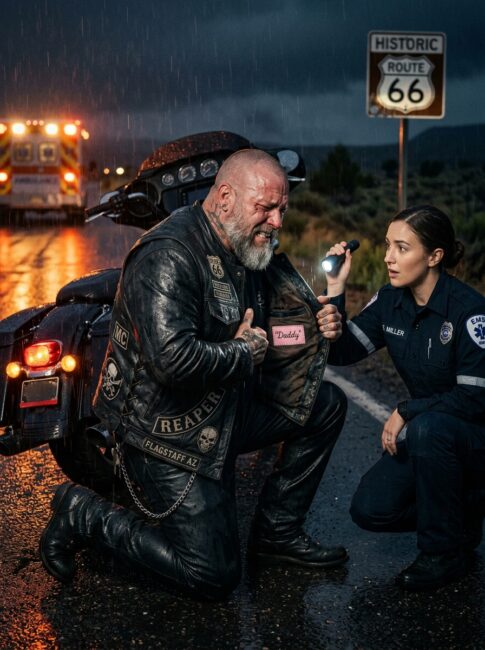
The accident happened on a Thursday night in October.
The Iron Saints were riding back from Winslow after dropping off donated winter coats at a church pantry. Nothing dramatic. No parade. No noise for attention. Just eight bikers heading west before the storm got worse.
Rain came early.
Cold rain.
The kind that makes road paint shine and gas station lights look underwater.
A family in a silver minivan lost control near a curve outside Flagstaff. The van spun, clipped the shoulder, and stopped half across the lane with its hazard lights blinking weakly.
The Iron Saints were the first to reach them.
That part never made the news clearly.
The report said “motorcycle involved in crash.”
People read that and filled in the blanks.
They always do.
But what happened was this:
Ridge saw the minivan sideways in the road. He slowed. Signaled with one hand. The riders behind him spread out and blocked traffic as best they could. Preacher got off his bike and ran to the van. Mateo, the young Latino prospect, called 911.
There was a child in the backseat crying.
Six years old. White American boy. Bloody nose from the airbag. No serious injuries, thank God, but trapped by a jammed sliding door and terrified out of his body.
Ridge pulled his Harley across the lane to shield the van from oncoming headlights.
He used the bike like a barricade.
One pickup saw the scene late, braked hard, slid in the rain, and tapped Ridge’s motorcycle enough to throw it over and knock him into the guardrail.
It could have been worse.
That phrase means nothing until you are standing in the rain with your hands on someone’s ribs, counting breaths.
When I arrived with the ambulance, the child was already out of the van, wrapped in Preacher’s denim vest, sobbing against his mother. Mateo was directing traffic with a flashlight, his face pale. The other bikers stood in the rain like a wall, not angry, not loud, just shaken.
Ridge lay near the guardrail.
Still conscious.
Still stubborn.
Still holding his vest closed.
“Don’t cut it,” he said before I even touched him.
His breathing was rough. His left shoulder sat wrong under the leather. The vest was torn near the side seam. Rain had soaked through his shirt. His hands kept going back to the inside lining.
I tried to keep my voice calm.
“Ridge, I need to see what’s hurt.”
“No.”
Preacher knelt beside him.
“Brother.”
“No.”
“Thomas.”
That name changed the air.
Ridge looked at him.
Preacher’s hand stayed gentle on his shoulder.
“You saved the boy. Now let them save you.”
Ridge’s jaw tightened. His eyes went wet, but nothing fell. Bikers like him do not cry easily. They learn to swallow tears early, then spend decades wondering why their chest feels full of glass.
I slid trauma shears under the leather.
His tattooed hand caught my wrist.
Not hard.
Not threatening.
Just desperate.
“Please.”
That word did more than any shout could have.
I stopped.
The rain ticked on my helmet. A semi rolled past slow, tires hissing. The Harley engine clicked as it cooled beside us.
“Tell me why,” I said.
He closed his eyes.
The torn lining shifted under my flashlight.
Pink thread.
Crooked letters.
Daddy.
Mateo saw it.
His face changed.
Preacher lowered his head like a man hearing church bells at a funeral.
Ridge whispered, “She made it.”
The boy from the minivan cried somewhere behind us.
Ridge’s hand shook harder.
The false climax was simple.
Everyone thought the vest mattered because of the club.
Because of pride.
Because of patches.
Because bikers love their cuts more than their skin.
But Ridge was not protecting the outside.
He was protecting the only part of his daughter he still got to carry.
At the hospital, they finally cut the vest.
Not through the patch.
Never through the patch.
I made that promise.
We slid the shears around the lining, worked slowly, ruined the leather everywhere except those four pink letters. Ridge watched every inch like I was operating on a heart outside his body.
His shoulder was dislocated. Two cracked ribs. Bad bruising. Nothing that would take him off the earth.
But he looked wrecked anyway.
Preacher stayed beside him.
Mateo sat outside the exam room with Ridge’s cut folded across his lap, both hands on it like an altar cloth.
That was when the second twist came.
I thought Ellie was dead.
Everyone who saw Ridge’s face thought that.
That kind of grief has a shape.
But Preacher told me quietly in the hallway, “She’s alive.”
I looked at him.
“Then where is she?”
He stared through the glass at Ridge.
“Colorado.”
That was all at first.
Later, the rest came out in pieces.
Ridge had not lost Ellie to a grave.
He had lost her to paperwork, anger, bad timing, and the kind of past that follows a man into every room before he can speak for himself.
When Ellie was four, her mother remarried. Her new husband was stable, clean, respected, and very good at looking worried in court. Ridge had a record. A club patch. A temper he had only recently learned to leash. He missed one hearing because he was in detox after a relapse he never forgave himself for.
Temporary custody became supervised visits.
Supervised visits became less.
Less became nothing.
Then Ellie’s mother moved to Colorado Springs.
Ridge fought until money ran out.
Then pride ran out.
Then hope ran out.
The only thing he kept was the vest.
And the patch.
He wore it everywhere, but inside, hidden against his shirt, where strangers could not judge it and where nobody could take it unless they cut him open.
Nine years passed.
Nine birthdays.
Nine Christmases.
Nine first days of school.
He sent cards through the attorney until they came back unopened. He bought presents and kept them in a cedar chest at the clubhouse. He never let the club throw them away.
Then the biggest twist came at 2:14 a.m. in a hospital hallway.
A woman in her thirties walked in wearing jeans, a raincoat, and the face of somebody who had driven too fast through a storm.
Beside her stood a thirteen-year-old white American girl with brown curls, serious blue eyes, and a pink backpack clutched to her chest.
Preacher saw them first.
His mouth opened.
Ridge was half-asleep when the girl stepped into the room.
She looked at the vest folded on the chair.
At the torn leather.
At the pink patch.
Then she said:
“You kept it?”
Ridge went completely still.
The machines beeped softly.
Rain tapped the window.
His voice came out broken.
“Ellie?”
She nodded once.
Not smiling.
Not running to him.
Thirteen is not four.
Time had stood between them too long for a clean movie moment.
But she was there.
And she had seen the patch.
Ellie had found him because of the accident.
Not from the news.
From a photo.
Someone at the scene had taken a picture of the Iron Saints blocking traffic around the minivan. It spread fast online, first with the usual captions people write when they think they know everything.
Biker crash on Route 66.
Motorcycle gang involved near Flagstaff.
Then the mother from the minivan posted the truth.
She wrote that the bikers had stopped to help. That one of them used his own motorcycle to shield her family. That a huge man with terrifying patches kept asking if her son was okay while rain ran down his face.
In one photo, Ridge was on the ground.
His vest had torn open.
The pink patch showed.
Ellie saw it because a girl at her school shared the post and laughed.
“Look,” the girl said, “some scary biker has Daddy sewn inside his jacket.”
Ellie recognized the stitches before she recognized the man.
That was the thing that broke me when she told it.
Not his face.
Not his name.
The stitches.
“I made that heart wrong,” she said from the hospital doorway.
Ridge stared at her like breathing had become optional.
“No,” he said.
His voice was rough.
“You made it right.”
Her mother stood behind her, older now, tired in the way people get when truth finally catches up. She did not look like a villain. That bothered me at first. Stories are easier when someone wears black.
She said, “Ellie asked to come.”
Ridge looked at her, but only for a second.
Then back to his daughter.
“I wrote,” he said.
Ellie nodded. “I know.”
That was another small twist.
Her mother had not thrown everything away.
She had kept the cards in a box.
Not given them.
Not returned them.
Kept them.
“I was angry,” the mother said quietly. “And scared. And I told myself your club was the danger.”
Ridge said nothing.
That silence had weight.
She looked at the torn vest.
“Maybe I was wrong about what danger looked like.”
Ridge’s tattooed hand moved on the blanket.
He wanted to reach for Ellie.
He did not.
That was how I knew he had changed.
Old Ridge might have grabbed at the moment. Demanded. Apologized too loudly. Tried to make nine years small enough to swallow.
This Ridge waited.
Ellie took one step closer.
Then another.
She touched the patch with one finger.
“It’s ugly.”
Ridge let out a sound that was almost a laugh and almost pain.
“Worst sewing I ever saw.”
She looked at him.
“You still wore it.”
“Every mile.”
“Why didn’t you take it off?”
His eyes shone.
Nothing fell.
“Daddy was my best name.”
The room went silent.
Preacher turned toward the window.
Mateo wiped his face with the heel of his hand and pretended he had rain in his eyes even though we were indoors.
The seeds all came back then.
The sewing kit in the saddlebag.
The rule about nobody touching the vest.
The gifts in the cedar chest.
The way Ridge froze whenever children called for their fathers near diners or gas stations.
The careful hands.
The hard face.
The hidden softness stitched where only his own heart could feel it.
Ellie did not hug him that night.
Not right away.
She sat in the chair beside his bed and opened her pink backpack.
Inside were the cards.
All of them.
Birthday cards. Christmas cards. One postcard from Winslow with a motorcycle drawn badly in the corner. One letter that said only:
I am sober. I am sorry. I am still here.
Ellie had read them that week.
Her mother had finally handed her the box after the photo went viral.
Ellie placed the cards on the hospital tray.
“I don’t know what to do with all this,” she said.
Ridge nodded.
“Me neither.”
That was the first honest thing between them.
Then she picked up the torn vest.
“Can I fix it?”
Ridge looked like she had handed him back ten years.
“You remember how?”
“No,” she said. “But I can learn.”
He nodded once.
A biker’s yes.
Small.
Forever.
The vest stayed in the hospital room for three days.
Not hanging on the chair like armor.
Spread across the blanket between father and daughter like a map.
Ellie came back each afternoon with a sewing kit from a craft store. Pink thread first. Then black. Then thicker leather needles that made her wince every time she pushed one through.
Ridge was terrible at sitting still.
Bikers are not built for hospital beds. They are built for bad coffee, cold mornings, and pretending pain is a scheduling issue.
But for Ellie, he stayed.
When she struggled with the needle, he held the leather steady with his tattooed hands.
When she got frustrated, he said, “Walk away before you ruin it.”
She said, “Is that your advice for sewing or life?”
He looked at her.
“Both.”
The Iron Saints came by in shifts.
Not all at once.
Ridge said too much leather would scare the nurses.
Preacher brought coffee he wasn’t supposed to bring. Mateo brought a tiny patch that said APPRENTICE as a joke and then got embarrassed when Ellie laughed. A white American woman biker named June brought a real leatherworker’s awl and said, “Men never have the right tools because they think suffering counts.”
Ellie liked June immediately.
The brotherhood had to learn a new kind of loyalty.
They had protected Ridge’s secret for years because they thought silence was respect. Now they had to stand back while the secret became a bridge.
That was harder for them.
Preacher admitted it one night.
“We thought keeping folks out was love,” he said.
Ellie threaded a needle.
“Maybe letting one person in is love too.”
Ridge looked at her like he wanted to memorize the sentence.
After he was discharged, a new ritual started.
Every second Saturday, Ridge rode halfway to Colorado Springs and Ellie’s mother drove halfway to meet him at a diner outside Santa Fe. Neutral ground. Public place. Green chile burgers. Bad coffee. No pressure.
Sometimes Ellie rode home with him in the truck.
Not on the Harley at first.
Ridge never pushed.
He kept a spare helmet on the passenger seat anyway.
One afternoon, almost a year later, she picked it up.
“Just around the parking lot,” she said.
Ridge nodded.
“Your call.”
The Harley started low.
Not loud.
Not showing off.
Ellie climbed on behind him, arms stiff at first, then tighter. Ridge rode one slow circle around the empty lot while her mother watched from beside the diner window.
When they stopped, Ellie took off the helmet and said, “Again.”
Ridge smiled.
A real one.
Gone fast.
But real.
Inside his repaired vest, the pink Daddy patch remained crooked.
Ellie refused to straighten it.
“History is crooked,” she said.
Ridge said, “You sound like Preacher.”
She said, “Good.”
I saw Ridge again last spring on old Route 66.
Same diner. Same back booth. Same black coffee.
But the vest looked different if you knew where to look.
There was a new stitch line along the side seam. Careful. Uneven in places. A little pink thread hidden near the black, like sunrise under a closed door.
Ellie sat across from him, sixteen now, hair longer, eyes still serious. She was sewing a loose button on his cuff while he held his arm out like a man under arrest.
“You move too much,” she said.
“I’m breathing.”
“Do it less.”
He obeyed.
That huge biker with skulls across his back sat perfectly still while his daughter fixed his sleeve.
Outside, his Harley waited in the morning sun, engine cooling, chrome ticking softly. A truck rolled by on the highway. Boots crossed the diner floor. Leather creaked when Preacher came in and saw them.
He did not interrupt.
Smart man.
Ellie finished the button and bit the thread.
Ridge looked at the stitch.
“Good work.”
“It’s crooked.”
“So was the first one.”
She smiled.
He reached inside his vest, touched the hidden patch once, then stood.
No speech.
No lesson.
Just a father holding the door open for the girl who had once sewn his best name where nobody could see it.
They walked out together.
Leather. Pink thread. Morning light.
The Harley started soft.
And this time, she rode behind him.
Follow the page for more biker stories that make you look twice before you judge.