A Blind Woman’s Guide Dog Led Her Toward a Biker in a Grocery Store—Then He Heard the Voice of the Wife He Thought Had Abandoned Him Six Years Earlier
Eva let go of the harness handle without releasing the leash.
“Scout, sit.”
The Labrador settled beside her shoe. She needed her hands free, but she did not reach for Jack again. Somewhere to her right, an employee was gathering the apples. Someone asked whether she needed a chair.
“Yes,” she said. “Somewhere quieter. And please tell me before you touch me.”
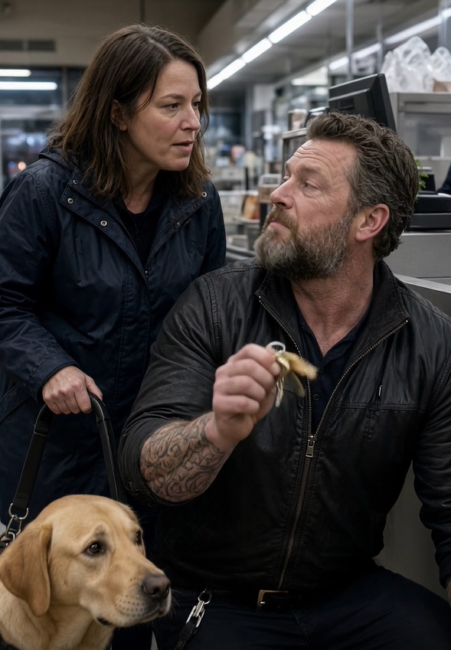
Jack stepped back.
That small movement frightened her more than his voice had. She knew how he moved when he was trying not to lose his temper. Weight back. Hands open. Words held behind his teeth until he trusted them.
The manager introduced herself as Denise and offered the customer-service office. Eva accepted. Jack followed only after she said he could.
They sat with a desk between them.
For several seconds, Eva heard nothing but a refrigerator compressor through the wall and Scout licking his nose.
Then Jack said, “Who was the man?”
“What man?”
“The one you went with.”
“There wasn’t one.”
“My mother had a picture.”
Eva pressed her palms against her knees.
After the accident, there had been a rehabilitation instructor named Daniel who taught her to travel with a white cane. He was married. He had driven the program’s van. Once, when a snowstorm canceled transportation, he had helped carry her suitcase to temporary housing.
“Was he wearing a blue jacket?”
Jack did not answer immediately.
That was enough.
Eva turned her face toward the window, where the refrigeration noise sounded slightly softer.
Six years of explanations rearranged themselves, and none of the new shapes felt safe.
“Your letter had your signature,” she said.
“I never wrote you a letter.”
“You said you couldn’t do this anymore.”
Jack exhaled sharply.
“I said that to my mother. About the insurance company. They’d denied another extension.”
Eva remembered those words exactly. The phrasing had hurt because it sounded like him.
That was the detail that made her doubt herself.
Had Lorraine misunderstood a conversation? Had Eva heard cruelty in something frightened people had handled badly? She hated how quickly she wanted an explanation that did not require believing someone had deliberately separated them.
Jack slid something across the desk.
“Your thimble.”
“May I?”
“It’s yours.”
Her fingers found the little brass cup attached to his key ring, the dent along its rim, the tiny drilled hole. She had made him carry it because he kept splitting his fingertips on sheet metal at the garage.
He had complained for three days.
Then he had never taken it off.
The office door opened.
“Jack?”
Lorraine’s voice was breathless but familiar, the same voice that had read hospital menus and described flowers when Eva first lost her sight.
Eva’s stomach tightened before she could stop it.
Lorraine said Eva must be confused. Jack asked about the letter. Lorraine denied there had been one.
Eva reached for her phone and asked the question she had carried for six years.
Why had Lorraine made her promise never to let anyone else read it aloud?
Before the accident, their kitchen had faced the alley behind Jack’s motorcycle repair shop.
Eva taught elementary-school art. Jack came upstairs smelling of metal filings and orange hand cleaner. On Fridays, they ate breakfast for dinner because neither could remember whose turn it was to shop.
He tapped his keys three times against the door before coming in.
Eva answered by tapping her spoon against a mug.
When she attached her grandmother’s brass thimble to his key ring, Lorraine watched from the kitchen table.
“You’ll lose it,” she told Jack.
“He loses gloves,” Eva said. “Not things people give him.”
Lorraine had brought a lemon cake and a stack of community-center letters to fold. She disliked personal business being discussed outside the family. When Eva mentioned reading a confusing insurance notice to a coworker, Lorraine stopped folding.
“Strangers don’t need our private troubles.”
Later, Eva saw her correcting a letter with a blue pen, replacing the word burden with better off.
“Same meaning,” Lorraine said. “Kinder language.”
Eva had not thought about that afternoon in years.
In the grocery-store office, Lorraine asked Denise to give the family privacy.
Eva said, “I’d like her to stay.”
Lorraine went quiet.
Jack explained that he and his mother had driven separately. He had shopped while she collected prescriptions at the pharmacy counter. Eva’s appearance was not something any of them had arranged.
That fact made the room feel stranger.
Eva had come across town for an accessibility workshop that morning. Her usual grocery store was nearer her apartment, but a bus diversion had left her at a different stop. Inside, a display had narrowed an aisle, and she had lost track of the checkout lanes.
Scout had briefly turned toward Jack.
He had been carrying dog treats for a club member’s foster Labrador.
There was nothing miraculous about it. A distraction. A wrong turn. Eva asking a stranger whether she was near the front.
Then Jack had heard her.
“Where have you been?” he asked.
“Columbus.”
“Six years?”
“Mostly.”
He lived outside Dayton, less than two hours away.
Eva heard him shift in the chair.
His mother had told him she wanted distance. She had shown him a photograph of Daniel carrying the suitcase, along with a message saying Eva wanted no further contact.
“I did send a message,” Eva said.
Jack stopped moving.
Lorraine seized the opening.
“There. You see?”
“But not that message,” Eva said. “And not when you said.”
Denise quietly offered water. Eva accepted and asked where the cup was. The ordinary exchange steadied her.
Jack told her he had eventually filed for divorce.
Not when Lorraine brought the letter.
Nearly two years later.
He had used a lawyer and the last address he believed was hers. When direct service failed, the case proceeded through additional steps his lawyer handled. Eva had never known about any of it.
“I thought it was already done,” she said.
Lorraine’s chair creaked.
Eva turned toward the sound.
If Jack had not filed until two years later, what exactly had Lorraine brought to rehabilitation and called a divorce letter?
Eva would not leave with either of them.
She called Mara Ellis, the friend who had helped her move into her first accessible apartment. Mara arrived twenty minutes later, smelling of wet wool and peppermint gum.
Jack recognized her name.
Lorraine had always described Mara as the person who encouraged Eva to start over without him.
Mara did not argue in the office. She introduced herself to Denise, asked Eva what she wanted, and waited.
“My place,” Eva said. “Jack can call tomorrow.”
Lorraine offered to explain everything over dinner.
“No,” Eva said.
The word came out steadily.
At home, Eva fed Scout, removed his harness, and let him carry his stuffed rabbit onto the rug. Then she asked Mara to get the document box from the bedroom closet.
The letter was still inside a brown envelope.
Eva had not thrown it away because every few months she needed to remind herself that the decision had not been hers.
Mara opened it.
She stopped breathing evenly.
“What?”
“I typed this.”
Eva turned toward her.
Mara set the paper down carefully.
At the time of the accident, she had worked part-time in the rehabilitation center’s administrative office. Lorraine had asked for help preparing a personal letter from Jack, explaining that he struggled with writing and had dictated it.
“She brought a handwritten draft,” Mara said. “I typed the body. I didn’t put his signature on it.”
Eva remembered Lorraine’s purse opening beside the bed. The paper being unfolded. Her own hands bandaged and clumsy. The promise that nobody else should be allowed to see something so private.
Jack came the following afternoon.
He brought no flowers.
Eva appreciated that.
Mara told him what she had done.
His chair scraped backward.
“So you helped her.”
“I thought I was typing what you wanted to say.”
“You didn’t ask me?”
“No.”
Mara did not defend the omission. It left the room with nowhere easy to put its anger.
Then Lorraine sent Jack a photograph of an old consent form.
His signature appeared near the bottom.
The signature on Eva’s letter looked almost identical.
“There,” Lorraine wrote. “Your handwriting. Please stop frightening people.”
For half an hour, Jack stared at both images. Eva listened while Mara described every mark.
The signature was his.
The sentence above it was not.
Lorraine’s proof had made her look less guilty at precisely the moment Mara had admitted creating the document.
Eva asked whether the office still had the original job record. Mara had no access now, but she could request information through the center’s records staff.
Three days later, the center confirmed an email from Lorraine’s address containing the draft.
The attachment had no signature.
The completed letter did.
Jack read the email twice, then asked Eva’s permission before contacting a lawyer.
Mara had typed the words, but who had decided they should sound like a husband abandoning his wife?
The lawyer’s office had a quiet waiting room and a coffee machine that sounded as if it was swallowing gravel.
Eva asked the receptionist to email documents in an accessible format. Jack started to offer to read them, caught himself, and sat down.
Attorney Rachel Shaw began with a question neither expected.
“What do you each want?”
Jack looked at Eva.
She could feel it.
“I want to know what happened,” she said. “Then I want to decide what happens next.”
Rachel represented Eva. She made that clear before discussing anything else. Jack would need his own advice concerning the old divorce and any position that might conflict with hers.
There would be no single lawyer making their marriage tidy.
Eva liked her immediately.
They requested records in stages: Eva’s rehabilitation correspondence, financial statements she was entitled to obtain, and copies of documents from the divorce case.
Nothing arrived all at once.
The signature question remained under examination. But bank records produced a problem that did not depend on handwriting.
After the accident, Eva had authorized Lorraine to help manage a temporary account used for household expenses and rehabilitation costs. Eva’s settlement money later passed through it before being moved elsewhere.
Eva had approved that arrangement.
She had not approved everything Lorraine did with it.
Over fourteen months, thousands of dollars went to a company whose name sounded like a residential-care provider. Eva assumed it had billed for transitional accommodation.
Mara had helped her move out of that accommodation after eleven weeks.
The payments continued for another ten months.
Rachel asked for invoices.
Meanwhile, Jack brought records of his own.
He had been paying his mother several hundred dollars a month, believing she was helping cover expenses connected with Eva’s transition. Lorraine had told him not to contact the program directly because Eva considered it interference.
He had obeyed.
The sentence sounded worse each time he said it.
“I thought giving her space was the only thing left I could do.”
Eva held the rim of her coffee cup.
“I needed space from the man in that letter.”
“I know.”
“No. You know now.”
He lowered his eyes.
The care company turned out to be a rental business owned by Lorraine’s nephew. Its invoices described services Eva had never received. Some payments had covered improvements to a duplex Lorraine hoped to move into after retirement.
Not all the money was missing. Some had paid legitimate expenses. That made the records harder to untangle and easier to explain away.
But not impossible.
Rachel laid out a timeline.
The false letter came first.
Restricted contact followed.
Then the unnecessary payments.
The separation had not merely satisfied Lorraine’s fear that Jack would spend his life caring for an injured wife. It had created an arrangement in which she controlled information and money on both sides.
That evening, Jack found a voicemail from his mother.
“You don’t know what she was like after the accident,” Lorraine said. “I protected you.”
He played it once.
Then he saved it.
Eva sat across from him, Scout asleep against her foot.
What kind of protection required its beneficiary never to learn what it cost?
Lorraine called people before Jack called her back.
By the next afternoon, two relatives had asked whether he was having another breakdown. A longtime customer mentioned hearing that Eva’s friend was pursuing money. Someone from the community center suggested Lorraine deserved patience.
Jack had once smashed a garage cabinet after the insurance company denied further coverage.
Nobody had been near it.
He had repaired it himself.
Now the incident returned as evidence that his mother needed protection from him.
“I gave her that story,” he told Eva.
“You gave her an incident. She chose the story.”
It was the first kind thing she had said to him without immediately stepping away from it.
Lorraine contacted Eva’s building manager next.
She said Eva was distressed, possibly being influenced, and might need someone to check on her. The manager knew Lorraine from earlier visits and called Eva before doing anything else.
Eva stood in her kitchen listening.
She had spent years learning the routes, systems, and small practical arrangements that let her live as she chose.
Now a familiar voice was reaching into those arrangements and describing her as incapable.
“Please note that she does not have permission to enter my apartment,” Eva said. “Or receive information about me.”
The manager agreed.
Eva changed the old emergency contact. She reviewed account permissions. Mara sat beside her for company while Eva made the calls herself.
Jack offered to stay overnight on the couch.
“No.”
He accepted it.
That mattered more than the offer.
Two days later, Lorraine arrived at the accessibility workshop while Eva was waiting for transportation. She caught Eva’s elbow and said she would drive her home.
Eva pulled her arm away.
“Tell me before you touch me.”
“Don’t make a scene.”
“I’m waiting for my ride.”
Jack had come to bring a box of belongings Eva had requested. He saw his mother take her arm again and moved toward them too quickly.
Scout stood, alert to the tension.
Eva heard Jack’s boots.
“Stop,” she said.
Both of them did.
She asked the receptionist to remain nearby. Then she called her ride service to confirm its arrival.
Lorraine began crying.
Several people watched Jack’s leather vest, his size, his clenched jaw.
Eva knew what they were seeing.
“He stopped when I asked,” she said. “She didn’t.”
The receptionist stayed until Eva’s driver arrived.
Afterward, Jack sat alone beside the box of her old books.
He could call twenty members of his club and have them there before the afternoon ended. None of them could make his wife feel less surrounded by other people’s certainty.
He called one friend instead.
“Can you come sit with me?”
That night, Eva opened an old audio folder on her phone.
She listened to a voicemail Jack had left three years earlier, after finding a possible way to reach her through Mara.
It had never been played for anyone else.
Why had she kept the one message that proved she had once been offered a chance to hear him?
Eva asked Jack to meet at a café near her apartment.
She chose a table away from the grinder. Scout settled beneath it, where the floor was cool.
Before ordering, she placed her phone between them.
“There’s something you need to hear.”
Jack recognized his own voice immediately.
Older than the man she remembered. Younger than he felt now.
“Evie, Mara said she could pass this along. I don’t know what you’ve been told. I’d like to talk. If you want me to leave you alone, tell her, and I will.”
The recording ended.
Jack looked across the table.
“You got it.”
“Yes.”
“Mara said you didn’t want contact.”
“I told her that.”
He sat back.
Eva could hear the small movement of his jacket against the chair.
For three years, he had believed that refusal confirmed everything Lorraine had told him.
For three years, Eva had believed his tentative message was guilt arriving too late.
She had already learned to cook again. Travel alone. Work part-time teaching art through a community program. She had built a life whose furniture did not move unless she moved it.
Then his voice had appeared inside it.
“I thought you wanted forgiveness,” she said.
“For what?”
“For the letter. For leaving.”
“I said I didn’t know what you’d been told.”
“I heard that.”
The admission hurt more because she made no excuse for it.
She had listened repeatedly. She had imagined calling. Then she had remembered hospital ceilings she could no longer see, Lorraine reading the sentence about being better off, and the humiliation of wanting someone who supposedly considered her a burden.
“I was afraid you’d say it yourself.”
“So you let me think you didn’t want me.”
“Yes.”
A server approached.
Jack ordered coffee because it gave him something ordinary to do.
Eva asked for tea.
Neither spoke until the cups arrived.
“I’m not saying that makes what your mother did smaller,” she said.
“It doesn’t.”
“I’m saying there was a point when she wasn’t the only person deciding.”
Jack rubbed the dented thimble between his fingers.
He had also made choices. He had accepted his mother’s interpretations because pursuing another answer risked hearing rejection directly. He had hired a lawyer for the divorce but never asked enough questions about the assumptions that led him there.
“I was hurt,” he said. “And lazy in a way I called respectful.”
Eva’s mouth trembled.
“You were angry.”
“Yes.”
“So was I.”
There was no embrace across the table.
He did not tell her the lost years no longer mattered.
After a while, he asked whether she wanted him to leave.
“Not yet.”
They finished their drinks.
When Jack offered his arm outside, she considered it before accepting. He described the curb. She told him she could feel it with her foot.
“Right,” he said.
They both almost laughed.
That evening, Lorraine sent an invitation to a community-center recognition breakfast where she was due to receive an award for helping vulnerable neighbors.
Beneath it, she had written: We can put this behind us as a family.
Eva forwarded it to Rachel.
Then she asked Jack a question neither of them had been ready for that morning.
What would happen if they finally answered Lorraine somewhere she could not decide what everyone else had heard?
They did not arrive with a motorcycle procession.
Jack parked his truck behind the community center. Two friends from his club came separately because Eva had invited them, and they sat near the back.
She had also contacted the center’s director in advance.
The director had agreed to a brief factual statement before the award presentation. She had not promised to settle a family dispute from a lectern. When the financial concerns became clearer, she postponed Lorraine’s award pending review.
Lorraine learned that when she arrived.
By then, the room held relatives, neighbors, volunteers, and people who had heard that Jack was being unreasonable.
Eva stood beside a chair rather than behind the lectern. Scout lay at her feet.
She said she had not left her marriage for another man. She had received a letter she believed came from Jack, delivered and read by Lorraine while she was in rehabilitation.
Jack said he had not written it.
He did not raise his voice.
Lorraine stood.
“This is private.”
Eva recognized the phrase so sharply that her fingertips went cold.
“You made it public when you told people I abandoned him.”
The director asked Lorraine to let Eva finish.
Mara described typing a draft supplied by Lorraine. She said she regretted failing to confirm it with Jack. Copies of the relevant email had been provided privately to the director.
Lorraine shook her head.
“You people are taking everything out of context.”
Rachel attended at Eva’s request. She said the disputed transactions had been referred for investigation and would not be tried at a breakfast. She asked that nobody approach Eva or Jack afterward with accusations presented as fact.
It might have ended there.
Then Lorraine looked at Jack.
“I never said she was a burden.”
Eva lifted her face.
The room was quiet enough for her to hear a serving spoon touch a plate.
“What did you say?” she asked.
“I said you would both be better off.”
Jack stopped turning his keys.
That sentence had not been quoted.
The letter had not been read aloud.
Lorraine had spent the morning insisting she had merely delivered a sealed communication and did not know its contents.
Eva remembered lemon cake, folded envelopes, a blue pen.
Same meaning. Kinder language.
“You changed that word,” she said.
Lorraine’s breathing grew audible.
“I was trying not to hurt you.”
No one moved.
Jack looked at his mother.
“Who wrote it?”
She stared at him.
“Who wrote the letter, Mom?”
“You were forty,” she said. “You were losing your business. You weren’t sleeping. Somebody had to think beyond the next hospital visit.”
“Who wrote it?”
“I put down what you couldn’t say.”
The admission landed without any of the noise Eva had imagined.
No gasps.
A chair shifted.
Somebody near the kitchen turned off a coffee warmer.
Jack’s voice was low.
“You didn’t know what I couldn’t say.”
Lorraine reached for his wrist. He stepped back.
She turned toward Eva.
“You have a good life now.”
Eva rested a hand on Scout’s head.
“Yes,” she said. “I made one.”
The director ended the presentation. Rachel asked Eva whether she wanted to leave. Lorraine remained beside the front table, surrounded by untouched name cards and folded napkins.
Outside, Jack opened the truck door, then waited rather than guiding Eva into it.
For the first time, they had heard Lorraine acknowledge the beginning.
But what did the truth entitle them to ask of each other now?
It did not entitle Jack to move back into Eva’s life.
It did not require Eva to decide that six years could be repaired because the person who damaged them had finally admitted doing it.
They began with Wednesdays.
Coffee after her afternoon class.
Sometimes dinner.
Sometimes an argument that ended with one of them asking for a week before trying again.
Jack learned not to move a chair because he thought it would be easier for her. Eva learned to tell him when she needed help before resentment made every offer sound like doubt.
Scout remained professionally indifferent to most of their progress.
He liked Jack’s kitchen floor, disliked the vacuum, and eventually stopped expecting treats whenever he smelled the leather vest.
The financial investigation moved slowly.
Records supported some of Eva’s concerns and disproved others. Legitimate rehabilitation payments were separated from transfers she had never approved. Lorraine’s nephew supplied records after initially resisting. A portion of the disputed money was returned before the remaining issues were resolved.
The old divorce paperwork required its own review.
Eva and Jack consulted separate lawyers and made decisions without Lorraine interpreting the documents. There was no automatic restoration of the marriage they remembered.
Jack found that disappointing.
Eva found it honest.
Lorraine wrote to both of them.
Her first letters explained how frightened she had been.
Later ones contained apologies.
Eva read them with her screen reader and saved them in a folder she did not open often. She did not resume visits. Jack chose limited contact under boundaries he discussed with a counselor rather than negotiating in his mother’s kitchen.
He still loved her.
He stopped treating that as a reason to disbelieve what she had done.
By autumn, Eva began spending an occasional weekend at the apartment above the garage.
The rooms had changed.
The kitchen no longer faced the same way because Jack had replaced a wall cabinet and moved the table. Before her first overnight stay, he started to rearrange everything to match the old apartment.
Then he called.
“What would you like me to move?”
“Nothing yet,” she said. “Show me where it is.”
He did.
Slowly.
She counted the steps from the couch to the bathroom. Found the edge of the counter. Asked him to stop leaving his boots halfway across the mat.
He forgot once.
She swore at him.
It was, unexpectedly, a good evening.
In November, Eva brought an old sewing basket upstairs. She had begun teaching a small tactile-art workshop and wanted the brass thimble back for a demonstration.
Jack unfastened it from his key ring.
For a moment, neither of them said anything.
The little cup lay in his palm, dented and polished by years of being carried.
“You kept it,” she said.
“You already knew that.”
“I know.”
She fitted it over her finger.
It still sat slightly crooked.
Downstairs, someone rolled a motorcycle across the garage floor. Scout slept beside the radiator. Jack put water on for tea and asked where she wanted the basket.
“By the table.”
He set it down.
Later, when he went downstairs to lock the shop, Eva remained in the kitchen, sorting thread by the labels she had added herself.
At the apartment door, his keys tapped three times.
She reached for a spoon.
Then paused.
“Are you coming in, Jack?”