Part 2: A Boy Brought My Old Photo to the Club Garage — And Asked If I Was the Father He Lost Forever
My name is Jonah Reed.
But nobody at the Iron Saints called me Jonah back then.
They called me Ghost.
Not because I was quiet.
Because I had a habit of disappearing before consequences found me.
At nineteen, I was all elbows, fists, cheap whiskey, bad powder, and worse decisions. I rode with men older than me who liked having a reckless kid around because reckless kids do the stupid things grown men have learned to avoid.
I thought danger made me interesting.
It didn’t.
It made me exhausting.
That summer, I met Lena at a gas station outside Black Mountain. She was nineteen too, white American, dark hair, yellow sundress, bare ankles, laugh like a screen door opening in June. She was filling up an old blue Toyota and I was leaning against my bike pretending I had somewhere important to be.
I didn’t.
She asked if the bike was mine.
I said, “Depends who’s asking.”
She rolled her eyes and said, “So you’re one of those.”
I should have hated that.
Instead, I followed her laugh like a starving dog.
We lasted three months.
Three months of cheap diners, long rides through the Blue Ridge foothills, motel coffee, gas station sandwiches, and me promising I would change with all the confidence of a boy who had never changed anything except oil.
Then one morning she was gone.
Apartment empty.
Phone disconnected.
The waitress at Red Oak Diner said Lena had left town before sunrise with two trash bags and a face like she had been crying all night.
I told myself she was cold.
I told myself she got scared of love.
I told myself whatever made me the wounded one.
That was easier than saying the truth.
I was dangerous.
Not movie dangerous.
Real dangerous.
The kind that does not look exciting up close.
The kind that forgets to come home. The kind that punches walls. The kind that drives too fast after drinking. The kind that gets high and calls it pain management. The kind that turns every good thing into something holding its breath.
Lena saw it.
She left.
Twenty years later, her son stood in my garage.
His name was Caleb.
That was the first thing he told me after he sat on an overturned milk crate near the workbench.
Not “nice to meet you.”
Not “are you really him?”
Just, “My name’s Caleb.”
I nodded like a fool.
“Jonah,” I said.
“I know.”
That hit harder than it should have.
The garage smelled like gasoline, old leather, burnt coffee, and rain on hot pavement. My brothers hovered in the background pretending not to listen.
Tank, a huge Black American man in his late fifties with silver beard and arms like bridge cables, leaned against a toolbox.
Preacher, a white American ex-marine with a shaved head and Bible verses tattooed over both wrists, suddenly found great interest in cleaning the same socket wrench three times.
Little Ray, who was not little, stood by the coffee pot with his jaw open.
I gave Caleb the wrench because I didn’t know what else to give him.
Men like me can rebuild a motor blindfolded but go stupid around a child looking for blood.
“Spark plug sits here,” I said.
He stepped closer.
His hands were thin. Nails bitten. A small scar across one knuckle.
“You ever worked on a bike?”
“No.”
“Car?”
“No.”
“Anything?”
He looked at me.
“My mom worked nights. I fixed the sink once.”
The way he said “my mom” shut the garage down again.
I wanted to ask.
I didn’t.
Not yet.
So I showed him the spark plug.
He watched like a kid watching a magic trick he was too proud to admit impressed him.
When his hand slipped, I didn’t grab it.
I just said, “Easy. Metal don’t like panic.”
He tried again.
That time he got it.
The smallest smile crossed his face.
It was mine.
God help me.
It was mine.
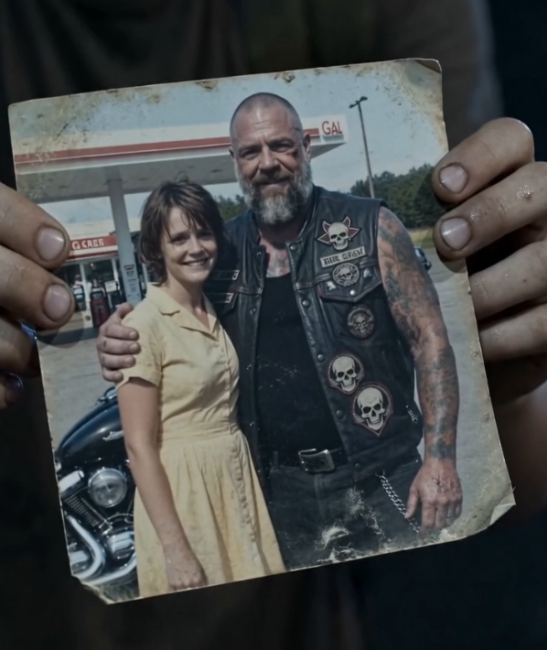
Caleb did not move in that day.
Stories make things happen clean.
Life does not.
He came to the garage three times that first week. Always after school hours. Always with that backpack. Always standing in the doorway until I said, “Come in.”
The first day, spark plugs.
The second, oil filter.
The third, he swept the floor for twenty minutes without being asked, then fell asleep in the chair behind Tank’s office.
That was when I saw how tired he was.
Not teenage tired.
Orphan tired.
The kind of tired that sits behind the eyes and waits.
On the fourth day, I asked where he was staying.
He looked at the floor.
“My aunt’s motel room.”
“Your aunt?”
“Mom’s sister. She drinks. A lot.”
The wrench in my hand got heavy.
“Where’s your mother, Caleb?”
He did not answer.
He reached into his backpack and pulled out a folded hospital bracelet.
Lena Marie Porter.
Date of death: March 8.
The garage noise stopped.
No air compressor.
No radio.
No brother pretending.
Just silence.
“She died two months ago,” he said. “Cancer.”
I sat down on the edge of the workbench because my knees forgot their job.
Lena was dead.
Lena, who had once thrown french fries at me because I said poetry was for people who couldn’t fix cars.
Lena, who had left before I could ruin her more.
Lena, who had carried my son somewhere safe and never told me he existed.
“She told me your name the week before she died,” Caleb said. “She said I could look if I wanted. She didn’t say I should.”
His voice did not break.
That made it worse.
Kids should not be that practiced.
I looked at Tank.
He looked back with the face men wear when they are ready to do whatever comes next.
“Does your aunt know you’re here?” I asked.
Caleb shrugged.
That was answer enough.
The false climax came two days later, when his aunt showed up at the garage.
Her name was Marcy.
White American woman in her forties. Shaky hands. Angry eyes. Smelled like vodka and gas station perfume. She came in hot, yelling Caleb’s name before she had both feet inside.
“You think you can run off to this place?”
Caleb went still beside the bike.
Not scared like a kid afraid of getting grounded.
Scared like a kid who knows which kind of drunk has walked in.
I stepped between them before I thought about it.
Marcy looked me up and down.
“Oh, great. The biker hero.”
“I’m Jonah,” I said.
“I know who you are.” She laughed once, sharp. “Lena knew too. That’s why she ran.”
That one landed.
Caleb looked at me.
“What does she mean?”
Marcy pointed at me.
“She means your mama had sense. She kept you from him.”
Tank moved, but I lifted one hand.
Stay.
Brotherhood is not always charging forward.
Sometimes it is letting a man take the hit because the truth belongs to him.
Marcy pulled papers from her purse.
Temporary guardianship.
Signed.
Messy, but real enough.
“You don’t get to play daddy because you got old and lonely,” she said.
I wanted to say something hard.
Something that would make her step back.
That old reflex rose in me, hot and familiar.
Then Caleb flinched.
Not because I moved.
Because he expected me to.
That broke me.
I looked at Marcy and kept my voice low.
“You’re right.”
The room turned.
Even Caleb looked confused.
I swallowed.
“If Lena kept him from who I was, she was right.”
Marcy’s anger stumbled.
I looked at Caleb.
“I was dangerous.”
His face changed.
Not disappointment.
Recognition.
Like some part of him had been waiting for me to lie, and the truth surprised him.
Marcy grabbed his backpack.
“We’re leaving.”
Caleb did not move.
But the law was on paper, and love without paperwork is just a man standing in a garage with empty hands.
He left with her.
The Harley outside ticked as it cooled.
I stood there holding a wrench I could no longer feel.
That night, the Iron Saints tested their brotherhood.
Not with fists.
With restraint.
The old me wanted to ride to that motel, kick the door in, and take the boy.
The new me knew that was exactly why Lena had run.
So we did it the slow way.
The legal way.
The humiliating way.
Tank called his daughter, who worked for a family attorney in Charlotte.
Preacher called a pastor who knew a social worker.
Little Ray drove by the motel twice but did not stop, because I told him not to and because he loved me enough to obey when obedience hurt.
By morning, we had a plan.
Not a dramatic plan.
A clipboard plan.
A background check. A DNA test. A petition for emergency review. A welfare report on Marcy’s motel room. Proof of steady work. Proof of sobriety. Proof I had been clean seventeen years, nine months, and six days.
That number mattered.
I carried it in my wallet on a folded recovery coin card.
Caleb did not know that yet.
The twist came one year later.
Not in court.
Not in the garage.
At a roadside diner off Blue Ridge Road, after Caleb had been living with me for six months under a custody arrangement nobody expected me to win.
He had grown taller. Filled out some. Still quiet. Still careful. Still watched exits like he had inherited my old instincts without my sins.
We were eating burgers after replacing a fuel line on an old Softail.
He asked, “Why didn’t you come find us?”
I put my burger down.
“I didn’t know.”
He stared at his fries.
“She said you were dangerous.”
I nodded.
“She was right.”
His head snapped up.
Most kids want their parents defended.
Caleb needed his mother honored.
So I gave him that.
“I was using. Fighting. Running with men I shouldn’t have followed. I almost went to prison when I was nineteen.”
“For what?”
“Bad choices stacked on bad choices.”
“That’s not an answer.”
“No,” I said. “It’s the only one I’m giving over fries.”
He almost smiled.
Then he said the sentence that changed how I understood the whole story.
“She didn’t leave because she hated you.”
I waited.
“She left because she was pregnant.”
My chest locked.
Caleb kept his eyes down.
“She wrote it in a letter. Said she knew if she told you, you’d try to be good for a week. Maybe a month. Then something would happen, and I’d grow up learning to be scared of engine noise and door slams.”
The diner noise faded.
Forks. Cups. A bell over the door.
All far away.
“She said leaving you broke her heart,” he said. “But staying would have broken me.”
That was the twist.
I had spent twenty years thinking Lena abandoned me.
She had not.
She had protected our son from the man I was.
And she had been right.
After that night, every seed came back.
The photograph.
The yellow dress.
The way Caleb stood with his hand on his hip.
The way he pulled back when I reached too fast.
The way he watched me around anger.
He had not come looking for a father because he believed I was good.
He came because his mother died, his aunt was drowning, and a boy with no one left will knock on the last door on the map.
Even if there might be a monster behind it.
The next morning, I took him to the garage early.
No big talk.
No father-son speech.
Biker men are bad at speeches, and I had already used more words in a year than the old me used in a decade.
I put two mugs on the workbench.
Coffee for me.
Hot chocolate for him.
He looked offended.
“I’m sixteen.”
“Then drink it angry.”
He did.
I pulled out the recovery card from my wallet and set it beside the mugs.
Seventeen years.
Nine months.
Seven days now.
Caleb read it.
“You were an addict?”
“Yeah.”
“Do you still want it?”
“Some days.”
That scared him.
I let it.
Trust built on pretending is just another lie.
“What do you do?” he asked.
“When I want to run?”
He nodded.
I pointed around the garage.
“I fix things. I call Tank. I ride sober. I go to meetings. I keep my hands busy until the bad voice gets bored.”
He turned the card over.
“Mom said people don’t really change.”
I nodded.
“Most don’t.”
His eyes rose to mine.
“You did?”
“I’m doing it.”
That was the best answer I had.
The club changed around Caleb.
Not soft.
Never that.
But careful.
Tank taught him how to weld and made him wear gloves even when Caleb complained.
Preacher taught him how to throw a punch only after making him promise that walking away came first.
Little Ray taught him how to make pancakes because, “A man who can’t feed himself is just a tall boy.”
They never called him prospect.
They called him kid.
Then son.
Then, one day, without ceremony, Tank said, “Your boy left his hoodie in my truck.”
Your boy.
I pretended to look for a socket until my eyes stopped burning.
The court required a DNA test.
Caleb wanted it more than I did.
“I need to know,” he said.
“I already know.”
“I don’t.”
So we did it.
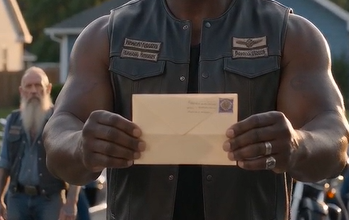
Two weeks later, the envelope arrived.
I opened it at the garage table with Caleb across from me and five bikers pretending not to breathe.
Probability of paternity: 99.9998%.
Caleb looked at the paper.
Then at me.
Then he said, “So you are.”
I nodded.
“Yeah.”
He swallowed.
“What now?”
I slid a spark plug across the table.
“Now you hold this.”
He laughed for the first time like a kid.
Not like a survivor.
A kid.
That sound did more to me than the DNA paper.
Every March 8, we ride to Lena’s grave.
Not fast.
Not loud near the cemetery.
The Iron Saints come, but they park outside the gates unless Caleb asks them in. That is his mother. His grief. His call.
The cemetery sits near a small Baptist church outside Marion, North Carolina, with gravel roads and oak trees that drop leaves into the flower cups.
Caleb always brings yellow flowers.
First year, he stood there with his hands in his hoodie pockets and said nothing.
I stood ten feet back.
Second year, he told her about school.
Third year, he told her he had learned to rebuild a carburetor.
Fourth year, he told her he had forgiven her, then cried like it cost him blood.
I did not touch him until he reached for me.
That was another thing I had learned.
Love waits for permission.
After the cemetery, we ride to the same diner off Blue Ridge Road.
He orders a burger.
I order black coffee.
Sometimes he asks questions about her.
Sometimes he asks questions about me.
Sometimes we just sit there, smelling like road dust and leather, while rain ticks against the window and the Harley cools outside.
The old photograph stays in the garage now, taped above the workbench in a cheap frame.
Nineteen-year-old me.
Lena in the yellow dress.
My arm around her like I knew how to hold anything.
Beside it is Caleb’s first spark plug.
Cleaned. Labeled. Dated.
The brothers tease me for that.
I let them.
There are worse things than being caught caring.
On quiet nights, after Caleb goes to bed, I sit outside the garage and listen to the metal roof pop as it cools. Sometimes the old shame comes back and sits beside me.
I do not chase it away.
It earned a chair.
But it does not get the keys anymore.
Caleb is twenty-two now.
Taller than me by half an inch, which he mentions like it is a legal victory.
Same eyes.
Same chin.
Same stubborn stance.
But his hands are steadier than mine were at his age.
That matters.
Last Sunday, he rolled into the Iron Saints garage on his own Harley, boots hitting gravel, engine dropping into a clean idle. The brothers looked up from the workbench like they had been waiting twenty years for that sound.
He shut it off.
Silence settled.
Then he pulled an old photograph from his vest pocket.
Not the one of me and Lena.
A new one.
Him and me outside the garage, grease on both our shirts, my arm around his shoulders, his hand on his hip.
He taped it beside the old picture.
I stared at it longer than I meant to.
Caleb picked up a wrench and tossed it to me.
“Hold this,” he said. “I’ll show you something.”
Tank laughed from the doorway.
Preacher looked away.
My son bent over the engine, explaining a repair I already knew how to do.
I listened anyway.
Outside, the Blue Ridge afternoon turned gold.
Inside, the garage smelled like oil, leather, coffee, and a life I almost didn’t deserve.
The Harley engines cooled one by one.
My boy kept talking.
I stayed.
Follow the page for more biker stories about rough roads, second chances, and the families found inside the noise.