I Dragged a Terrified Young Woman Out of a Stranger’s Car—Then the Driver Shouted That I Was the Kidnapper
I had one hand around a terrified young woman’s wrist and the other braced against a stranger’s car door when the driver began screaming that I was kidnapping her in broad daylight.
Her name was Kayla. She was nineteen, wearing a pale blue sweatshirt despite the Texas heat, and looking at me like I was the most dangerous man she had ever seen.
I couldn’t blame her.
I’m Wade “Gravel” Mercer, fifty-five years old, six-foot-four, with a shaved head, a gray beard hanging halfway down my chest, and enough faded ink on my arms to make strangers reconsider eye contact. My black leather cut was covered in old patches, my boots were stained with oil, and my Harley had been rumbling beside pump six like distant thunder.
To Kayla, I probably looked like the threat.
The driver looked respectable. Clean white shirt. Trimmed hair. New wristwatch. Calm voice. He had the kind of face people trusted without knowing why.
“Let her go!” he yelled, climbing out of the dark gray SUV. “She’s my niece. Somebody call the police!”
Kayla pulled against me. Her fingernails dug into my wrist as she cried for me to release her, while customers near the gas station entrance raised their phones and began recording.
I didn’t tighten my grip. I lowered my voice.
“Kayla, tell me his last name.”
She froze.
The driver stopped moving.
“Don’t answer him,” he snapped. “Get back in the car.”
I looked into her frightened eyes and asked another question.
“Where is he taking you?”
She opened her mouth, but no words came out.
That was when I knew I had been right.
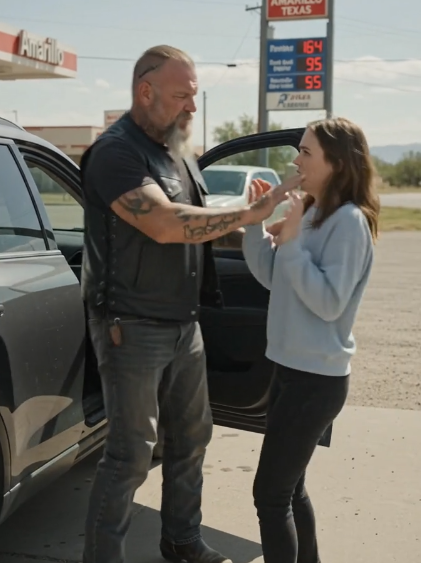
Ten minutes earlier, I had only stopped at that gas station outside Amarillo because my fuel light had been glowing for twelve miles.
The afternoon sun burned against the concrete, and the hot wind carried the smell of gasoline, dust, and truck exhaust across the lot. I killed the Harley’s engine, removed my gloves, and noticed the gray SUV parked beside the air pump.
Kayla stood near its open passenger door.
The driver was loading a small pink backpack into the rear cargo area, but he kept one hand on her phone. Every time she spoke, he interrupted. Every time she looked toward the store, he guided her attention back to him.
At first, it looked like an impatient father arguing with his daughter.
Then I heard him say, “Once we reach Dallas, the agency will explain everything.”
Kayla asked how long the photo shoot would take.
The man answered that she would find out after they arrived.
She asked whether the other models were already there.
He said she was asking too many questions.
That changed everything.
Several years earlier, after my younger sister disappeared, I started volunteering with a roadside awareness group that trained truckers, motel workers, and riders to recognize possible trafficking. We were taught never to judge a situation by clothing or appearances. We watched behavior instead.
Someone controlling another person’s phone.
A destination that kept changing.
A job offer without a clear company address.
One person answering every question for the other.
A young traveler carrying almost nothing.
And the most important sign of all: she did not seem to know the person taking her nearly as well as he claimed.
I walked toward the trash can beside the SUV, pretending to throw away an empty coffee cup. The driver noticed me immediately and moved between Kayla and me.
Protective men usually watched the world around the person they loved.
Controlling men watched the person.
“Everything good?” I asked.
“Family business,” he replied.
Kayla looked down.
The driver told her to get inside, and she obeyed without asking another question. He closed the passenger door, walked around the hood, and kept her phone in his hand.
I saw her test the interior door handle.
It didn’t open.
Then the SUV began rolling toward the exit.
I moved before I had time to reconsider.
The SUV had slowed for a delivery truck crossing the lot, so I stepped beside the passenger door and struck the window twice with my open palm. Kayla turned toward me, startled, while the driver shouted through the glass for me to move.
“Open the door,” I told him.
He accelerated a few feet, then stopped when the delivery truck blocked his path. I reached through the open rear window and pulled the passenger lock upward.
The door opened.
Kayla screamed when I took her wrist and guided her out. The driver grabbed the back of her sweatshirt, and for one terrible second she was caught between two strangers, neither of whom she fully understood.
I released her wrist immediately and put myself between them.
“Go inside the store,” I said.
She didn’t move.
The driver pointed at me and shouted that I had attacked his niece. He told the customers filming us to call the police. He spoke quickly and confidently, using the confusion like a weapon.
Kayla began crying.
“He’s taking me to a modeling job,” she said. “I met him online. He said his company hired me.”
The driver’s face changed.
Only slightly.
But I saw it.
A real uncle would have been confused by those words. He had just claimed she was family, yet she described him as someone she had met online.
I kept my hands where everyone could see them and nodded toward the store clerk.
“Call 911. Tell them we need officers. Nobody touches anybody.”
The driver tried to laugh.
“This is insane,” he said. “She’s an adult. She chose to come with me.”
That part was true. Kayla had entered his vehicle willingly, and she was legally old enough to travel wherever she wanted.
But consent built on a lie is a trap.
The driver reached for her hand again. Kayla stepped away, although she still looked uncertain about whether to trust me.
I asked her where the company’s studio was located.
She didn’t know.
I asked for the name of the photographer.
She didn’t know.
I asked why the man had her phone.
“He said the battery was low,” she whispered.
The phone showed eighty-three percent.
The driver called himself Darren Cole, but the name on his license plate registration would later turn out to be different. At that moment, however, all I had were warning signs and a frightened young woman who still believed she might be losing the opportunity of her life.
Darren told her I was jealous, unstable, and probably trying to rob them. He pointed at my tattoos and leather cut as if my appearance were evidence.
People listened.
A middle-aged customer told me to back away. Another man stood between me and my motorcycle, apparently worried I would escape before the police arrived. Three phones recorded my face from different angles.
I accepted all of it.
I had been mistaken for plenty of things in fifty-five years. A criminal. A gang member. A man looking for trouble.
Being misunderstood for twenty minutes was a small price if it kept Kayla out of that vehicle.
She asked me why I cared.
I looked at the silver chain around her neck, then at the pink backpack in the SUV. For a moment, I saw another girl standing beneath another hard sun many years earlier.
My sister Erin was seventeen when she left home with a man who promised her work in another state. She called once from a motel and said everything was fine, although her voice sounded wrong.
Then she disappeared.
Our mother kept the porch light burning every night for eleven years. My father drove through three states following rumors until his truck died and his savings were gone. I joined searches, handed out photographs, and learned how quickly a person could be moved beyond the reach of everyone who loved her.
Erin was never found.
I did not tell Kayla all of that in the parking lot. Bikers my age don’t explain every scar while strangers are watching.
I only said, “Because somebody should’ve stopped my sister’s car.”
Kayla stared at me.
Darren looked toward the highway.
Then he ran.
Darren reached the driver’s door before I understood what he was doing. I did not chase him or attempt to drag him down, because the delivery truck still blocked the exit and two patrol cars were already turning into the gas station.
He climbed into the SUV, reversed too quickly, and struck a concrete parking barrier. The impact was minor, but it trapped the rear wheel long enough for officers to surround the vehicle.
They ordered him out.
This time, he obeyed.
One officer separated Kayla from the crowd while another questioned me. I gave them everything I had seen and heard, expecting to spend the afternoon defending my actions.
Instead, a deputy returned from the SUV with Kayla’s phone, two additional phones, several prepaid cards, and a folder containing printed photographs of young women.
None of the photographs showed Kayla.
Not yet.
The name Darren Cole was false. The SUV belonged to a rental company in Oklahoma. The supposed modeling agency had no registered address, and the hotel reservation he had shown Kayla was for a roadside motel more than two hundred miles from the Dallas studio he claimed they were visiting.
The most frightening discovery was made after detectives examined his messages.
He had contacted Kayla six weeks earlier through social media, using the profile of a woman who claimed to recruit inexperienced models. The messages began with compliments, moved to friendship, and then introduced Darren as a trusted driver.
Kayla had been told not to inform her parents because the agency wanted “independent girls who could make adult decisions.” She had been promised cash, professional photographs, and a contract after arrival.
There was no photo shoot.
There was no agency.
Investigators connected the man to an active trafficking case involving several states. Police had been searching for the SUV under a different plate number, and evidence found inside linked him to at least two other disappearances.
When the detective explained that, Kayla sat down on the curb.
Her face emptied.
She looked at the vehicle, then at the little pink backpack holding everything she had planned to take into her new life.
One change of clothes.
A toothbrush.
Forty-three dollars.
She had believed she would be home by Sunday.
The detective told her she might never have reached Dallas at all.
Kayla asked to use my phone because hers had been taken as evidence. Her hands shook so hard she entered the wrong number twice before finally reaching her mother.
She tried to speak normally.
That lasted three seconds.
“Mom,” she whispered, and then the fear she had been holding inside finally broke through.
I walked away to give her privacy, but the parking lot had gone so quiet that I could still hear her apologizing. Her mother’s voice came through the speaker, frantic and confused, asking where she was and whether she had been hurt.
Kayla kept looking at me while she listened.
Not with fear anymore.
With the stunned expression of someone replaying the last hour and realizing the person she fought was the only person who had noticed.
Her parents arrived before sunset. Her father climbed from their pickup and ran past me without looking in my direction. He wrapped both arms around his daughter, while her mother held Kayla’s face and checked every inch of her as if she needed proof that the girl was real.
I understood.
My family had spent years imagining that reunion.
Kayla’s father eventually walked toward me. He was smaller than I was, dressed in work pants and a shirt with his name stitched above the pocket. He looked at my leather cut, my tattoos, and the fresh scratches Kayla had left on my wrist.
Then he asked what had happened.
I gave him the shortest version I could.
“I pulled her out of that car. The driver was a trafficker. She didn’t know how close she came to disappearing.”
Her father lowered his head.
When he looked up again, his eyes were wet.
He held out his hand, but when I took it, he pulled me into an embrace so sudden and tight that the chain on my vest pressed against my ribs.
“Thank you for seeing her,” he said.
That sentence stayed with me.
Not saving her.
Seeing her.
Because hundreds of people might have passed that SUV during its journey. Most would have seen a young woman traveling with someone she trusted.
I had seen what was missing from the picture.
The investigation continued for months. Darren was charged, and evidence recovered from his devices helped detectives identify other people connected to the operation. Kayla’s testimony became part of the case, although her name was protected and her family avoided the cameras.
She did not become fearless overnight.
For weeks, she slept in her parents’ room. She deleted every social media account she owned and refused to enter a vehicle unless she knew every person inside. Some nights she woke believing she was still trapped behind that locked passenger door.
Healing did not arrive like a movie ending.
It came slowly.
A month after the arrest, Kayla and her parents visited our clubhouse during a trafficking-awareness fundraiser. Twenty-eight bikers stood when she entered, and she almost turned around when she saw the leather cuts, tattooed arms, and weathered faces watching her.
Then she saw me near the coffee urn.
She crossed the room and hugged me before saying a word.
Kayla now speaks at high schools and community centers about false job offers, online grooming, and the small controlling behaviors that once seemed harmless to her. I sometimes ride behind the family’s truck when she travels to an event, although she no longer needs me standing between her and every unknown door.
She has her own voice now.
I still stop at that gas station whenever I pass through Amarillo. Pump six looks ordinary. The concrete barrier has been replaced, and the clerk who called 911 moved to another town.
Nothing there announces what nearly happened.
But every time I shut down my Harley, I remember Kayla’s terrified face and the way the entire parking lot believed I was the danger.
Maybe that is why predators succeed so often. They learn to look harmless, while the people willing to intervene sometimes look like men the world has already decided not to trust.
I keep Erin’s photograph inside my saddlebag.
Before leaving the station, I touch the edge of that faded picture, pull on my gloves, and listen as the V-twin comes alive beneath me.
That day, somebody’s sister came home.
Follow our page for more unforgettable biker stories about misunderstood strangers, hidden courage, and the rough-looking riders who refuse to leave vulnerable people behind.