Part 2: The Man Everyone Mocked for Paying With Coins at the Pharmacy — Until the Cashier Learned Why
The little girl could not have been older than nine.
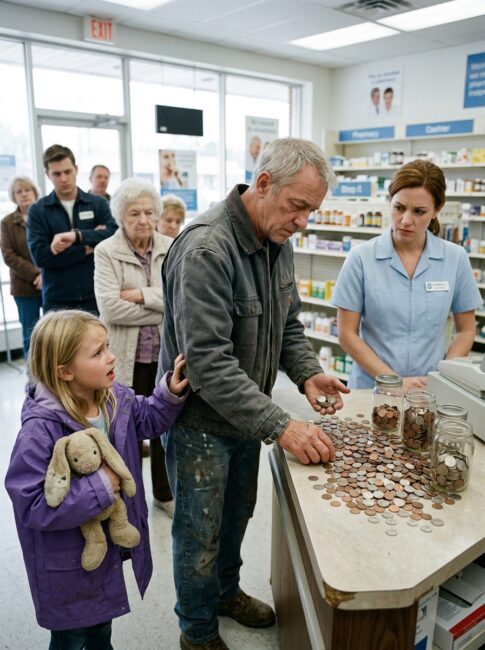
She wore a purple raincoat that was too large for her narrow shoulders. One sleeve had been folded twice at the wrist. Her hair was tied back with a yellow ribbon, and the stuffed rabbit in her arms had one ear repaired with uneven blue thread.
A woman in blue scrubs hurried around the corner behind her.
“Emma,” she said gently, “you cannot wander away from the waiting area.”
The girl did not move.
Her eyes remained fixed on the three jars.
“Those are your bus coins,” Emma said.
Walter gave her a tired smile.
“I can walk for a while.”
Emma shook her head. “But your knee hurts.”
Walter’s hand paused above a stack of nickels.
The people in line stopped shifting impatiently. Even the man who had checked his watch looked up.
Allison glanced at the label on the prescription slip.
The medication was not for Walter.
The patient’s name was Emma Caldwell.
Allison turned toward the girl in the purple raincoat. She had noticed Emma earlier, sitting near the consultation room with the woman in scrubs. She assumed the woman was her mother.
Now she saw the hospital wristband peeking from beneath Emma’s sleeve.
“Are you her grandfather?” Allison asked.
Walter shook his head.
“No, ma’am.”
The woman in scrubs stepped closer. “I am Emma’s aunt, Rachel. Her mother is at work.”
Allison looked down at the coins again.
The medication was an antibiotic prescribed after a procedure earlier that morning. Insurance had covered most of it, but not all. The amount due was still more than Walter’s small pile appeared to contain.
Allison began counting.
Walter did not rush her. He stood quietly, one hand resting on the counter, the other clutching the frayed strap of his canvas bag.
There were pennies darkened with age. Quarters with paint stains. Dimes wrapped in scraps of paper. A few silver dollars that looked as if someone had kept them for years.
One coin rolled toward the edge of the counter.
Emma caught it before it fell.
“Please do not spend this one,” she said.
She opened her palm.
It was a worn quarter with a strip of red nail polish across one side.
Walter looked at it for a long moment.
“That one was your mother’s,” he said.
Emma held it out to him.
“You told me it was lucky.”
Walter closed her fingers around it.
“Then you should keep it.”
Allison stopped counting.
Something about the scene no longer fit the assumptions she had made. Walter was not careless. He had sorted the coins by value. He had written the total on the inside of each jar lid. The handwriting was small and precise.
One jar lid read: Bus rides.
Another read: Laundry.
The third read: Emergency.
Rachel saw Allison reading the labels.
“He does not have to do this,” she said softly. “I told him that.”
Walter shook his head. “Emma needs the medicine today.”
Rachel lowered her voice. “Walter, that emergency jar is all you have left until next week.”
“It is raining,” he said. “I will find more gutters to clean when it clears.”
The younger man in line slipped his phone back into his pocket.
Allison continued counting, slower now.
The total was seventeen dollars short.
She counted again.
Walter watched her face and understood before she spoke.
“I may have another dollar in my truck,” he said. “Maybe two.”
Emma looked up at him. “But you sold your truck.”
Walter’s expression tightened for only a second.
“It is an old habit,” he said.
The little girl seemed confused.
Rachel was not.
She looked away and pressed her lips together.
Allison glanced through the pharmacy window. In the parking lot, beneath the gray rain, there was no truck. Only an old bicycle chained to the railing with a plastic grocery bag covering the seat.
Walter gathered the loose coins that remained near his elbow.
“I will come back,” he said. “Please keep the prescription ready.”
He turned toward the door.
Emma reached for the back of his jacket.
“Mr. Walter, wait.”
That was when Rachel finally said the words no one in line expected.
“He is not family,” she told Allison. “He is the man my sister blamed for almost ruining her life.”
Walter stopped walking.
The pharmacy grew quiet again.
Rachel glanced at Walter as if asking permission to continue.
He gave the smallest shake of his head.
She continued anyway.
“Walter used to own an auto repair shop on Mason Street,” she said. “My sister, Nicole, worked there when Emma was a baby.”
Walter faced the door, his shoulders still damp from the rain.
Rachel spoke carefully, filling in the truth one piece at a time.
Nicole Caldwell had been twenty-three when she began working at Walter’s shop. Emma’s father had left before Emma learned to walk. Nicole needed every shift she could get, but she was often late.
Sometimes Emma was sick.
Sometimes the babysitter canceled.
Sometimes Nicole arrived at work exhausted after spending the night in a folding chair beside Emma’s crib.
Walter covered for her more than once.
But the repair shop was struggling. Business had slowed, the roof leaked, and one of the hydraulic lifts needed replacing. Every delayed job cost money.
Then one afternoon, Nicole made a mistake while preparing an invoice for a fleet customer. It caused an expensive dispute.
Walter corrected the invoice himself and accepted responsibility when the customer threatened legal action.
Nicole never knew that part.
What she did know was that Walter had called her into his office two days later and told her the shop could no longer keep her on the payroll.
“She thought he fired her because she was a single mother,” Rachel said. “She told everyone he was heartless.”
Walter finally turned around.
“I did fire her,” he said. “That part is true.”
Rachel looked at him. “Because the shop was closing.”
Walter said nothing.
Rachel’s voice softened.
“He had already missed three mortgage payments. He sold his tools one set at a time. He could not afford to keep anyone employed.”
The woman behind Walter, the one who had sighed loudly, lowered her gaze.
Rachel continued.
“Nicole found another job at the hospital cafeteria. She worked hard. She still disliked Walter for years.”
Walter rubbed his thumb across the frayed strap of his bag.
“All of that was a long time ago,” he said.
But it was not the whole story.
Three months earlier, Nicole collapsed during a double shift.
At first, everyone assumed it was exhaustion. Then the scans revealed an aggressive form of cancer.
By the time treatment began, Nicole was spending more days at the hospital than at home. Rachel moved in to help with Emma, but Rachel had two children of her own and bills she could not ignore.
Walter heard about Nicole’s illness from an old customer.
He did not call Nicole. He did not want to reopen old wounds.
Instead, he began leaving grocery bags on Rachel’s porch every Saturday morning.
There was never a note.
Sometimes the bags contained cereal, soup, apples, and peanut butter. Sometimes there were coloring books for Emma. Once, there was a pair of rain boots in Emma’s size.
Rachel discovered who was leaving them only because she happened to open the front door early one morning.
Walter was halfway down the sidewalk, walking with a limp.
“I asked him why,” Rachel said. “He told me groceries were cheaper than apologies.”
Walter looked embarrassed. “I did not say it like that.”
Rachel almost smiled. “You said exactly that.”
The people waiting in line were no longer watching the clock.
Allison looked at the jars on the counter. Bus rides. Laundry. Emergency.
Rachel explained that Walter now lived in a small room above a laundromat. After losing the shop, he found work where he could: cleaning gutters, repairing porch steps, hauling old appliances, and sharpening lawn mower blades from a folding table outside the flea market.
He did not earn much.
Still, when Nicole’s insurance failed to cover Emma’s follow-up prescription, Walter heard about it from Rachel and arrived at the pharmacy before she could stop him.
“He saved those quarters for the bus,” Rachel said. “His knee has been getting worse. He needs surgery, but he keeps putting it off.”
Walter turned back toward the counter.
“Emma needs antibiotics,” he said. “I need a better pair of shoes. We all have a list.”
There was no bitterness in his voice.
That made Allison feel worse.
She remembered the way she had spoken to him only minutes earlier. She remembered pointing toward an imaginary coin machine as if he were wasting everyone’s time. She remembered assuming his coins were an inconvenience instead of a sacrifice.
She opened the cash drawer.
“I can cover the difference,” she said.
Walter shook his head immediately.
“No. That is kind, but no.”
The younger man who had checked his watch stepped forward.
“Then let me.”
Walter shook his head again.
“I appreciate it. But Emma’s mother would not want strangers paying her bills.”
Rachel stared at him. “Walter, you are paying her bill.”
“That is different.”
“How?”
Walter looked at Emma.
The girl still held the worn quarter marked with red nail polish.
“Because I owe her mother something,” he said.
Rachel’s expression changed.
“No, you do not.”
Walter looked down at the floor tiles.
“Yes, I do.”
Years earlier, during Nicole’s last week at the repair shop, Walter had found her crying in the employee restroom. She had been too proud to tell anyone she was out of formula for Emma.
Walter bought the formula, diapers, and groceries. He placed them in the trunk of Nicole’s car without telling her.
Nicole found the bags and assumed they came from a women’s shelter she had contacted that morning.
Walter never corrected her.
“She needed to believe she had found a way through it herself,” he said. “She had enough people making her feel small.”
Rachel blinked back tears.
Walter continued.
“When the shop closed, I should have told her why. But I was ashamed. I thought silence would protect my pride.”
He paused.
“Instead, it hurt hers.”
Emma stepped closer to him.
“My mom does not hate you anymore,” she said.
Walter smiled faintly. “I know.”
“How do you know?”
Emma opened the pocket of her raincoat and removed a folded piece of paper.
Rachel stared at it. “Where did you get that?”
“Mom gave it to me this morning. She said I should give it to Mr. Walter if he came.”
The paper trembled slightly in Emma’s hand.
Walter hesitated before accepting it.
He unfolded the note.
Nicole’s handwriting was weak but recognizable.
Walter read silently. His jaw tightened. His eyes filled, but he did not wipe them.
Emma looked up at him.
“What did she write?”
Walter folded the note again and placed it carefully inside his jacket.
“She wrote that I am still terrible at accepting help.”
A soft laugh moved through the line, gentle and brief.
Then Allison noticed something written on the back of the prescription slip.
A pharmacy assistance code.
Nicole’s hospital social worker had already submitted an emergency voucher that morning. The code had not been entered into the system yet.
Allison typed it in.
The remaining balance disappeared.
She printed the receipt and placed the medication in a white paper bag.
“There is no charge,” she said.
Walter stared at the bag.
“What about the coins?”
Allison pushed the jars back toward him.
“You will need them for the bus.”
Walter glanced toward the bicycle outside.
“I suppose I will.”
The younger man in line looked through the rain-streaked window.
“That bicycle yours?”
Walter nodded.
The man removed a set of keys from his pocket.
“I have a pickup truck,” he said. “I am heading near Mason Street anyway.”
Walter opened his mouth to refuse.
The man raised one hand.
“You can say no tomorrow. Today, it is raining.”
Walter looked at Emma.
She smiled.
This time, he accepted.
Two weeks later, Allison was working the afternoon shift when Walter returned to Miller’s Pharmacy.
The rain had stopped, but the sky still carried the pale gray color of early spring.
Walter wore the same work jacket. It had been washed, though the cuffs remained frayed. His limp was still noticeable, but he seemed less tired.
He carried one of the glass jars.
Allison looked at the label.
Emergency.
“I think you forgot this,” he said.
She frowned. “You took all three jars home.”
Walter placed the jar on the counter.
Inside were coins, but not the same coins he had brought before.
There were more quarters now. Several folded dollar bills. A five-dollar bill tucked against the glass. Someone had added a small handwritten note.
For the next person who has to count every penny.
Allison looked at him.
“What is this?”
Walter shrugged.
“The man with the pickup truck started it.”
His name was Daniel. He had driven Walter and Emma home from the pharmacy that rainy afternoon. On the way, he stopped at a diner and bought Emma a grilled cheese sandwich.
Then he asked Walter if he still repaired lawn equipment.
By the following Saturday, Daniel had brought him three broken mowers from a landscaping company. Two neighbors added leaf blowers. Someone from the pharmacy line dropped off a snow blower that had been sitting in a garage for years.
Walter fixed what he could.
He refused donations, but he accepted work.
After hearing about the jar, several customers began leaving spare change inside it. Allison placed it behind the pharmacy counter, beside the register, where everyone could see the label.
Emergency.
It was not a charity box. There were no photographs, no speeches, and no names written on the glass.
People took what they needed.
People returned what they could.
Some days, the jar contained less than ten dollars.
Other days, it was nearly full.
Three months later, Nicole finished her most difficult round of treatment.
She still had a long road ahead, but she was strong enough to visit the pharmacy with Emma and Rachel.
Walter was already there, standing near the blood pressure machine with a paper cup of coffee.
For a moment, Nicole remained by the entrance.
Walter saw her.
Neither of them seemed to know how to cross the distance between them.
Then Nicole walked toward him.
She looked thinner than before. A patterned scarf covered her hair, and fatigue showed in the careful way she moved. But her eyes were steady.
“You should have told me the shop was closing,” she said.
Walter nodded. “I should have.”
“You should have told me about the groceries.”
Walter looked at his coffee. “Probably.”
“You should stop saying no every time someone tries to help you.”
Walter almost smiled. “That one may take longer.”
Nicole reached into her purse and removed a small object.
It was the quarter marked with the faded strip of red nail polish.
Emma had given it back to her.
Nicole placed the quarter in Walter’s palm and closed his fingers around it.
“My father gave me that coin when I was a child,” she said. “He told me to keep it until I met someone who needed luck more than I did.”
Walter stared at his closed hand.
“I cannot take this.”
Nicole shook her head.
“That is what Emma said you would say.”
Walter looked toward Emma.
The little girl stood beside the counter, hugging her stuffed rabbit. The rabbit now wore a tiny red ribbon around its repaired ear.
Allison watched Walter place the quarter inside the emergency jar.
It landed with a soft metallic sound, almost lost beneath the ordinary noises of the pharmacy: a phone ringing, a receipt printing, the low hum of fluorescent lights.
Walter did not keep the lucky quarter.
He did not explain why.
He simply tightened the lid, slid the jar back into its place beside the register, and walked outside into the afternoon light.
Emma ran after him and slipped her hand into his.
Walter slowed his steps so she would not have to hurry.
If stories about quiet kindness and the people we misunderstand stay with you, follow this page for more heartfelt stories.