Part 2: Ten Harleys Silenced the Boy Nobody Could Handle — Then One Biker Opened His Garage
I had been volunteering at the home for four years when I first met the Cumberland Road Brothers.
They were not the kind of men people pictured when they heard the word volunteer.
They did not arrive in matching shirts carrying boxes for a holiday photo. They came in leather cuts that creaked when they walked, boots that left gravel near the front desk, and jackets carrying the smell of gasoline, cold air, old coffee, and machine oil.
They also fixed things without being asked.
The first time they visited, Big Mike noticed our back gate sagging on one hinge. He stared at it for five seconds, then turned toward a thin rider named Reed.
“Tools?”
Reed nodded.
By lunchtime, the gate closed properly for the first time in months.
Tiny, a three-hundred-pound plumber with a shaved head and a laugh that startled every toddler in the building, repaired the leaking sink in our art room.
Diesel said almost nothing.
He crouched beside the rusted swing set, tested each bolt, then replaced two chains and one cracked plastic seat. When he finished, he brushed metal dust from his jeans and stood back while the children ran outside.
Noah did not join them.
He watched from the hallway.
At six, Noah had already lived through more transitions than most adults tolerate well. His mother died when he was a toddler. No relative could take him long-term. He moved between temporary homes, each one ending with another plastic bag of clothes and another adult trying not to look relieved when the handoff was complete.
By the time he arrived with us, motion had become his language.
He rocked in chairs until their legs scraped the floor. He ran laps around tables. He pressed both hands against walls. He sought noise, pressure, movement, anything strong enough to organize the storm inside him.
We did not understand that yet.
We saw behavior.
Dr. Elena Morris, the child psychologist working with the home, saw a child who needed a careful evaluation, consistent routines, safe physical activity, and adults willing to notice patterns instead of simply reacting to the loudest moment.
“Noah is not a diagnosis,” she told us. “And he is not a bad kid. We need to understand what helps him regulate.”
She was cautious with language.
That mattered.
The Harley visit began with an accident of timing.
One afternoon, I was telling Reed about Noah while we stacked donated winter coats in the multipurpose room. I mentioned how the boy calmed briefly whenever the maintenance crew used a low-powered floor buffer in the hallway.
Diesel had been carrying boxes nearby.
He stopped walking.
“What kind of calm?” he asked.
“The kind where he finally seems comfortable inside his own skin.”
Diesel looked toward the hallway, where Noah was racing from one doorway to the next.
“Does he like swings?”
“Loves them.”
“Car rides?”
“When someone can take him.”
“Vacuum cleaner?”
I stared at him.
“Yes.”
Diesel nodded once.
Big Mike noticed the exchange.
“You thinking what I’m thinking?” he asked.
Diesel shrugged.
“Maybe.”
They spoke with Dr. Morris before doing anything else. That detail is important. They did not burst into the yard and treat a vulnerable child like a prop. They asked questions. They listened. They agreed on boundaries.
The bikes would remain parked.
The children would stay behind the fence until staff explained what was happening.
Noah would use child-sized hearing protection before going near the motorcycles.
Any contact would be brief, supervised, and stopped immediately if he showed distress.
No rides on public roads.
No spectacle.
When the Cumberland Road Brothers returned that Sunday, their motorcycles rolled slowly into a neat line outside the fenced yard. Ten engines idled together.
The sound traveled through the walls.
Every child ran toward the windows.
But Noah changed completely.
He did not jump.
He did not shout.
He stood still with both palms against the glass, eyes wide, breathing slower than I had seen in weeks.
Diesel watched him like a man recognizing a road he had once traveled himself.
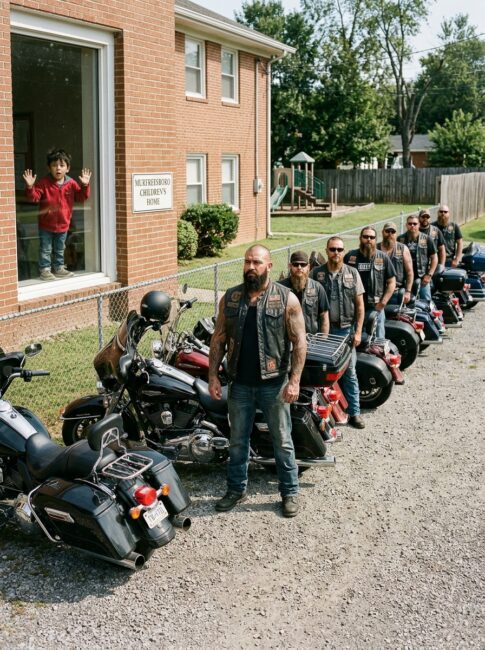
Big Mike shut down his engine first.
One by one, the other Harleys fell silent until only Diesel’s remained idling at the far end of the line.
The sudden quiet felt strange after the layered rumble.
Noah slapped the window once.
“Again,” he said.
It was the first word he had spoken calmly all morning.
Dr. Morris stood beside me near the doorway. She watched his shoulders, his hands, and the way he leaned toward the sound instead of away from it.
“Let’s go slowly,” she said.
We brought Noah outside with soft child-sized hearing protectors covering his ears. He held my hand for three steps, then pulled away—not to run wildly across the yard, but to move closer to the motorcycles.
Diesel killed the engine.
Noah stopped.
Diesel crouched several feet away, lowering his large frame until his eyes were level with the boy’s. His leather cut folded at the shoulders. A chain near his wallet tapped softly against his boot.
“Want to see the bike?” he asked.
Noah nodded.
“You listen to her.”
He pointed toward Dr. Morris.
Noah looked at her.
Dr. Morris smiled.
“Hands stay where Diesel shows you. The motorcycle stays parked. We stop whenever you want.”
Noah nodded again.
Diesel rolled the Harley into the yard with the engine off. It was a black touring bike, worn but clean, with road dust along the lower frame. Nothing flashy. Nothing polished for show.
Big Mike and Reed stabilized the motorcycle securely while Diesel lifted Noah carefully onto the seat.
The boy’s sneakers did not reach the ground.
For one brief second, I expected chaos.
Noah might grab at everything. He might twist around, yell, demand more, or leap down and run.
Instead, he placed both palms on the handlebars exactly where Diesel showed him.
Diesel stepped beside the bike.
“Ready?”
Noah looked serious.
“Ready.”
Diesel started the engine.
The Harley settled into a low, steady idle.
Noah’s entire body changed.
His shoulders dropped first.
Then his jaw loosened.
Then a grin spread across his face so slowly that several adults around me stopped breathing at the same time.
He did not scream.
He did not kick.
He did not knock anything over.
He sat on the parked motorcycle with two small hands gripping the bars, child-sized hearing protectors over his ears, and a smile that seemed almost unfamiliar on his face.
The vibration traveled through the seat and into his body.
Noah laughed.
Not the sharp, frantic laugh we sometimes heard before a hard moment.
A real laugh.
Open. Easy. Surprised.
Diesel looked away.
Only for a second.
Then he rubbed one large hand across his beard and stared toward the fence.
Big Mike stepped closer.
“You good, brother?” he asked.
Diesel nodded.
“Yeah.”
He was not.
His eyes had changed.
The other children took turns sitting briefly on the parked motorcycles under the same supervision. Some loved the sound. Some covered their ears and stayed farther back. One little girl wanted only to touch the cold chrome and then return to the swings.
Noah waited without pushing.
That alone felt impossible.
When his turn came again, he climbed onto Diesel’s Harley and placed both palms where he had learned to place them.
“Ready?” Diesel asked.
Noah nodded.
“Deal,” he said.
Diesel froze.
The word meant nothing to the rest of us.
Not yet.
After the visit, Noah remained calmer through lunch. He ate without leaving his chair six times. He helped another child stack plastic cups. He fell asleep before nine.
For the first time in months, the hallway stayed quiet.
I thought the story ended there.
A club of rough-looking bikers brought motorcycles to a children’s home and gave one overwhelmed little boy a peaceful Sunday.
That would have been enough.
But the following week, Diesel returned alone.
He was carrying a folder.
Dr. Morris never said Noah “needed a Harley instead of treatment.”
She said something more useful.
“Some children seek strong sensory input,” she explained during our staff meeting. “Rhythmic vibration, movement, deep pressure, and predictable sound can help them regulate. The motorcycles gave us information. Now we build a broader plan around what we learned.”
The plan included daily outdoor movement, a safer climbing area, scheduled swing time, weighted lap pads during quiet activities, occupational therapy consultation, and fewer hours trapped indoors whenever staffing allowed.
The Cumberland Road Brothers helped too.
They built a longer path around the edge of the yard so Noah could run laps without crashing into tables or doorframes. Tiny installed a heavy-duty swing. Reed donated protective ear gear in several sizes. Big Mike organized volunteers so the children could spend more supervised time outside.
Every Sunday, two or three club members visited.
Sometimes they brought motorcycles.
Sometimes they brought tools.
Sometimes they simply brought coffee for the staff and let the children play in the yard while leather cuts hung over the backs of plastic chairs.
Noah changed slowly.
Not magically.
He still had hard days. He still yelled when transitions came too quickly. He still knocked things over sometimes. He still needed patient adults, professional support, sleep, routine, and space.
But the adults around him stopped asking, “How do we make him behave?”
We started asking, “What is his body trying to tell us?”
Diesel understood that question better than anyone.
The folder he carried on his second visit contained the first documents required to explore foster placement and adoption.
I stared at him.
“You want to adopt Noah?”
Diesel looked toward the yard, where the boy was running the new path in a red jacket.
“I want to learn whether I can be the right home for him.”
That answer told me more than a dramatic promise would have.
Noah did not need another adult falling in love with an idea and disappearing when the reality became difficult.
He needed somebody willing to complete background checks, home studies, interviews, training, therapy meetings, and months of supervised visits.
Somebody willing to stay when the day was loud.
Diesel opened his leather vest and reached into the inside lining.
That was when I saw the tiny rocket-ship patch.
The stitching was uneven. Childish.
He touched it once.
“I grew up in a group home near Knoxville,” he said. “Different building. Same small rooms.”
I did not interrupt.
“They called me impossible too. Couldn’t sit still. Broke stuff. Ran every chance I got.”
“What helped?”
Diesel looked at the motorcycles outside.
“An old mechanic let me sweep his garage after school. Gave me things to carry. Things to build. Let me sit near the bikes when he worked.”
He rubbed the edge of the rocket patch.
“First person who figured out I wasn’t trying to make trouble.”
“Who made the patch?”
Diesel’s voice dropped.
“Me. Eight years old. Put it on my backpack. Kept it when the backpack fell apart.”
He glanced toward Noah.
“When he said ‘deal,’ I remembered something.”
“What?”
Diesel smiled slightly.
“The old mechanic used to say it every time he gave me a job. ‘You sweep. I teach. Deal?’”
The motorcycles had not simply calmed Noah.
They had carried Diesel back to the child he used to be.
Diesel’s real name was Daniel Ruiz.
Almost nobody called him that.
The nickname came from years working on trucks and heavy equipment, but it fit him too well to disappear. He smelled faintly of engine oil even after showering. His hands carried small scars from tools, metal edges, and long days repairing machines other people depended on.
He lived alone in a two-bedroom house on the edge of Murfreesboro, several miles from the home. The garage was cleaner than his kitchen. One wall held organized tools. Another held shelves of spare parts. His black Harley sat near the workbench beneath a fluorescent light that hummed whenever the weather turned damp.
Diesel had no wife.
No children.
No polished story about always dreaming of fatherhood.
He had doubts.
Good ones.
“What happens when he wakes up at two in the morning and cannot settle?” he asked Dr. Morris.
“What happens if he breaks something important?”
“What happens if he hates me after a week?”
“What happens if I get it wrong?”
Dr. Morris answered calmly.
“You will get some things wrong. Every parent does. The question is whether you keep learning.”
Diesel nodded.
“Deal.”
The process took months.
That was the first revelation most people missed when they heard the story later. Diesel did not arrive on a Harley one Sunday and leave with a child the next.
He attended training.
He completed paperwork.
He sat through interviews that made him revisit parts of his childhood he usually locked behind short answers.
He prepared his home.
He worked with Noah’s support team.
He learned that affection could not be forced and trust could not be scheduled like an oil change.
During early supervised visits, Noah barely acknowledged him unless a motorcycle was nearby.
Diesel did not take it personally.
He brought simple activities: a small toolbox, a set of large plastic bolts, wooden blocks, picture books about machines, sidewalk chalk, and a red kickball.
Some days went well.
Some did not.
One afternoon, Noah became overwhelmed when it was time to leave the playground. He screamed, threw a toy wrench, and kicked the leg of a picnic table.
Several adults turned toward Diesel.
Maybe they expected frustration.
Maybe they wanted to know whether the tattooed biker finally understood what “difficult” meant.
Diesel crouched several feet from Noah and waited.
His boots pressed into the dirt. His vest creaked when he lowered his shoulders. He did not grab the boy. He did not raise his voice.
“You need to run?” he asked.
Noah shouted something nobody understood.
Diesel pointed toward the fenced path.
“Three laps. I’ll go too.”
Noah ran.
Diesel ran beside him in heavy boots, moving awkwardly but steadily while Big Mike stood near the fence laughing into his coffee.
After three laps, Noah slowed.
Diesel slowed too.
“Better?” he asked.
Noah nodded.
“Ready to go?”
Noah wiped his face with one sleeve.
“Deal.”
The second revelation came from Big Mike.
He told me Diesel had been planning something in his garage for weeks.
“Kid thinks nobody notices,” Mike said. “But he’s been asking Tiny for bicycle parts like he’s building a space shuttle.”
Diesel had found a small used bicycle with a low frame. He stripped it down, repainted it black, added safe reflective details, installed a comfortable seat, and fitted wider handlebars that made it resemble a miniature cruiser without turning it into a motorized vehicle.
No engine.
No danger.
Just a child-sized bicycle built by a man who understood that belonging sometimes begins with an object waiting for you before you arrive.
The third revelation happened during a home visit.
Noah entered Diesel’s garage and froze.
On one side stood the Harley.
On the other stood the little black bicycle.
Noah walked toward it slowly.
He touched the handlebars.
“Whose bike?”
Diesel leaned against the workbench.
“Could be yours.”
Noah looked up sharply.
“For here?”
Diesel nodded.
“For mornings. Sidewalk first. Helmet every time.”
Noah studied the bike again.
Then he asked the question that tightened every throat in the garage.
“You keeping me?”
Diesel did not answer quickly.
He walked closer, crouched, and spoke carefully.
“I’m asking if you want us to try being a family. We keep learning. We keep showing up. Deal?”
Noah did not hug him.
Not then.
He simply placed one small hand on the bicycle seat.
“Deal,” he said.
For Diesel, that was enough.
The adoption became final the following spring.
By then, Noah knew the sound of Diesel’s boots crossing the children’s home lobby. He knew the difference between Big Mike’s deep laugh and Tiny’s louder one. He knew Reed carried peppermints in one vest pocket and spare ear protectors in the other.
He knew Sundays were not promises made for photographs.
The bikers kept coming after the paperwork began.
They kept coming after Noah moved into Diesel’s house.
They kept coming for the other children.
Every Sunday morning, the Cumberland Road Brothers rolled into the yard slowly and parked in a line outside the fence. They did not always start the engines. They asked first. Some weeks, the children wanted the deep rumble. Other weeks, they preferred chalk drawings, swings, and bicycle laps around the path.
The adults learned to listen.
Noah’s ritual at home was simple.
After breakfast, he put on a properly fitted bicycle helmet. Diesel checked the strap with two fingers beneath the buckle.
“Too tight?” Diesel asked.
Noah shook his head.
“Too loose?”
Another shake.
“Rules?”
“Helmet. Sidewalk. Stop at the driveway.”
Diesel nodded.
“Deal.”
Noah rode the small black bicycle in slow circles while Diesel walked beside him carrying coffee in a chipped metal mug. Some mornings, the garage door remained open behind them, revealing the Harley and the workbench and the tools arranged in careful rows.
On difficult days, Noah still needed movement.
Sometimes he ran laps around the yard.
Sometimes he pushed a weighted cart from one side of the garage to the other while Diesel sorted bolts into drawers.
Sometimes he sat on a shop stool with his ear protectors on while Diesel worked nearby, the radio low and the fluorescent light humming above them.
Noah was not suddenly quiet all the time.
That was never the goal.
He laughed loudly.
Asked endless questions.
Dropped things.
Forgot instructions.
Told Big Mike the same joke six Sundays in a row.
The difference was that nobody treated his energy like evidence that something was wrong with his heart.
One evening, I stopped by Diesel’s house with documents the school needed.
Through the open garage door, I saw Noah asleep on a folding chair beneath a small blanket. His bicycle leaned against the wall. Diesel sat on the concrete floor nearby, quietly tightening a loose pedal.
The giant tattooed biker could have carried the sleeping child inside.
He did not.
He knew Noah startled when lifted unexpectedly.
So he waited.
Five minutes later, Noah opened his eyes.
Diesel looked up from the pedal wrench.
“Ready to go inside?”
Noah nodded sleepily.
Then he reached for Diesel’s hand.
On the day Diesel brought Noah home for good, the Cumberland Road Brothers lined the driveway.
No parade.
No noise until Noah asked for it.
Just ten parked Harleys, ten weathered men in leather cuts, and one small black bicycle waiting inside the garage.
Noah climbed from the social worker’s car carrying a backpack with dinosaurs on it. Everything he owned fit inside two bags.
Diesel stood near the front step.
For a moment, neither moved.
Then Noah pointed toward the motorcycles.
“Can they do the sound?”
Diesel looked toward Dr. Morris, who had come to say goodbye.
She smiled.
“Hearing protection first.”
Noah pulled the soft child-sized protectors over his ears.
Diesel gave Big Mike a small nod.
One by one, the Harleys came alive.
The driveway filled with that deep, layered rumble Noah had first heard through a window months earlier. The sound traveled through the concrete and into his sneakers.
Noah grinned.
Not frantic.
Not overwhelmed.
Present.
Diesel led him into the garage and showed him the bicycle again.
Black frame. Wide handlebars. Reflective strips. Small bell near the grip.
Noah touched the seat.
“My bike?”
“Yeah,” Diesel said. “Every morning, we ride together. You on this. Me walking until you’re ready for more sidewalk.”
Noah looked toward him.
“Deal?”
Diesel smiled.
“Deal.”
The boy stood still for one second.
Then he stepped forward and wrapped both arms around Diesel’s waist.
It was the first time I had ever seen Noah hug anyone without being asked.
Diesel’s tattooed hands hovered in the air, uncertain and careful.
Then they settled gently across the boy’s back.
Outside, the Harleys idled.
Inside the garage, the little bicycle waited.
Noah held on.
Diesel did too.
Follow the page for more stories about the people behind the leather, the engines, and the scars.