Our Dead Brother’s Will Said, “Put Me on My Harley, Ride One Last Loop, Then Burn Us Both” — We Thought It Was His Final Joke
Mason’s will contained only three lines about his funeral: “Don’t bury me in a coffin. Put me on my Harley, take me around one last time, then burn us both.”
Nobody laughed.
Thirty-eight members of the Black River Riders sat inside our clubhouse outside Beckley, West Virginia, staring at attorney Rebecca Sloan as if she had spoken in another language. Rain struck the metal roof. Wet leather, road coffee, and engine oil thickened the air.
My name is Cole “Grinder” Maddox. I had ridden beside Mason “Rook” Mercer for thirty-four years. I was sixty-six, broad-shouldered, gray-bearded, tattooed from wrist to neck, and serving my seventeenth year as club president. I had buried eight brothers.
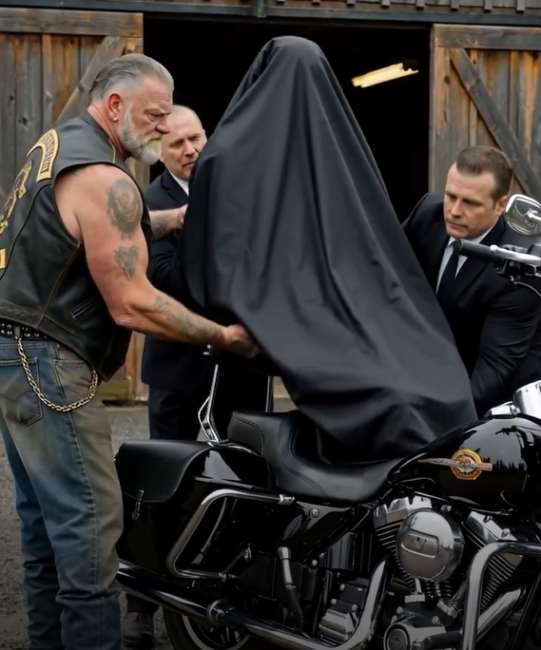
None had asked us to burn a Harley with him seated on it.
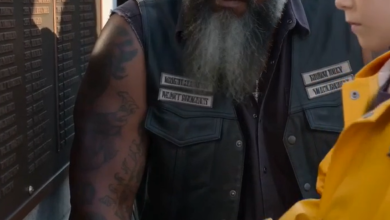
Mason had been larger than most men even after cancer hollowed his body—six-foot-five, shaved head, chest-length silver beard, scarred hands and a black leather cut faded nearly gray at the shoulders. Strangers saw his tattoos and crossed parking lots. Children saw him and usually stared.
Then he would kneel to their height.
That was Mason.
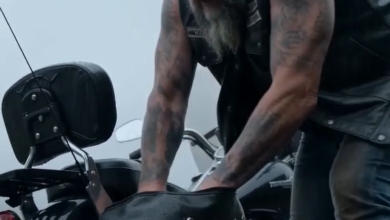
He had spent thirty years repairing school buses, twelve years volunteering at a food bank, and every Christmas Eve since 1998 delivering toys on a black 1987 Harley-Davidson Electra Glide. The motorcycle had outlived two engines, one marriage, three club presidents, and a collision with a deer near Bluefield.
He called it Mercy.
Mason died on a Tuesday morning with his daughter Nora holding one hand and mine gripping the other. His final spoken sentence was not about fire, motorcycles, or death.
He looked at Nora and whispered, “Check the left saddlebag.”
Then he was gone.
The will was read two days later.
His daughter stood so abruptly that her chair struck the floor.
“No,” she said.
Rebecca lowered the document.
“Nora—”
“You’re not strapping my father’s body to a motorcycle and setting him on fire for some club spectacle.”
Nobody argued.
She looked directly at me.
“You helped him write this, didn’t you?”
“I heard it for the first time with you.”
“You expect me to believe that?”
“Yes.”
Her face tightened.
For years, Nora had believed the club took more of her father than it gave. She remembered missed dinners, late-night calls, funerals, roadside rescues and engines starting before dawn. She did not remember the quiet things. Mason had made sure of that.
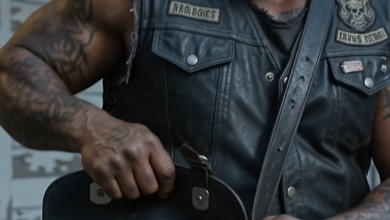
I crossed the clubhouse and opened Mercy’s left saddlebag.
Inside rested a child’s red mitten, a brass key, thirty-eight sealed envelopes bearing club members’ road names, and a legal document stamped by the county medical examiner.
Mason had planned everything.
The final ride had a route. The controlled cremation had permits. The Harley’s fuel, battery and hazardous parts were to be professionally removed before the ceremony. A licensed facility had agreed to receive both Mason and the remaining motorcycle in a private refractory chamber.
He was not asking us to break the law.
He was asking us to break a promise.
Thirty-four years earlier, after our first brother died, the club swore that no Black River Rider would ever make a final journey alone.
Mason wanted us to deliver him to the fire—and leave.
But the child’s red mitten raised a question none of us could answer. It had been carefully repaired with black thread, and stitched inside its cuff was a date from twenty-seven years earlier.
The date Mason stopped drinking.
Want to know who owned the red mitten and why Mason demanded that Mercy burn with him? Drop FIRE in the comments — I’ll share more soon.
Mason Mercer was not a good man who once looked frightening.
He was a complicated man who spent the second half of his life trying to outwork the damage he caused during the first.
We met in 1989 at a roadside bar outside Charleston. I was thirty-two and angry at nearly everything. Mason was thirty-four, recently divorced, carrying a dishonorable reputation from two counties and enough whiskey to make his shadow stumble.
He had not yet earned the road name Rook.
Back then, people called him Hammer because his hands were enormous and he used them before his brain caught up. He fought over insults, debts, women who did not want his protection, and one parking space that did not belong to him. He had spent eleven months in county jail after breaking a man’s jaw during a drunken argument.
I did not like him.
That was mutual.
The first time we rode together, his Harley broke down on Route 60. I considered leaving him beside the road. Then he opened the tool roll, removed the carburetor beneath a gas-station light, and repaired it while rain ran from his beard.
He knew machines.
More importantly, he understood broken things without despising them.
That black Electra Glide did not belong to him yet. It belonged to a man named Raymond Bell, one of the first Black River Riders. Raymond had bought it used, painted a small white stripe along the tank, and named it Mercy after the nurse who stayed beside his mother during her final night.
Raymond died in 1992.
A truck crossed the center line outside Lewisburg. Three riders went down. Two survived. Raymond did not.
His wife wanted nothing connected to motorcycles in her garage. She offered Mercy to the club for whatever we believed was fair. None of us had enough money.
Mason sold his pickup.
He paid Raymond’s wife more than she requested and walked ten miles home because the Harley still needed repairs. For six weeks, he rebuilt it in the clubhouse after work. He replaced bent metal but preserved Raymond’s white stripe.
When Mercy started again, the V-twin shook dust from the rafters.
Mason did not smile.
He placed one hand on the fuel tank and said, “Nobody owns her alone.”
That was when I began to understand him.
The road name Rook came later. During a chess game at the clubhouse, Mason moved the castle-shaped piece in a straight line across the board and knocked over Earl’s queen.
“Only moves one way,” Earl complained.
Mason shrugged. “Forward or sideways. Never backward.”
The name stayed.
Unfortunately, Mason’s drinking stayed too.
His daughter Nora was five then. She lived with her mother, Denise, in a small house near Fayetteville. Mason loved the child with an intensity that frightened him, which meant he repeatedly promised to change and repeatedly failed.
He would arrive sober for three visits, then miss the fourth.
He sent birthday gifts but forgot to call. He repaired Nora’s bicycle, then disappeared for six weeks. When Denise told him not to come while drinking, he waited outside their house in the rain until police asked him to leave.
Nora remembered the waiting.
She did not know why he stayed outside.
In 1997, Mason drove after drinking.
Nobody died.
That sentence does not make what happened small.
He ran through a red light near a school and struck the rear of a parked station wagon. Inside, a seven-year-old girl named Lucy Alvarez waited for her father to leave a pharmacy.
The impact threw her forward.
She suffered a broken collarbone, a concussion and cuts from shattered glass. She recovered physically. Mason carried the damage much longer.
When he climbed from his truck, he saw a red mitten lying in the road.
Lucy’s other mitten remained on her hand.
Mason picked up the fallen one before the police arrived. He later said he did not know why. Perhaps drunk minds grab meaningless objects because they cannot hold the truth.
He served eighteen months in prison.
Denise obtained full custody of Nora. The club removed Mason’s patch, not permanently, but until he could show that his promises meant something. Mercy remained locked in our storage unit.
Mason stopped drinking on February 12, 1997—the date stitched inside the mitten.
He never touched alcohol again.
After prison, he did not ask for his patch. He did not ask for Mercy. He found work repairing school buses on the night shift because most garages would not hire him. During the day, he attended recovery meetings, completed community service and mailed a small payment each month to Lucy’s family.
Her father returned every check.
Mason kept sending them.
For two years, he watched club rides pass without joining. He attended funerals in a plain jacket and stood behind the patched members. He never complained.
One winter morning, a school bus broke down on Route 19 with fourteen children aboard. Temperatures had fallen below freezing. The contracted repair company said it would take three hours.
Mason heard the call on a scanner.
He drove out in his own truck, repaired the fuel system beneath the bus and refused payment. When the driver asked his name, he said, “Nobody.”
That became his routine.
Nobody repaired the church van.
Nobody replaced tires on a single mother’s car.
Nobody left groceries outside an elderly veteran’s home.
Nobody paid the electric bill at Lucy Alvarez’s house after her father lost his job.
For twelve months, we watched.
Then Raymond’s widow came to the clubhouse carrying Mercy’s key.
“Mason paid for this bike,” she said. “Make him earn the right to ride it.”
We did.
His probation lasted another year. His vest came back without ceremony. Earl simply hung it over Mercy’s handlebar and waited.
Mason stood in front of it for a long time.
“I don’t deserve that.”
“No,” I told him. “You’re responsible for becoming the man who might.”
He put on the vest.
The leather no longer fit across his shoulders.
Nobody laughed until he did.
From then on, every mile on Mercy became repayment. Mason escorted funeral processions, delivered medicine during floods, and spent weekends repairing wheelchairs and generators. He never claimed these acts erased what happened to Lucy.
He said erasing was a drunk man’s fantasy.
“You don’t erase damage,” he told me once. “You build something useful beside it.”
Nora grew older, but trust did not return at the same speed. She saw him become dependable for strangers while remaining careful around her, as if one wrong step might collapse the narrow bridge between them.
At fifteen, she told him he loved the club more than her.
Mason did not defend himself.
“I loved the bottle more than everything,” he said. “The club taught me to put it down. I’m trying to learn what comes next.”
“What comes next is showing up.”
So he did.
Every school event.
Every birthday.
Every broken appliance.
Every call.
Nora eventually allowed him closer, though part of her remained five years old beside a window, waiting for an engine that did not always arrive.
That was why she distrusted us after his death.
She believed Mercy represented every mile Mason had ridden away from her.
She did not know it had carried him back.
The county permit did not settle the argument.
It made the request possible. That was different.
Mason had spent nine months arranging the ceremony with Rebecca Sloan, the medical examiner, a funeral director and a licensed high-temperature cremation facility built inside a former industrial foundry near Thurmond. The motorcycle would be prepared by environmental technicians. Fuel, oil, battery, tires, plastics and other hazardous components would be removed. Mason’s body would remain enclosed in a fire-safe ceremonial shroud designed for transportation, secured to Mercy on a custom steel cradle.
The final loop would take place on closed private and county-approved roads.
No open public burning.
No crowd near the chamber.
No one endangered.
He had solved every legal problem except the one inside us.
“We are not doing it,” Nora said.
We stood inside Mason’s garage the morning after the will reading. Mercy rested beneath a gray cover. Mason’s tools remained arranged above the workbench, each wrench outlined in white paint because he hated searching for things.
Rebecca placed the permit folder on the bench.
“Your father named the club as executor for the motorcycle,” she explained. “You remain next of kin for his remains. The ceremony requires both parties’ consent.”
“Then it ends here.”
Tommy Ruiz leaned against the wall. “He knew you might say no.”
“Good. Then he knew me.”
“He left you a letter.”
“I don’t want it.”
Nobody moved.
Nora was forty-seven, dark-haired like her mother, with Mason’s gray eyes and his way of clenching one hand when trying not to shake. She wore hospital scrubs beneath her coat because she had come directly from work.
My brothers looked at me for direction.
I had none.
Earl wanted to honor the will exactly. Marcus believed burning Mercy was disrespectful to Raymond Bell, its first rider. Tommy thought the final ride mattered but the Harley should be preserved. Six younger members saw the request as a legendary club spectacle until I shut that language down.
“This is not a show,” I said.
The room quieted.
“No cameras. No social posts. No flames for people to cheer at. If that is what you think Mason asked for, leave now.”
Two prospects lowered their eyes.
Nora watched me.
“You’re still considering it.”
“He planned it.”
“He was dying. Dying people can make irrational decisions.”
“Mason made irrational decisions long before dying. This wasn’t one.”
“You don’t know that.”
“No. I don’t.”
The truth tasted bitter.
I had known about the pancreatic cancer for four months. I knew he refused another treatment cycle after doctors said it might extend his life by weeks. I knew he had begun giving away tools and closing bank accounts.
I did not know about the fire.
That secrecy hurt more than I admitted.
Mason and I had survived prison visits, divorces, broken motorcycles, highway pileups, club fractures and the deaths of men whose voices I could still hear during long rides. Yet he had planned the largest decision of his death without telling me.
Perhaps he knew I would stop him.
Perhaps that was the point.
Nora pulled Mercy’s cover away.
Dust rose.
The Harley looked ready to start. Mason had polished the black paint days before entering hospice. Raymond’s white stripe still crossed the tank. A small red thread had been tied around the left handlebar.
The color matched Lucy’s mitten.
Nora saw it.
“What is that?”
“I don’t know.”
“You keep saying that.”
“I’m not going to invent answers because you’re angry.”
“I’m angry because all of you know pieces of my father that I don’t.”
Her voice cracked on the last word.
That silenced everyone.
She was not fighting only the funeral. She was fighting a lifetime of discovering that Mason had given strangers access to parts of himself he could not explain to his daughter.
I removed my vest.
Then I placed it on the workbench.
“We pause,” I said.
Earl turned sharply. “Cole—”
“We do nothing until Nora understands every part of the request. If she still says no, we carry Mason to a normal cremation and preserve Mercy.”
“He chose.”
“She is his daughter.”
“He was our brother.”
“And if brotherhood means trampling his child to honor him, then we learned nothing from the man.”
Earl walked out.
Three others followed.
The club divided by sunset.
Messages filled my phone. Some accused me of betraying Mason. Others said the request had always been unreasonable. Raymond’s widow, now eighty-three, called from Florida and asked only one question.
“Did Mason say why Mercy has to burn?”
“No.”
“Then find out before you destroy what belongs to more than one dead man.”
That night, Nora and I opened the thirty-eight envelopes from the saddlebag.
Each contained a letter to one club member. Some were only a paragraph. Mine was four pages, handwritten in Mason’s uneven block letters.
He thanked me for visiting him in prison.
He apologized for breaking my nose in 1990.
He instructed me to give his socket set to a young mechanic named Jesse.
He said nothing about the fire until the final line:
Grinder, when they fight you, follow the mitten.
Nora read it over my shoulder.
“What does that mean?”
“The girl from the crash.”
“Lucy?”
“You know about her?”
“Dad told me when I was eighteen.”
That surprised me. Mason rarely spoke her name.
Nora folded my letter.
“He said she forgave him.”
“She did?”
“That’s what he claimed.”
“Did you believe him?”
“No.”
Neither did I.
Forgiveness had always been the one thing Mason refused to accept on easy terms. If Lucy had offered it, he would have carried it carefully, not announced it as fact.
We located Lucy Alvarez through old payment records. She was thirty-five and living near Knoxville, Tennessee. Her social media profile identified her as an occupational therapist and mother of two.
I called.
A woman answered on the fourth ring.
“My name is Cole Maddox. I rode with Mason Mercer.”
Silence.
Then a slow breath.
“He died, didn’t he?”
“Yes.”
“I wondered when someone would call.”
“You knew about the will?”
“I knew about the ride.”
Nora stepped closer to the phone.
“Why does Mercy have to burn?”
Lucy did not answer immediately.
“Because the motorcycle isn’t the thing Mason is asking you to destroy.”
“What is?”
“The lie he built his life around.”
The call disconnected.
Nora stared at me.
Outside, wind moved beneath the garage door, carrying the smell of cold rain and gasoline.
We still had no answer.
But we finally had a direction.
Lucy Alvarez arrived two days later.
She drove a blue minivan with two child seats in the back and a cracked taillight Mason would have repaired before allowing her to leave. She was small, with dark hair, steady eyes and a faint scar along her chin from the crash.
Nora stood beside Mercy.
I waited near the workbench.
Lucy entered the garage carrying the matching red mitten.
For twenty-seven years, Mason had kept the left one. Lucy had kept the right.
She placed them together on the Harley’s seat.
The pair was faded, repaired and far too small for either woman’s hands.
“My father wanted to throw mine away,” Lucy said. “I wouldn’t let him.”
“Why?” Nora asked.
“Because Mason returned it.”
The police had kept the mitten as evidence. After prison, Mason asked permission to retrieve it, repaired the torn seam, and mailed it to Lucy with a letter.
The letter contained no request for forgiveness.
It described what he remembered from the crash and accepted responsibility for what he could not remember. He promised to send money but acknowledged that money could not purchase peace. He gave her permission to hate him for as long as she needed.
At the bottom, he had written:
I will never ask you to carry my guilt for me.
Lucy was ten when she read it.
She hated him anyway.
For years, Mason sent birthday cards without signing his name. He paid her physical therapy bill through a church account. When her father lost work, groceries appeared at their door. Lucy’s family believed the club was responsible.
It was Mason.
“How do you know?” I asked.
“Because when I turned eighteen, I confronted him.”
She found him at the school-bus garage. Mason stood beneath a raised bus, covered in grease. Lucy told him she knew about the money and wanted it to stop.
“He looked terrified,” she said.
Nora glanced toward me. We had both seen Mason face armed men without blinking. The idea of a teenage girl terrifying him made perfect sense.
Lucy asked why he kept helping after her family rejected him.
Mason answered, “Because stopping when nobody thanks you is just another kind of drinking.”
She visited again.
Not often. Once or twice a year. They drank coffee. She told him about college, marriage and her first child. Mason told her about recovery meetings and school buses. He never asked her to tell anyone.
“Did you forgive him?” Nora asked.
Lucy looked at the mittens.
“Eventually. But he didn’t believe me.”
“Why?”
“Because he thought forgiveness meant forgetting. I didn’t forget.”
Neither had Mason.
Lucy opened her purse and removed an old cassette recorder. Scratches covered its plastic body. A strip of tape held the battery compartment closed.
“Mason gave me this six months ago. He said to play it only if the club refused the ride or turned it into a show.”
She pressed the button.
Static filled the garage.
Then Mason’s voice emerged.
It was weak but unmistakable.
“If you’re hearing this, Grinder is being stubborn, Nora is furious, and Earl has probably threatened to ride Mercy through the courthouse.”
Despite everything, I smiled.
Earl had made that exact threat.
Mason coughed, then continued.
“First thing: the bike burns because it has become a shrine to a version of me that never existed. People see Mercy and remember toy rides, flood rescues, school buses and thirty sober years. They forget the drunk who nearly killed a child.”
Lucy closed her eyes.
“I don’t want my worst act to be my whole name,” Mason said. “I also don’t want my best acts used to erase it. Both men rode that motorcycle. Burn both stories together.”
Nora gripped the workbench.
The recording continued.
“Second thing: Mercy belonged to Raymond before me. I asked his widow. Her permission is in Rebecca’s file. I bought the bike with money, but Raymond gave it a name. Lucy gave it a purpose.”
I searched the permit folder.
Behind the legal forms was a handwritten letter from Raymond’s widow.
Mason has carried Mercy farther than Raymond could. Let the motorcycle finish with the man who kept her moving.
Mason’s voice weakened.
“Third thing: there’s something beneath the seat. Tommy knows how to remove it. Don’t open it until the last stop.”
Tommy had refused to attend the meeting that morning. I called him. He arrived seven minutes later, still wearing welding gloves.
Together, we removed Mercy’s seat.
A narrow steel compartment had been welded beneath the frame. Inside were dozens of folded papers, photographs and receipts sealed in waterproof sleeves.
We spread them across the garage floor.
A child standing beside a repaired wheelchair.
A family outside a flood-damaged house.
A school-bus driver holding new keys.
A veteran beside a mobility ramp.
Receipt after receipt carried Mason’s handwriting but other people’s names.
Nora knelt among them.
“What is this?”
Lucy picked up a photograph of Mason beside a young boy.
“The last ride.”
Mason had mapped a forty-six-mile loop through Beckley, Fayetteville, Oak Hill and Route 19. Each stop corresponded to someone represented beneath Mercy’s seat.
Not people he wanted to impress.
People he wanted the club to continue helping.
“He planned a fundraiser,” I said.
Lucy shook her head.
“No. Look at the back.”
Each photograph contained an instruction.
Replace Mrs. Keller’s porch steps.
Fund three months of Jesse’s recovery housing.
Repair the food-bank generator.
Pay school-bus driver Elaine Porter’s rent through winter.
Help Lucy’s clinic build an adaptive playground.
Mason had not left us a funeral route.
He had left us unfinished work.
Nora sat on the concrete floor, still holding a picture of her father repairing a child’s wheelchair.
“He never told me.”
“He didn’t tell anyone,” Lucy replied.
“He should have.”
“Yes.”
That answer mattered.
Lucy did not defend Mason’s silence. Love did not require pretending his secrecy was noble. He had spent his life helping strangers partly because strangers were easier than daughters. Gratitude from outsiders asked less of him than the possibility of Nora’s rejection.
The cassette clicked.
Then Mason’s voice returned for one final message.
“Nora, I missed things when you were little that no amount of showing up later could replace. You were right to be angry. If you stop the ceremony, I’ll understand. But Mercy taught me something: machines only move forward when every part carries pressure. I kept giving mine to the club because I was afraid you had carried enough.”
Nora covered her mouth.
“I was wrong,” Mason said. “You should’ve had the choice.”
Static swallowed the recording.
Then came six final words.
“Whatever you choose, I’m your dad.”
The tape ended.
For a long time, none of us moved.
Then Nora placed the two red mittens side by side on Mercy’s tank.
“We do the ride,” she said.
I looked at her.
“And the fire?”
Tears stood in her eyes, but her voice held steady.
“We finish what he asked.”
Preparing Mercy took three days.
Environmental technicians drained every fluid, removed the battery, replaced the tires with inert ceremonial replicas and stripped hazardous materials that could not enter the cremation chamber. Tommy protested each removed part until Nora reminded him Mason had signed the instructions himself.
The engine would run only for the first portion of the route.
At the final stop, Mercy would be secured to a low custom platform pulled by my Harley. Mason’s enclosed ceremonial shroud would rest on the seat within a professionally engineered support frame, protected from public view and monitored by the funeral director.
He would appear to ride.
But dignity remained intact.
We told no media. The club received strict instructions: no phones, no livestreams, no alcohol, no reckless riding. Anyone treating it as entertainment would surrender their patch before the engines started.
Nobody objected.
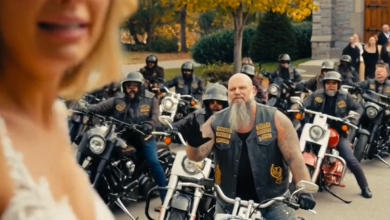
The morning of the ride arrived cold and clear. Forty-two Black River Riders gathered outside Mason’s garage before sunrise. More came from neighboring clubs, but I limited the formation to those who knew him personally.
Nora wore Mason’s leather cut.
It hung nearly to her knees.
Lucy tied the two red mittens to the inside, over his heart, where wind could not take them.
At 7:02 a.m., Tommy started Mercy.
The old V-twin turned slowly, coughed once, then settled into its familiar uneven thunder. Tools trembled against the garage wall. Coffee rippled inside paper cups.
Nobody cheered.
I placed my palm on the fuel tank.
“Ready, brother?”
The engine answered.
We left Beckley in two lines. Mercy traveled at the center on its support rig, Mason secured beneath the dark riding shroud, his gloved hands resting naturally near the bars. From a distance, he resembled a tired rider leaning into the morning.
Police closed intersections briefly, then reopened them after we passed.
At the first stop, Mrs. Keller waited beside her damaged porch. She was eighty-one and carried a photograph of Mason replacing her furnace during a snowstorm.
At the second, six school buses lined an empty parking lot. Their drivers stood beside the doors, hands over their hearts. Mason had repaired every vehicle at least once.
At the third, the food-bank workers held brown paper bags filled with the same groceries he had delivered for years.
Nobody had been told to attend.
The route had moved quietly through phone calls, family conversations and old favors. People emerged from diners, garages, churches and homes. Children held toy motorcycles. Veterans saluted. A nurse placed her hand against her chest as Mercy passed.
Nora rode in Lucy’s minivan near the rear.
At the Fayetteville bridge overlook, we shut down the formation.
The silence arrived slowly as engines died one after another. Mercy’s V-twin continued alone for several seconds.
Then Tommy reached forward.
His hand shook above the key.
He could not turn it.
I stepped beside him.
“I’ve got it.”
“No.”
Tommy had rebuilt Mercy’s engine twice. He had slept beside it after Mason’s cancer diagnosis because Mason kept claiming someone needed to monitor an oil leak that did not exist.
Tommy closed his fingers around the key.
The engine stopped.
That was the last time Mercy ever ran.
The sound left the mountains, and something inside forty grown men went with it.
Funeral technicians completed the transition to the inert transport setup. They secured the motorcycle to the platform behind my Road King. Mason remained on the saddle beneath the enclosed black shroud.
Before we resumed, Nora approached.
“I want to ride the last section.”
My passenger seat was empty.
She climbed behind me wearing Mason’s vest. Her hands wrapped around my waist.
“You okay?” I asked.
“No.”
“Good answer.”
We moved forward.
The final eleven miles followed a private road along the New River, then climbed toward the converted foundry where the licensed chamber waited. Autumn trees crowded both sides, their leaves red and copper beneath the midday sun.
Nobody spoke.
At the gate, every motorcycle stopped except mine.
This was the promise Mason wanted us to break.
No Black River Rider made the last journey alone.
But the facility allowed only the funeral director, Nora, Lucy, one club representative and essential staff beyond the inner gate. Mason’s written request instructed the rest of the club to stop outside.
Leave me before the fire, he had written. Brotherhood isn’t following a dead man forever. It’s knowing where the living still need you.
Earl refused.
“I’m going in.”
“No,” I said.
“He doesn’t finish alone.”
“He asked us to stay.”
“He asked us to ride.”
“And we did.”
Earl’s eyes reddened. “You expect me to turn around?”
“I expect you to keep his final order.”
For several seconds, the club stood divided again. Boots scraped pavement. Leather creaked. Engines ticked as they cooled.
Then Nora removed Mason’s vest.
She walked to Earl and placed it over his shoulders.
“My father isn’t going in alone,” she said. “I’m with him.”
Earl looked at her.
That ended the argument.
The club formed two lines leading to the gate. I rode between them, towing Mercy and Mason toward the foundry. Nora remained behind me. Lucy followed with the funeral director.
Nobody saluted.
Nobody shouted.
They simply touched two fingers to their hearts as we passed.
At the inner courtyard, I stopped.
The cremation building was plain brick and steel, not the open funeral pyre some men had imagined. A tall refractory chamber stood behind insulated doors. Professionals handled every movement with quiet precision.
Nora approached Mercy.
She untied the red thread from the handlebar and wrapped it around her wrist. Lucy removed both mittens from inside the vest and placed them beside Mason within the ceremonial shroud.
I inserted the key one final time.
Nothing happened.
The motorcycle had no battery, no fuel and no voice.
Still, I turned it to the riding position.
Then Nora reached beneath the seat and removed the final sealed envelope.
Her name was written across it.
She opened it.
Inside was a single photograph of Mason holding her at age four, asleep against his leather vest. On the back, he had written:
The best thing I ever carried was never this motorcycle.
Nora pressed the photograph against her chest.
The steel doors opened.
The final preparation happened beyond a privacy screen.
There was no spectacle.
No crowd watched Mason’s body burn. No flames rose against an open sky. The facility staff moved Mercy and its rider into the chamber with the same dignity they would have offered any family.
Only Nora, Lucy, the funeral director and I remained.
Before the doors closed, I saw the motorcycle once more.
Black tank.
White stripe.
Empty mirrors.
Mason rested where he had spent thousands of miles, no longer carrying pain. The two red mittens lay inside the shroud. Raymond’s name remained etched beneath the fuel cap. Mason’s guardian bell hung under the frame.
The motorcycle did not look like property.
It looked like a chapter refusing to end until somebody turned the page.
Nora touched the tank.
For years, she had resented that machine. Mercy had represented missed birthdays, emergency club calls, highway funerals and every morning her father left before breakfast.
Now she understood it had also carried him to recovery meetings. It had taken groceries to families, tools to stranded drivers and a sober man back toward the daughter he feared he had lost.
Both truths remained.
That was what Mason wanted.
Not forgiveness through fire.
Honesty.
Lucy placed her right hand beside Nora’s on the tank. The child Mason injured and the daughter he disappointed stood together beside the motorcycle that carried his attempt to become useful.
“I forgave him,” Lucy said. “But I never told him the crash stopped mattering.”
Nora nodded.
“He loved me. But that doesn’t give me back the years.”
“No.”
“Can both things be true?”
“They have to be.”
I removed my club ring and placed it on Mercy’s seat.
Nora looked at me.
“You’ve worn that since I was born.”
“Mason stole the first one.”
“He stole it?”
“Borrowed permanently.”
For the first time that day, she laughed.
I left the ring.
The chamber doors began closing.
Steel moved slowly across our view: rear wheel, saddlebag, Mason’s shrouded shoulders, black tank, then the white stripe.
Last came the handlebar.
The doors sealed.
A technician asked Nora whether she wanted to initiate the cycle. She looked at me.
“This was his decision,” she said. “But it’s my choice now.”
She placed her hand on the control.
Then stopped.
“Wait.”
The technician paused.
Nora removed the small brass key we had found in Mercy’s saddlebag. None of us had discovered what it opened.
Lucy recognized it.
“Mason’s recovery box.”
The box sat at the back of his garage, hidden beneath welding blankets. We had assumed it contained old tools. Nora asked the funeral director to delay the cycle.
We drove back with Mercy and Mason secured inside the locked chamber.
The club remained outside the facility gate.
Nobody complained about waiting.
Tommy used the brass key to open the box.
Inside were thirty years of sobriety medallions, arranged in rows. Beneath them rested forty-two unsigned birthday cards addressed to Nora.
One for every year after prison.
He had mailed others. These were the cards he wrote but believed he had no right to send.
Nora read the first.
I’m sober three months. Your mother says you don’t want to see me. She’s right to protect you. I’ll be here when you decide.
The tenth:
You graduated today. I watched from behind the gym because you asked me not to come. You looked brave. I’m sorry my pride made your childhood harder.
The twenty-second:
You called me Dad again without thinking. Best accident of my life.
The final card had been written two weeks before his death.
Nora, I spent years believing love meant staying close enough to help but far enough not to hurt you. That was cowardice dressed like sacrifice. You deserved a father who asked what you needed. I hope I became part of that man before time ran out.
Nora folded the card.
“Why hide these?”
“Shame,” Lucy said.
I shook my head.
“No. Fear.”
Mason had been willing to enter prison, recovery, cancer treatment and fire.
Yet asking his daughter to read forty-two imperfect apologies had frightened him.
Nora placed the final card inside her jacket.
The others remained in the box.
At sunset, we returned to the chamber.
This time, Nora did not hesitate.
She placed her hand on the control.
“Go ahead, Dad.”
The cycle began.
We never saw the flames.
We heard only the low mechanical rumble of the chamber and, beyond the walls, forty motorcycles starting together outside the gate.
The sound lasted one minute.
Then silence returned.
Three days later, the facility returned Mason’s ashes and the recovered metal from Mercy.
The motorcycle was gone as a machine. Heat had changed the frame, engine casing, spokes and handlebars into dark, twisted pieces that no mechanic could rebuild.
Tommy stared at the metal for a long time.
Then he chose one section from the fuel tank where part of Raymond’s white stripe remained visible.
He did not polish it.
He mounted it above the clubhouse door.
Beneath it, we placed two red mittens—not Lucy’s originals, which she kept, but a pair Nora sewed from red leather. Between them hung Mason’s guardian bell and my heat-darkened club ring.
There was no portrait.
Mason would have hated one.
The remaining metal went to a local artist who had once received help from the Empty Tank Fund Mason secretly supported. She forged it into forty-two small rook-shaped chess pieces.
One went to every club member.
One went to Lucy.
One went to Nora.
The last stayed on the clubhouse table, where Mason used to play chess and move pieces in straight lines while ignoring good advice.
The final ride changed the club.
We completed every instruction found beneath Mercy’s seat. Mrs. Keller received new porch steps. The food bank received a generator. Jesse entered recovery housing and later became our youngest certified mechanic. Lucy’s clinic opened an adaptive playground with a small black-and-white motorcycle spring rider near the entrance.
No plaque carried Mason’s name.
That was Nora’s decision.
“He spent enough years trying to make good deeds balance bad ones,” she said. “Let the work belong to whoever needs it.”
Every February 12, we gather at the old school-bus garage. We do not celebrate Mason’s death or pretend sobriety made him innocent.
We repair things.
One year it was wheelchairs. Another year it was donated bicycles. Last winter, we serviced heating units for elderly residents before a storm.
Nora joins us.
She wears Mason’s cut with the bottom folded beneath her belt. The red thread from Mercy’s handlebar remains wrapped around her wrist, faded nearly pink.
Sometimes people ask whether we truly burned a man and his Harley together.
The answer is yes.
But the fire was the smallest part.
The last ride carried Mason past every life he had touched without claiming. It forced his daughter, his victim and his brothers to hold the same truth at once: a man may become better without becoming innocent, and he may be loved without being rewritten.
We did not burn his history.
We stopped polishing it.
Years have passed, but I still hear Mercy on Route 19. Usually it happens before sunrise, when another Harley settles into that same low V-twin rhythm and the sound moves through the valley.
For half a second, I check my mirror.
Nobody is there.
Then I look down at the small rook hanging from my key ring. Its surface remains rough from the fire. One side carries a fragment of black paint.
I remember Mason’s final command.
Ride once.
Let go.
Keep moving.
Follow our page for more unforgettable biker stories about brotherhood, redemption, final rides, and the quiet promises carried long after the engines fall silent.
Mercy never rode backward.