The Man Mocked for Bringing a Cheap Wedding Gift — What Was Inside No One Expected
The laughter came first.
Not loud.
Not cruel enough to be called cruelty.
Just enough.
Enough to sting.
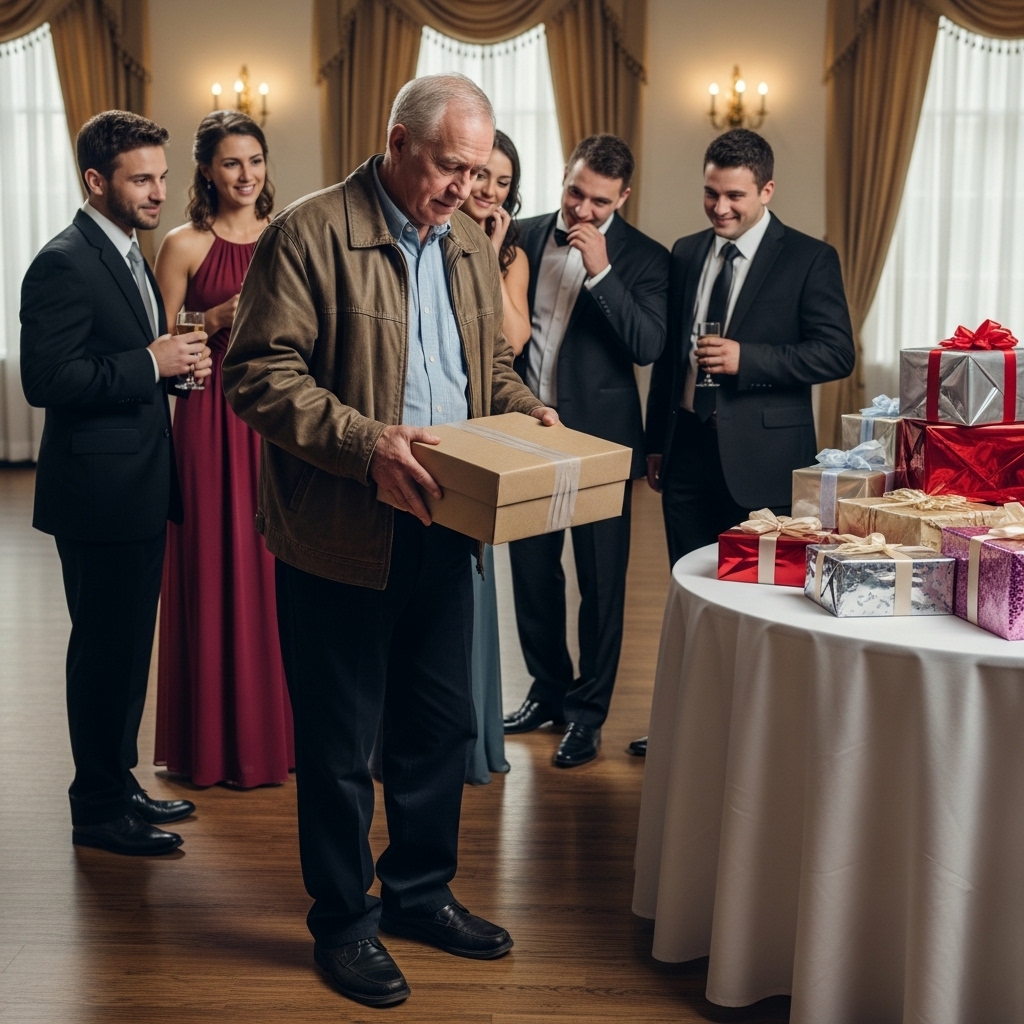
The man stood near the gift table, holding a plain brown paper box, the kind you might carry leftovers home in. No ribbon. No glossy wrapping. Just a strip of clear tape holding the lid together.
Around him, the wedding hall shimmered—crystal glasses, silk dresses, polished shoes. Gifts stacked high on the table sparkled with gold lettering and luxury brand logos.
Someone leaned in and whispered, “Is that… it?”
Another voice followed, quieter but sharper. “That’s embarrassing.”
The man didn’t rush. He didn’t apologize. He waited for the bride and groom to finish greeting other guests, standing awkwardly to the side, the box cradled carefully in both hands.
To the room, he looked out of place.
His jacket was old. His shoes scuffed. His hair neatly combed, but the kind of neat that comes from habit, not wealth.
A bridesmaid glanced at the box and raised an eyebrow.
“That’s his gift?” she murmured.
The groom’s cousin smirked. “Guess not everyone understands wedding etiquette.”
The man finally stepped forward.
He placed the box gently on the table, aligning it with the others as if it mattered just as much. His hands lingered a second longer than necessary, fingers pressing lightly on the lid.
Then he stepped back.
No card was visible.
No envelope.
Just the box.
The bride noticed it then.
Her smile faltered for half a breath—barely noticeable, but enough.
She said nothing. She nodded politely. But her eyes flicked to the groom, then back to the table.
The judgment was instant.
Cheap.
Thoughtless.
An obligation guest who didn’t care enough to try.
The man turned to leave the table.
Behind him, someone laughed again.
Dinner unfolded as expected.
Wine poured. Stories shared. Plates cleared. The gift table remained untouched, waiting for later, when the couple would open everything in private—or so everyone assumed.
The man took a seat near the back.
Alone.
He didn’t eat much. He watched instead. Watched the bride laugh. Watched the groom lean in to whisper something that made her smile wider. Watched the room celebrate a future he had already lived long enough to know was fragile.
A server passed by and offered dessert.
He shook his head.
Across the room, the brown paper box sat quietly among velvet bags and polished boxes. It looked smaller now. Almost apologetic.
But there were details people hadn’t noticed.
The way the tape had been reinforced twice.
The careful fold of the paper edges.
The faint handwriting on the bottom—numbers, dates, crossed out and rewritten.
The groom’s mother passed the table and paused.
She frowned—not at the box’s simplicity, but at the writing.
She leaned closer.
“Did you see this?” she whispered to her husband.
He shrugged. “Probably nothing.”
But she looked again.
The handwriting wasn’t sloppy. It was deliberate. The kind you write when you don’t want to make mistakes.
Later, as music softened and conversations grew looser, the bride excused herself and walked toward the table. She wasn’t planning to open gifts—just to move a few aside so staff could clear space.
Her hand brushed the brown box.
It was heavier than it looked.
She froze.
She lifted it slightly.
Set it back down.
Her smile faded.
She glanced around, then crouched to look closer, her dress pooling around her knees. On the bottom corner, written faintly in blue ink, were three words:
“For your foundation.”
She straightened slowly.
The groom noticed her expression and approached. “What is it?”
She shook her head. “I don’t know.”
They exchanged a look—confusion, then curiosity.
The groom picked up the box.
It didn’t rattle.
It didn’t shift.
Whatever was inside had been packed with intention.
A nearby guest noticed them holding it.
“Opening gifts already?” someone joked.
The groom smiled politely, but his attention stayed on the box.
“Do you know who brought this?” he asked.
Silence.
People scanned the room.
Someone shrugged. Someone else laughed awkwardly. “Probably someone who didn’t want to be noticed.”
The bride’s gaze drifted to the back of the hall.
To the man sitting alone.
He felt it.
He always did.
He looked up just as their eyes met.
For a brief moment, his expression changed—not defensive, not ashamed.
Resolved.
He nodded once.
That was all.
The groom swallowed.
He carried the box to a quiet corner, away from the noise. The bride followed. Her hands trembled as she reached for the tape.
“Maybe we should wait,” she whispered.
The groom shook his head. “No. I think… I think we’re supposed to open it.”
He peeled the tape carefully.
The lid lifted with a soft sound.
Inside was not money.
Not cash.
Not a check.
Inside were documents.
Neatly stacked. Bound. Labeled.
At the top: a folder stamped with an old seal.
The bride blinked. “What is this?”
The groom flipped the first page.
His face drained of color.
Slowly, conversations around them faded—not because people were being quiet, but because something about their stillness demanded attention.
The groom looked up, eyes wide.
“This isn’t a gift,” he said hoarsely.
“It’s… proof.”
The bride’s breath caught.
People leaned in.
Someone whispered, “Proof of what?”
The groom didn’t answer.
He turned another page.
And another.
Each one heavier than the last.
Across the room, the man lowered his eyes again.
He had known this moment would come.
He had also known what it would cost him.
The groom sat down slowly, as if his knees had forgotten how to work.
He stared at the papers again.
Then again.
The bride leaned closer, her hand hovering over the pages, afraid to touch them—afraid they might disappear if she did.
“What is it?” she whispered.
The groom swallowed hard. “It’s the house.”
Silence tightened around them.
“The old foreclosure,” he continued, voice unsteady. “The one that almost went through five years ago. The lien. The back taxes. The mistake in the filing that no one could fix.”
He turned to the next document.
“All corrected. All cleared.”
The bride covered her mouth.
The guests nearby had stopped pretending not to listen.
“This says…” the groom paused, disbelief cracking through his words, “this says the property was transferred into a trust. Our names.”
A sharp breath moved through the room.
The bride looked up, eyes searching—until they found the man at the back.
He hadn’t moved.
He sat exactly where he was, hands folded, head slightly bowed, as if he were waiting for the noise to pass.
The groom stood.
“Everyone,” he said, louder now. “Please—give us a moment.”
No one did.
They watched.
The groom walked across the room, the documents clutched to his chest. The bride followed, dress brushing the floor, eyes never leaving the man.
When they reached him, the groom stopped.
“You did this,” he said—not accusing. Awed.
The man nodded once.
“I didn’t want it announced,” he said quietly. “It’s your wedding.”
The bride shook her head. Tears spilled freely now.
“You paid off our house?” she asked.
The man looked at her then. Really looked.
“I paid off a promise,” he said.
The room leaned in.
“I was your father’s apprentice,” the man continued. “Back when he still had both knees and a laugh you could hear down the street.”
The bride froze.
“He taught me the trade,” the man said. “When he got sick, he trusted me with his work. When he passed, he trusted me with you.”
A murmur rippled—recognition dawning.
“I watched you grow up,” he said gently. “Watched you struggle to keep that house when everything went wrong. I knew you wouldn’t ask.”
He glanced at the papers. “So I didn’t wait.”
The groom’s voice broke. “Why didn’t you tell us?”
The man smiled faintly.
“Because gifts aren’t supposed to make noise,” he said. “They’re supposed to hold.”
The bride stepped forward and hugged him.
It wasn’t planned. It wasn’t graceful.
It was necessary.
The room erupted then—not with laughter, not with whispers—but with applause that carried regret.
People who had mocked the box looked down.
People who had laughed earlier wiped their eyes.
The brown paper box, once dismissed, now felt too heavy for shame.
Later, when the music softened and the night leaned toward quiet, the man slipped outside.
He stood under the string lights, breathing in the cool air, the noise inside finally distant enough to let his thoughts settle.
The bride found him there.
She didn’t bring the papers. She didn’t bring words.
She brought two glasses of water.
“Stay,” she said simply.
He nodded.
Inside, the brown paper box sat empty on the gift table—creased, worn, honest.
No one touched it.
They didn’t need to.
Because everyone in that room had learned something they hadn’t expected to learn that night:
That value doesn’t shine.
That love doesn’t announce itself.
That some gifts are wrapped in silence.
As the last dance ended and the lights dimmed, the groom raised his glass.
“To the man who brought us a future,” he said.
The man lowered his eyes, uncomfortable with praise.
But he smiled.
Just a little.
What do you think—how many times have we judged a gift before understanding the heart behind it?
Share your thoughts in the comments below.