Part 2: The Biker Brought Flowers Weekly — But Never Only To His Wife
I didn’t know Russell Kane’s name the first month.
To me, he was just “the biker with two bouquets.”
Cemetery workers give people names before we learn their real ones. The blue-coat widow. The man with the folding chair. The teacher who reads out loud. The kid who brings Matchbox cars. It helps us remember where grief belongs without asking questions that might split somebody open.
Russell came every Friday.
Same time. Same bike. Same two bouquets.
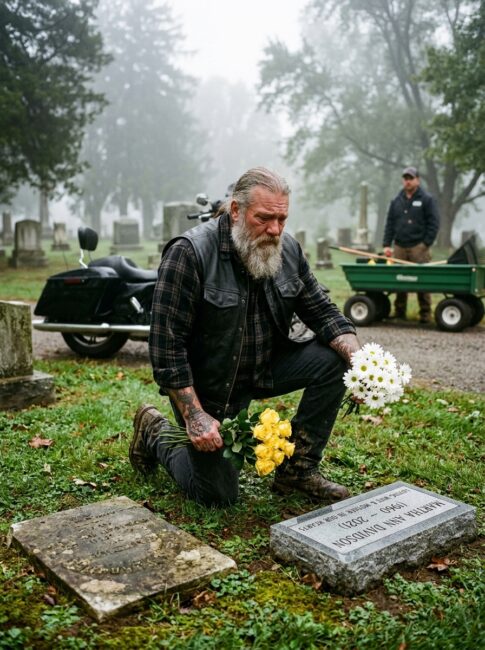
Yellow roses for Maggie. White daisies for the grave beside her.
His Harley would turn in from Cemetery Road, chrome dull under river mist, engine thumping low enough to rattle the loose chain on our maintenance shed. He never revved it. Never showed off. He killed the motor before he got close to the stones, then pushed the bike the last few yards if a funeral was happening nearby.
That was the first thing that didn’t fit the way people looked at him.
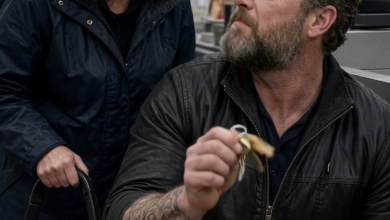
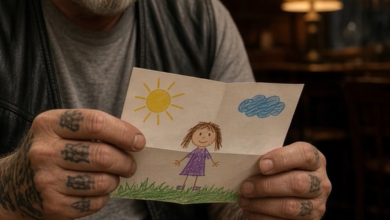
Everything about Russell said rough. His leather cut was worn soft at the shoulders but still looked like armor. He had a faded club patch on the back with the letters too cracked to read unless you stood close. His knuckles were swollen from age and work. One tattoo across his wrist looked like barbed wire. Another, on the back of his hand, was a small sparrow carrying a wrench.
The sparrow made no sense to me.
Neither did the way he trimmed the grass around that nameless grave with pocket scissors.
Men like Russell usually don’t kneel easy. The body gets older. Knees start talking back. Pride gets louder than pain. But every Friday, he would kneel in the damp grass, clean Maggie’s stone first, then the blank marker beside it. He used a soft toothbrush for the grooves. He carried a little bottle of water in his saddlebag. In winter, he brushed snow away with his bare hand even when his fingers turned red.
I asked around town.
Marietta is the kind of place where people know a man’s story even when they pretend they don’t. Russell had run Kane’s Auto & Small Engine Repair off Pike Street for almost thirty years. Before that, he had been trouble. Not movie trouble. Real trouble. Drinking too much. Fighting too fast. Sleeping in the back room of garages. Getting fired for his mouth. Losing friends to roads and bottles and bad nights.
Then he met Maggie.
She worked mornings at a diner near the old bridge, poured coffee like she was doing you a favor, and had a laugh people could hear over the kitchen fan. Russell came in one winter with busted hands and a busted lip, ordered black coffee, and said nothing for forty minutes.
Maggie refilled his cup anyway.
The story goes she told him, “You can sit there bleeding on my counter, or you can let somebody be kind without making it a fight.”
He married her three years later.
She was the reason he got sober. He would never say she saved him. Bikers don’t like sounding rescued. He said, “She held the flashlight while I crawled out.”
They had no children. Not for lack of wanting. That was another quiet grief, the kind nobody brings casseroles for after the third doctor says no.
So Russell built family where he could. His riding brothers. The kid who swept his shop after school. The widow whose lawnmower he fixed every spring and never billed. The old men at the diner who pretended they came for coffee but really came because Russell would listen without giving advice.
Still, every Friday, it was Maggie and the stranger.
Yellow roses. White daisies.
One morning in late October, I noticed something tucked behind the nameless marker.
A tiny wooden train.
Hand-carved. Painted blue. Weathered almost gray.
When Russell saw me looking, he picked it up, wiped mud off the wheels, and put it back carefully.
“Was that there before?” I asked.
He shook his head.
“I leave one every November.”
“For who?”
He didn’t answer.
His eyes stayed on the blank grave.
That was the second thing that didn’t fit.
A man who looked like he could scare a bar quiet was leaving toy trains for someone whose name he didn’t know.
The first time Russell missed a Friday, the cemetery felt wrong.
That sounds dramatic. It was just one man with flowers. But routine matters in places like that. It lets the dead keep time. It lets the living pretend love has a schedule.
At 8:10, no Harley.
At 8:30, still nothing.
By nine, the fog had lifted off the river and the gravel road was empty. I kept looking toward the gate while pretending to trim around the veterans’ section.
Russell had never missed. Not in rain. Not during snow. Not even the summer the heat index hit a hundred and the asphalt near the chapel went soft under the funeral home tires.
At ten, a black pickup pulled in.
Two bikers climbed out.
One was a Black American man in his late sixties, short, broad, with silver hair under a red bandana and a limp that made his chain wallet tap against his thigh. The other was a White American woman around fifty-five with braided gray hair, a denim jacket, and hands that looked like they had changed tires in the dark more than once.
The man carried yellow roses.
The woman carried white daisies.
They walked straight to Maggie’s grave.
“Morning,” I said.
The man nodded. “You the groundskeeper?”
“One of them.”
“Russell asked us to cover.”
“Cover?”
He lifted the flowers slightly. “He don’t miss.”
That was how I learned Russell was in the hospital.
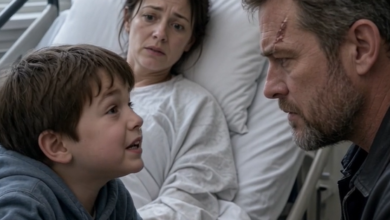
Heart trouble. Nothing theatrical. No crash. No bar fight. Just an old body that had carried too much for too many years deciding to make noise in the middle of the night.
His club brothers found him because he didn’t show up at the diner for breakfast. Bones — the Black biker with the red bandana — said Russell had one hand on his chest and the other around a note written on the back of a parts invoice.
Maggie first. Stranger second.
That was all the note said.
The woman with the braid was named Carol. She laid the yellow roses at Maggie’s stone. Bones placed the daisies on the nameless grave. Neither one rushed. Neither one looked embarrassed. They did it like a church service.
“Y’all know whose grave that is?” I asked.
Bones shook his head.
“Nope.”
“But you bring flowers anyway?”
Carol looked at me like I had asked why water was wet.
“Russ does.”
That was brotherhood, I guess.
Not loud. Not pretty. Not the kind people print on T-shirts.
A man is too sick to ride, so his brothers bring flowers to a stranger because his love has chores.
The false climax came two weeks later.
Russell returned.
He rode in thinner than before, wearing a hospital bracelet tucked halfway under his sleeve and walking like each step had a bill attached. His beard had been trimmed short. His face looked older. The Harley sounded the same, but he didn’t.
I wanted to tell him he should be home resting. Everybody wants to boss sick people around because helplessness makes us rude.
Before I could say anything, he opened his saddlebag and pulled out two bouquets.
Yellow roses.
White daisies.
His hands trembled.
Not much. Enough.
He made it to Maggie’s grave, set her flowers down, and lowered himself slowly. His breath caught halfway, but he waved me off before I moved toward him.
“Don’t,” he said.
That one word had gravel in it.
So I stood there useless, rake in hand, while he cleaned Maggie’s stone.
Then he turned to the nameless grave.
His hand shook harder when he tried to brush leaves off the marker. One leaf stuck in the wet mud near the sunken edge. He picked at it with two fingers and couldn’t get it loose.
I stepped forward.
This time he didn’t stop me.
I pulled the leaf free.
Russell stared at that blank marker.
Then, for the first time in twelve years of coming there, the big biker with tattoos on his hands and a skull on his vest put his palm flat on the nameless grave and whispered, “Sorry, kid. I’m running late.”
Kid.
That word changed everything.
I went to the office after Russell left and pulled the old burial map.
I shouldn’t have.
Cemetery people are supposed to respect privacy. But that grave had become a question under my skin, and Russell saying “kid” made it impossible to leave alone.
Section C, Row 14, Plot 22.
The record was thin. Older than our digital system. Scanned from paper. A child burial from 1958. No headstone purchase recorded. No surviving contact listed. The name field had been damaged by water years ago, but part of it remained.
Baby Boy H——
The rest was gone.
Age: approximately 3.
That was all.
Not even a full name.
A child had been buried beside where Maggie would be laid decades later, and time had rubbed him nearly out of the world.
I didn’t tell Russell at first. I didn’t know how. What do you say? Congratulations, the stranger you’ve been loving for twelve years was a toddler? Sorry, the grave was sadder than you thought?
A week later, I found him sitting on the bench near Maggie’s row, drinking gas station coffee from a paper cup. His Harley was parked under an oak tree, leaves collecting on the seat. The engine clicked as it cooled. The whole place smelled like wet grass, oil, and woodsmoke from somebody’s chimney beyond the fence.
“I looked up the grave,” I said.
He didn’t turn.
“Figured you would.”
“You knew it was a child?”
Russell nodded once.
“How?”
He took a slow breath. “First day Maggie was buried, I sat here until dark. Everyone left. Funeral home. Pastor. Her sisters. Club. Everybody.”
His voice stayed flat, but his fingers tightened around the coffee.
“I was mad. Not at God. Not at Maggie. Just mad that the whole world kept moving. Cars on Route 7. Barges on the river. Kids getting out of school. I wanted everything to stop because my wife had stopped.”
He looked toward the nameless marker.
“Then I saw that little grave beside her. No flowers. No stone. Just a sunken patch of dirt. Looked like nobody had said that child’s name in fifty years.”
He swallowed.
“Maggie hated lonely things.”
That was the twist, but not all of it.
Russell reached into his vest and pulled out a folded napkin. It had been unfolded and refolded so many times the edges had gone soft. On it was Maggie’s handwriting.
Blocky. Practical. Diner-waitress handwriting.
Don’t let grief make you mean.
“She wrote that the week before she passed,” he said. “Cancer had her down to skin and stubbornness. I was mad at nurses, doctors, weather, soup, everything. She told me if I couldn’t be gentle with the living, I could at least be gentle with the dead.”
He folded the napkin again.
“So I made a rule. Nobody lies next to my Maggie and gets forgotten.”
He said it like a shop policy.
Like changing oil every 3,000 miles.
Like locking the front door at night.
Not like the most tender thing I had ever heard from a man who looked carved out of bad decisions.
“And the trains?” I asked.
Russell’s jaw tightened.
“Boy should have toys.”
“He was three.”
“Then he definitely should have toys.”
He stood up slowly, knees cracking, leather vest creaking.
“That all?”
It wasn’t. But men like Russell give you a door and close it fast.
So I nodded.
He rode out five minutes later, taillight red in the gray afternoon, and I stayed by the nameless grave longer than I meant to.
The next day, I posted a small photo on the cemetery’s community page.
No names. No face. Just two bouquets side by side.
I wrote: “For twelve years, a local man has brought flowers not only to his wife, but to the forgotten child buried beside her.”
I thought maybe a hundred people would read it.
By Sunday night, half of Washington County had shared it.
By Monday morning, my phone rang.
An elderly woman on the other end was crying so hard I could barely understand her.
“Is the grave beside Margaret Kane marked with a little blue train?” she asked.
Her name was Evelyn Harlan.
She was eighty-two, White American, from Parkersburg, across the river in West Virginia. Her daughter drove her to Riverview Cemetery in a beige Buick that looked as old as some of our map cabinets. Evelyn stepped out holding a black-and-white photograph in both hands.
She was small. Not fragile exactly. More like a woman who had been carrying weight so long her body had shaped itself around it.
Russell arrived ten minutes later.
I hadn’t called him. Bones had. Brotherhood travels faster than office phones.
His Harley came through the gate soft and low. He parked farther away than usual, maybe to give her space, maybe because he didn’t know where to put himself in a moment like that.
Evelyn walked to Maggie’s grave first because that was where the flowers were easiest to see.
Yellow roses.
White daisies.
A fresh blue train beside the nameless marker.
She saw it and made a sound I have never forgotten.
Not a scream. Not a sob.
Recognition.
Her daughter reached for her, but Evelyn lowered herself to the ground before anyone could stop her. She pressed the photograph against her chest and touched the blank marker with her other hand.
“Tommy,” she said.
The name did what stone had failed to do.
It gave the grave back its shape.
Tommy Harlan had been her little brother. Three years old. Died in 1958 from a fever that turned fast, back when their family lived near the river and money was something adults whispered about in kitchens. Their father worked barges. Their mother cleaned houses. There had been a funeral, but no proper stone. Temporary marker. Promises to come back when money got better.
Then the family broke apart in the way poor families sometimes do after a child dies. Her father left. Her mother moved them to West Virginia. Records got lost. Last names shifted through marriages. Evelyn grew up, had children, buried a husband, and spent most of her life believing she had failed her brother because she couldn’t find the exact grave again.
“I looked,” she told us, still kneeling. “Years ago, I looked. They told me records were damaged. I thought he was alone.”
Russell stood a few feet away, hands open at his sides.
He looked uncomfortable. Almost guilty, which made no sense until I realized kindness can feel like trespassing when the rightful family returns.
Evelyn turned and saw him.
The biker who had been bigger than doorways suddenly looked like a boy caught touching something sacred.
“I’m sorry,” he said.
Those were the first words he gave her.
Evelyn blinked up at him. “For what?”
“I didn’t know his name.”
She looked at the daisies. The train. The trimmed grass. The clean marker. The place beside Maggie that had never been empty because Russell refused to let it be.
Then she reached for his hand.
Russell hesitated.
His hands were scarred and tattooed, oil buried in the lines no soap ever fully reached. Evelyn’s hands were thin, blue-veined, trembling.
She took one anyway.
“You were family for us,” she said. “For twelve years, you were family for us.”
Russell’s face did not break the way people expect faces to break in stories.
He didn’t cry hard. Didn’t fall to his knees. Didn’t give a speech about love or healing.
His eyes went wet, and his mouth tightened like he was holding a wrench between his teeth.
He looked down at the grave.
“Tommy,” he said.
One word.
That was enough.
Evelyn’s daughter showed us the photograph. A little boy in overalls, dark hair sticking up, one hand gripping a wooden train. Behind him stood Evelyn at maybe six years old, squinting in sunlight.
The train was not a symbol Russell invented.
It had been true all along without him knowing.
That was the part that made all of us go quiet.
For twelve years, he had left the right toy on the right grave because grief had taught him to guess gently.
Russell looked at the photo, then at the little blue train he had placed that week.
“Guess he liked trains,” he said.
Evelyn laughed through tears.
“He wouldn’t sleep without one.”
Russell nodded like that settled something.
The next week, a real stone was ordered.
Not fancy. Russell argued against fancy, and Evelyn agreed. A small marker, clean and simple.
Thomas “Tommy” Harlan.
Beloved Brother.
A few days before it was installed, Russell came by alone and removed the old blue train from the dirt. He wiped it clean with his bandana and handed it to Evelyn when she arrived.
She tried to refuse.
He shook his head.
“His sister should have it.”
She held it like a relic.
Then she gave him the photograph.
“Maggie should know who’s beside her,” Evelyn said.
Russell tucked it inside his vest, behind Maggie’s napkin.
A child’s photo next to a dead wife’s handwriting.
That was his chapel.
After Tommy got his stone, Russell still came every Friday.
People assumed he would stop. That the mystery was solved, the family found, the duty finished.
They didn’t understand Russell.
He brought yellow roses for Maggie and white daisies for Tommy. Every November, he still brought a wooden train, though now he set it carefully between both stones, where the grass made a small green bridge.
Evelyn came once a month until winter made the drive hard. Sometimes she brought cookies in a tin. Russell always said he didn’t need cookies. Russell always took the tin.
Bones and Carol started coming on Maggie’s birthday. The rest of the club joined the second year after the story spread. Not many. Six or seven bikes. They parked outside the cemetery gate and walked in, helmets under their arms, boots quiet on the grass.
No speeches.
Just presence.
The first time they came, a young mother visiting another grave pulled her little boy closer when she saw them. I understood. I had done my own version of that the first time I saw Russell. Leather and tattoos carry stories people think they can read from a distance.
Then Russell knelt with his pocket scissors and trimmed around a child’s headstone.
The mother stopped pulling.
Her son asked, “Why is that big man cutting grass with tiny scissors?”
She said, “I don’t know.”
Russell heard and looked over.
“Small job,” he said. “Small scissors.”
The boy accepted that.
Kids usually understand Russell faster than adults do.
Over time, Tommy’s grave changed. Not into a shrine. Russell would have hated that. But into a place that looked remembered. Daisies. A train. Sometimes a little flag because Evelyn said Tommy liked parades. Once, a toy car showed up from a stranger who had read the story online and driven two hours to leave it.
Russell removed the car after a week and placed it in our cemetery office.
“Trains,” he said. “Kid likes trains.”
That was Russell. Tenderness with rules.
Every Friday, after flowers, he would sit on the bench and drink bad gas station coffee. Sometimes he talked to Maggie. Sometimes to Tommy. Usually he said almost nothing.
Once I heard him mutter, “She keeping you in line, kid?”
The wind moved through the oaks.
Russell nodded.
“Yeah. Figured.”
When his knees got worse, Bones offered to take over trimming.
Russell said no.
When his hands got stiff, Carol brought bigger-handled scissors.
Russell accepted those without thanks, which meant he was grateful.
The Harley aged too. More scratches. More dull chrome. A little blue train sticker appeared on the left saddlebag. Next to it, a yellow rose decal.
I never asked who put them there.
Some questions are better left riding.
The last time I saw Evelyn and Russell together, the river was high and the morning smelled like rain.
She was eighty-five then, moving slowly with a cane. Russell was sixty-four, moving like a man made mostly of stubbornness. They met at Maggie and Tommy’s stones under a sky the color of old tin.
Evelyn brought daisies.
Russell brought roses.
They stood there side by side, not talking much. Two people connected by a woman one had loved and a child the other had lost, with twelve years of flowers laid between them like a bridge.
Evelyn touched Tommy’s name.
Then she touched Maggie’s.
“She must have been something,” she said.
Russell looked at his wife’s stone.
“Yeah.”
That was all he could manage.
Before Evelyn left, she placed one hand on Russell’s leather sleeve.
“Thank you for not letting him be alone.”
Russell looked down at the graves.
“He wasn’t,” he said. “Maggie was there.”
The rain started after she drove away.
Russell stayed.
He put on his helmet, then took it off again. Bent down slow. Adjusted the daisies so they didn’t lean into the mud. Brushed one oak leaf from Maggie’s name. Set the little wooden train between them, wheels facing the river.
Then he walked back to the Harley.
His boots crunched on gravel. His leather vest creaked. The old Road King started with that low V-twin heartbeat that made the cemetery windows tremble.
He sat there a moment, looking at the two stones.
Wife.
Child.
Both remembered.
Then he rolled down the hill toward Route 7, taillight red through the rain, engine fading along the river road.
The daisies stayed white.
Follow the page for more biker stories that reveal the heart behind the leather.