The Old Woman Was Told She Was “Too Poor” to Sit in the Front Pew at the Millionaire’s Funeral — Until the Lawyer Read Who He Married First
PART 1
By the time Robert Hale’s daughter realized what the old woman had picked up from beneath the front pew, she’d already told half the people around her why the woman belonged in the back.
Doris held the blue handkerchief by two corners. A little gold pin had caught in the hem. She knew how easily the clasp could bend. She’d fixed one just like it with the tip of a nail file and a pair of tweezers years ago.
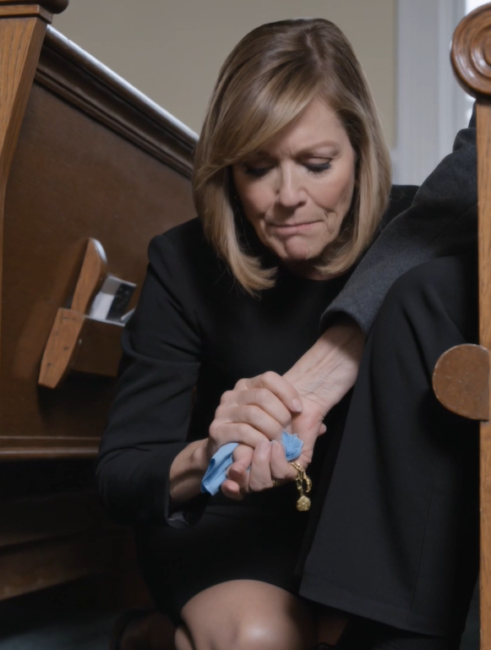
Elaine reached for it. Her hand was shaking. Doris put two fingers beneath her wrist and waited until she had a good grip. From the aisle, it could have looked like one woman helping another with a loose button.
“You dropped it when you stood up,” Doris said.
The man behind Elaine looked down at his program. He’d done the same thing a minute earlier, when Elaine had told Doris to look for a seat in the back.
Doris let go of the wrist. The pin turned in Elaine’s palm, and for an instant she could see the little torch stamped into the gold. She wondered how many years Robert had let Elaine believe that pin had always belonged to her mother.
PART 2
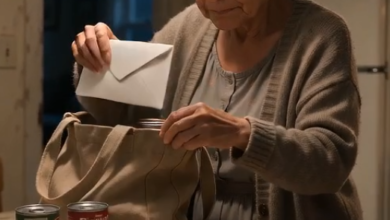
That morning, Doris had polished her shoes over the grocery circular at her kitchen table. She’d glued the left sole down the night before and weighted it with a can of tomatoes. In daylight the repair showed. She pulled on her charcoal wool coat anyway, pinned her silver hair at her neck, and walked to the bus stop.
She was eighty-two. On days when the first bus ran late, she had to cross two lanes on a short light to make her connection. She let the second bus go rather than hurry and waited another twenty minutes in the cold. By the time she reached Grace Street Chapel in Erie, the ushers had brought out folding chairs.
A woman at the door handed her a program and asked how she’d known Robert. Doris slipped her transfer into the fold.
“A long time ago,” she said.
The woman took that for an answer. People usually did.
Inside, there was a photograph of Robert in a cap and gown. Doris had the same picture in a kitchen drawer, in an envelope with a paycheck stub and a key that fit a door long since replaced. She knew what was outside the frame. The photographer had asked her to move her paper lunch sack off the wall before he took the picture.
In the printed program, beneath that photograph, were the names of Robert’s schools, the company he’d started, and the foundation he’d funded after selling it. There was a line about Ruth, who’d died three years earlier, and another about Elaine, their only child. The program called Robert and Ruth’s marriage the beginning of his family.
Doris took out the pencil she used for her grocery list. In the margin by the graduation photograph, she wrote Doris Mercer, the name she’d been born with. Then she put the pencil away. She had meant to leave the program in the rack by the door when she went home. She didn’t know yet why she wanted that name to go with it.
At the front of the chapel there was an empty seat by the aisle. Doris had chosen it because she could brace her hand against the pew to lower herself. Before she could sit, a woman slid a black handbag into the space.
Doris recognized her from the obituary. Up close, Elaine had Robert’s habit of pressing her lips together before she said something she’d already decided.
PART 3
“Family and major donors up front,” Elaine said.
She was fifty-five, with a dark blond bob and a plain black dress. All morning she’d been moving relatives around to make sure her father’s oldest friends had places they could reach without climbing over anybody. Her daughter Anna had told her twice that Uncle Paul’s flight was canceled. Elaine had kept his seat anyway.
Doris looked at the handbag. “I just need the end.”
Anna started to say that Paul wasn’t coming. Elaine leaned toward her daughter and lowered her voice just enough to make it clear she thought she was being discreet.
“She’s too poor to be on the donor list, Anna. Look at her shoes.”
A man in the second pew lowered his program. Two women across the aisle turned toward each other. One gave a short, surprised laugh. The other stared straight ahead.
Doris took her hand off the wood. She could feel the little pull at the toe of her left shoe as she turned. She hoped the glue would hold until she got home. It was easier to think about that than to look at Anna, who had gone red from her collar to her ears.
“There’s room in the back,” Elaine said.
Doris could have said Robert’s name the way she used to say it when he fell asleep over a textbook and she needed him to get up so she could turn off the lamp. She could have told Elaine what had been in the pocket of that graduation gown. The woman was about to bury her father. Doris kept walking.
Then she saw a blue corner sticking out beneath the pew. She braced herself against the wood again and bent down. When she lifted the handkerchief, something small and gold knocked against the floor.
Elaine heard it. Her hand went straight to the empty pocket of her dress.
PART 4
“Is this yours?” Doris asked.
Elaine reached too fast. The pin slipped against her thumb, and Doris steadied her wrist until she could close her fingers around it. Elaine’s skin was cold.
“It was my mother’s.”
Doris had been close enough to see that the clasp was still bent slightly inward. Robert had caught it on his graduation gown, then asked her to take it off before he tore the fabric. She’d bought the pin with tip money because she couldn’t afford the class ring he wanted. She had paid for it in three installments at the bookstore.
She could have asked how Ruth came to have it. She folded the handkerchief around the pin instead so it would stay put.
Anna followed her down the aisle. At twenty-four, she had inherited her grandfather’s straight brown hair and none of his ease with a room full of people. She fiddled with the bottom button of her black cardigan before she spoke.
“Would you mind if I sat here?”
Doris moved her coat. Her bus transfer fell, and Anna picked it up. When she put it back inside the program, she saw the name penciled next to the graduation photo. She looked at Doris and then at the picture. Doris knew the moment the girl decided to ask. She was grateful when the organ started first.
Through the first hymn, Elaine sat with her handbag in the empty place. During the second, she lifted it onto her lap. She kept the handkerchief in her right hand, and when Anna looked up front, her mother was turning the pin over through the cloth, feeling for the shape of it.
The last hymn ended. Elaine got up and went to Helen Brooks, the lawyer who’d handled her father’s affairs. She’d asked Helen that morning to skip the personal note Robert had left for the service.
Now she asked to see it.
PART 5
Anna stayed with Doris while the pastor thanked the choir. The man who’d lowered his program came down the aisle to leave. He stopped by their pew, took one look at Doris’s knees pressed against the wood, and moved a folding chair out of the way so she’d have a clear path when it was her turn.
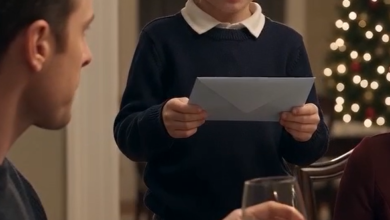
At the front, Helen pulled a page from a cream envelope. She was sixty-one, with short salt-and-pepper curls and a navy suit. She’d told Elaine before the service that she could read just the paragraph thanking the people from the company. There was a separate section Robert had specifically asked her to share if Doris came and agreed to it.
Elaine read the page twice. Then she looked at the empty seat beside her handbag.
“Go ahead,” she said.
Helen carried the page down the aisle. Doris recognized her from a visit to her apartment three weeks earlier, when Helen had sat at the kitchen table and asked her about a date in June. Doris had fetched the envelope from the drawer. She’d made Helen wait while she found her glasses, though she could have told her the date without them.
“Is it all right if I read what we talked about?” Helen asked.
Doris glanced at Elaine, who still had the handkerchief in her fist. Then she nodded.
Anna leaned closer. “Did you know him in college?”
Doris looked down at the graduation photo. “He had a dollar in his pocket the day that was taken.”
At the lectern, Helen opened the envelope. A few people near the doors stopped putting on their coats. She began to read, and Anna heard her grandfather say, in words he’d left on a sheet of plain paper, that he’d had one dollar in his pocket the day he graduated.
Anna looked again at the name beside his picture.
PART 6
The dollar was bus fare. Doris had pressed it into Robert’s palm before the photograph because she had to be at work and couldn’t drive him home. Her shift started at four. Afterward, she’d change aprons and go to the hospital laundry. She’d worked both jobs for three years while he finished college.
The graduation picture was the one he’d used in company brochures. In the uncropped print, a woman’s hand rested on the stone wall beside him. Doris wore her work apron under her coat that day. The photographer had caught one of its strings, too.
Helen read a little farther. Robert’s first business, the one people in the chapel had heard him describe as started with fifty dollars and a borrowed toolbox, had needed a lease deposit. The deposit came from Doris. She’d saved the money to replace their refrigerator. The borrowed toolbox was hers, too. It had belonged to her father.
Elaine looked toward a retired man from the company’s first shop. He was studying the carpet. Years ago, he’d come to the house for supper and told Elaine that story about the fifty dollars. She’d put it in the program herself.
Robert had left after the shop landed its first large contract. He took the newer car and left Doris the apartment, the refrigerator that froze the milk, and a note saying he’d have papers sent. By the time she got word that he was with Ruth, he had moved across the state. A letter came from an attorney with a proposed agreement. Doris signed her copy in the break room at work and sent it back. Years later, Robert told her the divorce had gone through. She believed him.
Helen’s visit to Doris’s apartment had started with a different piece of paper. Robert had asked her to straighten out the records while he was still well enough to talk. The court file contained a petition and an order closing the case after it sat inactive. Helen had shown him both. He recognized the closing notice. He admitted he’d received it at the shop and put it in a drawer.
He’d told Ruth the divorce was final before their wedding. Then he’d told Doris the same thing.
There was one more person who’d asked about that first stretch of his life. When the company prepared its anniversary booklet, Ruth had noticed a woman’s hand at the edge of the original graduation photo. She’d written a question on the back. Robert tucked the picture away and gave the printer a cropped copy.
Helen had asked Doris whether she wanted to see that original. Doris already had one. In hers, Robert had written We made it across the back.
At the lectern, Helen reached the line where Robert had finally written out the name he’d kept out of the company history. She read the first few words, then stopped midway down the page.
The cream envelope lay open beside her hand. She looked up toward the back pew.
PART 7
“Mrs. Doris Hale, would you please come to the front?”
A man near the aisle stopped halfway into his coat. Somewhere behind Elaine, a program slid off a knee and hit the floor. Nobody reached for it.
Doris got her feet under her. Anna stood beside her and held out an arm. This time Doris took it.
Helen waited until they reached the front. Then she finished Robert’s sentence. Doris Mercer was the first woman he married. She had put him through college. He had left her as soon as his business began to make money. No divorce decree had ever ended their marriage. He’d known that when he let both women believe otherwise.
Elaine’s eyes went to the handkerchief. “Did my mother know?”
“About me, I think she knew some of it,” Doris said. “About the divorce, your father told her what he told me.”
Elaine moved the handbag. Her mouth worked for a second before anything came out.
“I’m sorry I made you walk to the back.”
Doris sat down. After a moment she slid over so Elaine could sit, too. Elaine set the gold pin between them on the bare wood.
Then she asked Anna to get something out of her coat pocket. “The letter with Mom’s handwriting.”
PART 8
Elaine had found the letter three days earlier, in the box where Ruth kept spare buttons. It was folded around the uncropped graduation picture. She’d brought it to the funeral thinking she might ask Helen about it afterward. She hadn’t understood who it was for.
Doris opened it on her lap. In the photograph, her twenty-year-old hand lay flat on the wall. She remembered pressing it there because it was cool and she’d burned her palm on a coffee pot that morning. She hadn’t remembered the apron string until she saw it again.
Ruth had written the letter on the back of a page from the anniversary booklet. On the printed side, Robert stood alone.
Elaine held one corner while Doris turned it over. The first line began Dear Doris. Under it was a sentence neither woman had expected.
I asked Robert whose hand that was, and when he told me, I asked him to find you. He said you were the one who wanted to be left out.
Doris looked up at Elaine. “Did he ever tell her I wrote back?”
If Doris’s story stayed with you, follow our page for more true-to-life stories about the lives families only learn to talk about years later.