A Grandmother Knocked on Our Garage Door — The Harley Inside Belonged to Her Dead Husband
The boy’s name was Mateo.
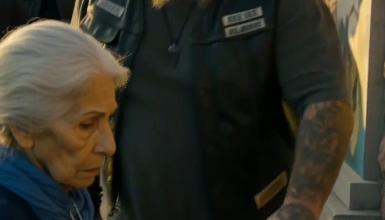
His grandmother, Elena Alvarez, lived in a small stucco house near Route 66, behind a tire shop and two blocks from a diner with a red neon sign that buzzed after sunset.
When I arrived the next afternoon, Mateo was sitting on the front steps with his hood pulled up, even though the Arizona heat still pressed against the pavement.
He looked thirteen and older than thirteen at the same time.
Thin shoulders. Sharp eyes. One sneaker tapping against the concrete. A phone in his hand. A guarded expression I recognized immediately.
I had worn that expression myself before Mateo was born.
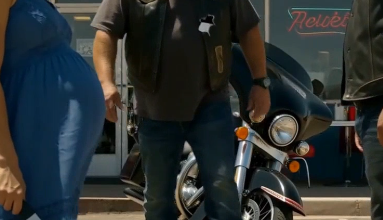
My Harley rolled to a stop at the curb with a low uneven pulse. I shut it down. The pipes cooled with small metallic clicks.
Mateo did not look impressed.
That helped.
Kids can smell a performance.
I took off my gloves and walked to the edge of the yard. My boots scraped lightly against the gravel.
“You Mateo?”
He did not answer.
“I am Rook.”
Still nothing.
I could see Elena through the screen door, pretending not to watch.
I did not mention school.
I did not mention the boys he had been running with.
I did not mention his father, his mother, the pastor, or the counselor.
I held up a ring of keys.
“I have an old bike at the garage,” I said. “Does not run.”
Mateo glanced at me once.
“I need somebody to clean parts, hand me tools, and keep the floor from turning into a landfill.”
He looked back at his phone.
“Twenty dollars each afternoon,” I said. “Cash. Two hours. You show up late, you lose five.”
That got his attention.
“Why me?”
“Your grandmother says you know how to work.”
“She says a lot.”
“Is she wrong?”
He shrugged.
I turned toward my bike.
“Tomorrow. Four o’clock.”
“What if I do not come?”
I pulled on one glove.
“Then I clean my own mess.”
The engine caught beneath me. The sound rolled down the block and bounced against the tire shop wall.
I did not ask for an answer.
The next day, at 4:11 p.m., Mateo walked into our garage.
He was eleven minutes late.
I handed him fifteen dollars at the end of the shift.
He stared at the bills.
“You serious?”
“You were late.”
“That is stupid.”
“Probably.”
He came back the next afternoon at 3:57.
The bike beneath the tarp was a faded black Harley touring model with dulled chrome, cracked leather, and dust packed into every seam. I had moved it into the center of the garage but left the brass key tag hanging from the handlebar.
Mateo ran one finger through the dust on the tank.
“This thing is dead.”
“Most things are not as dead as they look.”
He glanced at me.
“You always talk like that?”
“Only when I am trying to annoy teenagers.”
For the first week, he came for the money.
I know because he counted it twice before leaving.
The second week, he started asking questions.
The third week, he stopped checking the time.
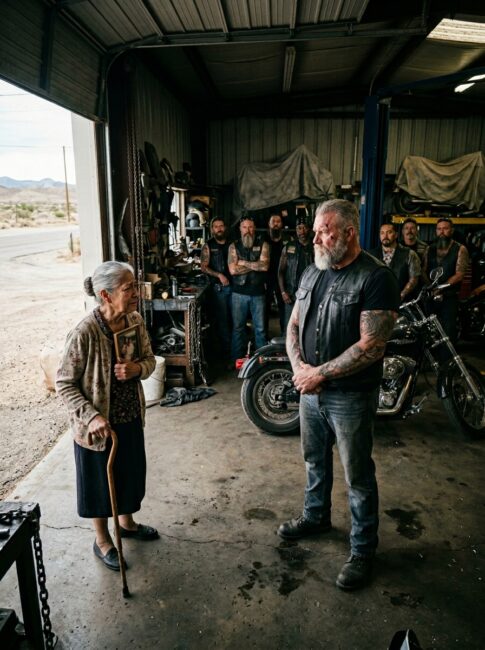
The club did not know what to do with Mateo at first.
Some of our guys had raised children. Some had lost contact with children. Some had never been trusted with anything more fragile than a torque wrench.
But they understood work.
That became the language.
June, our oldest rider, taught Mateo to place every bolt on a clean rag in the order it came off.
Rome showed him how to label small parts with masking tape.
Luis made him sweep the floor before leaving, even on days when it already looked clean.
“Why?” Mateo complained.
“Because tomorrow begins with whatever you leave behind today,” Luis said.
Mateo rolled his eyes.
Then he swept.
The garage had its own rhythm around him.
Metal clinked into trays.
Boots crossed concrete.
Leather cuts creaked when men leaned over workbenches.
A radio played old songs beneath the deeper sounds of engines turning over near the open bay door.
Mateo learned the smell of degreaser, hot coffee, old leather, and oil embedded in the floor after years of repairs.
He also learned that nobody chased him when he went quiet.
That mattered more than any speech.
One Thursday, he arrived with a bruise near his jaw.
I saw it.
The club saw it.
Nobody surrounded him.
Nobody demanded names.
I handed him a socket wrench.
“You safe at your grandmother’s house?”
He stared at the bike.
“Yeah.”
“Need anything?”
“No.”
I nodded.
“Tell me if that changes.”
That was all.
Ten minutes later, while he loosened a stubborn bolt, Mateo said, “Some guys got mad because I stopped hanging out.”
I kept sorting tools.
“People get loud when they lose control of somebody.”
He looked at me.
“You scared of them?”
“No.”
He waited.
I set down the wrench in my hand.
“But you should understand something. Being unafraid does not mean being careless. If someone threatens you, you tell your grandmother. You tell me. You tell an adult who can get the right help.”
“You mean cops?”
“If that is what keeps you safe.”
He did not answer.
But the next day, he brought his school backpack to the garage instead of leaving it somewhere else.
That felt like progress.
Then he disappeared for four days.
No call.
No text.
No Mateo.
Elena walked to the garage on the third afternoon. Her cane tapped faster than it had the first time.
“He is staying out late again,” she said. “He will not speak to me.”
I felt the old anger rise inside my chest.
Not anger at Mateo.
Anger at the machinery of it all.
A kid loses a father. A mother leaves. The wrong people offer belonging before the right people figure out how to reach him.
Twenty years earlier, I had been that kid in a grown man’s body.
I wanted to ride out and drag Mateo back by force of will.
But you cannot pull someone toward a life they have not chosen.
That night, I sat alone in the garage beside the half-restored Harley.
The tarp lay folded on a workbench.
The brass key tag turned slowly beneath my thumb.
RAY.
At 9:42 p.m., the side door opened.
Mateo stepped inside.
His hoodie was dusty. His face looked tired. He avoided my eyes.
I stayed seated on the shop stool.
“You done?” I asked.
“With what?”
“Running in circles.”
His jaw tightened.
“I do not need a lecture.”
“Good. I did not prepare one.”
Silence settled between us.
Outside, a truck passed along the service road.
Mateo looked at the bike.
“You going to fire me?”
“No.”
“Why?”
“Because the bike is not finished.”
He looked at the frame, the parts trays, the cleaned metal, the open space waiting for the next piece.
Then he picked up a rag.
That was the night I thought we had won.
I was wrong.
Two weeks later, Mateo found the photograph.
It had slipped from the back of an old service manual while he searched for a wiring diagram.
The picture landed faceup on the workbench.
Two men stood beside the same Harley fifteen years earlier.
One was younger me.
The other was Ray Alvarez.
Mateo stared at it.
The garage sounds continued around us for a few seconds. A wrench struck concrete. An engine turned over in the far bay. Somebody laughed near the coffee machine.
Then the room slowly quieted.
Mateo pointed at Ray.
“That is my grandpa.”
I nodded.
He looked at the bike.
Then back at the picture.
“This was his?”
“Yes.”
His expression changed.
“You knew?”
“Yes.”
“From the beginning?”
“Yes.”
The word came out harder than I intended.
Mateo took one step backward.
“So this whole thing was some setup?”
“No.”
“You paid me to fix my dead grandpa’s bike and did not tell me?”
“Yes.”
“That is messed up.”
“Probably.”
He threw the rag onto the bench.
“Why?”
I could have given him the clean answer.
I could have said the bike belonged to his family.
I could have said restoring it might help him feel connected to the grandfather he barely remembered.
All of that was true.
None of it was the reason.
I looked toward the photograph.
“When I was thirty-five, I was running with people who kept promising me respect and collecting pieces of my life in return.”
Mateo said nothing.
“I had been arrested. I was drinking too much. I had no steady work. I was angry at everybody, which usually means you are angry at yourself but do not have the guts to admit it.”
I tapped Ray’s face in the photograph.
“Your grandfather found me sleeping behind this garage.”
Mateo glanced around the room.
“He owned it?”
“He built it.”
I nodded toward the faded club sign outside.
“He started this club.”
Mateo looked at the old Harley again.
“Grandpa?”
“Your grandpa.”
I picked up the brass key tag.
“Ray did not preach at me. Did not threaten me. Did not tell me his life story.”
“What did he do?”
“He handed me a broom.”
Mateo blinked.
“I came back the next day because he paid me twenty dollars.”
For the first time that afternoon, Mateo looked directly at me.
“That is exactly what you paid me.”
“I know.”
Ray Alvarez was not a dramatic man.
He had thick hands, a narrow mustache, and a habit of drinking coffee long after it had gone cold.
He wore a black leather cut softened by years of weather. His boots squeaked slightly when the soles got wet. He never raised his voice unless an engine was running nearby.
The first day he found me behind the garage, I expected him to tell me to leave.
Instead, he pointed toward a broom leaning against the wall.
“Floor is dirty,” he said.
I laughed because I thought he was joking.
He was not.
“Twenty dollars,” he said. “Two hours.”
I needed money.
That was the beginning.
For weeks, Ray asked me to sweep, clean parts, hold flashlights, and fetch tools. He did not ask why I looked exhausted. He did not ask where I went after dark. He did not tell me I was wasting my life.
He put work in front of me.
Work became routine.
Routine became a place to stand.
One night, I arrived with blood dried beneath one nostril and my left hand swollen from a fight I should have avoided.
Ray looked at me for a long time.
Then he handed me an ice pack wrapped in a shop towel.
“You want out?” he asked.
I knew what he meant.
I stared at the floor.
“Maybe.”
Ray nodded toward the half-disassembled Harley on the lift.
“Maybe does not turn bolts.”
That was all he said.
The next morning, I came back.
Over time, I stopped returning calls from people who only needed me when trouble needed company.
Ray gave me more shifts.
The club gave me a place at the workbench.
Nobody pretended the change happened cleanly.
It did not.
I slipped.
I lied.
I disappeared twice.
Ray never chased me.
But whenever I returned, the broom remained in the same corner.
Years later, when I finally earned my cut, Ray handed it to me without a speech.
“Do not wear this to look important,” he said. “Wear it when somebody needs you to show up.”
Ray died fifteen years before Elena walked into our garage.
After the funeral, we rolled his Harley beneath a tarp and placed it in the back corner.
Nobody voted to sell it.
Nobody volunteered to ride it.
Some things do not need rules.
They simply wait.
Mateo stood beside the old bike while I told him all of that.
His eyes stayed on the photograph.
“Grandma knows?” he asked.
“She knows the bike was his.”
“She knows you were in a gang?”
“No.”
“Why not?”
“Your grandfather did not tell people my worst chapter after I turned the page.”
Mateo picked up the brass key tag and turned it between his fingers.
For a while, neither of us spoke.
Then he asked, “Did Grandpa know you would help me?”
“No.”
“You sure?”
I looked at Ray’s handwriting in the margins of the repair manual. Small notes. Part numbers. Grease stains. A coffee ring on one page.
“No,” I said again.
But the truth sat differently inside me.
Maybe Ray did not know Mateo would need that garage one day.
Maybe he did not know I would become President.
Maybe he did not know the same motorcycle would wait beneath the same tarp for fifteen years until his grandson was old enough to place both hands on it.
But Ray knew something.
He knew that one person pulled from the ditch might someday reach back for somebody else.
Not because he owed a debt.
Because somebody had to be standing there.
Mateo finished the bike in the spring.
Not alone.
None of us did anything alone in that garage.
But the final afternoon belonged to him.
He tightened the last piece carefully, wiped the dust from the tank, and stepped backward.
The Harley still carried its years.
The leather seat had cracks we decided not to hide. The chrome held faint marks that polishing could not erase. The brass key tag remained scratched and uneven.
RAY.
Elena arrived just before sunset.
She walked more slowly than usual, leaning on her cane. When she saw the motorcycle standing near the open garage door, she stopped.
For a moment, she did not speak.
Her free hand rose to her mouth.
Mateo stood beside the bike, taller than he had looked six months earlier. Not physically, maybe. But something in his shoulders had shifted.
He was not disappearing into his hoodie anymore.
Elena touched the seat.
“My husband rode this home the day Mateo’s mother was born,” she said.
Mateo looked at her.
“You never told me.”
“You never asked.”
She smiled through tears.
Then she looked at me.
“Thank you.”
I shook my head.
“Do not thank me.”
She waited.
“Thank the Harley,” I said. “The kid did not come here for me. He came for the bike. I just happened to be sitting beside it.”
Elena laughed softly.
The sound stopped me cold.
“My husband used to say things like that.”
Behind me, the garage became quiet.
June lowered her coffee cup.
Rome looked toward the floor.
Luis folded his arms across his chest.
Elena touched the brass key tag.
“You remind me of Ray,” she said.
I could not answer immediately.
The old man’s voice came back to me through fifteen years of silence.
Floor is dirty.
Twenty dollars.
Two hours.
I looked at Mateo.
Then at Elena.
Then at the bike.
“Ray pulled me out once,” I said quietly.
Elena’s eyes widened.
I placed one hand on the worn handlebar.
“This was me returning the favor.”
Mateo did not leave the garage after the Harley was finished.
That was the part Elena had not expected.
Neither had I.
He still came after school three afternoons a week.
Sometimes he swept.
Sometimes he worked on homework at the bench near the window while impact wrenches rattled against metal and coffee burned slowly in the old pot.
Sometimes he asked questions.
Sometimes he said almost nothing.
He stopped spending time with the boys who had been pulling him toward trouble. There was no single dramatic moment. No final confrontation. No speech beneath a streetlight.
He simply started choosing a different road often enough that the old one stopped knowing his footsteps.
We did not give him a leather cut.
He was thirteen.
A club patch is not a costume, and belonging should never be rushed.
But Luis gave him a clean shop shirt with his first name stitched above the pocket.
MATEO.
He wore it until the sleeves grew too short.
On the anniversary of Ray’s death, we rolled the restored Harley outside before sunrise.
Elena stood near the garage door with both hands resting on her cane.
Mateo held the brass key tag.
I started the engine.
The old V-twin stumbled once.
Then it settled into a deep uneven rhythm that filled the service road and pressed softly against my ribs.
For a few seconds, nobody spoke.
The sun came up beyond Route 66.
Chrome caught the first light.
Mateo stood beside me with grease on his fingers and his grandfather’s key in his palm.
I thought about Ray.
About the broom in the corner.
About twenty dollars.
About the strange ways a man can remain in a room long after his boots stop crossing the floor.
I had spent years believing I was paying back a debt.
Standing there beside Ray’s grandson, I finally understood.
The debt was never meant to end.
It was meant to travel.
The engine kept running.
Some roads lead back.
Follow the page for more stories about the people behind the leather.