I Let a Biker Use My Old Phone for One Quick Call… and the Next Morning, Strangers Were Standing Silent Outside My Door
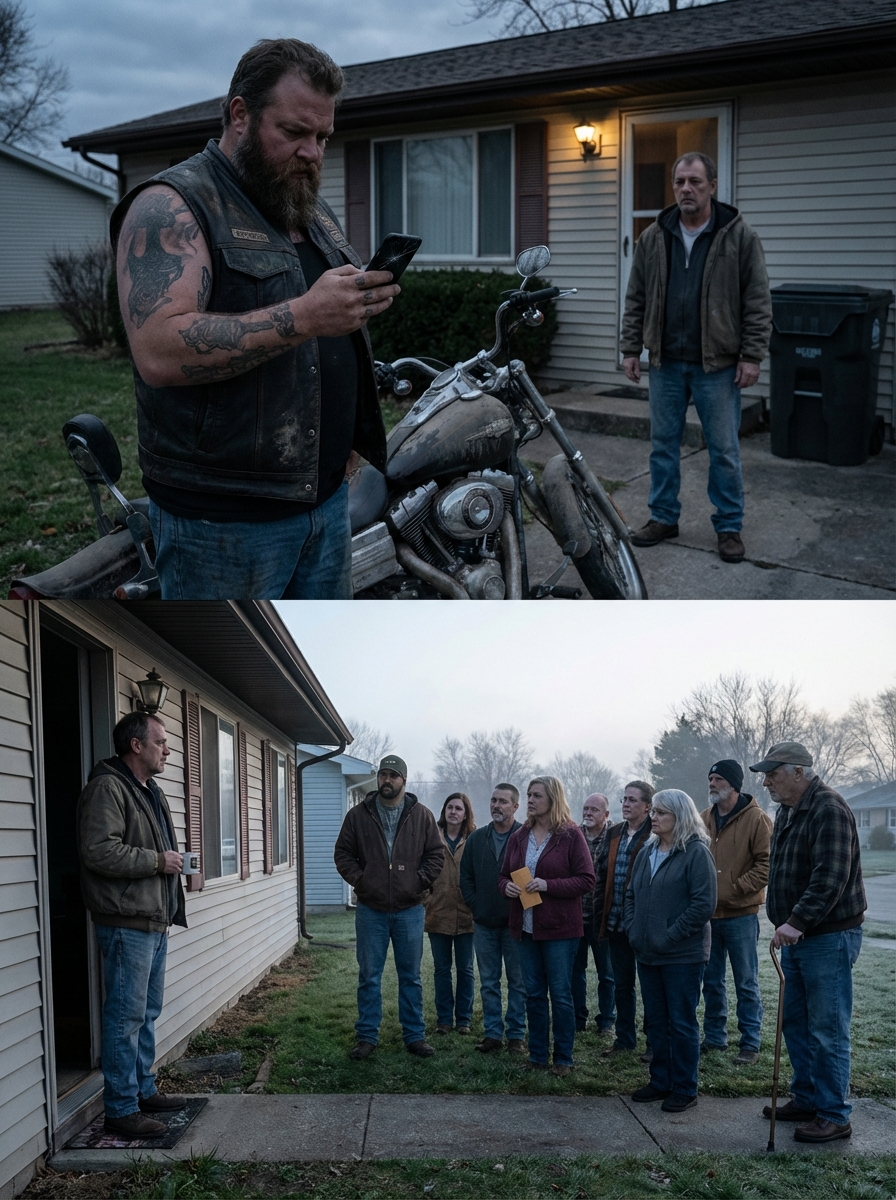
The most ordinary thing I did that evening was hand a stranger my old cracked phone so he could make a quick call, but the strange part was the way the biker stood there staring at my house afterward—and the next morning, when I opened my front door, there were seven people standing silently on my lawn like they had been waiting for me.
At first, I thought I had the wrong house.
That’s how unreal it felt.
They weren’t talking.
Not even to each other.
Just standing there. Spread out a little. Hands in pockets. One older woman with a coat too thin for the weather. A man leaning slightly on one leg like it hurt. A younger guy holding a folded piece of paper he kept smoothing out over and over again.
No one knocked.
No one rang the bell.
They were just… there.
Waiting.
I stood in the doorway longer than I should have.
Barefoot. Coffee still in my hand. The mug warm, but my fingers suddenly cold.
“Can I help you?” I finally asked.
No one answered right away.
Then the older woman stepped forward half a step—not enough to feel like she was approaching, just enough to be seen—and said quietly,
“Is this… your house?”
I nodded.
She looked at the others. Then back at me.
“He told us to come here.”
That was when something inside me shifted.
Because I already knew who she meant.
And I realized—
whatever that biker had done with my phone the night before…
wasn’t just a call.
My name is Daniel, and most of my life runs on small routines that don’t leave much room for surprises.
I’m forty-two. I work maintenance at a public middle school just outside Columbus. Nothing complicated. Fix what’s broken. Keep things running. Go home tired, but knowing you did something useful.
I live alone now.
My wife passed three years ago.
Cancer.
Short word. Long process.
After that, the house got quieter.
Not in a peaceful way. In a way where you start noticing sounds you didn’t used to hear. The fridge clicking on. The pipes shifting at night. Your own footsteps moving through rooms that used to hold two people instead of one.
I kept most things the same.
Her chair is still by the window.
Her mug—blue, chipped at the rim—is still in the cabinet, second shelf on the left. I don’t use it. I just don’t move it.
Money is… steady, but careful.
I fix things instead of replacing them.
Drive a truck that starts on the second try most mornings.
And I keep an old phone in the kitchen drawer.
That’s the object.
A cheap, outdated phone I stopped using years ago when I upgraded. The screen is cracked across the corner, battery drains fast, but it still works if you need it to.
I keep it charged.
Not for any big reason.
Just in case.
That evening, I had come home around 6:10.
Same as most days.
Boots by the door. Keys in the bowl. TV on low, more for noise than anything else. I heated up leftovers. Ate standing at the counter like I usually do.
Around 6:40, I stepped outside to take the trash out.
Cold air. Quiet street. A couple houses down, someone’s dog barking at nothing.
That’s when I heard the motorcycle.
Not loud.
Just… present.
It rolled to a stop near the curb in front of my house.
I didn’t think much of it at first.
Until the engine cut.
And no one left.
I remember thinking—
that’s not normal.
Then I saw him.
He was standing beside the bike when I turned back toward the house.
Tall. Broad. The kind of build that fills space without trying. Leather vest, worn down at the edges. Arms covered in tattoos that had faded slightly with time. Not flashy. Just permanent.
His helmet rested on the seat.
Black. Scratched.
He looked like someone who had been moving for a long time.
“Hey,” he said.
Not aggressive. Not friendly either. Just direct.
“Sorry to bother you.”
That alone was enough to put me on edge.
People don’t usually stop in front of someone else’s house and open with that unless something’s off.
“Yeah?” I said.
“My phone’s dead,” he said, holding it up briefly. “Need to make a quick call.”
I hesitated.
Not long.
But long enough to notice things.
His eyes didn’t move around the way most people’s do when they’re asking for help.
They stayed steady.
On me.
On the house behind me.
Then back to me again.
That was the first thing that felt… off.
The second was how specific he sounded.
Not a call.
A quick call.
Like the difference mattered.
“I’ve got an old one inside,” I said finally. “It works.”
He nodded once.
Didn’t say thank you.
Didn’t say anything else.
Just waited.
I went inside, opened the drawer, grabbed the phone.
That small object suddenly felt heavier than it should have.
I handed it to him outside.
He took it carefully.
Not like someone grabbing something in a hurry.
Like someone borrowing something they understood had weight.
He stepped a few feet away.
Turned his back slightly.
Dialed.
And then—
he only said a few words.
“That address. Yeah. It’s still here.”
Pause.
“No. Don’t call. Just come.”
Another pause.
“Morning’s fine.”
Then he hung up.
That was it.
No explanation.
No second call.
He walked back over and handed me the phone.
“Appreciate it,” he said.
Simple.
Done.
But he didn’t leave.
Not right away.
Instead, he looked at the house.
Really looked.
From the porch.
To the windows.
To the mailbox at the edge of the yard.
Slow.
Like he was memorizing it.
That was the third thing that didn’t sit right.
“You good?” I asked.
He nodded.
Then, almost as an afterthought, he said,
“You live here long?”
“Few years,” I said.
He gave a small nod.
Like that confirmed something.
Then he put on his helmet, started the bike, and pulled away without another word.
I stood there for a second longer than I needed to.
Then I went back inside.
Set the phone on the counter.
And told myself it was nothing.
Just a guy needing help.
Just a call.
But that night—
I checked the front window twice before going to bed.
And when I woke up the next morning and opened the door—
those people were already standing there.
Waiting.
And I had no idea what I had just been pulled into.
No one moved when I asked who they were.
That was the first thing that made it worse.
Usually, when people show up at your door, there’s a reason. A delivery. A question. A mistake. Something you can understand in the first ten seconds.
This wasn’t that.
They just stood there.
Waiting.
The older woman looked at me again. Her hands were shaking slightly, but not from cold. More like… nerves.
“You’re Daniel, right?” she asked.
That hit me harder than it should have.
I hadn’t told the biker my name.
Not out loud.
I nodded slowly.
“How do you know that?”
She glanced at the man beside her—the one with the limp. He stepped forward half a step, then stopped, like he wasn’t sure how close he was allowed to get.
“He said this was the place,” the man said. “Told us… we’d understand when we got here.”
That was twist one.
I felt something tighten in my chest.
“Who is he?” I asked.
No one answered right away.
Instead, the younger guy—the one holding the folded paper—opened it and looked down like he needed confirmation.
Then he said, “He didn’t give a name.”
Twist two.
Of course he didn’t.
That fit.
I looked past them, scanning the street.
More people were arriving.
Not many.
But enough.
Two more cars pulled up slowly, like they weren’t sure they had the right place. A woman stepped out of one, holding something close to her chest. A man from the other car leaned against the door, watching.
None of them knocked.
None of them called out.
They all just… joined the quiet.
That was twist three.
This wasn’t random.
This was organized.
But without noise.
Without direction.
I stepped outside, pulling the door halfway behind me.
“Look,” I said, trying to keep my voice steady, “I don’t know what you think this is, but—”
“He called us last night,” the older woman said, cutting me off gently.
That was twist four.
“He?” I repeated.
She nodded.
“From a number we didn’t recognize.”
My phone.
The old one.
The one in the kitchen.
A small object.
Now suddenly too important.
“What did he say?” I asked.
She hesitated.
Then said, “Not much.”
Of course.
Always not much.
“He said… ‘If you still think about it, come tomorrow. Same place.’”
I stared at her.
“That’s it?”
She shook her head.
“No. He also said…” She paused, like the words mattered more the second time.
“‘You’ll know it when you see it.’”
That was twist five.
I didn’t understand.
Not yet.
But something about the way she said it made the air feel heavier.
Behind her, the man with the limp shifted his weight again.
Then he looked at my house.
Not casually.
Not like a stranger looking at someone else’s property.
More like someone recognizing something they hadn’t expected to see again.
That was twist six.
“You’ve been here before?” I asked him.
He didn’t answer right away.
Then, quietly, he said, “Not me.”
And looked away.
That didn’t help.
At all.
More people had gathered now.
Ten.
Maybe twelve.
Still quiet.
Still waiting.
And somehow—
no one was asking me anything.
They were waiting for something else.
Something I didn’t have.
Or didn’t know I had.
That was the part that unsettled me the most.
It was the woman with the envelope who changed everything.
She had been standing near the back at first.
You could almost miss her.
Late forties, maybe. Hair pulled back. Coat zipped all the way up. She held a small brown envelope against her chest like it was something fragile.
When she stepped forward, the others shifted slightly.
Not making space.
Just… acknowledging.
Like they had been waiting for her to move.
“You let him use your phone,” she said.
Not a question.
A statement.
I nodded.
“Yes.”
She held up the envelope slightly.
“He called me too.”
That was twist seven.
My mind started connecting pieces, but they didn’t fit yet.
“What did he say to you?” I asked.
She looked down at the envelope for a second.
Then back at me.
“He said, ‘You kept it, right?’”
I frowned.
“Kept what?”
She didn’t answer immediately.
Instead, she looked at my house.
The windows.
The porch.
The mailbox.
The same way he had.
That slow, careful scan.
Then she asked, “You’ve lived here three years?”
My chest tightened.
“Yeah.”
She nodded once.
“Then you wouldn’t know.”
That was twist eight.
“Know what?” I asked.
She took a step closer.
Not threatening.
Just certain.
“This house,” she said quietly, “used to belong to a man named Richard Hale.”
The name meant nothing to me.
At least—not at first.
I shook my head. “I bought it from the bank. Foreclosure.”
She nodded again.
“I know.”
Silence stretched between us.
Then the older woman spoke from behind her.
“My sister worked for him,” she said.
The man with the limp added, “He helped me when I couldn’t walk for six months.”
The younger guy lifted his paper slightly. “He paid for my school books one year.”
One by one—
small pieces.
Small stories.
Different people.
Same direction.
All pointing back to the same name.
Richard Hale.
And suddenly—
I understood something.
Not everything.
But enough.
“He helped people,” I said slowly.
They all nodded.
Not proudly.
Not dramatically.
Just… fact.
“And then what?” I asked.
The woman with the envelope answered this time.
“He got sick.”
My stomach dropped.
Of course he did.
That’s how these stories go.
“Lost the house,” she continued. “Moved away. Quietly. Didn’t tell anyone where.”
“And the biker?” I asked.
That was the question that mattered.
She looked at me for a long second.
Then said,
“He was there at the end.”
The street felt smaller after that.
Like everything had pulled in closer.
“What do you mean?” I asked.
Her grip tightened slightly on the envelope.
“My brother,” she said, “worked at the facility where Richard spent his last months.”
I didn’t move.
Didn’t speak.
Because I already knew what was coming.
“He said there was one man who came to see him,” she continued. “Not family. Not someone on any list. Just… someone who showed up. Sat with him. Talked very little.”
The biker.
Of course.
“He didn’t stay long,” she said. “Never made a scene. Just sat there. Listened. Sometimes held his hand.”
My throat tightened.
“He never told anyone who he was,” she added. “But before Richard passed…”
She paused.
And for the first time, her voice shifted.
Just slightly.
“He gave him something.”
She opened the envelope.
Inside—
a small key.
Old.
Worn smooth at the edges.
“This house key,” she said.
I stared at it.
Impossible.
“This isn’t—” I started.
“It is,” she said gently.
“The original.”
I felt something break open inside my chest.
Not loud.
Not sudden.
Just… there.
“He couldn’t come back,” she continued. “Too sick. Too far gone. But he kept talking about this place. About what it meant. About the people he wished he could see again.”
The crowd behind her shifted slightly.
Not restless.
Just… present.
Listening.
“So the biker,” I said slowly, “used my phone…”
“To find us,” she finished.
“To bring us here.”
“To this place.”
Not for himself.
Not for attention.
Just to reconnect something that had been left unfinished.
All with one call.
Three sentences.
A borrowed phone.
I looked around at them.
All these people.
Different lives.
Different stories.
Standing on my lawn because one man decided to follow through on something someone else couldn’t finish.
And suddenly—
everything made sense.
The way he looked at the house.
The way he asked how long I’d lived here.
The way he didn’t explain anything.
He wasn’t part of the story.
He was just… carrying it.
They didn’t stay long.
That’s the part I remember most.
No speeches.
No big moment.
Just quiet conversations.
A few of them walked up to the porch.
Touched the railing.
Looked through the front window.
Not like visitors.
Like people remembering something that used to belong to them too.
The woman handed me the key before she left.
“You should keep this,” she said.
I almost told her it wasn’t mine.
But something stopped me.
Because maybe—
in a small way—
it was now.
That night, I put the key in the same drawer as the old phone.
The cracked one.
The one that still worked when you needed it to.
I stood there for a while, looking at both of them.
Two small objects.
Neither of them important on their own.
But together—
they had brought people back.
Closed something that had been left open.
And the next morning, when I stepped outside again—
the street was empty.
Quiet.
Normal.
Like nothing had happened.
But when I locked the door behind me—
I used the old key.
Just once.
To feel it turn.


