My Fiancé Left Me Beside the Highway at Midnight—The Biker Who Stopped Had My Birthday Tattooed on His Arm, and My Mother Said He Was Dead
I turned the phone facedown.
Richard’s smiling photograph disappeared, but the vibration kept traveling through the tabletop.
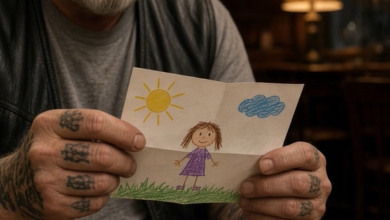
Across from me, the biker folded his hands. His right thumbnail had a dark crescent beneath it. Mechanic’s hands. My mother had described my father as an accountant, a quiet man who never learned to change a tire.
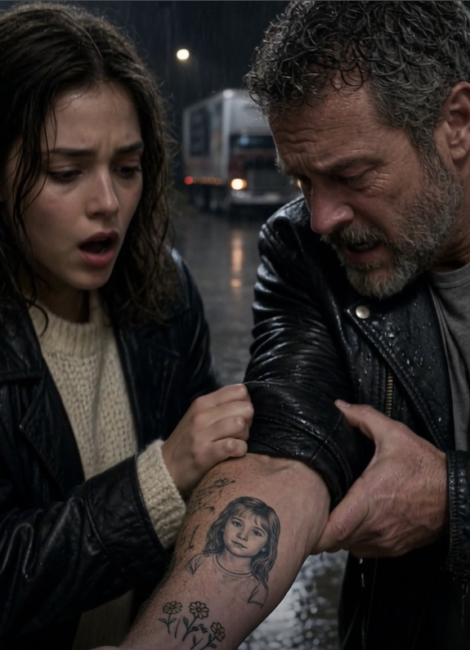
“You have the wrong person,” I said.
“I’d like that.”
“His name is Richard Mercer. Commercial property. Charity golf tournaments. He bought the wheelchair lift at my grandmother’s church.”
The man nodded toward my phone.
“Same face.”
A waitress brought two glasses of water. He thanked her without looking away from me.
“What’s your name?”
“Daniel Bennett.”
My birth certificate said Daniel Bennett.
I could feel the booth’s split vinyl catching the backs of my legs.
“Show me your license.”
He slid it across the table. Fifty-one. Newark, Ohio. The photograph showed the same deep crease beside his mouth.
I checked his name twice.
Then I opened the obituary my mother had emailed me when I was seventeen and needed information for a family-history assignment.
There was his name.
A photograph.
A paragraph about a private service.
Daniel leaned forward, then stopped before touching my phone.
“That picture came from my company badge.”
“You’re saying someone made an obituary?”
“I’m saying I’m sitting here.”
That should have settled something.
Instead, it made everything worse.
I had been awake since five that morning. Evan had spent the drive telling me I was unstable, suspicious, incapable of accepting help. Now a stranger had my birthday on his arm and a story that sounded built for someone desperate to believe it.
“Did Evan send you?”
Daniel’s eyebrows tightened.
“The man who left you?”
“Answer me.”
“No.”
He didn’t look offended. Somehow that made me angrier.
I called my mother.
She answered before the second ring.
“Lila, thank God. Richard says Evan can’t find you.”
“He knows where he left me.”
A pause.
“Where are you?”
“With someone named Daniel Bennett.”
The kitchen clock at my mother’s house chimed through the phone. I knew the sound because she had refused to replace that clock for twenty years.
Then nothing.
“Mom?”
“Put him on.”
“First tell me whether Dad is dead.”
Daniel stood.
I grabbed his sleeve before I knew I was going to.
He looked down at my hand, then sat again.
My mother began crying.
Not loudly. Little breaths, carefully separated.
“Lila, you don’t know what that man did.”
“What did he do?”
“He went to prison.”
The room seemed to tilt.
“For what?”
“Burning your grandfather’s warehouse.”
I looked at Daniel.
He nodded once.
My mother heard me stop breathing and hurried into the opening.
“He’s dangerous. Whatever he tells you, do not go anywhere alone with him.”
Daniel pushed his untouched water toward me.
Then he said, quietly enough that she couldn’t hear, “Ask who testified.”
I did.
My mother’s crying stopped.
And before she answered, I heard Richard Mercer speaking somewhere behind her.
Why was my fiancé’s father in my mother’s kitchen after midnight?
I didn’t ask immediately.
Something small had surfaced, and I was afraid a question would drive it under again.
I was three, sitting on a folded shop towel on a workbench. Dad cooled cocoa in a red camping mug, whistling twice between each breath. A blue ceramic bird sat beside the radio. One wing had broken off, leaving a white triangle.
I used to press my finger against it.
“Bluebird’s hurt,” I would tell him.
“Still a bird.”
He kept a spare key inside its hollow base. I remembered him shaking it out onto his palm while I demanded another whistle.
That was almost the whole memory: cocoa, a chipped bird, his hand blocking the mug until it cooled.
I had spent years believing it belonged to a dream.
“Mom,” I said. “Was there a blue bird in Dad’s shop?”
Her breath caught.
Daniel looked at me.
“A little ceramic one,” I continued. “Broken wing.”
“Your grandmother had hundreds of things.”
“I didn’t say Grandma’s house.”
Richard spoke again, farther away this time.
My mother covered the receiver too late.
“Who’s there?”
“Richard came because we’re worried.”
“Evan left me on the highway.”
“He says you demanded to get out.”
“I asked him to stop yelling.”
Those were different sentences.
My family had always been good at making different sentences mean the same thing.
Daniel took a receipt from his pocket and wrote a telephone number on the back.
A woman’s name followed.
Mara Ellis. Attorney.
“Call her yourself,” he said. “Don’t trust a number from me. Look her up.”
My mother heard him.
“You’re letting him coach you?”
“I’m letting him finish a sentence.”
The silence afterward felt older than I was.
I told her I was safe and ended the call.
Daniel explained that Mara had been reviewing his conviction for almost a year. He had served fifteen years, been released eight years earlier, and rebuilt motorcycles in a rented garage.
“Why didn’t you find me?”
He rubbed the edge of the receipt flat.
“I wrote.”
“We never got letters.”
“I know that now.”
At first the prison mail had come back. Later, a lawyer wrote that my mother had remarried and that contact would hurt me. After his release, he paid an investigator who found an address that turned out to be wrong.
“I should’ve kept going,” he said.
There was no speech about sacrifice. No request that I understand.
Just that.
I asked why he was on the highway.
He showed me a repair invoice on his phone: an evening delivery to a customer west of Columbus. His garage was east of the city. He had been riding home.
An ordinary route.
An impossible intersection.
The waitress offered to let me use the office charger. I called Mara from the number listed on her firm’s website, and her answering service reached her.
She confirmed Daniel’s identity.
Then she asked whether my mother had contacted Richard.
“Yes.”
“Don’t tell either of them where you’ll sleep tonight.”
I stared at the receipt.
What did an attorney know about my future father-in-law that his own son hadn’t told me?
Mara arrived forty minutes later wearing sneakers beneath suit trousers.
She ordered tea, asked permission to sit beside me, and placed her phone where we could see that it wasn’t recording.
“Daniel is my client,” she said. “You aren’t required to agree with him.”
That was the first sentence all night that made me feel less cornered.
She brought an electronic copy of the trial record.
There had been a fire in November 2003 at a warehouse owned by my grandfather’s company. Nobody died. A night watchman escaped through a loading entrance and later testified that he saw Daniel’s pickup leaving the yard.
Investigators found payroll envelopes and a restricted-area key in Daniel’s toolbox.
My mother testified that she had seen him enter the building with a fuel can earlier that evening.
Daniel had reported financial irregularities before the fire.
The prosecution said he had discovered his own theft was about to be exposed.
“He said she said?” I asked.
“More than that,” Mara answered. “Which is why this has taken time.”
Richard’s name appeared repeatedly.
He had arranged an outside investigation for my grandfather. He hired a civil attorney who assembled documents and delivered them to investigators. He paid the watchman’s relocation expenses.
“But he didn’t prosecute the case,” Mara said. “And paying for an investigation isn’t proof that he fabricated one.”
I looked at Daniel.
He nodded.
He had accused Richard. His own attorney was refusing to let me treat the accusation as evidence.
Then Mara showed me a statement my mother had submitted months earlier through separate counsel.
It said she had not personally watched Daniel carry anything into the warehouse.
She had seen his truck.
Her trial testimony had been prepared under pressure from her father.
“She changed her story?” I asked.
“She corrected it.”
“Before tonight?”
“Seven months ago.”
I called my mother again.
This time she answered from somewhere quiet.
“Why didn’t you tell me you were helping him?”
“Because I didn’t know how to tell you what I’d done.”
For the first time, she sounded like someone I might recognize.
She said my grandfather had threatened to take custody of me. His lawyers said Daniel had stolen from the company. Richard brought photographs, bank records, an explanation that seemed to fit everything.
She had been twenty-seven, frightened, financially dependent.
“Then why keep saying he was dead?”
“Because once I said it, I didn’t know how to take it back.”
I could hate that answer and still hear the fear inside it.
For several minutes, my grandfather became the center of everything.
He had owned the warehouse. Controlled the money. Threatened his daughter. He had died two years earlier, leaving framed photographs and a trust in my name.
Richard, my mother said, had merely handled what my grandfather ordered.
Then Mara asked me why Evan and I had argued.
I forwarded the agreement.
She read three pages.
Her expression changed.
“Lila, when did they start asking you to sign this?”
“Right after we set the wedding date.”
She turned the screen toward me.
If Richard had only followed my grandfather’s orders, why was the new company receiving my money registered to Richard’s own office?
The agreement wasn’t a prenup.
I had said that twice in Evan’s car, and he had kept correcting me until I nearly believed him.
It was an election to release part of my inheritance early.
My grandfather’s trust allowed distribution at twenty-seven, or after marriage if I requested it. The attached investment instructions directed the released funds into a development company managed by Evan.
Richard’s company guaranteed nothing.
I did.
“They told me this was routine,” I said.
Mara drew a line beneath a paragraph.
“Routine doesn’t mean harmless.”
The projected return depended on the sale of several commercial properties. One address belonged to the warehouse site where Daniel had worked.
The old building had been replaced years earlier.
The land remained.
Daniel stared at the address without touching the screen.
Mara asked whether I had any documents from my grandfather’s estate.
I did.
After his death, my mother had forwarded a huge scanned archive because I was making a memorial slideshow. Most of it was useless: Christmas cards, deeds, invoices, photographs of machinery nobody could identify.
I had downloaded everything.
Even the boring folders.
We moved to Mara’s office after sunrise. Daniel rode separately. I took a licensed taxi and sent its details to a friend from work.
For three hours, nothing happened.
Files opened slowly. The office printer jammed. Daniel went downstairs and returned with breakfast sandwiches nobody finished.
Then I found a folder labeled FIRE—CARRIER.
The insurance adjuster had photographed the warehouse office before the damaged contents were removed. There was the desk.
The radio.
The blue ceramic bird with its missing wing.
I pressed my finger against the screen.
Daniel whispered, “You remember that?”
“Yes.”
Mara asked us both to stop talking while she saved an untouched copy.
Inside the same archive were invoices my grandfather’s accountant had retained for the insurance claim. One was a locksmith’s duplicate order from three days before the fire.
Restricted key.
Collected by R. Mercer.
A second page recorded a payment to the watchman’s brother.
“Relocation expenses,” I said.
“Before the fire,” Mara answered.
My stomach tightened.
There were financial records too. Transfers from employee benefit accounts into a company Richard and my grandfather had controlled together.
Daniel had flagged those transfers in a handwritten maintenance-budget report because money intended for equipment repairs kept disappearing into the same account.
The report was dated eleven days before his arrest.
Richard hadn’t simply hired someone to defend my grandfather’s interests.
He had interests of his own.
Mara requested preservation of records and contacted an investigator she already knew through the case. She warned us that a scanned signature could be challenged. The archive needed authentication. Original files mattered.
Then Evan texted.
Dad says Daniel is using you to reopen an insurance claim. Come home before this gets embarrassing.
I hadn’t mentioned the insurance archive to him.
I showed Mara.
She read it twice.
Then another message arrived.
I’ve turned off your phone line. We need to talk in person.
How much of my life had I allowed Evan to control before I noticed the door closing?
The phone went dead while I was looking at it.
No dramatic warning.
Just the little service bars disappearing.
I had joined Evan’s family plan six months earlier because it was cheaper. He had insisted we didn’t need separate accounts once we were married.
Mara handed me her office phone.
I called my friend Nora.
Before I could explain, she said, “Are you okay? Evan says you’re having some kind of episode.”
He had called my workplace too.
A confused supervisor left a message asking whether I needed medical leave.
Richard sent my mother a newspaper clipping about Daniel’s conviction. She forwarded it with one sentence.
Please remember there are facts.
I looked at the photograph beneath the headline.
Daniel was thirty with his wrists held together in front of him.
He stood across the room now, fifty-one, trying to open a packet of oatmeal without spilling it on Mara’s carpet.
I began to cry.
That annoyed me more than anything else.
Everybody had a document. Everybody had a version. I was tired enough to mistake exhaustion for proof that I couldn’t trust myself.
Daniel set the oatmeal down.
“Want me outside?”
“No.”
“Okay.”
He stayed.
We spent that night at separate hotels. Mara asked us to keep the locations private and preserve every message. I bought a prepaid phone, changed passwords, and disabled location sharing from a computer.
By then, Evan had already seen the hotel address through our shared account.
He arrived while I was getting a key replaced at the front desk.
He looked relieved.
That nearly worked.
“Lila. Thank God.”
Then I saw my overnight bag in his hand.
He had packed it at our apartment.
“Your mother wants you home,” he said.
“I spoke to her.”
“You spoke to her while that convict was coaching you.”
The desk clerk looked up.
Evan lowered his voice.
“You’re making a scene.”
I hadn’t raised mine.
He placed his hand against my elbow and steered me toward the automatic doors. Outside, Richard sat in an SUV with the engine running.
I stopped.
Evan kept walking until my arm straightened between us.
“Let go.”
“Please don’t do this.”
“Let go.”
The clerk came around the counter.
“Sir, she asked you to release her.”
He did.
A security employee stood beside me while another called police. I asked them to save the lobby footage. My own hands were shaking too hard to unlock the new phone.
Evan set the bag on the floor.
For one second, his pleasant expression dropped.
“You think he stopped for you by accident?”
There it was.
An explanation ready to replace the one I had just learned.
Daniel was waiting outside the attorney’s office, miles away. He hadn’t come to the hotel. He didn’t even know the room number.
But Evan knew exactly where to find me.
I gave a statement. I went upstairs with an escort. Later, Mara arranged for Nora to collect me.
Before we left, my mother called the hotel directly.
“I need to tell you something without Richard there.”
What could she have kept from me after everything she had already admitted?
We met the next morning in Mara’s conference room.
My mother brought a grocery-store cake carrier.
For one foolish second, I thought she had brought breakfast.
Inside were letters.
Forty-three envelopes, bundled with kitchen string.
Some had prison return addresses. Others bore the address of a garage in Newark.
All were addressed to me.
“I didn’t know what he was writing at first,” she said.
I looked at the dates.
The oldest was from 2004.
The newest had arrived nine months earlier.
“That stopped being true a long time ago.”
She nodded.
Daniel sat beside the window. He had asked Mara whether my mother wanted him absent.
I had said I wanted him there.
My mother explained that after her father died, she found records suggesting Richard had moved money from the company. She contacted an attorney about correcting her testimony.
That part was true.
Then Richard approached her about my engagement.
He knew what she had said to Mara’s investigator.
He also knew my mother had signed documents over the years acknowledging payments from family companies she had never meaningfully examined.
“He said I’d lose everything,” she whispered.
“What did you agree to?”
She rubbed her wedding ring. My stepfather had left years earlier, but she still wore it when she was anxious.
“I agreed not to tell you until after the wedding.”
Daniel closed his eyes.
Mara asked the next question.
“Did you know what the investment election would do?”
“Richard said it would stabilize the family holdings.”
“That wasn’t my question.”
My mother looked at me.
“Yes.”
The room became very quiet.
My mother had been threatened at twenty-seven.
At fifty, she had made another choice.
Those things could both be true.
“Was Evan part of this?” I asked.
“He knew your grandfather’s trust would release the money after marriage.”
“Did he know about Dad?”
She didn’t answer quickly enough.
Daniel stood, then sat again.
It was the smallest movement. Somehow it hurt more than shouting.
My mother pushed the letters toward him.
“I thought I was keeping her life from being ruined.”
“You let me marry into it,” I said.
She began crying.
I didn’t move around the table.
After a while, Daniel asked whether he could see the envelopes. He touched the top one, recognizing his own handwriting.
My mother reached into her purse and brought out an invitation.
The Mercer Foundation’s annual donor luncheon was that Saturday. Richard planned to announce a new development partnership and our wedding date.
“He’s going ahead?” I asked.
“He thinks you’ll come back.”
Mara told us that a luncheon wasn’t a courtroom. She would not let us turn evidence into a performance that could damage Daniel’s petition.
But the public announcement presented a practical problem.
Richard was still using my name to reassure people about a project I had never agreed to fund.
I emailed a withdrawal of consent to the organizer and copied Mara. I requested written confirmation that neither my inheritance nor my engagement would be presented as part of the project.
Richard replied himself.
Come explain that in person. Bring whoever is advising you.
Why was a man who had spent twenty-three years controlling the story suddenly inviting us into a room full of witnesses?
Because he thought witnesses belonged to whoever paid for lunch.
That was my conclusion when we walked into the hotel ballroom.
Richard stood beside a display of proposed buildings, shaking hands beneath a foundation banner. Evan waited near the entrance in the navy suit I had helped him choose.
He looked at my left hand first.
The ring was gone.
Then he saw Daniel.
“You brought him?”
“I brought my father.”
The word felt strange in my mouth.
Daniel didn’t react. He simply took the chair beside mine after I pulled it out.
Mara sat on my other side. Nora came because I wanted someone present who didn’t owe anything to either family.
We weren’t carrying a slideshow.
We weren’t livestreaming.
Mara had already sent the documents to the investigator and filed a supplement in Daniel’s case. Our purpose was to withdraw my name from Richard’s announcement in front of the people who had been told I supported it.
Richard approached before the salads arrived.
“Lila, we can handle this privately.”
“I tried that in the car.”
Evan’s jaw moved.
“That isn’t what happened.”
“The hotel has its video. The truck stop has its cameras. We can each keep our version.”
Richard looked at Mara.
“You’re encouraging this?”
“I’m asking you to honor her written withdrawal.”
He glanced toward the donor tables.
Then his voice warmed.
“Of course. Nobody wants Lila to feel pressured.”
He put a hand on Daniel’s shoulder.
Daniel moved away.
Several people noticed.
Richard sighed, as if patience were a burden he had learned to carry.
“Daniel has been through difficult things. That doesn’t mean every accusation becomes true.”
Mara asked him to remove his hand from the chair.
I placed one printed photograph on the table.
The insurance adjuster’s image of the warehouse office.
The blue bird sat beside the radio.
“Do you remember this?” I asked.
Richard barely looked.
“Your grandfather’s office.”
“My father’s workbench was in the next room.”
“It was a long time ago.”
“Did you order a duplicate of the restricted-area key?”
“No.”
Mara touched my wrist.
I stopped.
Richard should have stopped too.
Instead, he smiled at the people watching from the next table.
“Now we’re going to hear that I took key seventeen out of a broken bird.”
The number landed between us.
Daniel’s hand flattened against his knee.
In the public trial record, the key was identified by an exhibit letter. The photograph on the table showed the bird upright. Its hollow underside wasn’t visible.
I hadn’t mentioned a number.
Mara stood.
“Mr. Mercer, don’t discuss this further with my client present.”
But I was already looking at Daniel.
“Was it seventeen?”
He nodded.
Scratched into the brass.
The locksmith’s order in the archive listed that same number and Richard’s signature.
Richard saw my face and understood what he had supplied.
Evan stepped backward.
Not far.
Enough.
“You said the key was his,” he told his father.
Richard turned.
“Don’t.”
People nearby stopped pretending to eat.
Evan looked at me.
For the first time, he looked frightened of someone other than losing my money.
What else had Richard told his son that he now needed him to keep quiet?
Evan did not suddenly become brave.
I want that clear.
He asked Richard whether they could step outside.
Richard told him to sit down.
Mara asked the organizer to preserve any event recording and security footage. Then she guided us toward the exit before the room could become something none of us controlled.
My mother followed.
At the doorway, she stopped beside Evan.
“Tell them about the address,” she said.
His face changed.
“What address?” I asked.
She looked at me.
“The one the investigator gave Daniel.”
Evan shook his head.
“That was before us.”
“Your father told you about it.”
Richard was approaching quickly now.
Mara stepped between us and asked everyone to stop discussing potential evidence in a hotel corridor.
We left.
There was no applause.
One donor held the ballroom door. Another stared into his water glass. Behind us, Richard was already explaining that a family misunderstanding had interrupted the program.
The rest took months.
Evan obtained his own attorney. Through that attorney, he provided messages showing Richard had known Daniel was searching for me after his release. The private investigator Daniel hired had received misleading information through a paid intermediary.
The false address had not been an accident.
Evan said he learned about it later.
I let the investigators sort out what “later” meant.
The watchman, retired and living with his sister, agreed to another interview after Mara’s investigator showed him the payment records. His new statement described pressure from my grandfather and Richard.
He had seen a pickup.
He had not seen who drove it.
The locksmith’s business had closed, but its former owner authenticated his handwriting and the duplicate order retained in the insurance archive. A retired adjuster identified the photographs and explained how the claim file had been copied to my grandfather.
Nothing depended on Richard’s sentence at lunch alone.
That sentence helped.
The records did the heavier work.
My mother gave a fuller statement with her own lawyer beside her. She admitted the letters, the false account of Daniel’s death, and her agreement to delay telling me until after the wedding.
I read her statement.
Then I stopped answering her calls for a while.
Daniel never asked me to forgive her.
He never asked me not to.
When the court set aside his conviction and a new trial was ordered, the prosecutor’s office reviewed what remained. Eventually, the case against him was dismissed.
I sat beside him when Mara explained the filing.
He asked whether his name would still come up when somebody searched it.
“Yes,” she said. “But this will come up too.”
He nodded.
That was the moment I understood how small justice could feel after being imagined for so long.
Richard faced a separate investigation involving the financial records and efforts to interfere with witnesses. I refused interviews while it continued.
I found an apartment.
Changed jobs.
Sold nothing to pay for Evan’s development.
And one Saturday, carrying a box of unanswered letters, I drove to Daniel’s garage.
He had cleared a space on the workbench.
Beside it sat a red camping mug.
“Coffee?” he asked.
I shook my head.
“Do you have cocoa?”
His fingers tightened around the mug.
After everything the records had returned to him, could we learn how to give each other an ordinary morning?
The first cocoa was terrible.
He used water because he didn’t have milk. There were lumps at the bottom, and he apologized three times before I told him to stop.
Then he whistled.
Two falling notes.
I cried into a paper towel that left white pieces stuck to my face.
He pretended not to notice until I laughed.
After that, Saturdays became easier.
Sometimes I helped sort bolts into plastic drawers. Sometimes he worked while I answered emails at the little desk near the window. We learned things that no court record could supply.
He hated cinnamon.
I put it in everything.
He listened to weather reports even when he wasn’t going anywhere.
I talked when I was nervous.
He went quiet.
Once, that silence frightened me enough that I asked whether he wished he hadn’t stopped beside the highway.
He put down the wrench.
“Never ask yourself that again.”
“I might.”
“Then I’ll answer again.”
We didn’t become a family all at once.
I was still angry that he had stopped searching when another try might have found me. He listened when I said it.
He was angry too.
Sometimes at my mother.
Sometimes at the man he had been when he believed another lawyer’s letter meant his daughter would be better without him.
We found a counselor who didn’t rush either of us toward gratitude.
My mother wrote to me.
I read her letters when I could.
Months later, I agreed to coffee in a public place. I didn’t call it forgiveness. She didn’t ask me to.
That helped.
Daniel kept the jacket I had worn the night he found me on a hook beside the garage door. I offered to have it cleaned.
“Smells like truck-stop coffee,” I said.
“Usually smells worse.”
He had cut the frayed lining away from one pocket and stitched it closed himself. The repair was crooked.
I liked knowing that.
For my birthday, Nora found a blue ceramic bird at a flea market. Similar shape. Wrong shade.
Both wings intact.
Daniel held it carefully, then set it beside the red mug.
Neither of us pretended it was the old one.
Some things were replacements.
Some things weren’t.
The first time I rode with him again, it was daylight. We had nowhere urgent to be. He checked the spare helmet, handed me gloves, and waited while I fastened them badly.
Then he showed me how.
No hurry.
No raised voice.
My own keys sat safely inside my zipped pocket.
Before he started the Harley, I touched the tattoo on his forearm.
“Did it hurt?”
He looked at the letters of my name.
“Wasn’t the hard part.”
I leaned my helmet against his shoulder for a moment.
From the garage, the little blue bird faced the open door.
I could see both its wings.
“Ready, Bluebird?”
I put my arms around him.
“Take the long way, Dad.”
For the first time, the road ahead didn’t feel like somewhere I had been left—who knew how many ordinary Saturdays were still waiting for us?