Everyone Thought the Boy Who Stole a Car Would Steal Again — Then I Watched Him Find $500 on My Garage Floor
The first time Marcus walked into my garage, he was fourteen, fresh out of juvenile detention, and carrying the kind of silence that makes decent people suspicious before a kid has even done anything wrong.
Everybody in Dayton knew what he had done.
At thirteen, Marcus had stolen a car.
It was an old Honda Accord sitting outside a convenience store on North Main Street, engine running while the owner went inside for coffee. Marcus saw the open door, heard two older boys laughing behind him, and made a decision that took less than ten seconds.
He drove six blocks before a patrol car stopped him.
The boys who had dared him ran. Marcus stayed behind the wheel, both hands locked around it, too frightened to move. By sunrise, his photograph was moving through neighborhood Facebook groups beneath words like dangerous, future criminal, and lost cause.
Nobody mentioned that he was thirteen.
Nobody asked why a boy who had never owned a bicycle wanted so badly to look fearless in front of two older kids who would not remember his name a month later.
They only remembered the stolen car.
Eleven months later, when he came home from juvenile detention, mothers pulled their children indoors when he walked past. Shopkeepers followed him through the aisles. Even boys who had once played basketball with him crossed the street rather than be seen beside him.
Then a county youth counselor named Elena Alvarez called me.
“My last three mentors backed out,” she said. “One searched his name online. Another spoke to the car owner. The third said he didn’t feel comfortable bringing Marcus around his business.”
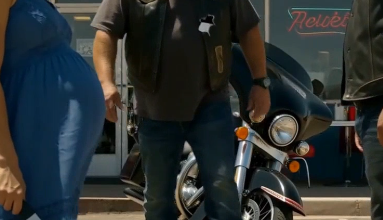
I was standing beside my 2004 Harley Road King, wiping grease from my hands. Behind me, impact wrenches hammered against lug nuts, classic rock played through an old radio, and three men from my riding club were arguing over a carburetor none of them understood.
“What do you want from me?” I asked.
“Two afternoons a week. Maybe three. Teach him something. Keep him occupied.”
“You know my record?”
“That’s why I called.”
I looked across my garage at the framed photograph hanging above my toolbox. I was seventeen in that picture, standing beside a stolen Chevrolet with a grin I had not earned and a switchblade tucked into my belt.
Three years after that photograph was taken, I went to prison.
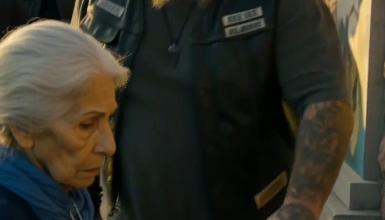
My name is Caleb Hayes, though most people around Dayton call me Grinder. I was fifty years old, six-foot-four, 270 pounds, with a shaved head, a gray beard reaching my chest, tattoo sleeves, scarred knuckles, and a black leather vest that made parents grip their children a little tighter.
People saw me and moved away.
That made me the right man for Marcus.
“Bring him Thursday,” I said.
He arrived wearing an oversized gray hoodie, worn sneakers, and an expression that said he expected me to reject him before he had to care whether I did.
Elena introduced us. Marcus never raised his eyes.
“So,” I said, “you stole a car.”
His jaw tightened.
“Yes.”
“Did you check the oil first?”
His eyes finally lifted.
“What?”
“You heard me. Did you check the oil?”
“No.”
“Then you weren’t a car thief. You were an idiot holding somebody else’s steering wheel.”
Elena covered a smile. Marcus looked offended for three seconds, then something shifted at the corner of his mouth.
It was not quite a smile.
But it was close.
I handed him a pair of work gloves and pointed toward a blue Ford pickup waiting on the lift.
“If you’re going to be judged by one car for the rest of your life,” I told him, “you might as well learn how cars actually work.”
That was how it began.
Not with trust.
With a socket wrench.
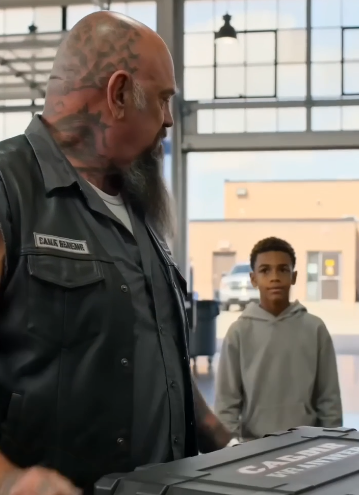
Marcus barely spoke during the first month, but he watched everything.
He watched where I placed each tool. He watched how I listened to an engine before opening the hood. He watched me run my fingers along a belt, check the tension, then step back as if the machine might tell me something if I gave it enough room.
Machines usually tell the truth.
A worn bearing complains. A loose belt squeals. Bad fuel makes an engine hesitate. Metal does not smile at you while planning to use your worst mistake against you.
Marcus liked that.
At first, I gave him the jobs nobody wanted: sweeping the floor, organizing sockets, draining oil, cleaning parts, and carrying tires from one side of the garage to the other. He never complained, but he treated every task like punishment.
One Thursday, I found him sweeping the same clean corner for nearly ten minutes.
“You planning to dig through the concrete?” I asked.
He stopped.
“I finished.”
“Then say that. Don’t hide behind a broom.”
He stared at the floor and whispered, “People don’t like it when I say things.”
“People don’t like most things. Say them anyway.”
That afternoon, I showed him how to change brake pads. The next week, he learned how to replace a battery. By summer, he could identify the difference between a failing alternator and a weak starter just by listening.
The men in my club were slower to accept him.
My closest friend, Denny “Crow” Mercer, kept his wallet in his front pocket whenever Marcus was around. Another member counted the tools after every shift. Nobody accused the boy directly, but Marcus noticed.
Kids like him always notice.
One evening, he left early after Crow asked where his silver ratchet had gone. We found it ten minutes later beneath the seat of Crow’s own truck.
“You owe the kid an apology,” I said.
Crow’s face hardened. “I never accused him.”
“You looked at him before you looked under your seat.”
“That boy stole a car.”
“So did I.”
“You were young.”
“He’s fourteen.”
Crow stared at me, and the garage became quiet except for the cooling clicks of an engine on the lift.
My leather vest creaked when I folded my arms.
“You trust me now,” I said. “But somebody had to be the first fool willing to stand near me long enough to see whether I had changed.”
Crow found Marcus at the bus stop.
I never heard the apology, but the following Thursday, Marcus arrived carrying a used red toolbox. Crow had given it to him. Inside were two complete socket sets, three screwdrivers, a torque wrench, and the missing silver ratchet.
Marcus kept that toolbox cleaner than his shoes.
Months passed. His shoulders straightened. His grades improved because I made him bring his homework to the garage before touching a vehicle.
When he failed algebra, I banned him from a transmission rebuild he had been waiting weeks to help with.
“That’s not fair,” he snapped.
“Neither is a customer paying you to repair a machine when you can’t calculate a gear ratio.”
“I’m not good at school.”
“You weren’t good at engines six months ago.”
“That’s different.”
“No. You simply care whether you fail here.”
He hated me that night.
He passed algebra the following semester.
By fifteen, Marcus had stopped hiding his hands inside his hoodie. Grease lived beneath his fingernails, small cuts crossed his knuckles, and he carried himself like a boy beginning to understand that he could become useful.
Still, temptation does not disappear because someone learns a trade.
The old voices remain.
Take it.
Nobody trusts you anyway.
You may as well become what they already believe.
I knew those voices.
They had once sounded like my own.
Part 3 — Five Hundred Dollars
Two years after Marcus first entered my garage, he was sixteen and rebuilding a carburetor at the back workbench.
It was a hot Tuesday in August. The bay doors were open, cicadas buzzed beyond the parking lot, and the smell of hot asphalt mixed with motor oil and gasoline.
I had spent the morning collecting payments from three customers. Before lunch, I counted the cash, folded five hundred dollars into my brown leather wallet, and placed it in my back pocket.
Then the tow truck arrived with a Buick that would not start.
The rest of the afternoon became noise: phones ringing, compressors running, Crow cursing at a rusted bolt, and a customer insisting her engine had begun making a strange sound only after her nephew “fixed something small.”
At five-thirty, I rode home.
At five-forty, I reached for my wallet at a gas station.
Nothing.
I knew exactly where it had fallen.
The back pocket of my jeans had torn slightly that morning, and I had spent twenty minutes lying beneath the Buick near Marcus’s workbench. The wallet must have slipped out when I stood.
I turned the Harley around.
The garage was nearly empty when I returned. Crow had left, the front office lights were off, and Marcus was alone at the workbench finishing the carburetor.
I parked across the street so the engine would not announce me, then entered through the side storage door.
That was when I saw him.
My wallet lay on the concrete three feet behind his stool.
Marcus noticed it when he turned to reach for a rag. He froze, stared at the wallet, then looked toward the open bay doors.
He picked it up.
From the shadow of the doorway, I watched him open it.
Five one-hundred-dollar bills sat inside.
For thirty seconds, Marcus did nothing.
Thirty seconds is not a long time when you are waiting for coffee or sitting at a traffic light. But when a sixteen-year-old boy with six dollars in his pocket is holding five hundred dollars nobody knows he found, thirty seconds can contain an entire future.
He slid the bills out.
He counted them once.
His thumb moved across their edges, and I could see the fight happening behind his eyes. Five hundred dollars could buy the used gaming system he wanted. It could buy shoes his mother could not afford. It could buy freedom from asking permission, even if that freedom lasted only a week.
Nobody trusted him anyway.
That was the thought I imagined moving through his head, because it had moved through mine many years before.
He looked toward the door again.
I remained still.
Marcus folded the money, placed every bill back in the wallet, closed it, and set it on my workbench.
Not hidden beneath a rag.
Not placed inside a drawer where he might reconsider later.
Right in the middle of the table, where I would see it as soon as I returned.
Then he switched off the overhead lights, locked the front office, and left through the bay door with his red toolbox in one hand.
I stayed in the darkness.
I did not call after him.
I did not slap his back, tell him I was proud, or turn his private decision into a speech for the men in my club.
Some choices need silence around them.
I picked up the wallet and counted the money.
All five hundred dollars remained.
That night, after sitting at my kitchen table for nearly an hour, I called Marcus.
He answered on the fourth ring.
“Yeah?”
“Marcus, you found my wallet.”
Silence.
Then his voice tightened. “I didn’t take anything.”
“I know.”
“How?”
“I came back. I was standing at the side door.”
His breathing changed.
“So you tested me.”
“No. I forgot my wallet.”
“You stood there watching.”
“After I came back, yes.”
“That’s a test.”
“No, kid. A test is something someone designs for you. I truly forgot it. You found it. You had a choice.”
He said nothing.
“That wasn’t a test,” I continued. “That was life.”
Another long silence followed.
Then Marcus spoke so quietly I nearly missed it.
“I wanted to take it.”
“I know.”
“For about thirty seconds, I really wanted it.”
“I know that too.”
“You don’t know.”
“Yes,” I said. “I do.”
Part 4 — The Choice I Failed
I told Marcus to meet me outside the garage.
It was nearly ten at night when he arrived on his bicycle, still wearing the same gray work shirt from that afternoon. I was sitting on an overturned bucket beside my Harley, with the garage doors raised and only the lamp above the workbench burning.
He remained near the entrance.
“You going to fire me?” he asked.
“For returning my wallet?”
“For wanting the money.”
I pointed toward another bucket.
He sat, but he kept several feet between us.
For a while, neither of us spoke. A truck passed on the road. Somewhere behind the building, an air conditioner rattled against a window.
Then I opened the lower drawer of my toolbox and removed an old photograph.
In it, I was seventeen years old, thin as a wrench, with black hair hanging over my eyes. My arm rested on the roof of a Chevrolet Chevelle that did not belong to me.
I handed Marcus the picture.
“That you?”
“Yeah.”
“Nice car.”
“It belonged to a man named Thomas Bell. He worked twelve-hour shifts at a paper plant and spent four years restoring it with his son.”
Marcus looked at me.
“You stole it?”
“I saw it outside a pool hall with the keys hidden under the floor mat. I wanted it for thirty seconds too.”
“What did you do?”
“I took it.”
My answer hung between us.
I told him how I drove that Chevelle for two days, showing it off to people who disappeared as soon as police lights filled the rearview mirror. I told him the judge gave me probation because it was my first adult charge.
Then I told him what happened next.
I started stealing parts. I carried packages for men who paid cash and never gave full names. At nineteen, I broke into an auto shop with two friends because we believed the owner kept money in the office safe.
The safe held eighty-seven dollars.
I received four years in prison.
Marcus stared at the photograph again.
“You never told me that.”
“You knew I had been locked up.”
“Not why.”
“I was ashamed of how small the reason was.”
People expect prison stories to contain some grand tragedy, desperate sacrifice, or single terrible misunderstanding. Mine contained eighty-seven dollars, a broken office window, and a younger man too proud to admit he was frightened.
I leaned forward, resting my scarred hands on my knees.
“When I was your age, I found something that wasn’t mine. I wanted it. Then I took it.”
Marcus rubbed his thumb against the edge of the photograph.
“You found something that wasn’t yours,” I continued. “You wanted it. Then you put it back.”
“But I still wanted it.”
“That does not make you a thief.”
“I stole a car.”
“That tells me what you did at thirteen. It does not decide what you do at sixteen.”
He shook his head. “Everybody says people don’t change.”
“Most people don’t watch long enough.”
The lamp above us hummed. Marcus looked toward the workbench where the wallet had been lying only hours earlier.
Finally, I said the words I had needed someone to say to me when I was young.
“The difference between us is that you returned it, and I took it. That’s why you’re not going to prison like I did.”
His eyes filled, but he turned his face before any tears fell.
Boys learn early to hide the moments that might save them.
“Keep the photograph,” I said.
“Why?”
“So the next time somebody tells you people like us never change, you’ll have proof that one did.”
He slipped it carefully into his shirt pocket.
The next morning, Marcus arrived at the garage fifteen minutes early.
He never mentioned the wallet.
Neither did I.
But he placed my old photograph inside the lid of his red toolbox, where it remained for years.
Part 5 — Building More Than Engines
At eighteen, Marcus graduated from high school.
His mother, Denise, sat in the front row and cried through the entire ceremony. Crow, Denny, and nine other bikers from the club occupied the row behind her, wearing clean black shirts because the school had asked us not to wear patched vests indoors.
The principal mispronounced Marcus’s last name.
We cheered anyway.
Afterward, Marcus found me beside the parking lot, where my Harley stood among minivans and family sedans.
He handed me his diploma.
“I’m not keeping this for you,” I said.
“Just hold it.”
“Why?”
“Because I need both hands.”
Before I could ask, he wrapped his arms around me.
Marcus was nearly as tall as I was by then, but for a second, I felt the weight of the fourteen-year-old boy who had once stood in my garage expecting to be sent away.
“I got accepted,” he said against my shoulder.
“To what?”
“Sinclair. Automotive Technology.”
I pushed him back far enough to see his face.
“You didn’t tell me you applied.”
“I didn’t know if they’d take me.”
“They did.”
“Yeah.”
“That means you go.”
He studied the ground. “Mom can’t pay for all of it.”
“You have hands.”
“What?”
“You have hands, a toolbox, and every Saturday from now until classes begin. You work. We put your wages toward tuition.”
He nodded, but I could tell he was fighting emotion again.
Crow walked over, carrying a long cardboard box.
Inside was a professional mechanic’s torque wrench engraved with Marcus’s name. Every member of the club had contributed.
The men who once counted their tools after Marcus left were now buying him tools they expected him to keep for life.
College was not easy.
Marcus worked mornings, attended classes in the afternoon, and returned to the garage two evenings a week. He struggled with electrical diagnostics and nearly quit after failing an exam.
I made him diagnose the same faulty wiring harness six times.
On the seventh attempt, he found the corroded ground connection in nine minutes.
“Failure is information,” I told him.
“You have a saying for everything.”
“No. I repeat the same five sayings until you finally listen.”
He smiled.
By twenty, Marcus could hear problems experienced mechanics missed. Customers began asking for him by name. Mothers who once pulled their children away now handed him the keys to their family cars.
Some recognized him.
One man entered the garage, stared at Marcus’s name patch, and said, “Aren’t you the kid who stole that Honda?”
Marcus wiped his hands on a rag.
“Yes, sir.”
The man glanced toward the parking lot as if reconsidering leaving his vehicle.
Before I could step in, Marcus said, “I was thirteen. I’m certified now, but if you’d prefer another technician, I understand.”
The customer hesitated, then handed Marcus the keys.
“Just fix the brakes.”
Marcus did.
The man returned two weeks later with his wife’s car.
Trust rarely arrives in one dramatic moment. It comes back in small pieces: one repaired brake line, one honest estimate, one set of keys placed into your palm.
Marcus earned every piece.
Part 6 — Second Choice
When Marcus was twenty-five, he told me he wanted his own garage.
We were closing for the evening. He had been quiet all day, checking the same inventory list twice and staring at an empty building across town whenever we passed it on test drives.
“You found a place,” I said.
He looked surprised. “How did you know?”
“You’ve been pretending not to look at that old tire shop for three months.”
The building stood near Route 4, fifteen minutes from where Marcus had stolen the Honda twelve years earlier. It had three service bays, a leaking roof, cracked office windows, and enough weeds in the parking lot to hide a motorcycle.
“It’s rough,” he said.
“So were you.”
“The bank wants a bigger deposit.”
“How much?”
He named the amount.
I nodded and returned to locking the tool cabinets.
“That’s all you’re going to say?” he asked.
“What do you want me to say?”
“I don’t know. That it’s a stupid idea. That I’m not ready.”
“You’re not ready.”
His face fell.
“Nobody is,” I continued. “You prepare, then you begin before fear changes your mind.”
The next Saturday, twelve Harleys rolled into the abandoned tire shop. Their engines shook dust from the windows, and the men dismounted carrying ladders, paint, roofing materials, and more opinions than anyone had requested.
Crow handed Marcus an envelope containing the remaining deposit.
Marcus refused it.
Crow pushed it against his chest. “It’s not charity.”
“Then what is it?”
“An investment.”
“In what?”
Crow looked toward me. “Being wrong about somebody.”
Marcus accepted the envelope.
For six weeks, we repaired the building. We replaced the roof, painted the walls, installed lifts, rewired the office, and pulled weeds until the cracked parking lot appeared again.
Marcus did not reveal the name until the sign arrived.
It was simple: white letters against a dark blue background.
SECOND CHOICE AUTO & CYCLE.
Beneath it, in smaller letters, were four words:
HONEST WORK. HONEST WAY FORWARD.
I stood in the parking lot and stared at the sign.
“Second Choice?” I asked, though I already understood.
“People talk about second chances,” Marcus said. “But a chance doesn’t do anything by itself. You still have to make another choice.”
He opened his red toolbox and removed my old photograph.
The edges were worn. A grease stain crossed one corner. My seventeen-year-old face still grinned beside Thomas Bell’s stolen Chevelle.
Marcus placed it in a frame and hung it inside his office.
Next to it, he mounted a brown leather wallet.
Mine.
Seven years earlier, after Marcus completed his certification, I had given him the wallet as a graduation gift. There was no money inside, only a note I had written on a folded piece of shop paper:
You saw it. You wanted it. You chose right.
On opening day, more than a hundred people came through the garage. Former teachers, customers, neighbors, bikers, and two juvenile counselors shook Marcus’s hand.
Elena Alvarez arrived carrying the same clipboard she had held the day she brought him to me.
“You took a chance on him,” she said.
“No,” I replied. “I opened a garage door. He made the choices.”
Marcus overheard me.
He did not say anything, but later I saw him straighten the wallet’s frame on the office wall.
Part 7 — The Next Boy
Three months after Second Choice opened, Marcus called me before sunrise.
“I need you to come down here.”
“What broke?”
“Nothing.”
“Then why are you calling at five-thirty?”
“I need your opinion.”
When I arrived, his garage lights were already on. Marcus stood near the first service bay beside a skinny fifteen-year-old wearing a black hoodie and county-issued sneakers.
The boy kept his eyes on the floor.
A youth counselor waited near the office.
Marcus folded his arms. At twenty-five, he was broad-shouldered now, with oil-darkened hands and the calm expression of a man who knew exactly where each tool belonged.
“This is Jordan,” he said. “He got released last week.”
“What did he do?”
Marcus glanced at the boy.
“He broke into an auto-parts store.”
Jordan’s face tightened as he waited for judgment.
I looked at Marcus.
Marcus looked toward the framed wallet in his office.
Then he reached into his toolbox, removed a pair of clean work gloves, and offered them to Jordan.
“You know anything about engines?” he asked.
The boy shook his head.
“Good. Means I don’t have to make you forget bad habits.”
Jordan slowly took the gloves.
Outside, I leaned against my Harley while Marcus showed him how to raise a vehicle safely on the lift. His voice was patient, firm, and familiar.
The sun came up beyond Route 4, laying a strip of orange light across the cracked parking lot. The Second Choice sign hung above the bays, and somewhere inside, a socket wrench clicked against metal.
Marcus caught me watching from the doorway.
He nodded once.
I nodded back.
Then he turned toward the boy and placed the right tool in his hand.
Some doors should never close.
Follow this page for more powerful biker stories about second chances, unlikely brotherhood, and the quiet choices that can change an entire life.