The Girl No One Came For at Graduation—Until the Biker in the Front Row Stood Up
“Why is he sitting in the front row?” the woman behind me whispered, just loud enough for half the gym to hear, as a broad-shouldered biker in a black leather vest took the seat with the best view of the stage.
It was the kind of sentence that moved faster than common sense.
By the time the folding chair stopped scraping against the polished gym floor, people had already decided what he was. A problem. A threat. A man who did not belong at Franklin High School’s senior graduation on a humid Friday evening in May.
He looked wrong for the room. That was the truth of it.
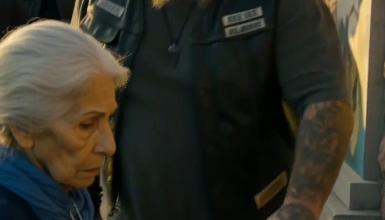
Everyone else wore soft things—pastel dresses, pressed shirts, church shoes, flowered blouses, the careful clothes people saved for milestones they’d imagined for years. He wore heavy boots, dark jeans, and a sleeveless black vest stretched over a gray T-shirt that showed thick tattooed forearms and old scars faded white under the lights. His beard was cut short but rough at the jaw, and his face had that weathered, stern stillness some men carried like armor. He didn’t fidget. Didn’t smile. Didn’t look around nervously the way people do when they know they’re being stared at.
He simply sat down in the front row.
In my row.
I was standing in line with the rest of the graduates near the side entrance, cap pinned too tight over my braids, gown sticking to the backs of my legs. The gym smelled like lemon cleaner, cheap carnations, and somebody’s overdone perfume. Families leaned into aisles with phones already raised. Little brothers climbed bleachers. A toddler in a yellow dress was chewing on a program.
And in all that noise, all that belonging, I noticed the one thing I had trained myself not to notice.
No one had come for me.
Not one empty chair had my name on it. No foster parent from this month. None from last year. No caseworker. No teacher pretending to be “just passing through.” No one waving too hard from the back to make up for it. I had known that might happen. I had prepared for it the way foster kids prepare for birthdays—by lowering the ceiling before disappointment can hit it.
Still, I had looked.
Then I saw him.
The biker sat with his hands on his knees, eyes on the stage, like he had every right to be there.
I had never seen him before in my life.
My friend Tasha, two places ahead of me in line, followed my stare. “Do you know that guy?”
“No.”
“You sure?”
“Yes.”
That should have been the end of it. But then Assistant Principal Dean came hurrying down the aisle with the tight, red-faced look he got whenever anything threatened his perfect public image. Beside him walked one of the security guards, Mr. Ruiz, broad and calm and not yet alarmed, though he was getting there.
Dean bent toward the biker and said something nobody else could hear.
The biker didn’t move.
Not even an inch.
The whispering grew teeth.
A woman in pearls near the aisle turned around and clutched her husband’s wrist. Two rows back, somebody muttered, “This is a school.” Another voice answered, “Call the police if he won’t leave.” Someone else said, “Whose parent even is that?”
Not mine, I thought, and the words landed hard enough to make my throat burn.
Then the biker finally lifted his head.
Just once.
His gaze moved across the stage, then the line of graduates, then settled—briefly, precisely—on me.
It lasted maybe a second.
But it was enough to make the air inside my chest go thin.
Because he wasn’t looking at me the way strangers looked at foster kids when they knew the story. Not pity. Not curiosity. Not some vague polite kindness.
He looked at me like he had come for a reason.
And somehow that was worse.
Mr. Dean straightened, jaw tight. Mr. Ruiz’s hand shifted toward his radio. Near the back of the gym, I heard a woman say, “Oh my God, is he here for one of the girls?”
The line started moving.
Graduation had begun.
And the biker in the front row still hadn’t left.
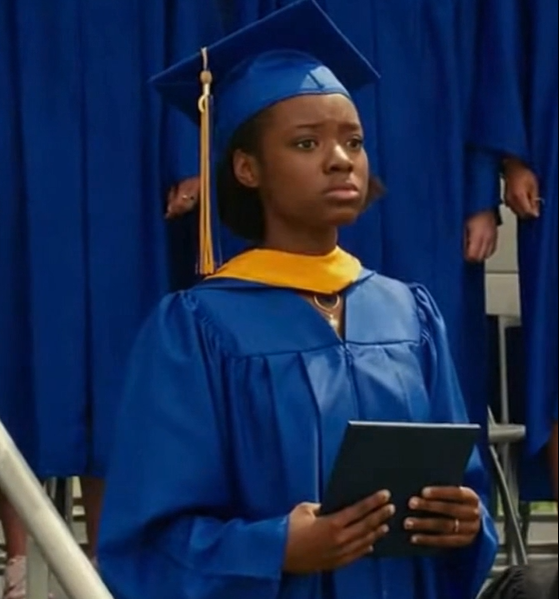
If you’ve never graduated with no one in the crowd, let me tell you what nobody says out loud.
You become hyperaware of everything.
Every bouquet wrapped in plastic. Every balloon knocking lightly against the ceiling. Every parent standing too early for a blurry photo. Every grandmother dabbing her eyes with a tissue. Every family laughing too loud because relief always comes out as noise first.
And every empty space where your own people should have been.
We filed down the center aisle in pairs while the band played something too triumphant for how sick I felt. The gym lights were bright enough to flatten everybody into the same shiny surface, but from where I walked, I could still see him.
Front row. Center section. Hands folded now.
The biker did not clap for anyone.
That made it worse.
When Tasha’s aunt screamed her name and waved a giant foam finger, the whole row around her laughed. When the football captain crossed the stage, people whistled. When the twins got their diplomas back-to-back, their mother cried so hard she had to sit down.
And through all of it, that man sat there like stone.
Twice, Mr. Dean passed near him. Twice, the biker ignored him.
By the time the salutatorian started her speech, nobody was listening to her anymore. Heads kept turning toward the front. A few parents were openly filming the biker now, holding their phones low like they were catching evidence. One man in a blue blazer moved his wife behind him every time he looked over. A little boy asked, loud as a bell, “Mommy, is that a bad guy?”
His mother shushed him too late.
The biker didn’t react.
He had one of those faces that gave nothing away unless you knew how to read it, and nobody in that gym knew how. His shoulders were square. His posture was disciplined, almost military. On the back of his vest, partly hidden by the chair, I could see the edge of a patch stitched in red and gold thread. A motorcycle club, I guessed. Maybe a veterans’ group. Maybe not. At that moment the difference didn’t matter to anyone around him.
He was the wrong shape in a room built for softer things.
When my name was called, I walked on legs that no longer felt attached to me.
“Naomi Carter.”
Applause scattered politely through the gym, the thin kind schools give kids with no cheering section because pity has its own sound. I stepped onto the stage, shook the principal’s hand, took the fake diploma cover, and looked out on instinct even though I had promised myself I wouldn’t.
Most people were looking down at their phones or sideways at the front row.
But the biker was looking directly at me.
Then, in a room where nobody expected him to move at all, he stood.
The scrape of his chair against the floor sliced through the applause.
A woman gasped.
Someone near the back said, “Jesus.”
And before anybody could make sense of it, he reached into the inside pocket of his vest.
Everything stopped.
Mr. Ruiz lunged first, fast enough to knock into the aisle chairs. Another security guard came in from the side wall. Mr. Dean shouted something sharp and useless. A woman screamed. Programs fluttered to the floor. Half the gym rose to its feet because panic spreads quickest through people already primed for it.
From the stage, all I could see was the biker’s hand disappearing into black leather while two guards closed in.
I didn’t think gun at first.
I thought of course.
Of course the one person who stood up for me in that whole room—if he was standing for me—would be the one to ruin it.
Of course my graduation, the one clean thing I had been dragging myself toward for four years and six homes and two shelters and a thousand forms with other people’s signatures, would turn ugly right when my name was still hanging in the air.
Mr. Ruiz grabbed the biker’s wrist.
The gym exploded.
“Get him out!”
“My kids are here!”
“Call 911!”
The biker moved then, not wildly, not like a man trying to fight his way out, but with a force that made the security guards look suddenly smaller than they had a second before. He pulled his arm free, stepped sideways, and turned his body in a way that blocked them from grabbing him again.
A controlled movement. Efficient. Trained.
That detail only made him look more dangerous.
Onstage, the principal was saying, “Please remain calm,” which of course nobody ever does when told to remain calm. A girl behind me started crying. Tasha hissed, “Naomi, get back.”
But I couldn’t move.
Because in the biker’s hand—now visible above the chaos—there wasn’t a weapon.
It was a folded piece of paper.
Just one sheet. Creased and worn soft at the corners as if it had been opened and closed too many times.
He held it up once, high enough for the stage to see, but not for the crowd.
Then he looked at me again.
Only me.
Security reached for him a second time. The biker said something I couldn’t hear. Mr. Ruiz froze—not relaxed, exactly, but confused enough to hesitate. Dean kept shouting. Parents kept filming. The principal glanced toward the side doors where, I guessed, the police had already been called.
And right there, in the center of all that noise, the biker placed the folded paper carefully on the empty chair beside him.
Like it mattered more than his own hands.
I didn’t know why, but that tiny motion hit harder than the shouting.
People who came to cause damage didn’t handle paper like that.
Then he sat back down.
Just sat.
As if he had finished the only movement he meant to make.
The room didn’t know what to do with that. Neither did I.
Mr. Dean leaned toward Mr. Ruiz, furious now, face glossy with sweat. Mr. Ruiz answered without taking his eyes off the biker. One of the teachers came toward the stage stairs, waving for the next students to keep moving, because institutions will continue a ceremony over a crack in the earth if the printed schedule says they should.
My diploma cover was still in my hand.
My name had already been swallowed by the next announcement.
And in the front row, next to a man nobody trusted, sat a folded piece of paper that somehow felt like it had my whole life inside it.
The ceremony should have stopped.
Everybody knew it. Nobody said it that way.
Instead there was this awful American compromise, where adults kept smiling with their mouths while their eyes stayed fixed on the place danger might still come from. The principal returned to the microphone with a trembling voice and announced there had been “a minor disruption.” Parents laughed bitterly at that. More security appeared along the side walls. Someone opened one of the rear gym doors, and hot evening air slid in with the distant wail of sirens.
So yes. Police were coming.
I should have been thinking about getting offstage, about not being the foster girl tangled in some public mess that would live online forever by morning.
Instead I kept staring at the paper on the empty chair beside the biker.
It was ordinary copy paper. White once, now gone almost cream with age. Folded in thirds. No envelope. No seal. Nothing dramatic about it except the way he had protected it.
Tasha caught up with me when we were directed to the side after crossing the stage. “Naomi, seriously, do you know him?”
“No.”
“Then why did he stand up on your name?”
“I don’t know.”
She studied my face and must have seen that I meant it.
“Maybe he’s from your case history,” she said softly, immediately regretting it.
Case history. That was one way to say it. Like I was paperwork with shoes on.
I had been in foster care since I was eight. Some homes were decent. Some were bad in ways that didn’t show bruises. A few people meant well and still left. A few promised too much and left faster. By seventeen, you stop keeping a clean timeline because memory gets heavy when there’s nowhere safe to set it down.
So yes, there were names from the past I didn’t say out loud anymore. Men and women who might have recognized me grown taller. Teachers from old schools. A neighbor from a placement in Wichita. A church volunteer from Tulsa. A social worker from Kansas City. Even the one emergency foster home outside St. Joseph, Missouri, where I’d stayed only eleven days after one placement blew up and before another was found.
Eleven days. That was all.
But as the sirens got closer, something cold walked down my spine.
Because one image, buried deep and stubborn, had started pushing upward through the noise.
A parking lot.
Rain.
A motorcycle.
And a man standing under a flickering motel sign while two adults argued about where I was supposed to sleep.
I hadn’t thought of that night in years.
On the gym floor, Mr. Ruiz crouched beside the biker now, talking low. The biker answered with his head barely turned. No agitation. No apology. Just that same iron stillness. Another security guard reached toward the folded paper on the chair.
The biker’s hand came down over it in an instant.
Not violent. But final.
The guard jerked back.
That did it. A fresh murmur tore through the bleachers. A mother grabbed her son and hustled toward the exit. Someone shouted, “He’s hiding something!” Another voice snapped, “Then remove him already!”
And for the first time, I saw something change in the biker’s expression.
Not anger.
Something harder to watch.
Hurt, maybe. Or disgust. Not at being judged—men like that had probably been judged on sight their whole lives—but at the fact that this, whatever this was, was being dragged into spectacle.
The side door banged open and two police officers stepped inside with their hands visible and their faces set in that careful neutral law enforcement uses when a room is one bad decision from becoming a headline. One officer was young, tight at the shoulders. The other was older, slower, scanning first, deciding where the real temperature was.
Mr. Dean nearly sprinted to them.
He pointed before he even spoke.
The entire gym followed the line of his arm.
Front row. Black vest. Tattoos. Problem identified.
My pulse was so loud I could feel it in my teeth.
The older officer approached first. “Sir,” he said, not unkindly, “I need you to step away from the chair.”
The biker looked up at him.
“No,” he said.
Just that.
No threat. No raised voice. No performance.
Yet somehow that single syllable made everyone around him pull tighter.
The younger officer moved to the side, creating angle and distance. Mr. Ruiz stood up and took two backward steps, palms out, signaling space. Teachers were now guiding graduates farther from the stage, but I stayed near the curtains, half-hidden, unable to leave. Tasha grabbed my elbow once. I shook her off without looking at her.
The officer tried again. “We can talk over here.”
The biker’s gaze flicked to the paper, then to me.
And I knew.
Not what it meant. Not who he was. But I knew with that terrible, skin-deep certainty that whatever was on that page had come for me.
“I need to see it,” the officer said.
The biker’s jaw shifted once. Then he spoke a little louder, enough that I heard every word from the wings.
“It’s hers.”
The gym fell into a silence so sudden it felt staged.
Mine.
He was talking about me.
Every face I could see turned at once.
I have never wanted to disappear more in my life.
Mr. Dean looked furious. The younger officer looked suspicious. A woman in the bleachers actually said, “Oh no,” in the tone people use when they’ve decided the worst version of a story before hearing any facts.
The older officer glanced toward the stage list in the principal’s hand, then toward me. “Naomi Carter?”
My mouth went dry.
I should have stayed still. Let adults handle it. Let procedure do what procedure does, which is usually protect itself first and people later.
Instead I stepped out from behind the curtain.
A hundred heads tracked the movement.
“I’m Naomi,” I said, and my voice sounded smaller than I wanted.
The biker stood again.
Not fast this time. Slowly. Deliberately. Like he understood exactly how bad it looked and hated that it had come to this.
The officers tensed. Mr. Ruiz cursed under his breath. Somewhere in the bleachers, somebody started filming again with both hands.
The biker did not reach inside his vest.
He picked up the folded paper from the chair beside him with surprising care, as though it might tear if he handled it like everything else in his life. Then he held it out toward the older officer, but kept his eyes on me.
The officer took it, unfolded it halfway, then stopped.
His expression changed.
Not enough to explain anything. Just enough to make the room lean forward.
“What is it?” Mr. Dean demanded.
The officer didn’t answer.
Instead he looked at me, then back at the biker, and asked the question that turned every muscle in my body to ice.
“How long has it been,” he said quietly, “since you’ve seen her?”
The biker swallowed once.
When he answered, his voice was rough, controlled, and nowhere near loud enough for anyone who hadn’t gone silent to hear.
“Ten years,” he said.
And that was the moment I understood this man had not come to watch a graduation.
He had come to return something that should have reached me a decade ago.
Nobody in that gym moved.
The older officer held the paper with both hands now, suddenly careful with it, and whatever he was seeing had drained the sharpness out of his face. Mr. Dean tried to step closer, but the officer lifted one palm without even looking at him.
“Not now.”
It was the first useful thing anyone in authority had said all evening.
I stood at the edge of the stage stairs, my diploma cover hanging useless at my side, and watched the biker watch me. He did not smile. He did not reach for me. He looked like a man who had spent a long time rehearsing silence because every other version of this had failed before it began.
The officer folded the paper again, more neatly than before, and walked it over.
“You should read it yourself,” he said.
My fingers didn’t want to work. I took the page anyway.
The paper was old enough to feel soft at the creases. Across the top, in looping handwriting I did not recognize at first, were the words:
For Naomi. When she graduates. If I can’t be there, make sure this gets to her.
The gym blurred.
I looked up so fast my cap shifted.
The biker still hadn’t moved.
Beneath the first line was a signature.
Not his.
Elena Carter.
My mother.
The world did not stop dramatically the way people claim it does in stories. It narrowed. That was worse. Sound pulled away from me in ragged strips until all I could hear was the blood rushing inside my ears and the squeak of somebody’s shoe across the floor fifty feet away.
My mother had been dead for ten years.
That was the fact I had carried. The official fact. The state fact. The version adults gave me when I was eight and nobody wanted to explain why I was being moved in the middle of the night with a trash bag full of clothes and a backpack missing its zipper.
I looked back down.
The rest of the letter was short. My mother’s writing slanted harder in some places, like she’d been tired, or rushed, or trying not to let her hand shake.
She wrote that if I was reading it, then I had done the one thing she had begged life to let me do: make it to the end of school. She wrote that I was never hard to love, no matter what anyone said after. She wrote that there had been a man named Gabriel who had promised her, in a hospital hallway that smelled like bleach and old coffee, that if she couldn’t stay, he would look for me when the time was right.
At the bottom, there was one more line.
He was there the night you thought no one came.
My knees nearly gave out.
And just like that, the memory came back whole.
Not a motel. Not exactly. A roadside motor lodge outside St. Joseph, Missouri, in November 2016. Cold rain. Flashing ambulance lights bleeding red across wet pavement. My mother on a stretcher, trying to lift her head. Two county workers arguing under the awning because the emergency placement had fallen through. Me standing in socks on the curb, holding my backpack to my chest.
And a biker.
He had taken off his gloves because I was crying too hard to answer questions. He had crouched, not too close, and handed me a packet of crackers from a gas station. Then later, when the adults were distracted, my mother had called him to her side.
I never heard what she said.
I only remembered the patch on his vest. Red and gold thread. The same one half-hidden by the folding chair tonight.
My mouth opened, but the only word that came out was, “Gabriel?”
The biker gave one slow nod.
That was all.
But it changed his face. Not softened it. Revealed it.
He wasn’t a stranger.
He was the man from the rain.
By then the ceremony had stopped pretending to continue.
The principal had stepped away from the microphone. Parents were standing in clusters, unsure whether to be embarrassed or curious. A few people were still filming, but most had lowered their phones, caught in that awkward human moment when judgment starts curdling into shame.
I walked down the stage stairs before anyone could stop me.
Nobody blocked me. Not the officers. Not security. Even Mr. Dean, finally sensing the room had turned against him, said nothing.
Gabriel stayed where he was until I reached the row in front of him. Up close, he seemed older than I had guessed at first—late fifties, maybe—his eyes pale with tiredness, his shoulders carrying the kind of restraint that looked less like toughness and more like practice. There was a scar near his temple I didn’t remember, and another along one knuckle. His hands were clean. His boots were polished. He looked like a man who still believed showing up properly mattered, even if no one welcomed him when he did.
“You kept it,” I said, holding the letter like proof.
“For ten years.”
His voice was low, roughened by age or engines or both.
“Why didn’t you send it?”
That question had lived in me for years without a name. Why didn’t anyone tell me? Why didn’t anyone come back? Why was every goodbye allowed to harden into silence?
Gabriel glanced at the officers, then back at me. “I tried.”
No dramatics. Just truth.
He told it in pieces because that was the kind of man he was.
He had known my mother through a veterans’ outreach shelter in Kansas City where she worked nights after leaving an abusive relationship. Gabriel had been there helping fix bikes for a fundraiser and doing transport runs for women who needed rides the police could not give safely. My mother had trusted him because he asked nothing from her.
After the accident—black ice on Interstate 29, three cars, one semi, and too much bad luck—she had handed him the letter and made him promise. But the state moved me fast. Emergency placement. File errors. County transfer. Wrong addresses. Closed records. Then foster rules tightened. Names disappeared behind paperwork. He followed what he could. Lost the trail. Picked it up again years later. Lost it once more.
“I found your school last month,” he said. “Didn’t trust mail with something like this.”
So he had come himself.
All that fear. All that spectacle. All those whispers.
And the man had only come to keep a promise.
My throat hurt too much to swallow. “Why the front row?”
A flicker passed through his face. Not quite a smile.
“Wanted you to see at least one person there for you.”
That did it.
Not because it was sentimental. It wasn’t. He said it like a fact, stripped clean of pity. As if he had noticed the empty seats before I had and decided, with the blunt logic of men who fix what they can, that emptiness should not be the loudest thing in the room.
Behind me, I heard someone begin to cry quietly. Tasha, I thought. Or maybe one of the teachers. It didn’t matter.
For the first time that evening, the gym had gone still for the right reason.
I thought that was the whole truth.
It would have been enough.
Then Gabriel reached into the inside pocket of his vest again, slowly this time, every movement announced by the room’s attention. The younger officer tensed out of habit, then visibly checked himself.
Gabriel pulled out a small velvet box worn thin at the corners.
He held it but did not open it until I nodded.
Inside was a silver ring on a fine chain.
Not expensive. Not flashy. The stone was tiny, cloudy with age, the kind of thing bought by people measuring love in weeks of overtime. I knew it instantly anyway, though I had not seen it since childhood.
My mother used to wear it on a chain when she worked.
“She gave me this too,” Gabriel said. “Told me it was yours when you were old enough.”
I stared at the ring, but he wasn’t finished.
“There’s one thing she asked me not to tell you unless I could say it face-to-face.”
The whole gym seemed to lean in again, but now nobody was judging. They were witnessing.
Gabriel looked down once before meeting my eyes.
“I’m not your father,” he said, and the words landed strangely because I had never imagined they might need saying. “But the man who was… he died before he knew where you were. He had been looking.”
I could not breathe.
My mother had never spoken about my father except once, in fragments, when she thought I was asleep. I had grown up with the clean, defensive story foster kids learn to build around missing people: if they loved you, they would have stayed; if they didn’t stay, don’t ask.
Gabriel’s voice stayed even.
“Your mother left him before you were born. She had reason. Later, he got sober. Joined a recovery program. Tried to find you both. By then she was hiding. Then she was gone. He found me through the outreach shelter three years after the accident because Elena had written my name down on an intake card once. He kept asking if I’d heard anything. He sent money twice for your school clothes when he thought I might have a lead. I sent it back when I didn’t.”
He paused.
“He died in 2022. Cancer. Before he died, he asked one thing. If I ever found you, tell you he was late for the right reasons and absent for the wrong ones.”
The gym did not make a sound.
That was the twist that hollowed me out.
Not that there had been some perfect father waiting just offstage all along. Life wasn’t that generous. It was worse, and more human. There had been damage. Fear. Addiction. Lost years. Failed attempts. A man becoming better too late to repair what he had broken, but not too late to grieve it.
And another man—one with no blood claim at all—who carried the promise anyway.
I looked at Gabriel and finally understood the real shape of what he had done. Not one night in the rain. Not one appearance at a graduation.
Ten years of trying without asking to be thanked.
Ten years of keeping my mother’s handwriting from being lost to mildew, moves, fire, theft, weather, and time.
Ten years of refusing to let me become fully abandoned in the official version of my own life.
The principal eventually said something into the microphone about resuming the ceremony, but nobody cared much about ceremony anymore.
What I remember is smaller.
Gabriel stepping back, as if the truth itself required room.
The older officer touching two fingers to the brim of his cap before walking away.
Mr. Ruiz muttering, “Should’ve listened first,” to nobody in particular.
Tasha appearing at my side, tear-streaked and furious on my behalf in the tender way only best friends can manage.
And then, when the names were done and the crowd began to loosen into end-of-evening noise, something happened I had not prepared for.
People started clapping.
Not the big explosive applause of speeches and trophies. Something warmer. Uneven at first. Then spreading.
Not for the interruption.
For him.
Gabriel did not turn around to receive it. He looked uncomfortable, almost trapped by it. He gave one brief nod, then looked at me instead, as if asking whether he had done enough or too much.
I walked back to the stage when they called the graduates for the final tassel turn. This time, when I looked into the crowd, there was no empty front row.
Gabriel sat exactly where he had chosen to sit from the beginning, hands folded, face unreadable except for the smallest lift in his chin.
Present.
Afterward, in the parking lot behind the gym, families clustered under the orange wash of the streetlights taking photos beside pickup trucks and minivans. A warm Missouri wind pushed discarded programs along the curb. Someone somewhere was laughing too loudly. Someone else was already talking about dinner reservations.
I stood beside Gabriel’s motorcycle, still in my gown, holding my cap in one hand and my mother’s letter in the other.
He took a step toward the bike, then stopped. “You need a ride somewhere?”
It was such a careful question. No assumption in it. No claim.
I almost laughed.
“I aged out last month,” I said. “I’ve got a dorm room at community college this summer. Full scholarship after that, if I keep my grades.”
He nodded once, pride kept tightly under control.
“Good.”
We stood there in the sound of cooling engines and far-off voices.
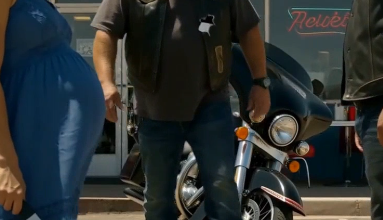
Then, without making it into a speech, without trying to become something dramatic, Gabriel reached into his saddlebag and took out a small paper-wrapped bouquet. Grocery store flowers. White daisies and cheap greenery tied with blue ribbon.
“Didn’t know if anybody else would bring any,” he said.
That nearly broke me more than the letter.
I took them. “Thank you.”
He tipped his head toward the flowers, then toward the chain in my palm. “Keep both.”
I did.
Before he put on his helmet, I asked the only question left.
“Will I see you again?”
Gabriel looked at me for a long moment, like he understood how dangerous hope could be when you’d lived without it too long.
Then he gave the kind of answer a reliable man gives.
“If you want to.”
Not I promise forever. Not I’m your family now. Nothing swollen with performance.
Just a door left honestly open.
He kicked the bike to life. The engine rolled low through the parking lot, deep enough to feel in my ribs. I stepped back, holding the daisies against my gown. Gabriel pulled away slowly, no theatrics, no roaring exit, and paused once at the edge of the lot when the light caught him.
He lifted two fingers from the handlebar.
Then he was gone.
I stood there until the taillight disappeared.
Later that night, alone in my dorm room with cinderblock walls and one narrow bed, I laid the letter flat on the desk and placed the silver ring beside it. The bouquet leaned in a plastic cup near the window. Outside, somebody on campus was shouting and laughing and living like summer had already begun.
I read my mother’s words three more times.
Then, for the first time in years, I stopped trying to remember my life as a list of people who left.
And started remembering it as proof that one of them had tried to come back, and one of them—who owed me nothing—actually did.