Part 2: A Boy Was Mocked Because His Father Cleaned Sewers — His Essay Left the Teacher in Tears
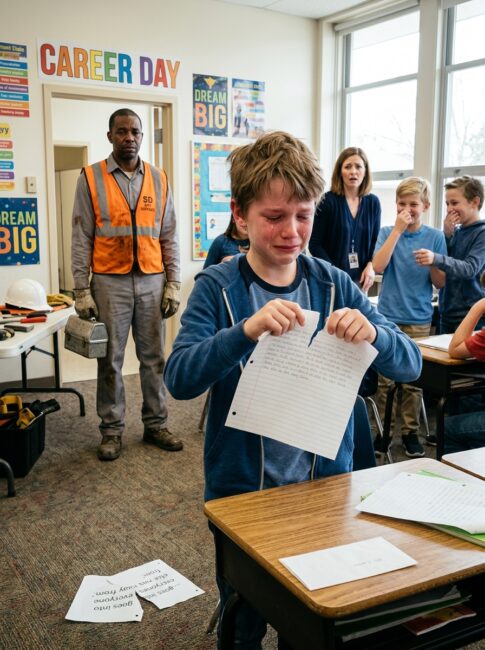
For several seconds, no one moved.
Eli bent down quickly, collected the torn pages, and pushed them beneath his notebook.
His teacher watched him with concern.
Ms. Bennett had taught fifth grade for thirteen years. She had seen children become embarrassed by old clothes, secondhand backpacks, and parents who spoke with heavy accents.
But Eli had never reacted like that before.
He was usually quiet and careful. He sharpened his pencils before class began. He returned library books early. He stayed after school whenever someone needed help cleaning paintbrushes.
That morning, however, his hands were trembling.
Ms. Bennett turned toward the hallway.
Marcus Carter was already gone.
Through the classroom window, she saw him crossing the school parking lot toward a white city maintenance truck. A faded magnet on the door read:
DAYTON PUBLIC WORKS — WASTEWATER MAINTENANCE
Tyler leaned toward another student.
“My mom says those guys climb into toilets for a living.”
Ms. Bennett faced the class immediately.
“That is enough.”
Her voice was sharper than usual.
Tyler lowered his eyes, although a smile remained at the corner of his mouth.
Career Day continued.
A cardiologist demonstrated a stethoscope. A real estate agent passed around miniature house-shaped keychains. A firefighter explained how quickly smoke could fill a bedroom.
Eli did not look up once.
At lunchtime, Ms. Bennett found him sitting alone near the playground fence.
His food remained inside the metal lunchbox Marcus had left beside his chair.
She sat on the bench a few feet away.
“Your dad packed something for you.”
Eli shrugged.
“He always does.”
Ms. Bennett waited.
Children rarely filled silence when adults rushed to fill it first.
After a moment, Eli opened the lunchbox.
Inside was a turkey sandwich wrapped in wax paper, a small apple, and a folded note written on the back of a city work order.
Sorry I could not stay, buddy. Big rain coming. Eat the apple first. Dad.
Eli turned the note over before Ms. Bennett could read the printed side.
“You can finish your essay another day,” she said.
“I already finished it.”
“You do not have to read it aloud.”
Eli looked toward the muddy prints his father’s boots had left near the classroom entrance.
“They would still laugh.”
Ms. Bennett considered telling him that other people’s laughter did not matter.
The words seemed too easy.
Before she could respond, the school custodian hurried across the playground toward the main building.
Mr. Holloway was nearly sixty and rarely moved quickly. That afternoon, he was carrying a flashlight and speaking urgently into his phone.
Ms. Bennett stood.
“What happened?”
“Storm drain behind the cafeteria is backing up,” he said. “Water is already rising near the loading dock.”
The sky had darkened beyond the school roof.
A low roll of thunder moved across the playground.
Mr. Holloway looked toward the parking lot.
“Marcus still here?”
“I thought he left.”
“He never leaves when rain is coming.”
Eli looked up.
Mr. Holloway noticed him and softened his voice.
“Your father knows every line under this building better than anyone in the city.”
Another custodian pushed open the rear door.
“Water is coming through the kitchen floor.”
Mr. Holloway hurried away.
Ms. Bennett turned toward Eli.
He was no longer staring at the ground.
He was watching the maintenance truck parked near the cafeteria, where Marcus had already removed his orange vest and pulled on waterproof coveralls.
For the first time that day, Eli looked less embarrassed than frightened.
“He should not go down there alone,” he whispered.
Ms. Bennett followed his gaze.
Marcus lifted a steel cover behind the cafeteria and crouched beside the opening. Rain began to strike the pavement around him.
A second city worker had not yet arrived.
Ms. Bennett placed one hand gently on Eli’s shoulder.
“Does he do this often?”
Eli nodded.
“When everybody else goes home.”
The rain arrived faster than the forecast predicted.
Within minutes, water rushed across the parking lot and gathered near the cafeteria doors. Teachers guided students toward the gym while staff members stacked towels along the hallway.
Marcus remained outside.
He connected a thick hose to the maintenance truck, then knelt beside the open drain. His movements were practiced and steady, despite the rain running down his face.
Mr. Holloway returned carrying a toolbox.
“Main line is blocked,” he told Ms. Bennett. “If it pushes backward, we could lose the cafeteria and the first-floor classrooms.”
“Can the children stay inside?”
“For now.”
Through the gym windows, Eli watched his father work.
Several classmates gathered nearby.
Tyler stood behind them, unusually quiet.
A second maintenance truck finally turned into the parking lot. A Black American man in his late 40s climbed out and hurried toward Marcus.
“Sorry, brother,” he called. “Eastwood flooded first.”
Marcus nodded and pointed toward the drain.
“Roots caught something. I need the smaller cutter.”
The worker opened the equipment compartment.
Ms. Bennett had expected Marcus to seem different outside the classroom, perhaps louder or more confident.
He did not.
He remained the same man who had apologized for his boots.
He simply knew what needed to be done.
Eli held the torn essay pages in both hands.
One piece had become wrinkled from his grip.
Tyler glanced toward the paper.
“What did you write?” he asked.
Eli did not answer.
A sudden metallic sound came from outside.
The hose jerked sharply across the pavement.
Marcus stepped backward, then reached for the control valve before it struck the side of the truck. Mr. Holloway shouted something Ms. Bennett could not hear through the glass.
Eli moved closer to the window.
“He hurt his hand last year doing that.”
Ms. Bennett looked at him.
“How do you know?”
“I saw the stitches.”
He unfolded one piece of the essay.
“He tells me not to worry because he wears gloves. But sometimes the gloves do not stop everything.”
Outside, Marcus wrapped one hand briefly with a cloth, then returned to the drain.
Ms. Bennett crouched beside Eli.
“May I read your essay?”
Eli hesitated.
“You do not have to read it to the class,” she said. “I would only read it myself.”
Slowly, he handed her the torn pages.
The writing had been done in pencil. Several words had been erased and rewritten carefully. One paragraph continued across a ripped edge, forcing Ms. Bennett to align the pages with her fingertips.
The title was simple.
The Job Nobody Wants
Ms. Bennett began reading.
My dad cleans sewers for the city. Some people laugh when they hear that. Some people make faces because sometimes he smells bad when he gets home. My dad always showers before dinner, even when he is tired. He says dirty clothes should not sit on the couch because my mom picked that couch.
Ms. Bennett paused.
She knew Eli’s mother had died three years earlier. Cancer had taken her slowly, leaving Marcus to raise their son alone.
She continued.
My dad did not always have this job. He used to fix heating systems with my uncle. When my mom got sick, he needed a city job with health insurance. He took the first opening they had. It was underground maintenance.
Ms. Bennett looked toward Eli.
He stared through the window, watching his father.
The essay continued.
My mom told him she was sorry he had to do work people looked down on. My dad told her there was no work to look down on if it kept somebody safe. After she died, he could have gone back to his old job. He stayed because he said the city still needed people willing to go down there.
Outside, the hose began vibrating again.
Marcus and the second worker pulled together, guiding a mass of roots and soaked debris toward the surface.
Water surged around their boots.
Ms. Bennett kept reading.
My dad knows where the old people live on our street. Before storms, he checks the drains near their houses because some of them cannot carry things upstairs. He never tells them he does it. He says you do not need to scare people with problems you can fix quietly.
Ms. Bennett blinked hard.
Something about that sentence reached into a memory she had not visited for years.
Four summers earlier, a storm had flooded the neighborhood where her mother lived alone.
Ms. Bennett had been trapped on the highway behind stalled traffic, calling her mother repeatedly and receiving no answer.
By the time she reached the house, the rain had slowed.
A city worker in soaked coveralls was clearing branches from the curb. Water that had nearly reached the porch was draining steadily toward the street.
Her mother was safe inside.
The worker refused the cash Ms. Bennett offered him.
He only asked whether her mother needed help moving anything heavy.
At the time, darkness and rain had hidden most of his face.
Ms. Bennett looked through the gym window.
Marcus Carter wore the same battered wristwatch.
Her hands began to tremble.
She returned to Eli’s essay.
Last winter, my dad found a little red mitten inside a drain near Jefferson Avenue. He washed it in our sink and drove back after work because he thought a kid might be missing it. He found the other mitten hanging on a fence. He clipped them together so somebody would see them.
A tear landed on the paper.
Ms. Bennett wiped it quickly, but another followed.
The final paragraph was shorter.
I used to wish my dad had a job I could explain without people laughing. Now I think maybe the best jobs are the ones people only notice when nobody does them. My dad goes into places everyone else runs away from. Then he comes home, washes his hands, and makes my lunch for the next day.
Ms. Bennett lowered the pages.
Around her, the gym had become quiet.
She had not realized she was reading aloud.
Students, teachers, and several parents had gathered behind her.
Eli turned slowly.
His face reddened when he saw the crowd.
Ms. Bennett stood, pressing the pages gently together.
“I am sorry,” she whispered. “I should have asked before reading the rest.”
Eli looked toward the window.
Outside, the water near the cafeteria door had begun to recede.
His father was kneeling beside the drain, gathering tools beneath the rain.
Eli shook his head.
“It is okay.”
Tyler stared at the floor.
“My basement flooded last year,” he said quietly. “My dad said the city guys came at midnight.”
Eli did not respond immediately.
Then he folded the torn essay and returned it to his pocket.
Marcus entered the gym several minutes later.
His uniform was soaked. Mud marked his sleeves. A shallow cut crossed the back of one hand.
The sour smell returned with him.
This time, no one laughed.
Mr. Holloway walked beside him.
“Line is clear,” he announced. “School stays open tomorrow.”
A few teachers began clapping.
Marcus looked uncomfortable and raised one hand.
“Please do not do that. We just cleared a pipe.”
Ms. Bennett stepped forward holding a clean towel.
“You did more than that.”
Marcus glanced toward Eli.
His son stood near the window, surrounded by classmates who were no longer covering their noses.
Marcus seemed to understand that something had changed.
He accepted the towel quietly.
Then Eli walked across the gym and handed him the apple from his lunchbox.
“You forgot your snack,” Eli said.
Marcus smiled.
“I thought I packed that for you.”
“You need it more.”
Marcus rubbed the apple against the cleanest part of the towel and placed it inside his vest pocket.
“Thank you, buddy.”
Eli looked at the cut on his father’s hand.
“You should let somebody check that.”
Marcus nodded.
“Yes, sir.”
The following Monday, Ms. Bennett returned Eli’s essay in a clear folder.
She had carefully aligned the torn edges, but she had not taped them together.
Some things did not need to be hidden to remain whole.
At the top of the first page, she had written:
Thank you for trusting us with this.
Eli read the note twice before slipping the folder into his backpack.
Career Day had ended differently than anyone expected.
The physician packed away his stethoscope. The real estate agent collected the remaining keychains. The firefighter returned to the station before the rain became heavier.
Marcus had left through the rear entrance after the school nurse cleaned the cut on his hand.
He did not stand in front of the classroom or explain his work.
He did not give a speech.
Before leaving, he only asked Mr. Holloway to call if water returned near the cafeteria.
During recess, Tyler approached Eli near the basketball court.
He held something behind his back.
“I found this in my room,” he said.
It was a pair of thick work gloves, still wrapped in plastic.
“My dad bought extras for the garage. He said maybe your dad could use them.”
Eli studied the gloves.
“Your dad knows these are not the right kind.”
Tyler looked embarrassed.
“I know. I just thought…”
Eli took them gently.
“He can use them when he fixes our fence.”
Tyler nodded.
For several seconds, neither boy spoke.
Then Tyler asked whether Eli wanted to join the basketball game.
Eli placed the gloves beside his backpack and followed him toward the court.
Later that afternoon, Ms. Bennett drove across town to visit her mother.
The rain had washed the streets clean. Leaves and small branches still gathered near several curbs.
Her mother was sitting near the front window with a knitted blanket across her knees.
Ms. Bennett carried groceries into the kitchen, then stepped outside again.
Near the end of the driveway, the storm drain was clear.
A few wet leaves had been moved carefully into a small pile beside the curb.
Her mother opened the door behind her.
“That city worker came by yesterday morning,” she said.
Ms. Bennett turned around.
“Marcus?”
“I never remember his name. The quiet man with the old watch.”
Her mother smiled faintly.
“He always checks after a heavy rain. He thinks I do not notice.”
Ms. Bennett looked down the street.
No maintenance truck remained in sight.
The following Friday, Roosevelt Elementary displayed several student essays on a bulletin board outside the library.
Eli agreed to share his work, but he requested one change.
He removed his name from the page.
When Ms. Bennett asked why, he looked toward the window, where sunlight stretched across the clean hallway floor.
“My dad says the work matters more than the name.”
Ms. Bennett nodded, although her eyes filled again.
That evening, Marcus returned home after sunset.
He placed his boots on the mat beside the door and carried his stained uniform toward the laundry room. The house smelled faintly of tomato soup.
Eli sat at the kitchen table finishing his homework.
Marcus noticed the clear folder beside his backpack.
“They return your essay?”
Eli nodded.
“How did it go?”
Eli considered the question.
“Ms. Bennett cried.”
Marcus stopped.
“Was it that bad?”
Eli laughed softly.
“No. She liked it.”
Marcus opened the refrigerator and reached for the milk.
After a moment, Eli spoke again.
“Dad?”
“Yeah, buddy?”
“Are you embarrassed when people know what you do?”
Marcus closed the refrigerator door.
He looked tired. There were shadows beneath his eyes, and a small bandage covered the cut on his hand.
Still, he took the question seriously.
“Sometimes I wish I smelled better when I walk into a room,” he said.
Eli smiled.
Marcus sat across from him.
“But no. I am not embarrassed.”
“Even when people laugh?”
Marcus looked toward the boots near the door.
Mud had dried in the deep lines of the soles. Tomorrow, he would scrub them before his next shift.
“People usually laugh at the part they can see,” he said. “They do not always know what is underneath.”
Eli thought about that sentence.
Then he pushed his homework aside and opened his lunchbox.
Inside was a sandwich, an apple, and a folded note written on the back of another city work order.
Proud of you, buddy. Eat the apple first. Dad.
Eli placed the note carefully inside the clear folder with his torn essay.
In the hallway, Marcus’s boots waited quietly beside the door, ready for another place most people would never have to see.
Follow our page for more heartfelt stories about the quiet people whose work keeps the rest of us safe.