Part 2: The Poor Woman Sitting Quietly at the Back of the Plane — What She Did for a Stranger’s Child Left the Entire Cabin in Tears
A few minutes earlier, Margaret had been almost invisible.
She sat in seat 34A, pressed against the window in the final row, with her canvas bag resting carefully beneath her feet.
Her coat had belonged to her older sister before it became hers. The sleeves were slightly short, and one button had been replaced with a mismatched black one.
When the flight attendant offered snacks, Margaret accepted only water.
“Nothing else?” the attendant asked.
Margaret smiled. “Water is enough, thank you.”
The man seated beside her noticed the unopened granola bar inside her bag. It had been packed inside a clear plastic sandwich bag along with an apple and two crackers.
Margaret did not touch any of it.
She checked the small digital clock on her wrist several times, then looked out the window as Atlanta disappeared beneath the clouds.
Near the middle of the cabin, the boy sat beside his father.
His name was Noah Bennett.
He had curly brown hair, a green sweatshirt, and a small laminated card clipped to his backpack. His father, Daniel, carried the tired expression of a man who had not slept properly in weeks.
Before takeoff, Noah asked the same question several times.
“When will we see Mom?”
“In a few hours,” Daniel answered each time.
“And she will be there?”
“She promised.”
Daniel kept one hand on Noah’s backpack and the other wrapped around his phone.
His screen showed a hospital message he had already read too many times.
Patient is stable. Please travel safely.
Noah did not understand why his mother was in Denver. He only understood that she had left suddenly three days earlier, and adults had begun speaking quietly whenever he entered the room.
The first stretch of the flight was calm.
Then the aircraft entered a patch of rough air over Missouri.
The plane dipped once.
A plastic cup slid across a tray table.
Noah grabbed the armrests.
Daniel leaned closer. “You are safe. It is only turbulence.”
But another jolt followed.
Noah’s breathing changed.
He pressed both hands against his ears and began rocking in his seat.
Daniel searched beneath the seat in front of him, then opened the backpack with growing panic.
“It has to be here,” he whispered.
He pulled out coloring books, a small tablet, headphones, and an extra sweatshirt.
The item he needed was missing.
Noah’s cloth airplane had disappeared somewhere between the airport security line and the gate.
Daniel tried the headphones.
Noah pushed them away.
He tried the tablet.
Noah could not look at the screen.
The boy’s cries grew louder as the plane shook again.
Some passengers watched with sympathy.
Others did not.
A woman across the aisle sighed and placed both hands over her ears. A man in a business jacket turned toward Daniel.
“Can you calm him down?” he asked.
Daniel’s face tightened.
“I am trying.”
At the back of the plane, Margaret heard the child crying.
She closed her eyes for a moment.
Then she reached beneath the seat and pulled the canvas bag onto her lap.
Her fingers moved past the granola bar and the apple. They touched a folded envelope, a small wooden box, and a cloth airplane with blue wings.
Margaret held the airplane for several seconds.
She did not stand immediately.
Instead, she ran her thumb over the uneven stitching on one wing as though asking herself a difficult question.
Then Noah cried out again.
Margaret rose from her seat.
The flight attendant tried to stop her because the seat belt sign remained on. Margaret apologized but continued moving carefully through the cabin.
She knew what frightened children sounded like.
She also knew that sometimes a familiar shape could reach a child before words could.
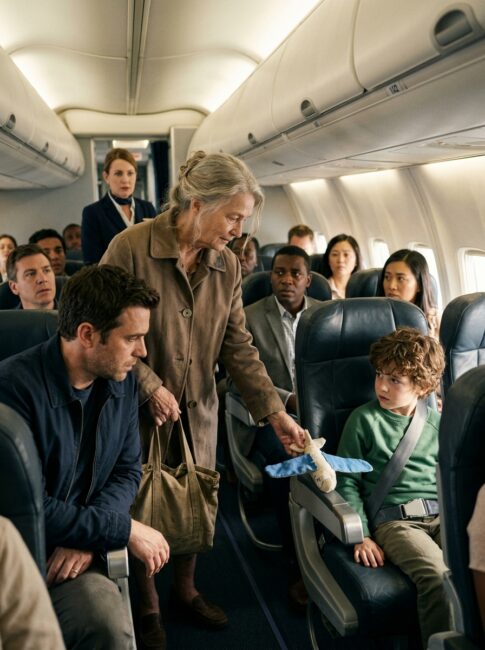
When Margaret placed the handmade airplane on the empty seat beside Noah, his cries softened.
He stared at the blue wings.
The plane looked almost identical to the one he had lost.
Not because it came from a store.
Because both airplanes had been sewn by the same person.
Daniel picked it up slowly.
His expression changed as he turned the cloth toy over and saw a tiny embroidered letter beneath one wing.
E.
He looked at Margaret.
“Where did you get this?”
Margaret held the seatback for balance.
“My daughter made it,” she said.
Daniel looked at the toy again.
Then at Noah.
Then back at Margaret.
“What was your daughter’s name?”
Margaret swallowed before answering.
“Emily.”
Daniel stopped speaking.
For several seconds, the sounds inside the cabin seemed distant. The engines continued their steady hum, but something quieter had entered the row.
Noah held the blue airplane against his chest.
Margaret remained in the aisle, waiting for the turbulence to ease.
Daniel studied her face carefully.
“Emily Hale?” he asked.
Margaret nodded.
Daniel looked as though the answer had removed the air from his lungs.
“My wife talks about her all the time.”
Margaret gripped the seatback more tightly.
“Your wife is Rachel?”
Daniel nodded.
The flight attendant approached again, but her voice softened when she saw Noah sitting quietly.
“Ma’am,” she said, “we can help you return to your seat.”
Margaret hesitated.
Noah reached for her hand.
“Stay until the bumps stop,” he whispered.
Margaret looked toward Daniel.
He moved his backpack aside and gestured toward the empty aisle seat across from them.
“Please,” he said.
Margaret sat down.
She hummed the melody again.
Noah held the handmade airplane and watched her as though he was trying to remember something he had once heard in a dream.
Daniel lowered his voice.
“How did you know the song?”
“Emily used to sing it when she was nervous,” Margaret said. “I suppose she sang it to other people, too.”
Daniel stared at the small embroidered letter.
Rachel Bennett had worked with Emily Hale at a community children’s center in Atlanta.
Rachel was a speech therapist. Emily was a classroom aide who spent most of her time with children who struggled to communicate during overwhelming moments.
She did not speak loudly.
She did not rush children.
She sat nearby and waited until they trusted her enough to come closer.
During lunch breaks, Emily sewed small cloth airplanes from fabric scraps. The toys were soft, easy to carry, and simple enough for anxious hands to hold tightly.
Noah received one on the first day Rachel brought him to the center.
He was four years old then.
He had refused to enter the classroom.
Emily sat on the floor several feet away and rolled a cloth airplane gently across the carpet.
Noah picked it up.
By the end of the afternoon, he had allowed Rachel to leave the room for almost ten minutes.
The toy became part of his daily life.
He slept with it beside his pillow. He carried it to medical appointments. He held it whenever airports, crowded stores, or unfamiliar rooms became too loud.
Daniel looked toward the toy in Noah’s hands.
“I thought his airplane was the only one.”
Margaret gave a small smile.
“Emily made dozens.”
The smile faded as quickly as it appeared.
“She kept the first one.”
Daniel studied Margaret’s worn coat and canvas bag.
“Why do you have it with you?”
Margaret looked down at her hands.
“I was bringing it to Denver.”
She reached into the bag and removed the folded envelope.
The paper had been opened and closed many times. A Denver address was written carefully across the front.
Emily had died eight months earlier after a brief illness.
She was thirty-six.
The diagnosis came late. Treatment moved quickly, then stopped working more quickly than anyone expected.
For months after the funeral, Margaret could not bring herself to sort through Emily’s apartment.
She left the books on the shelves.
She kept the coffee mug near the sink.
She did not move the sewing basket from the small table beside the window.
When she finally opened it, she found several unfinished airplanes, pieces of blue fabric, and a notebook filled with names.
Some pages contained reminders.
Maya likes yellow thread.
Jordan needs a larger loop for his backpack.
Noah squeezes the left wing when he feels overwhelmed. Reinforce the seam.
Margaret had read that final note more than once.
Daniel looked at the blue airplane in Noah’s hands.
Without thinking, Noah had wrapped his fingers around the left wing.
The reinforced seam remained firm.
Margaret opened the wooden box from her canvas bag.
Inside were several cloth airplanes made from different scraps of fabric.
“Emily wanted the center to have them,” she said. “I could not afford to mail everything, and I needed to deliver some papers in person.”
Daniel glanced at the address on the envelope.
It belonged to a pediatric rehabilitation hospital in Denver.
Rachel had recently accepted a temporary position there because her younger sister needed emergency surgery. Daniel and Noah were traveling to join her.
Margaret was on the same flight for a different reason.
The hospital had agreed to start a small sensory-support corner in Emily’s memory. Margaret was bringing the first toys herself.
She had saved for the plane ticket for months.
The canvas bag contained nearly everything she had prepared.
The cloth airplane she gave Noah was different.
It was the first airplane Emily ever made.
The stitches were uneven because Emily was still learning. One wing tilted slightly upward. The embroidered letter beneath it was not a child’s initial.
It stood for Emily.
Daniel understood before Margaret explained.
“You were keeping this one,” he said.
Margaret looked at Noah.
“I thought I was.”
Noah pressed the airplane against his green sweatshirt.
His breathing had settled.
Outside the window, the clouds began to thin.
Daniel rubbed one hand across his face.
“Mrs. Hale, he has another airplane at home. We can return this one.”
Margaret shook her head gently.
“He needs this one now.”
“But it belonged to Emily.”
Margaret looked toward the small boy holding the toy her daughter once stitched with uncertain hands.
“It still does.”
The flight attendant stood nearby, listening quietly.
A passenger in the row behind them lowered his eyes. The woman who had covered her ears earlier removed her hands and looked toward Noah with an expression that had changed completely.
The plane leveled out.
The seat belt sign remained illuminated, but the worst turbulence had passed.
Noah looked at Margaret.
“Did Emily make this for me?”
Margaret considered the question.
“She made it because she knew someone might need it.”
Noah nodded as though the answer made perfect sense.
Daniel looked at Margaret’s canvas bag.
“You did not eat your snack,” he said.
Margaret glanced toward the granola bar and apple inside the clear plastic bag.
“I was saving them.”
“For later?”
“For the airport,” she answered. “Denver is a long day when you are trying not to spend extra money.”
Daniel started to speak, but Margaret seemed to anticipate the offer.
“I have enough,” she said softly.
A few minutes later, the flight attendant returned with a tray.
She placed a hot meal, tea, and a small container of fruit on Margaret’s tray table.
“I did not order this,” Margaret said.
The attendant nodded toward the front of the cabin.
“Someone else did.”
Margaret turned.
Several passengers quickly looked away, pretending to read or adjust their seat belts.
A man in a business jacket stared down at his hands.
No one announced what they had done.
No one made a speech.
Margaret removed the lid from the tea and let the warmth reach her face.
Across the aisle, Noah held Emily’s airplane beneath his chin and watched the clouds pass beyond the window.
When the plane landed in Denver, passengers stood slowly and reached for their bags.
For once, no one seemed eager to rush toward the aisle.
Daniel waited until Margaret had placed the wooden box securely inside her canvas bag. Then he lifted it into the overhead bin for her without asking.
Noah remained beside the window, holding the blue airplane.
“Can Miss Margaret walk with us?” he asked.
Margaret smiled. “I am going to the same hospital.”
At the baggage claim, Rachel Bennett was waiting near the sliding doors.
She wore a navy sweater, hospital identification badge, and the exhausted expression of someone who had been trying to appear strong for too long.
Noah ran toward her first.
Rachel crouched and wrapped both arms around him.
Then she noticed the blue airplane.
Her expression changed.
She looked beyond Daniel and saw Margaret standing several feet away in the worn brown coat, holding the faded canvas bag with both hands.
Rachel covered her mouth.
“Mrs. Hale?”
Margaret nodded.
Rachel walked toward her slowly.
“I wrote to you,” she said. “I did not know whether the letter reached you.”
“It did.”
“I wanted to come to Atlanta after Emily passed.”
“I know.”
Rachel’s eyes filled.
“She stayed late with Noah so many times. She never acted as though he was difficult. She always made him feel like he simply needed a little more room.”
Margaret looked toward Noah.
He was showing the airplane to his mother, pointing carefully at the stitched letter beneath the wing.
“She wrote his name in her notebook,” Margaret said. “She remembered which seam needed to be stronger.”
Rachel closed her eyes briefly.
Then she hugged Margaret.
The embrace was quiet and slightly awkward because the canvas bag remained between them. Margaret did not let go of it.
Inside were the unfinished airplanes, the papers for the hospital, and the wooden box carrying the small pieces of work Emily had left behind.
Two days later, Rachel helped Margaret arrange the toys inside the hospital’s new sensory-support corner.
The room was modest.
There was a soft rug, a low bookshelf, a rocking chair, and a basket filled with cloth airplanes in different colors.
A small framed card stood beside the basket.
It did not describe Emily’s illness.
It did not mention how much Margaret had sacrificed to make the trip.
It contained only one sentence from Emily’s notebook:
Some children do not need us to speak louder. They need us to stay close enough for the room to feel quieter.
Before Margaret returned to Atlanta, Noah visited the room.
He carried the blue airplane with the uneven wings.
For several minutes, he sat on the rug and studied the toys inside the basket.
Then he removed a newer airplane made from green fabric.
He placed it carefully in his backpack.
Rachel watched him.
“What about the blue one?” she asked.
Noah walked toward Margaret.
He held Emily’s first airplane out with both hands.
“You should keep this one,” he said. “It helped me get here.”
Margaret looked at the toy.
The left wing was wrinkled where Noah had held it during the flight.
For a moment, she did not move.
Then she closed his fingers around the airplane again.
“Emily made things to travel,” she said. “This one already knows where it belongs.”
Noah looked at her carefully.
“Can I bring it back when another kid needs it?”
Margaret smiled through the tears she no longer tried to hide.
“That would be a good place for it to go next.”
At the airport the following morning, Margaret returned to the final boarding group with the same old canvas bag and the same repaired shoes.
But inside the bag, one space remained empty.
Miles away, a small cloth airplane rested beside a child’s backpack, its uneven blue wings carrying a story that would continue long after the flight ended.
Follow our page for more stories about the quiet moments that remind us how deeply one person’s kindness can travel.