Part 2: The Biker Showed My Son His Scar — Then I Learned Why He Never Hid It Again
My name is Claire Bennett.
Before that week, I knew almost nothing about bikers beyond the assumptions people collect without noticing. I knew the sound of motorcycles passing our house after dark. I knew the leather vests, the patches, the boots, the beards. I knew the way a group of riders could change the temperature of a gas station parking lot simply by pulling in together.
Bull looked like every warning I had ever absorbed.
He also carried a canvas tote bag filled with coloring books.
The nurses knew him. That should have told me something.
Every Tuesday afternoon, Bull rode from a small garage near the old Route 66 district to the hospital’s pediatric wing. Sometimes he came alone. Sometimes three or four bikers followed him into the visitor lot, their V-twins settling into silence one after another beneath the Texas sun.
They never revved their engines near the entrance.
They never crowded the hallway.
They carried boxes.
Crayons. Toy trucks. Paperback books. Soft blankets. Individually wrapped snacks for parents who had forgotten to eat.
Bull handled the heavy boxes. His club brothers handled the smaller ones.
A thin biker called Preacher always brought coffee for the night nurses. Lena, a broad-shouldered woman with silver hair braided down her back, repaired broken toys in the family room with the seriousness of a mechanic rebuilding an engine. Moose, who looked capable of lifting a vending machine, spent twenty minutes assembling a plastic dollhouse because one little girl refused to sleep until the front door closed properly.
The riders called their small volunteer group the Lantern Crew.
No banners.
No speeches.
No social media cameras unless a parent asked for a photograph.
“They show up,” one nurse told me. “That’s their whole thing.”
Bull did more than deliver boxes.
He remembered names.
He knew which children hated clowns, which ones wanted dinosaur stickers, and which ones would accept a fist bump but not a hug. He never entered a room without knocking. He never stood over a frightened child when he could kneel or sit.
He had rules.
Ask permission.
Speak slowly.
Never promise something will not hurt.
Never tell a child not to cry.
“Pain gets worse when people make you ashamed of it,” he told a new volunteer one afternoon.
The sentence stayed with me.
So did the scar.
After Noah’s blood draw, Bull helped the nurse place a small green bandage on my son’s arm. Noah inspected it solemnly.
“Did you get a green bandage?” he asked Bull.
Bull looked at his own forearm.
“Not green.”
“What color?”
Bull paused.
“White, I think.”
Noah frowned, considering this.
“Green is better.”
“Probably is.”
That was Bull’s sense of humor. Dry. Almost invisible.
Noah smiled for the first time all day.
Then Bull reached into the pocket of his leather cut and pulled out a small sheet of stickers. Noah chose a yellow duck and pressed it onto Bull’s volunteer badge, directly over a worn scratch in the plastic.
Bull could have peeled it off later.
He did not.
The next Tuesday, the duck was still there.
I noticed another detail that did not fit the man I thought I understood.
Whenever Bull walked past Room 214, his steps slowed.
The room was empty during our stay. The lights were off. The bed was stripped. Nothing about it seemed special.
But every time Bull passed that doorway, his right hand moved to the inside edge of his vest.
Two fingers pressed against something hidden behind the leather.
Then he kept walking.
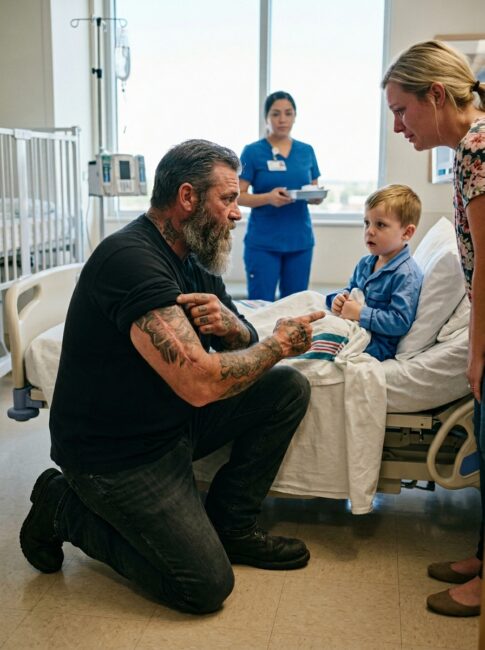
Noah’s fever came down on the fourth morning.
The doctors were relieved. So was I.
But relief does not arrive all at once after you have spent three nights watching numbers on a monitor. It leaks in slowly. A degree at a time. A full cup of water. A few bites of toast. A child complaining about cartoons instead of lying too still beneath a blanket.
By Friday afternoon, Noah was asking when we could go home.
The nurse smiled.
“Soon.”
Then she brought one final tray.
Noah saw it and pulled his arm against his chest.
“No.”
His voice was small.
Not dramatic.
That made it worse.
I sat beside him and tried to repeat the words Bull had used.
“You can be scared and still—”
“No.”
Noah began to cry.
He kicked the blanket away. He buried his face against my shirt. The nurse stepped back, giving him room.
I felt helpless in the particular way only a parent can feel helpless: desperate to take the fear away, knowing you cannot do the hard thing on your child’s behalf.
Bull happened to be at the nurses’ station with a box of coloring books.
He heard Noah crying.
He appeared at the doorway but did not enter.
“Need backup, little brother?” he asked.
Noah looked up.
His cheeks were wet.
“You said brave means I don’t quit.”
Bull nodded.
“What if I want to?”
Bull stayed quiet for a moment.
Then he walked into the room and lowered himself into the chair beside the bed. Leather creaked. His keys tapped softly against his thigh. The red-and-white hospital wristband from the volunteer desk circled his thick wrist beneath the edge of his sleeve.
“Wanting to quit ain’t quitting,” Bull said. “They’re different things.”
Noah sniffed.
“How?”
Bull looked at the tray. Then at Noah.
“Sometimes you sit for a minute. Sometimes you cry. Sometimes you tell somebody you’re scared. Then you decide what happens next.”
Noah wiped his face on my shirt.
“Did you sit for a minute?”
Bull’s jaw tightened.
“A long minute.”
That was all he said.
Noah finally held out his arm.
The blood draw took less than a minute. Noah cried the entire time. He squeezed my fingers hard enough to leave tiny red marks in my skin.
Bull did not tell him to stop.
He did not distract him with a toy.
He sat beside us and breathed slowly until Noah began matching the rhythm without realizing it.
When the nurse finished, Noah looked at the cotton ball taped against his arm.
“I cried,” he said.
Bull nodded.
“Still counts.”
“As brave?”
“Especially brave.”
Noah leaned back against the pillow, exhausted but proud.
I expected Bull to smile.
Instead, he stood too quickly.
The chair scraped the floor.
His rough hand moved to his left sleeve. His fingers closed around the fabric above the scar. For half a second, his face changed. The hospital room seemed to disappear from his eyes.
Then Preacher appeared in the doorway.
He did not ask what happened.
He looked once at Bull’s hand gripping his sleeve.
“Walk with me, brother,” Preacher said.
Bull hesitated.
Preacher did not touch him.
He simply waited.
Bull looked at Noah.
“You did good, little man.”
Then he followed Preacher into the hallway.
I watched them through the narrow window in the door.
Bull’s boots moved heavily across the polished floor. Preacher stayed beside him, matching his pace. They passed Room 214.
Bull stopped.
His shoulders rose with one slow breath.
Preacher sat down on a bench.
After a moment, Bull sat beside him.
Neither man spoke.
I had seen Bull use that same silence with frightened children.
Only then did I realize somebody had once taught it to him.
Noah was discharged the next morning.
I should have packed our bag, thanked the nurses, and gone home.
Instead, I found myself looking for Bull.
I wanted to thank him properly. Not the quick thank-you parents offer while managing paperwork, a tired child, and a phone full of unread messages. I wanted him to understand that his few blunt sentences had given my son something I could not.
I found Preacher near the vending machines.
He was holding two cups of coffee. One for himself. One untouched.
“Bull around?” I asked.
Preacher looked toward the elevator.
“Getting some air.”
I hesitated.
“Can I ask you something?”
“You can ask.”
“The scar on his arm.”
Preacher’s expression changed.
Not anger.
Protection.
I almost apologized and walked away.
Then Preacher spoke.
“People assume motorcycle wreck.”
“That’s what I thought.”
“Bull lets them.”
The vending machine hummed behind us.
Preacher looked down at the second coffee.
“Fifteen years ago, he was in a bad place. Worse than he let anybody see. Lost his marriage. Lost the shop he built with his old man. Started drinking too much. Stopped answering calls.”
His voice remained steady.
“He tried to end his life.”
The words landed quietly.
No graphic details.
No dramatic pause designed for shock.
Just the truth, handled carefully.
“He survived,” Preacher continued. “Barely. Ambulance brought him here. Room 214.”
I looked down the hallway.
The empty room.
The doorway Bull slowed beside every Tuesday.
“The scar,” I said.
Preacher nodded.
“It came from that night.”
For several seconds, neither of us spoke.
I thought about Bull kneeling beside my son.
I thought about his rough finger tapping the healed skin.
I was scared. I cried. I wanted to quit.
Every word had been true.
Bull had not told Noah the whole story. A four-year-old did not need the whole story.
But he had not lied.
“Why does he come back?” I asked.
Preacher looked through the glass doors toward the parking lot, where a dark touring Harley stood among the cars.
“Same reason some men ride past the house they grew up in,” he said. “Same reason some men keep an old photograph in their wallet even when it hurts to look at it.”
He took a sip of coffee.
“Because going back proves the road didn’t end there.”
That was the twist I understood first.
Bull’s scar was not a trophy.
It was not a dramatic symbol he showed strangers for attention.
For years, he had hidden it beneath long sleeves.
The second twist came later.
Bull had not started volunteering at the hospital because he believed he had something to teach sick children.
He started because Preacher brought him there when Bull was the one who still needed help.
Preacher told me the rest slowly.
Not because he wanted to expose Bull’s private life, but because he wanted me to understand the difference between a secret and a shame.
They are not always the same thing.
Fifteen years earlier, Preacher had been a new prospect in the club. He was younger then, still learning when to speak and when to keep quiet. Bull was already a large presence. Loud engine. Thick beard. Heavy boots. A reputation for fixing almost anything with a wrench and enough patience.
But after Bull’s life began collapsing, patience left him.
He withdrew.
He missed rides.
He stopped answering the garage door.
The brothers argued about what to do.
Some thought Bull wanted space.
Some thought showing up uninvited would make things worse.
Preacher disagreed.
“You don’t leave a brother alone just because he makes it difficult to stay,” he told them.
So they went to Bull’s house.
Not one rider.
Six.
They found him alive, but in immediate danger.
They called for help.
Then they stayed.
Preacher rode behind the ambulance to the hospital. Moose parked beside him. Lena arrived later with coffee nobody drank. One brother left only long enough to feed Bull’s dog. Another called Bull’s mother and sat with her until she stopped shaking.
They spent the night beneath fluorescent lights near Room 214.
Nobody made speeches.
Nobody called Bull weak.
Nobody asked him to explain himself before he was ready.
They sat.
When Bull woke, Preacher was in the chair beside the bed, boots planted on the floor, leather cut folded across his lap.
Bull looked at him.
Preacher looked back.
“You staying?” Preacher asked.
Bull turned his face toward the window.
After a long time, he nodded.
That one nod was not the end of anything.
Bull did not walk out of the hospital suddenly healed. He did not become a different person because a single night scared him enough. Recovery was slower and less cinematic than that.
Appointments.
Hard conversations.
Days when getting out of bed counted as work.
Club brothers taking turns driving him when he did not trust himself to be alone.
Lena keeping his shop paperwork organized until he could think clearly again.
Moose repairing the garage door after Bull admitted he had ignored it for months.
Preacher sitting on a stool nearby while Bull changed oil, saying almost nothing.
The brotherhood was not tested by a highway crash or a fight in a parking lot.
It was tested by silence.
By repetition.
By the uncomfortable work of staying after the emergency passed and the casseroles stopped arriving.
A year later, Bull returned to Room 214.
He stood in the hallway for ten minutes before entering.
A nurse recognized him. She had been working the night he arrived.
Bull thanked her.
She accepted the thanks, then asked whether he would consider helping with a holiday toy drive.
Bull almost laughed.
Children were not his territory. Hospitals were not his territory. He preferred engines because engines made sense. A rattle meant one thing. A leak meant another. Metal did not ask personal questions.
But he came back with a box of toy trucks.
Then another box.
Then coloring books.
Then blankets.
Eventually, the hospital made him an official volunteer.
The tiny yellow duck sticker on Bull’s badge was not the first sticker a child had placed there. When the plastic became too crowded, he removed the older stickers and pressed them onto a square of black cloth sewn inside his vest.
That was the object his fingers touched whenever he passed Room 214.
Not a weapon.
Not a flask.
Not something hard.
A patchwork of crooked stars, cartoon animals, dinosaurs, and smiling suns given to him by children who had been scared and continued anyway.
When Noah added the yellow duck, Bull placed it carefully on the outside first.
He let the sticker stay visible for the rest of our hospital visit.
Maybe he wanted Noah to see it.
Maybe he wanted to see it himself.
Before we left, I found Bull standing near the hospital entrance, looking toward the old stretch of Route 66 beyond the parking lot. Heat shimmered above the pavement. His Harley’s chrome caught the morning light.
Noah ran toward him with his discharge papers tucked beneath one arm.
Bull turned.
Noah lifted his bandaged arm.
“I didn’t quit,” he said.
Bull looked at the small green bandage.
Then at my son’s face.
“No,” he said. “You didn’t.”
Noah pointed toward Bull’s sleeve.
“Neither did you.”
Bull went still.
He glanced at me.
I had not told Noah anything.
My son did not know the history of the scar. He only understood the words Bull had given him.
You were scared.
You wanted to quit.
You did not.
Bull lowered himself onto one knee.
“No,” he said quietly. “I didn’t.”
We returned to the hospital three months later for a routine follow-up.
Noah was healthy.
He carried a folded drawing in one hand and insisted on delivering it himself.
Bull was in the family room, repairing the loose wheel on a toy fire truck while Moose sorted boxes of crayons by color because a seven-year-old girl had instructed him to do it that way.
The room smelled faintly of coffee, disinfectant, and the leather of four biker cuts hanging from chair backs.
Noah walked directly to Bull.
“I made you something.”
Bull wiped his hands on a rag and accepted the drawing carefully.
It showed two figures.
One was very large, with square shoulders and arms covered in uneven green scribbles meant to represent tattoos. The other was small, holding up one arm with a bright green bandage.
Between them, Noah had drawn a yellow duck.
At the top of the page, with help from his mother, he had written:
BRAVE CAN BE SCARED.
Bull read the words twice.
Then he folded the paper once and slipped it into the inside pocket of his vest.
Behind the pocket was the square of black cloth covered with old stickers.
The yellow duck joined them that afternoon.
The ritual continued.
Every Tuesday, Bull parked his Harley near the curb and shut off the engine before approaching the hospital doors. The sudden silence always seemed to arrive a second after the V-twin stopped. Then came the quieter sounds: keys tapping against his leg, boots crossing tile, the soft creak of leather as he lowered himself to speak with a frightened child.
The Lantern Crew expanded its work.
Once every spring, riders met at a diner on the old Route 66 strip and rode together to the hospital for a blood drive. Nobody treated the ride like a parade. The motorcycles lined up beneath the faded diner sign. Coffee steamed in paper cups. Boots scraped concrete. Riders told bad jokes and waited their turn.
Bull never gave a speech.
At the hospital, he rolled up his sleeve.
The scar remained visible.
Not displayed.
Not hidden.
Visible.
Afterward, he placed the small bandage beside the others on his arm and drank orange juice from a paper cup while Preacher complained that the hospital cookies tasted like drywall.
Bull ate two anyway.
A year after Noah’s hospital stay, we saw Bull outside a diner near Route 66.
It was early evening. The sky above Amarillo had turned the pale color it gets before sunset, when every parked car throws a long shadow across the pavement.
Bull stood beside his Harley with Preacher and Lena.
His cut looked older.
His beard looked grayer.
The yellow duck sticker was gone from the outside of his badge, but I knew where it had ended up.
Noah spotted him first.
He dropped my hand and ran across the parking lot.
Bull turned at the sound of his sneakers slapping concrete.
“Hey, little brother.”
Noah stopped in front of him.
He had a scraped knee from falling off his scooter earlier that week. Nothing serious. Just the ordinary evidence of being five years old and moving faster than your balance can manage.
Bull pointed toward the scrape.
“That hurt?”
Noah nodded.
“You cry?”
“A little.”
“You quit?”
Noah shook his head.
Bull nodded once.
“Still counts.”
Preacher climbed onto his motorcycle. Lena followed. One engine started, then another, then Bull’s. The sound rolled beneath the diner awning and settled into the pavement.
Before Bull pulled away, he pushed up his left sleeve.
The scar caught the last light of the day.
Noah raised his small arm in return, showing the fading scrape on his knee as if the two marks belonged to the same private language.
Bull dipped his chin.
Noah nodded back.
Three motorcycles turned onto Route 66.
Their red taillights grew smaller beneath the wide Texas sky.
The sound faded.
The road remained.
Bull stayed.
Follow this page for more stories about the people behind the leather.