The Biker Pulled the Fire Alarm in a Quiet Office Tower—And Everyone Thought He Was the Danger
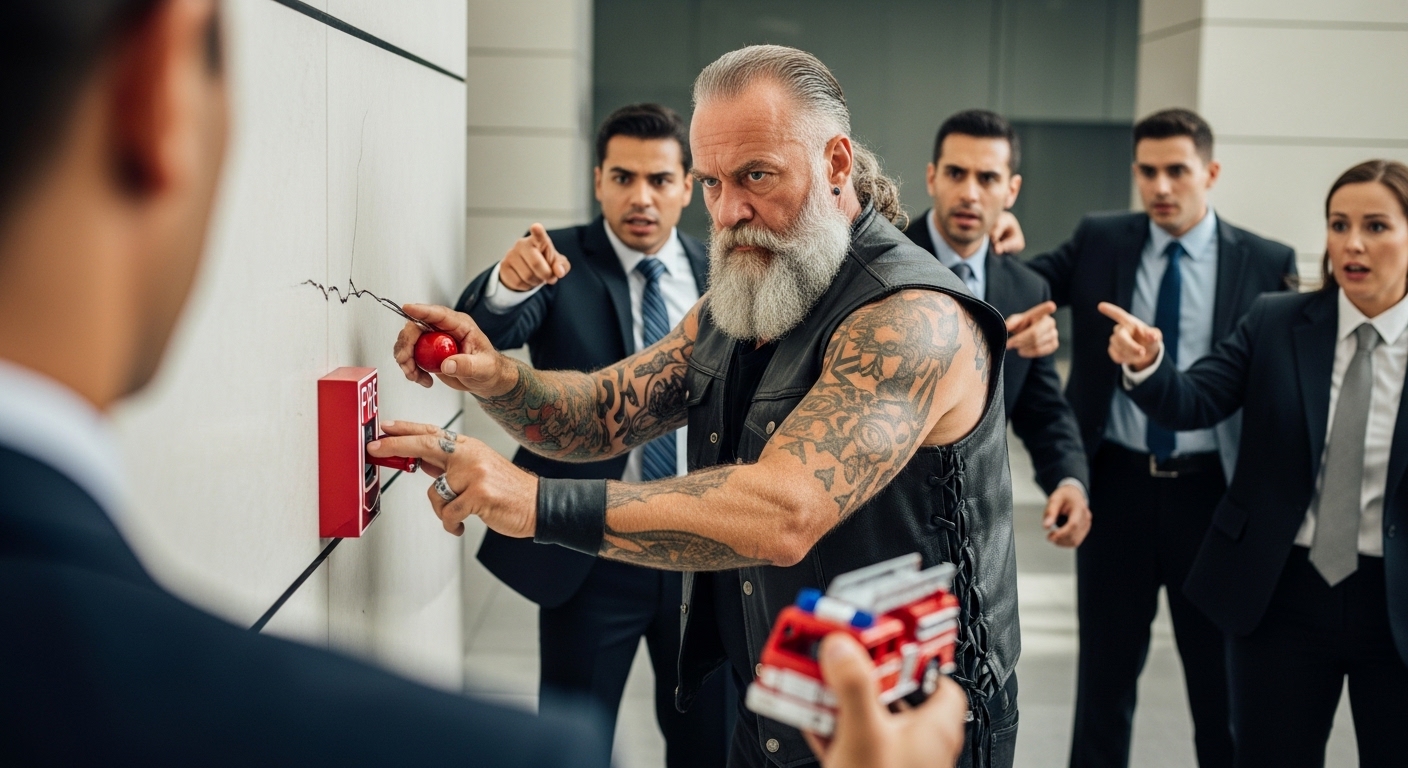
The biker slammed his fist into the fire alarm in the middle of a quiet office lobby, and the strangest thing was not the siren ripping through the building—it was the way he kept staring at one section of wall like he had heard it scream first.
It was just after 9:10 on a gray Tuesday morning in downtown Cleveland, the kind of workday built from elevator dings, paper coffee cups, badge scans, and people already annoyed before noon—until one rough-looking stranger in a sleeveless leather vest shattered the routine so completely that nobody knew whether to run, yell, or call security.
I was standing near the reception desk on the fourteenth floor when the first alarm pulse hit through the ceiling speakers.
Sharp.
Mechanical.
Wrong.
Every head lifted at once.
Someone groaned, “Not again.”
A man from accounting laughed under his breath and said it was probably another false alarm, because the building had a history of those—bad sensors, old wiring, construction dust, excuses that had become part of office folklore. People complained about them the way they complained about bad coffee.
Annoyed.
Not afraid.
That was the first thing I noticed.
Nobody moved fast.
Not at first.
Monitors stayed on. Phones stayed in hands. A woman near the copier finished her sentence before hanging up. Even I hesitated, because ordinary panic has a rhythm, and this wasn’t it. This was the tired, practiced impatience of people who believed danger was mostly an inconvenience.
Then I saw him.
Big man. Late fifties maybe. Broad shoulders, gray beard, tattooed forearms, black leather cut with the sleeves torn off, standing alone near the east corridor where the carpet met a section of beige wall nobody had looked at twice in years.
He wasn’t heading for the stairs.
He was listening.
Not to the alarm.
To the wall.
His jaw had locked so hard I could see it from twenty feet away. In one hand he held a small red toy fire truck, cheap plastic, paint chipped at the ladder.
Why would a man like that be carrying a child’s toy into an office building?
Then he took one step closer to the wall, touched it with the back of his hand—
And his whole face changed.
Not confusion.
Recognition.
And then, over the alarm, he shouted one sentence that turned every lazy eye in the room toward him.
“Get out now. It’s inside the wall.”
My name is Nora Bennett, and before that morning, I would have told you I knew exactly how false alarms worked.
I had been a tenant coordinator at Hanover Place Tower for almost four years, which meant half my job was solving problems nobody noticed until they became everybody’s problem—stuck deliveries, broken access cards, a leaking pipe on twelve, the eternal war between the legal firm on sixteen and the marketing agency on fourteen over conference-room bookings. The building looked polished from the outside, all reflective glass and respectable stone, but inside it had that familiar old-city compromise: recent paint covering old bones.
You learned to live with its moods.
The heating that clicked too loudly in winter.
The lights in the south stairwell that flickered when it rained.
The smell of hot dust from vents on the first cold day of the season.
None of that felt like emergency anymore.
Which is why the biker immediately looked like the problem.
He had come in ten minutes earlier, according to Marta at reception, asking for Suite 1408, where a small insurance firm rented space. He gave no company name. No clear reason. Just said he was there to “drop something off.” Marta had nearly called security on instinct alone. Men like him did not fit the building’s morning pattern. People in Hanover wore pressed shirts, office heels, branded fleece pullovers. They did not arrive with heavy boots, scarred knuckles, and a red plastic fire truck clenched in one hand like it meant something no one else was allowed to understand.
Marta told me she noticed another strange thing too.
When he signed the visitor sheet, he paused after writing his first name.
Long enough to bother her.
As if he had forgotten, for a moment, what name he used in buildings like ours.
Then the alarm sounded, and everything ordinary cracked.
Even then, most people assumed he had pulled it for attention. That was the story that spread first, fast and ugly, because it made sense in the easy way ugly stories do. Some said he looked unstable. Some said he was angry about being turned away. One man from compliance muttered that “these biker types” always wanted a scene.
Meanwhile the biker ignored all of us.
He moved along the east corridor slowly, touching the wall at intervals with the back of his hand, then crouching once to look near the baseboard where the paint had blistered in a bubble no one had noticed before. He leaned in close, not theatrical now, not aggressive—focused, the way people get when they know something the room hasn’t caught up to yet.
Security finally arrived.
Two guards, both flustered, radios hissing. One of them, Darren, asked the biker if he had triggered the alarm.
The man didn’t answer the question.
He only said, “How long has this section been running hot?”
Darren stared at him.
“So you did pull it?”
The biker stood and glanced down the hallway toward the emergency stairwell, where employees were still shuffling, not evacuating so much as lingering. His eyes moved back to the wall. Then to the ceiling vent above it. Then to the fire truck in his hand.
That detail hit me again.
The toy.
He kept rubbing his thumb across its chipped roof like it was a habit, not a gesture.
I stepped closer before I could stop myself. “What do you mean, running hot?”
He looked at me for the first time.
His eyes were pale and exhausted and far too calm for the noise around us.
Then I smelled it.
Faint.
Almost nothing.
Not smoke.
Something sharper.
Burning plastic.
And just as I realized that, the light above the east corridor door flickered twice—
Then went black.
That should have been enough.
It should have been the moment everyone stopped rolling their eyes and started moving.
But fear doesn’t always arrive cleanly. Sometimes it comes tangled with embarrassment, routine, and the desperate hope that somebody else is overreacting.
So people hesitated.
Again.
The alarm kept pulsing.
The security guards started directing employees toward the stairs, but even then there was resistance—half-packed bags, muttered complaints, people trying to finish emails before leaving a building that might already have been turning dangerous around them. One partner from the law firm demanded to know whether there was “actual fire” or just “a mechanical issue.” Someone else asked if we’d be allowed back up within the hour.
I remember wanting to scream.
Because the smell was stronger now.
Still thin. Still easy to deny.
But there.
The biker moved faster.
Not wildly. Not like a man causing chaos. More like someone following a pattern he had seen before and hated for recognizing. He pressed his palm near the wall once, flinched almost invisibly, then looked upward toward the conduit box above the ceiling tiles as if he could see through plaster.
“Kill power on this floor,” he said.
Darren snapped back, “Sir, step away.”
The biker didn’t.
That was when Mr. Kessler, the insurance manager from Suite 1408, came out into the corridor, tie loosened, face red with anger. He pointed straight at the biker and said, loudly enough for everyone to hear, “That’s him. He’s the one I told reception not to let in.”
All attention shifted.
It happened instantly.
The biker became the story again.
Not the wall. Not the smell. Not the dead light.
Him.
Kessler strode forward, already performing outrage for the employees gathering behind him. “He showed up last week too,” he said. “Asked questions about the electrical closets. Said he needed to see old maintenance access.”
A woman near me gasped.
Darren’s radio crackled as he reached for the biker’s arm. “Sir, I need you to come with us.”
The biker turned so sharply the toy truck flashed red in his fist. “If you stop me now,” he said, voice low and rough, “you’re trapping people above the source.”
That sentence landed wrong in my stomach.
Above the source.
Not if there was a fire.
Where it was.
As if he already knew.
Kessler laughed once, tight and ugly. “You hear that? He knows too much. Maybe because he set it.”
For one terrible second, I believed it.
I hated that I did, but I did.
Because why had he come asking about electrical access? Why did he know what overheated walls smelled like? Why was he carrying a child’s fire truck into a building he’d visited before? Every strange detail began leaning in the same direction, and that direction was dark.
Then the corridor gave a sound I will never forget.
Not an explosion.
Not yet.
Just a dry crackle from inside the wall, followed by a tiny thread of gray slipping from the seam near the blistered paint.
Marta screamed.
People started moving for real now.
Fast. Wrong. Chaotic.
The biker lunged past Darren toward the east utility door, and Darren grabbed for him too late. Kessler shouted that he was trying to escape. Someone fell near the stairwell. The alarm strobes painted the hallway in broken red flashes, and through all of it the biker jammed the little fire truck into my hand so suddenly I almost dropped it.
It was warm.
Warmer than it should have been.
And on the bottom, written in black marker so faded I nearly missed it, were three words:
For Liam. Come back.
Before I could ask who Liam was, the biker hit the utility door with his shoulder—
And from somewhere behind me, a voice shouted his name in pure terror.
“Eli, no!”
I turned at the sound of that name.
The voice belonged to a woman I had not noticed before—a thin Black woman in navy scrubs, maybe early sixties, standing at the far end of the corridor with one hand pressed against the wall for balance. She looked like she had run harder than her age wanted to allow. Her badge said Marianne Cole, building nurse for the clinic on twelve.
But the way she said his name did not sound professional.
It sounded personal.
“Eli, no!”
He froze for half a breath at the utility door, and in that half-second the whole hallway rearranged itself around suspicion. Kessler pointed at him as if he had finally been handed proof. Darren reached again for his arm. The smoke thread at the wall seam thickened, then vanished, then returned in a trembling line so small it looked imagined.
Everything in me split in two.
One part wanted to run.
The other wanted to understand why a man who looked like trouble had a nurse calling after him like she had seen him walk into fire before.
Employees were pushing toward the stairwell now, no longer joking, no longer annoyed. The red strobes pulsed over their faces and made panic look mechanical. Somebody dropped a laptop bag. A woman from payroll kept saying, “It’s probably just wiring,” as if repeating it could make it less true. Kessler was still shouting over everyone, telling security to restrain Eli before he “made things worse.”
That phrase caught.
Made things worse.
Because that was the version that fit him best. Rough biker. Strange questions. Unauthorized visit last week. Fire alarm pulled. Utility door forced.
Cause.
Not warning.
I hate how quickly a crowd can fall in love with a convenient villain.
Eli looked at Marianne once. Just once. And whatever passed between them made her face collapse with dread.
“Tell them to clear the north offices,” he said.
She whispered, “Eli—”
“Now.”
Darren finally got a grip on his vest. “You’re done.”
Eli turned, and for one second I thought he was about to swing.
He didn’t.
He said something quieter, which somehow felt more dangerous.
“Feel the door.”
Darren frowned.
Eli nodded toward the utility door. “If I’m lying, arrest me on the sidewalk.”
Darren hesitated. Kessler snapped, “Don’t listen to him.”
But hesitation is sometimes all truth needs.
Darren reached out.
Touched the metal push bar.
And jerked his hand back.
Not with pain exactly.
With surprise.
“Jesus,” he muttered.
The push bar was hot.
Not warm from the building. Not sun-heated. Wrong-hot. A trapped, electric heat with no flame visible yet, which made it somehow more frightening, like the building had decided to hide the worst part until it was too late.
Kessler saw Darren’s face change.
So did I.
And still Kessler said, “That doesn’t prove anything.”
That was the moment I started to distrust him more than the biker.
Not because he was scared. Everyone was scared.
Because he was working too hard to keep the fear aimed in one direction.
Marianne moved closer, breathing unevenly. “The clinic lost power twice last month,” she said. “I filed reports.”
Kessler rounded on her instantly. “This is not the time.”
“No,” she said, eyes on Eli. “Maybe it is.”
Another crackle came from inside the wall.
Louder now.
Then a sharp popping sound above us, and the fluorescent panel nearest Suite 1408 burst in a spray of sparks.
People screamed.
The hallway surged.
Darren shouted for immediate evacuation.
Kessler backed away at last, but not before I saw something I couldn’t unsee: he glanced at the smoking wall, then at the utility door, and then at me with the expression of a man who knew exactly what I had just started noticing.
He knew more than he had said.
Maybe much more.
Eli hit the utility door again with his shoulder.
This time it gave.
Just enough to open three inches.
And through that narrow black gap, I saw something that turned my blood cold—
A strip of red cloth tied around a conduit pipe, darkened by soot, fluttering in the hot draft like a warning that had been waiting for someone to remember it.
The corridor emptied in waves after that.
Not cleanly. Not bravely. Just humanly.
People stumbled into the stairwell carrying their phones, shoes slipping on polished tile, voices too loud, breathing too fast. Somewhere below us the building alarm changed tone, which meant the system had finally decided this was no drill, no glitch, no office inconvenience to gossip about later over bad coffee.
I should have gone with them.
Instead, I stayed.
Not because I was heroic. Because by then terror and curiosity had tied themselves together inside me so tightly I couldn’t tell which one was pulling me forward.
Darren ordered everyone out, then looked at Eli, at the half-open utility door, and made the kind of decision people make when training collides with instinct. He told his partner to sweep the floor and then said to Eli, “You’ve got thirty seconds.”
Kessler exploded.
“Are you insane? He could have started this!”
Eli ignored him completely. He braced one boot against the wall and forced the door wider. A wave of air hit us—burnt insulation, hot metal, something oily and chemical that made my eyes sting.
Inside the narrow utility space, cables ran up behind panels that had clearly been patched more than once. The red cloth I’d seen was tied to a bundle of conduit near shoulder height, faded and brittle, as if someone had marked that section long ago and nobody had removed it because nobody had wanted to look too closely.
Eli stared at it like it had reached out and touched him.
“Transformer junction,” he said.
Darren asked, “Can you see flame?”
“Not yet.”
Not yet.
That phrase felt worse than yes.
Because not yet meant there was still time to fail.
Marianne came up beside me. She was trembling now, but not from smoke. From memory. I could feel it. Some people shake from present danger. Others shake because something old has just stood up inside them.
She looked at the red cloth and whispered, “He tied one just like that.”
My head turned sharply. “Who?”
She did not answer.
Eli crouched, peering along the wall cavity. Then he reached toward a warped panel near the floor and pulled back fast.
“Sparking in the insulation,” he said. “Could run vertical.”
Darren swore under his breath and radioed down for fire department priority on the east shaft. Kessler kept objecting, but his voice had changed now. Less commanding. More frayed. He looked at the open utility space the way people look at a lie that has begun leaking through its edges.
Then Eli said, without turning around, “Why wasn’t this shut down after the first report?”
Silence.
Only for a second.
But long enough.
Marianne closed her eyes.
Darren slowly turned toward Kessler.
And I saw it arrive—the next layer. The darker possibility. The one that made every previous detail rearrange itself.
The prior visit. The questions. The lost power. The patched wall. The organizer—no, not organizer this time, the manager—controlling access. The instant effort to blame the biker.
Maybe Eli had not been prowling.
Maybe he had been trying to warn them.
Which raised a much worse question:
What had Kessler known, and for how long?
Kessler’s face hardened. “This building has passed inspection.”
Eli stood. “Inspections don’t smell like this.”
“That is enough.”
“No,” Eli said, finally turning to face him. “Enough was before people were still working above a hot chase you never fixed.”
The red strobes cut across both their faces. Darren stepped between them. The wall crackled again, louder now, and a brief orange pulse flashed behind the insulation like a hidden eye opening.
I felt myself go cold from scalp to heel.
Fire.
Real fire.
Still buried. Still mostly unseen. But there.
Darren shouted that everyone out now meant everyone. Marianne grabbed my sleeve. I stumbled backward with her toward the stairwell. Eli stayed one second longer, eyes fixed on the red cloth tied to the conduit.
Then Kessler said the sentence that made everything drop another level.
He said it too quietly for panic. Too clearly for accident.
“You said you’d never come back into a burning building.”
The fire department arrived fast enough to feel miraculous and not fast enough to feel safe.
By the time we reached the sidewalk, Hanover Place Tower had become what all office buildings eventually become in an emergency: a crowd of badly dressed people staring upward, trying to read the truth in windows. Rain had started—thin, gray, miserable rain that turned the pavement dark and made the alarm lights look harsher in the glass. Employees huddled under awnings, some still clutching laptops, some crying without quite understanding why they were crying.
Nobody laughed about false alarms anymore.
On the curb, someone draped a blanket around Marianne’s shoulders. She did not seem to feel it. Her eyes stayed fixed on Eli, who stood apart from the crowd, wet beard dripping, one hand still wrapped around that small red toy fire truck I had given back to him on the stairs. Kessler was ten feet away, arguing with a battalion chief, then stopping the instant he realized Darren was speaking to another firefighter with too much detail and too little loyalty.
The east wall on fourteen had begun to smoke visibly by then.
Just wisps near the seam.
But enough.
Enough to prove Eli had been right.
The relief that moved through the crowd did not come clean. It came mixed with shame. People looked at him differently now, but not fully. Not kindly. More like they were trying to back away from the version of him they had built an hour earlier without admitting they had built it at all.
I went to Marianne because I knew she was the door.
Not to the fire.
To him.
She watched the trucks for a long time before speaking.
“His full name is Elias Rowan,” she said. “My sister married him twenty-two years ago.”
The words hit me so hard I almost missed the next ones.
“My sister and their little boy died in a fire in Akron.”
I did not interrupt.
There are moments when a person’s voice tells you the story is already costing them enough.
“It was electrical,” she said. “Bad wiring inside an older wall. Small signs first. Flickers. Warm paint. A smell nobody respected because there was never visible flame. They thought the alarm was being oversensitive. The neighbors complained. People stayed in place too long.”
I looked toward Eli.
He had his head down now, thumb rubbing the roof of the toy truck in the same slow motion I had noticed upstairs.
“Liam,” I said.
Her mouth trembled once. “Their son.”
The toy truck.
Of course.
Not random. Not odd. Not the prop of a disturbed man.
A relic.
A wound made portable.
She told me the rest in fragments, each one fitting painfully into place.
After the fire, Elias changed in all the ways grief changes men who survive the wrong night. He sold the house. Rode for years. Did odd electrical work, then formal safety training, then volunteer building checks for older community properties nobody wanted to pay to update properly. He became the sort of man managers hated because he noticed what should not have been ignored and had no talent left for politeness when people dismissed him.
He had come to Hanover last week because Marianne asked him to.
The clinic on twelve had lost power twice during appointments. She smelled heat in the stairwell one evening and filed reports no one answered. Elias came by unofficially, was denied access, and left only after memorizing the layout. He returned that morning with Liam’s toy truck in his pocket because it was Liam’s birthday.
That detail hurt worse than the rest.
He had not brought it for symbolism.
He had brought it because grief has habits, and some dates make the dead feel close enough to carry.
I looked toward Kessler.
“Did he know?”
Marianne’s eyes hardened. “He knew enough.”
Later, Darren filled in the final missing piece. Maintenance reports had been delayed, downgraded, and bounced between vendors because the insurance firm on fourteen—Kessler’s firm—was about to sign a lease expansion, and shutting the east electrical chase for emergency work would have meant temporary closure, expensive disclosures, maybe lost contracts. Nobody had planned a fire. That would have been easier to hate. They had planned something smaller, more familiar, more ordinary: delay.
And delay, as it turns out, can burn too.
The firefighters opened the wall on fourteen. The heat bloom was worse than anyone outside had guessed. Charred insulation. Arcing near the vertical run. One more hour, maybe less, and the hidden flame could have climbed fast through the shaft before most people on the upper floors believed it was real.
I stood in the rain and felt sick.
Not because I had almost died.
Because I had watched the one man who knew exactly what we were standing in front of get treated like a threat for trying to stop it.
Elias did not gloat when the chief confirmed it.
He did not speak at all.
He just looked up at the building with the expression of a man seeing two timelines at once—the one that happened, and the one that almost did.
Then Marianne stepped beside him and touched the red toy truck.
He closed his eyes.
Only for a second.
But it was enough to show me the real shape of his courage: not noise, not toughness, not dramatic rescue. Just a man walking back toward the smell that had once taken everything from him because somebody else still had time.
No one around us said much after that.
What was there to say?
The sirens kept turning.
Rain kept falling.
And somewhere behind the soaked, confused crowd, a child in another building laughed at something ordinary, which made the whole morning feel even more unbearable.
Hanover Place reopened in stages.
First the lower floors. Then the clinic. Then the east side of fourteen, stripped open for weeks, its walls peeled back to show the blackened path the fire had been preparing for us in silence. Every tenant had to walk past that exposed cavity at least once, and I almost think that mattered more than the emails, the insurance notices, the polished statements about “an incident successfully mitigated.”
Because once the wall was open, nobody could pretend anymore.
You could see the damage.
The hidden place.
The cost of delay.
Kessler was placed on leave within days, then quietly resigned a month later when documents surfaced showing repeated deferrals and softened wording on internal safety tickets. He never spoke to me again. Darren did, though. One evening, weeks after the fire, he stopped by my desk and set down a printed incident report with a Post-it note that read only: He was right before the smoke showed.
I kept that note.
Not because it was profound.
Because it was late.
And late truth has its own weight.
I saw Elias one more time that season.
Not in the building.
At the memorial bench outside Station 14, three blocks away, where the city kept a modest garden for victims of residential fires. It was early evening, cold enough that the metal bench leached heat through a coat. He sat there in the same sleeveless leather cut, broad shoulders bowed for once, the red toy fire truck beside him on the bench instead of in his hand.
I almost turned around.
He looked like a man deep inside something private, and I had already taken enough from him in the name of understanding.
But he noticed me and nodded once, so I crossed the path and sat at the other end.
For a while we said nothing.
The little truck between us looked smaller outdoors.
More fragile.
Its chipped paint had a softness to it in the late light that it never had under the office fluorescents.
“I’m sorry,” I finally said.
He did not ask what for.
Maybe because there had been too many reasons.
“I thought you were causing it,” I said. “At first.”
He stared at the truck.
“Most people do,” he said.
No bitterness. That was the hardest part.
Just fact.
After another long silence, he told me Liam had carried that truck everywhere for six months. Grocery store. Church. Bed. Car seat. Then after the fire, the toy was found under a radiator in the hospital family room where someone must have placed it while waiting for news that never turned good. Elias kept it because it was the last thing his son had held long enough to leave a thumb mark in the paint.
I looked down.
There it was.
A tiny dull patch on the roof where the red had worn smooth.
“I bring it on birthdays,” he said. “And on bad gut-feeling days.”
That sentence stayed with me.
Not because it was poetic.
Because it sounded like survival stripped down to habit.
Before I left, I asked him why he went back toward the utility door after the sparks started—why he risked one more step, one more second, when everyone else was running.
He took a long breath.
Then said, “Because the first time, I listened to people who said it was probably nothing.”
I had no answer to that.
None good enough.
Winter came early that year. The building heater clicked too loudly again. The south stairwell lights still flickered when it rained, though not for long because suddenly maintenance tickets moved with almost suspicious speed. Employees evacuated when alarms sounded. Not lazily. Not perfectly. But faster. More honestly.
And every so often, on hard gray mornings, I would catch myself pausing by the patched section of east corridor wall on fourteen. There was no memorial there. No plaque. Just new paint over old damage.
Still, I always thought of the same image:
A rough man with tattooed forearms, a gray beard, and a child’s red fire truck in his hand, listening to a wall that the rest of us had mistaken for ordinary.
That is what stays with me now.
Not the siren.
Not the smoke.
The listening.
Because danger does not always arrive roaring. Sometimes it hides inside drywall, behind schedules, inside delayed emails and tired assumptions, and sometimes the only person willing to hear it is the one who has already lost too much to ever ignore that sound again.
Months later, I passed Station 14 after dark and saw the bench in the cold glow of a streetlamp. Someone had left the outline of a small red truck in chalk on the concrete beside it, the lines already fading in the damp.
I stood there longer than I meant to.
Then I went home.
Some alarms start long before the bell.
Follow for more stories about the people we misjudge first—and understand too late.