The Biker Threw His Own Wallet Into the Street—And Everyone Thought He’d Finally Snapped
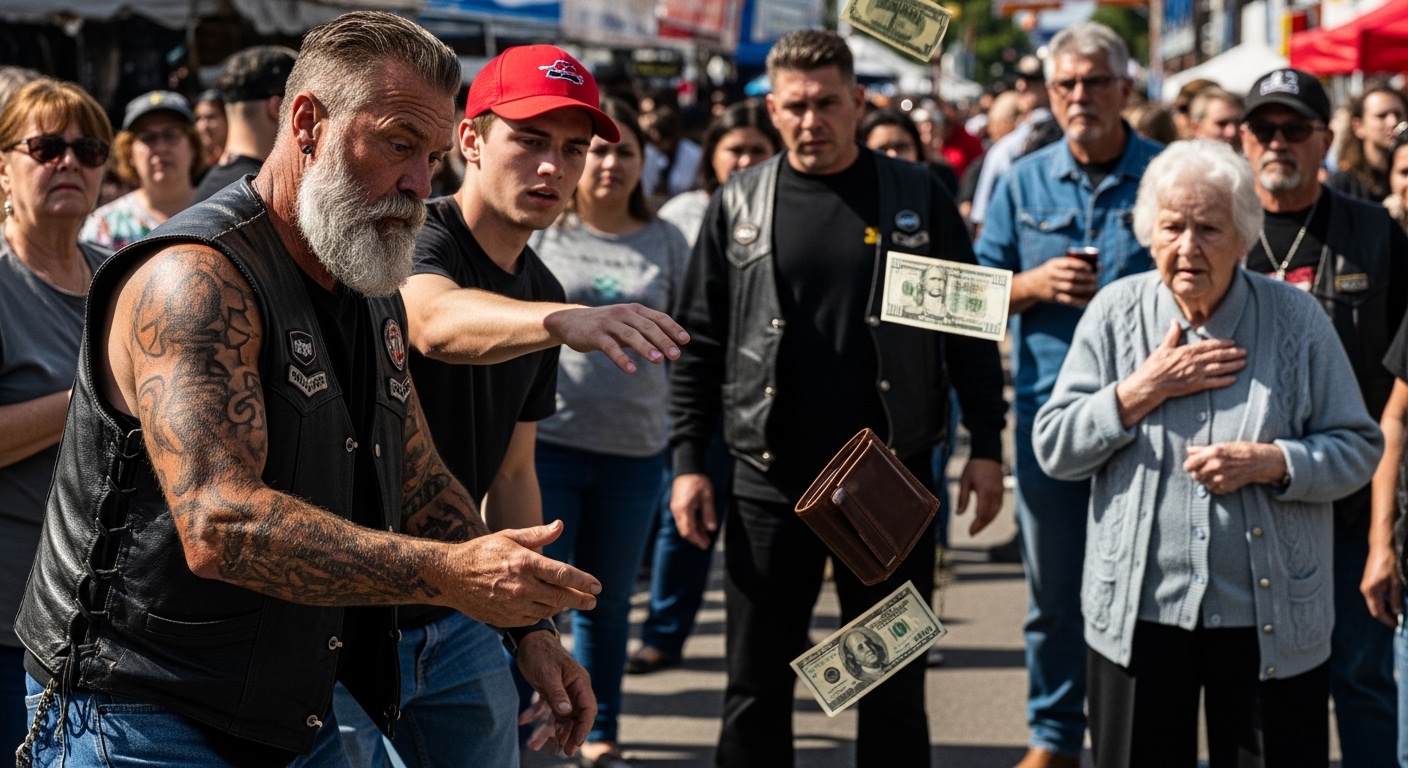
The biker hurled his own wallet into the middle of a crowded street like it was on fire, and the strangest part wasn’t the wallet hitting the pavement—it was the way he smiled at the woman standing three feet behind me.
It happened on a bright Saturday at the Riverside Street Fair in Cincinnati, with live music, paper cups of lemonade, kids smearing ice cream on their faces, and that one ugly second when a normal day seemed to split open for no reason at all.
I was holding two coffees and trying not to spill them when the sound cut through the crowd—not loud, not like a gunshot, not even like a crash. Just a hard leather slap on hot asphalt.
People turned all at once.
So did I.
The wallet lay open near the curb, cracked brown leather, old enough to look soft at the edges, with bills spilling halfway out as if someone had yanked its mouth open. A few twenties fluttered loose under the wind from a passing bus. For half a second nobody moved.
Then everyone started talking at once.
“Is he drunk?”
“Hey, man, your money!”
“What the hell is wrong with him?”
The biker stood in the middle of the foot traffic like a man who had stepped into the wrong dream. He was maybe in his late fifties, broad-shouldered, sun-burned, wearing a faded black leather vest over a gray T-shirt, his beard more silver than brown. Not movie-star rugged. Not polished. Just worn, the way old bridges are worn.
His motorcycle helmet hung from one hand. His other hand stayed loose by his side.
He wasn’t looking at the wallet.
He was watching the crowd.
Not wildly. Not confused.
Carefully.
That was the first thing that made my stomach tighten.
The second was the old woman near the pie stand.
She had both hands pressed to the front of her cardigan, her mouth slightly open, her eyes fixed on the scattered money as if she recognized something there that the rest of us didn’t. Beside her, a teenage vendor in an apron asked if she was okay, but she didn’t answer.
The biker took one slow step toward the wallet.
Then stopped.
A young man in a Reds cap bent down, too fast, too eager, reaching for the bills before they blew farther into the street—
And the biker said, almost gently, “Don’t touch that.”
The crowd laughed.
The guy in the cap didn’t.
Because at that exact moment, from somewhere behind us, a woman screamed that her purse was gone.
My name is Ellen Mercer, and before that day, I would have told you I knew exactly what kind of man he was.
Not personally. Men like him don’t usually drift into your life by invitation. You notice them the way you notice thunder—because something changes in the air. I owned a used bookstore two blocks from the riverfront, and every spring the city turned that whole district into a postcard: string lights, kettle corn, handmade soaps, local bands covering old Tom Petty songs. People came to the fair because it felt safe, familiar, almost rehearsed.
Which is why the biker stood out so badly.
He’d been around all morning.
I remembered him because of the wallet.
He had taken it out twice that I’d seen—once at a coffee cart, once near the flower stalls—and each time he’d opened it, stared at something inside for a beat too long, then closed it again with this strange, private expression that didn’t match the rest of him. Not sentimental exactly. More like bracing against pain.
At the time, I barely noticed. Everybody at a street fair looks like they’re waiting for something.
But after the scream, that detail came back sharp.
The woman who cried out was in her thirties, red blouse, stroller, one hand still gripping a paper bag of kettle corn. Her purse had been zipped across her chest a second earlier. Now the strap hung loose, sliced clean near the buckle. There was a red mark across her shoulder where it had jerked away.
That changed the air instantly.
Conversations broke apart.
Phones came out.
A man near me muttered, “No coincidence.”
And just like that, suspicion found the easiest place to land.
On the biker.
People began building the story out loud, piece by piece, because crowds are good at that. He threw the wallet to distract everybody. He made a scene. His buddy snatched the purse. Maybe he’d done this before. Maybe the whole rough, gray-bearded act was part of it.
It fit too neatly.
Even I felt it click into place.
The old woman by the pie stand took a shaky step backward. She looked frightened now—not just startled, but deeply, personally frightened—and she kept one hand pressed over the center of her chest. Her purse, a small navy-blue handbag, hung from her elbow. I saw her glance at the biker, then away from him, then back again. Not like she knew him.
Like she was trying to decide whether she should.
A police officer from the traffic detail started pushing through the crowd.
The biker still didn’t pick up the wallet.
Instead, he crouched slightly and looked beneath the vendor tables, then toward the funnel cake line, then toward the stroller woman—not at her face, but at the cut strap, the angle of it, the direction her body had turned when she screamed. He was reading the moment the way mechanics read an engine they know is about to fail.
“Sir,” the officer barked, hand already half-raised, “step away from the money.”
The biker looked up.
And for the first time, I saw irritation flicker across his face.
Not guilt. Not panic.
Recognition.
As if this was exactly the mistake he’d expected us to make.
“Your pickpocket’s still here,” he said.
Somebody behind me scoffed. “Convenient.”
The officer told him to put his hands where he could see them.
The crowd tightened into a ring. People love a public unmasking almost as much as they love a parade.
But the biker didn’t argue.
He slowly raised both hands, one still holding the helmet, and said, “Check the man in the Reds cap.”
All heads turned.
The guy in the cap—mid-twenties, tan shorts, clean sneakers, festival wristband—was already edging sideways through the bodies, not running, just melting away with the casual speed of someone who hoped not to be remembered.
The officer shouted at him to stop.
He did stop.
Too quickly.
Then he grinned.
It was a small grin, mean in a quiet way.
“I didn’t take anything,” he said.
Maybe he hadn’t. Maybe he was just embarrassed. Maybe we all wanted the biker to be wrong because then the world would make sense again.
Then the old woman near the pie stand whispered, to no one I could identify, “Not again.”
I heard it because I was close enough.
And I swear to God, the biker heard it too.
His head turned toward her so fast the whole crowd seemed to feel it.
There was something in his face then I couldn’t name. Shock, yes. But not from being accused. From seeing her.
The officer stepped toward the Reds cap.
The Reds cap stepped back.
And from under the old woman’s cardigan, something slipped loose and fell to the ground—a folded paper receipt, yellowed with age, tucked around a tiny photograph.
The biker went pale.
Then the old woman looked straight at him and said, barely above a breath, “Danny?”
Before I could understand why that name hit him like a blow, the young man in the Reds cap bolted.
Chaos at a street fair does not sound dramatic at first.
It sounds stupid.
A stroller wheel squeaking hard over pavement. Someone dropping lemonade. A child crying because adults are suddenly moving too fast. Sneakers slapping concrete. The police officer shouting, “Stop!” into air already full of noise. Music from the stage still playing because nobody had told the band to cut it.
And above all of it, the biker’s wallet still lying in the street like a deliberate wound.
The cracked brown wallet became the center of everything after that. People stepped around it. Stared at it. Filmed it. One of the spilled twenties had plastered itself against a damp patch near the curb, and another kept flipping over in the breeze like it was trying to signal us.
The officer went after the guy in the Reds cap, but the crowd slowed him just enough. The kid vanished past the candle booth and into the alley between a closed tailor shop and the parking garage.
The biker moved too.
Fast.
Too fast for his age, too fast for the version of him I’d already started building in my mind.
He handed his helmet to a stunned vendor, pointed at the old woman, and said, “Stay with her.”
Then he ran.
I don’t know why I followed.
Maybe because I’d heard the name Danny. Maybe because the old woman’s face had gone colorless and I couldn’t shake the feeling that whatever had just happened wasn’t random, wasn’t small, wasn’t over. Or maybe because once a story opens in front of you, some weak selfish part of you has to see how bad it gets.
I told the teenage clerk from the bookstore annex to watch my coffees—still ridiculous, even now—and pushed after them.
The alley smelled like wet cardboard and fryer grease from the diner on Fourth. At the far end, I caught a blur of tan shorts turning the corner. The police officer was behind him but losing ground.
The biker wasn’t.
He knew how to move through tight spaces, how to cut angles, how to anticipate panic. I watched him vault a stack of milk crates with one hand against the brick wall, boots hitting the pavement with a heavy, practiced rhythm. He didn’t shout. He conserved breath.
That frightened me more than yelling would have.
At the mouth of the next lane, I slowed enough to keep out of sight.
The Reds cap had stopped near a dumpster.
Not because he was trapped.
Because he wasn’t alone.
A second man stood there waiting—thin, shaved head, denim jacket despite the heat. He had the stroller woman’s purse in one hand and something else in the other: a small navy handbag.
The old woman’s.
A pulse of cold went straight through me.
So it had been real. Not one theft. Two.
The biker flattened himself against the wall, unseen from their angle. I was thirty feet back, half-hidden behind a newspaper box, close enough to hear pieces.
“Old lady fought harder than she looks,” the shaved-head man muttered.
The guy in the cap laughed once. “Check the side pocket. She kept patting it. That’s where the cash is.”
Then he pulled something from his own pocket and held it up.
Not cash.
Not a phone.
A tiny photograph wrapped in a yellowed diner receipt.
The same one I had seen fall near the pie stand.
“Why would she carry this around?” he said.
The shaved-head man squinted. “Who cares? Move.”
But the biker made a sound then—not loud, not even a word, more like the kind of breath a man makes when something buried deep inside him has just been dug up bare-handed.
Both thieves turned.
The Reds cap smirked first. “There he is.”
So they knew him?
That possibility hit me so hard I nearly stepped out by accident. Every ugly assumption I’d been nursing came roaring back worse than before. Maybe he wasn’t just part of this. Maybe he was the reason the old woman had said not again. Maybe Danny wasn’t a name from mercy. Maybe it was a name from history.
The shaved-head man tossed the navy handbag once, catching it by the strap. “You following us, old man?”
The biker’s expression changed when he saw the photograph.
All the tight anger drained out of him, leaving something rawer.
“Put that down,” he said.
The Reds cap lifted the receipt and photo between two fingers. “Or what?”
No one moved.
Behind me, at the far end of the lane, I heard the officer’s footsteps closing in—but still too far, still separated by distance and bad timing.
The shaved-head man glanced toward the street, then back to the biker. “You know this woman?”
The biker didn’t answer.
He took one step forward.
The man with the cap smiled wider and tapped the photo against the navy handbag. “You do.”
And that was when I saw what was in the picture.
A teenage boy, thinner than he should have been, sitting in a diner booth with a plate piled high in front of him. His hair was longer, his face unshaven, his shoulders sharp under a borrowed coat.
But it was him.
The biker.
Years younger. Half-starved. Almost unrecognizable.
On the back of the yellowed receipt, in faded blue ink, were five words I could read even from where I stood:
Eat first. Pay kindness later.
My mouth went dry.
The officer was almost there.
The thieves sensed it too.
The shaved-head man shoved the old woman’s purse under his jacket. The Reds cap crumpled the receipt in one fist, still holding the photo in the other, and looked at the biker with sudden interest, as if he had just realized he’d grabbed something worth more than cash.
Then he said, very softly, “She remembers you. That could be a problem.”
And before I could process what that meant, a voice rose behind me from the alley entrance—
“Ellen,” someone said, close enough to freeze my blood, “don’t move.”
I knew that voice.
It was Mara, the college kid who worked Saturdays at my bookstore annex—the one I’d asked to watch my coffees five minutes earlier, as if this were still an ordinary afternoon and not the moment my whole understanding of the day had started to split.
I turned too fast.
She was standing at the mouth of the alley, one hand on the brick wall, breathless, phone in the other. “There are two more officers coming,” she whispered. “And somebody from the crowd said the biker is armed.”
Of course they had.
That rumor fit him too perfectly not to spread.
By then the first officer had reached the lane behind us, shouting for everyone to stay where they were. But the alley had narrowed into the sort of bad geometry where one wrong move could turn panic into violence, and the two thieves seemed to understand that better than anyone. The shaved-head man backed toward the parking-garage ramp. The guy in the Reds cap kept the old photograph lifted between his fingers like bait.
The biker—Danny, if that was really his name—didn’t look at the officer.
He looked only at the photo.
It was the first time I understood that the most dangerous thing in that alley might not be a weapon.
It might be memory.
“Drop the bags,” the officer ordered.
The shaved-head man raised his free hand in a half-mocking gesture. “Sure, officer. Right after he tells us why he’s following us.”
And then he jerked his chin toward the biker.
That did it. The officer’s attention shifted. Not fully, but enough. Enough for suspicion to land where the crowd had wanted it all along.
“Sir,” the officer snapped, “against the wall. Now.”
The biker didn’t move.
Mara grabbed my arm so hard her nails bit into my skin. “Ellen,” she hissed, “what if they know each other?”
I had been asking myself that already.
Too many things fit in ugly ways. The biker had noticed the theft before anyone else. He’d thrown his own wallet into the crowd like a decoy. He had chased the thieves not with surprise, but with the speed of a man who had done this kind of thing before. And now one of them was talking to him without fear, almost with familiar amusement.
Maybe he wasn’t hunting them.
Maybe he was settling something with them.
The officer repeated the order.
The biker finally spoke, his voice low and rough. “If you put me against that wall, they’ll run.”
The officer took one step closer. “And if you don’t, I’m putting you down.”
For one suspended second, nobody breathed.
Then the man in the Reds cap smiled and said, “Tell him about the diner, Danny.”
The words landed like a blade.
The biker’s jaw tightened. Not guilt exactly. Worse than guilt. Something like shame dragged into daylight.
My stomach dropped.
The shaved-head man seemed to sense the shift and pressed harder. “Go on,” he said. “Tell him why an old lady carries your picture in her purse.”
I felt the entire scene tilt toward one terrible explanation. Maybe he had known her years ago for reasons that had nothing to do with kindness. Maybe the photograph was leverage. Maybe the diner receipt was not a blessing but a debt. Maybe the woman had recognized him because he had hurt her before.
Even now, writing this, I hate how quickly my mind went there.
But fear likes the worst story best.
The officer’s hand moved toward his holster.
The biker took a breath, like he was about to say something he had spent years not saying.
And then, from the garage entrance above us, tires screamed.
A black sedan shot down the ramp too fast, engine snarling, headed straight toward the lane.
Everyone turned.
The thieves moved first.
And in the split second before impact, the biker lunged—not toward the criminals, but toward me.
He hit me hard enough to knock the air from my lungs.
We slammed against the brick wall just as the sedan tore through the space where I had been standing. Its side mirror clipped the newspaper box and exploded plastic across the alley. Mara screamed. The officer stumbled backward, hand finally on his weapon. The shaved-head man vanished behind the car. The guy in the Reds cap rolled across the hood, somehow using the chaos instead of fearing it, and came down running.
For a moment, the whole alley became fragments.
Burnt rubber. Shouting. The metallic stink of fear.
The biker got to his feet before I did. He looked once to make sure I was alive, then went after the Reds cap.
Not with rage.
With purpose.
That scared me more.
The officer yelled into his radio. Mara was crying now, not loudly, just in the stunned, disbelieving way people cry when the world moves too violently for thought. The sedan had braked crooked near the back fence, driver’s door flying open. Another man jumped out—heavyset, black hoodie, tattoo crawling up one side of his neck. He shouted something I didn’t catch and ran toward the garage stairs.
Three of them.
Maybe more.
So this hadn’t been a random grab at festival wallets. It was organized. Smooth. Rehearsed.
And suddenly the biker’s strange calm, his scanning eyes, his impossible timing all took on a darker shape. Maybe he knew these patterns because he belonged to them. Maybe he had once run the same streets, used the same distractions, built the same exits.
That thought followed me as I pushed myself upright and saw the cracked brown wallet still back in the street beyond the alley entrance, tiny now in the distance, like the first dropped match in a fire nobody could stop.
The officer ran after the sedan driver. Mara grabbed my sleeve. “Don’t go,” she said.
I went anyway.
I saw the biker tackle the Reds cap near the loading dock behind the garage. They hit the concrete hard. The photograph flew free, skidding under a delivery truck. The old woman’s navy handbag swung loose from the thief’s wrist. For one hopeful second I thought it was over.
Then the man in the cap drove an elbow into the biker’s ribs and scrambled up with a folding knife in his hand.
Everything inside me went cold.
He held the blade low and quick, like someone who knew exactly how to use it without drama.
The biker didn’t back away.
There was an old scar visible now above the collar of his T-shirt, pale against sun-browned skin, and in that instant he looked less like a threat than a man who had spent a long time standing too close to bad decisions.
“Give me the bag,” he said.
The thief laughed, breathless. “You still think this is about the bag?”
The biker didn’t answer.
The young man flicked the knife once, then nodded toward the photograph under the truck. “It’s about her. It was always about her.”
I stopped moving.
The biker did too.
The alley noise seemed to drain away from the edges of everything.
The thief’s grin sharpened. “You should’ve kept riding, Danny.”
That was when I finally understood the most frightening detail of all:
This wasn’t their first contact.
The biker knew them.
Maybe not as partners. Maybe not as friends. But they knew enough about him to use his old name and enough about the old woman to know the photograph mattered.
The heavyset man from the sedan appeared on the loading dock above us, shouting for the thief to move. Somewhere beyond the garages came the rising sirens of additional police.
The Reds cap heard them too.
His face changed.
No more performance. No more swagger. Just calculation.
He grabbed the navy handbag, took one step backward, and looked straight at the biker.
Then he said the one thing in that entire day that made the biker’s face go truly empty.
“She fed you for six months, and you never came back.”
I don’t know whether the knife or the sentence stunned him more.
But in that instant of stillness, the thief turned and ran for the stairwell.
And the biker followed.
Later, after the statements and the ambulances and the tape and the rain that finally came at dusk, I would replay the next few minutes with the unnatural clarity disaster gives you.
The stairwell door banged open.
Footsteps thundered upward.
The sirens got closer.
I reached the landing just in time to hear the crash above me—metal railing, a grunt of pain, someone cursing—and when I came up to the second level, the scene was already ending.
The guy in the Reds cap was on the concrete, pinned beneath two officers.
The navy handbag lay torn open beside him, its contents scattered in a sad little fan: tissues, a pill bottle, hard peppermint candies, a church bulletin folded into quarters, and that old yellowed diner receipt with the photograph tucked inside.
The biker sat against the far wall, one hand pressed to his side where the knife had sliced through his shirt but not deep enough to kill him. Blood had darkened the gray cotton. Not much. Too much. His chest rose and fell hard.
He never looked at the officers.
He looked at the photograph in the old woman’s hand.
Because she was there now.
I still don’t know who brought her up the stairs. Maybe she followed on her own. Maybe stubbornness kept her moving. Maybe some debts are stronger than age. But she stood there in her cardigan with the navy purse strap hanging broken, eyes shining with the terrible calm of someone who has already recognized the past and no longer has the strength to fear it.
“Danny,” she said again.
This time it wasn’t a question.
He lowered his head.
And very quietly, like confession was something physical scraping its way out of him, he said, “I didn’t know it was you.”
Nobody interrupted.
Not the officers. Not me. Not even the thief on the ground, though I could feel him listening.
The old woman stepped closer. Her hands trembled around the picture. “I knew you the second you turned,” she said. “Even with the beard.”
He gave a short, broken laugh that held no humor. “You shouldn’t have.”
That was the moment the real story finally began to take shape.
Not because anyone explained it all at once. They didn’t. The truth came the way difficult truths always come—in fragments that hurt before they fit.
Years earlier, before the motorcycle, before the leather vest, before he had become the kind of man strangers distrusted on sight, Danny had been nineteen and sleeping behind dumpsters three blocks from a diner called Maybell’s. His mother was dead. His father was drunk or gone depending on the week. He was, in his own words, “too proud to beg and too hungry not to.”
The old woman—her name was Mrs. Nora Bell—had worked mornings at that diner. Not owner. Not manager. Just a waitress with aching feet and the habit of noticing who tried to disappear in public.
She had seen him twice before she spoke to him.
On the third morning, she set down eggs, toast, and coffee in the alley behind the kitchen and left without asking his name.
On the receipt she wrote: Eat first. Pay kindness later.
She did that again the next day. And the next. And then for months.
Sometimes food from the diner. Sometimes a sandwich from home. Once, in winter, a coat her late husband had worn. Danny kept every receipt she wrote on because shame makes archivists out of the people who survive it.
Then one night he got arrested in a sweep with boys who really were stealing. He was released two days later, humiliated, angry, convinced the whole city saw him as trash. He left town before sunrise. No note. No goodbye. Nothing.
“I told myself I’d come back when I was worth something,” he said, staring at the concrete.
Mrs. Bell was crying silently now.
“But I didn’t,” he finished. “Years kept passing. And after a while, not coming back became easier than explaining why I hadn’t.”
So why had she been carrying his photograph?
Because she had found it.
A year after he disappeared, Maybell’s closed. In the alley out back, tucked behind the old grease bins, she found a small tin box where Danny had hidden the receipts, a snapshot taken by one of the dishwashers, and twenty-six dollars in crumpled bills—everything he had been trying to save.
She kept the photo and one receipt in her purse ever since.
Not from fear.
From hope.
The thief on the ground gave a bitter laugh then, ruining the stillness. “Tell them the rest.”
One officer told him to shut up.
But the biker looked up and answered anyway.
He had seen the pickpocket crew working the festival since noon. He knew the signs because, after he’d left town, he had spent two bad years running with men who stole in crowds and vanished into traffic. He got out. Most of them didn’t. A few ended up in prison. A few resurfaced in other cities. He recognized the Reds cap kid as the younger brother of a man he used to ride with, a man who had once taught him exactly how to create a distraction in a crowd.
So Danny had done the opposite.
He threw down his own wallet to break the pattern before the thieves could finish it.
He had meant to expose them.
Instead, he exposed himself.
Every suspicious detail I had collected through the afternoon rearranged itself in a single, brutal slide. The scan of the crowd. The refusal to touch the wallet. The instant focus on the cut strap. The chase. The panic when he saw the photograph. The way the thieves spoke to him—not like a partner, but like a ghost who had betrayed their kind by surviving.
Mrs. Bell took one more step and knelt with difficulty in front of him.
“You came back,” she whispered.
He shook his head once. “Not in time.”
She touched the broken edge of his wallet where it had been brought upstairs by another officer and set beside him with the recovered cash. I saw then that tucked behind the clear plastic ID sleeve was one of her old receipts, folded soft from years of being carried.
Eat first. Pay kindness later.
He had kept it too.
All at once, the wallet wasn’t a prop, or bait, or evidence of instability.
It was a promise he had been carrying for years.
And suddenly the whole day felt unbearable.
Mrs. Bell refused the ambulance.
Danny did not, though he argued with the paramedic until blood soaked through the side of his shirt badly enough to end the discussion. Even then, while they loaded him in, he kept turning his head toward her as if he still expected the moment to vanish and leave him nineteen again, hungry and ashamed in an alley behind a diner that no longer existed.
I rode with Mrs. Bell to the hospital because her hands would not stop shaking and because by then I no longer trusted myself to return to the festival and pretend ordinary life had resumed.
In the waiting room she held the photograph in her lap the whole time.
Not tightly.
Tenderly.
Like something that had finally finished breaking.
She told me little pieces while we waited: that she had never married again after her husband died; that she had worked too many years on tired knees; that she had no children but had fed more than one runaway in that alley because hunger was easy to recognize once you had lived near it long enough. Danny was not the only one she remembered.
“Why keep his picture?” I asked.
She looked at me as if the answer should have been obvious.
“Because he looked like somebody trying very hard not to need anybody,” she said. “Those are the ones who stay with you.”
He got eleven stitches.
Nothing vital hit.
The police said the crew had been working fairs from Louisville to Dayton, lifting wallets, cutting straps, passing items to runners in parking structures before victims even realized they’d been touched. Danny’s statement helped tie them to other thefts. The officer who had nearly cuffed him came by the next morning to apologize in the stiff, embarrassed way decent people do when shame arrives late.
Danny accepted it.
He did not look at me.
Not until I found him in the discharge lobby, moving slowly, one hand braced against the wall, his vest folded over his arm.
“I thought you were one of them,” I said.
He gave a tired half-smile. “Most people did.”
There was no accusation in it.
That made it worse.
Mrs. Bell was waiting by the curb in a borrowed wheelchair the nurses insisted on. When he saw her, he stopped like a man approaching a church after years away.
She held out the photograph.
“You keep this now,” she said.
He didn’t take it immediately.
“I left,” he said.
“You were a boy,” she answered.
“I still left.”
“And you still remembered.”
For a long moment he just stood there, shoulders heavy, eyes wet in a way he seemed to resent. Then he took the picture with both hands.
Not like a biker. Not like a hard man. Just like someone being given back a piece of himself he thought he had forfeited.
A week later, I walked three blocks off Vine Street and found the old shell of Maybell’s Diner. Boarded windows. Faded sign. Weeds in the cracks out front. Somebody had spray-painted over the side door twice and somebody else had painted over the spray paint badly. It looked like a place the city had stopped looking at.
Danny was there.
So was Mrs. Bell.
And so were three volunteers from the neighborhood, plus Mara from my bookstore, hauling out broken stools and rusted shelving into a rented dumpster.
I stood there a long second before Mrs. Bell saw me and laughed.
They were cleaning it.
Not reopening the whole diner, not yet. Just the front room, just enough for coffee and pie on Saturdays, just enough to make the place breathe again. Danny had sold a custom part off his motorcycle and matched the rest with savings. “Payment plan,” he called it, embarrassed.
The wallet stayed in his back pocket now, repaired but still visibly scarred. Sometimes I caught the edge of that folded receipt inside when he paid for nails or paint rollers or sandwiches for the volunteers.
No speeches were made.
No grand lessons offered themselves up.
Just work.
Dust.
Coffee in paper cups.
A room slowly coming back to life because a woman had once fed a hungry boy without asking whether he deserved it, and because that boy, long after becoming the kind of man crowds mistrusted, had finally found his way back to the place where kindness first cornered him.
The last time I saw the photograph, it was taped behind the counter near the old register.
Not framed.
Just there.
A reminder.
A witness.
A debt that had changed shape.
Sometimes I still think about the exact sound that wallet made when it hit the street—that hard leather slap, sharp enough to turn every head, sharp enough to begin the misunderstanding that carried us all through the day. I thought it was the sound of a man losing control.
It wasn’t.
It was the sound of a promise refusing to stay buried.
Follow for more stories that begin with a mistake and end by breaking your heart a different way.