The Boy Dialed the Wrong Number Begging for Help—And the Voice That Answered Belonged to a Biker

Wade didn’t answer right away because the wrong answer, at the wrong volume, to the wrong people, could turn the next ten seconds into something none of them could pull back from.
Outside, a police officer shouted again.
“Come out now! Hands up!”
The red-and-blue wash of the cruisers moved across the hallway walls, over broken glass, over the fallen picture frames, over the flathead screwdriver near Wade’s boot. From the street, it probably looked clean and simple now: armed intruder inside, child at risk, neighbors terrified.
From where Wade stood, it looked like what it really was.
A mess.
The bathroom door opened two inches.
Noah’s eye appeared in the crack.
Huge. Wet. Terrified.
“You said not to open it,” he whispered.
“I know.”
The boy opened it a little more.
He was smaller than Wade had imagined from the voice. Eight, maybe closer to seven in that moment, because fear has a way of shrinking children. Thin arms. Blue flannel pajama pants. One sock missing. His mother’s old phone clutched so tightly his knuckles had gone pale.
Wade lowered himself slightly, not all the way to a knee, not yet. He kept one eye on the back door.
“Noah,” he said, voice low and even, “listen to me. Police are outside.”
The boy’s face changed at once.
Relief first.
Then confusion.
“Good.”
“Maybe,” Wade said.
That word landed strangely between them.
Another command came from outside, louder now, closer to the front porch.
“We know you’re in there!”
Noah flinched hard enough to hit the bathroom frame with his shoulder.
Wade finally crouched.
The hallway was narrow. Too bright with rotating lights. Too full of pieces that meant the wrong thing. He picked up the screwdriver with two fingers and set it on the entry table where it could be seen clearly and away from the child. Then he did one thing that, in another context, would have looked suspicious too.
He took off his leather vest.
Not fast. Not dramatic.
He shrugged out of it and laid it over the broken glass in front of the bathroom so Noah wouldn’t cut his feet if he stepped forward.
The boy stared.
Underneath, Wade wore only the faded gray thermal shirt, darkened with sweat at the collar.
“You stay behind me,” he said.
Noah swallowed. “Are they here for you?”
Wade looked at him.
A good man might have lied to calm him.
Wade chose the truth, trimmed down to something an eight-year-old could carry.
“They think the wrong thing.”
The front door shook under a heavy knock.
“Last warning!”
Noah’s eyes filled again. “I called the wrong number.”
Wade’s expression didn’t soften much. He wasn’t built that way. But something in his face quieted.
“No,” he said. “You got somebody.”
It was the shortest kind of comfort.
It was enough.
Then Noah noticed something half under the fallen family photo near Wade’s boot. A small rectangle of paper, bent at the corner.
“My drawing,” he whispered.
Wade glanced down.
A child’s school paper had slid from the entry table when the intruder hit it. Crayon stars. A crooked house. A woman in purple scrubs. Two children. And at the far edge, almost as an afterthought, a figure on a motorcycle with the words MOM SAID IF I’M SCARED CALL SOMEONE BIG written in uncertain pencil across the top.
Wade stared at it for half a second too long.
Noah snatched it up and pressed it to his chest beside the phone.
Outside, boots pounded onto the porch.
Inside, a tiny piece of paper had shifted the room.
Not enough to explain anything.
But enough to make the next choice matter more.
Wade stood slowly and raised both hands shoulder-high.
“Noah,” he said, still looking toward the front of the house, “when I open this door, you tell them your name first. Loud.”
The boy nodded, though his lips were trembling.
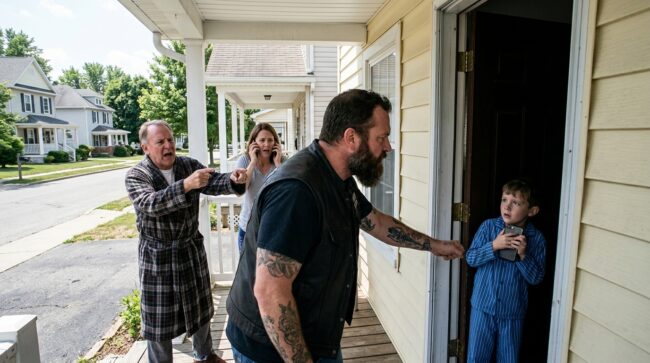
Wade walked to the living room, Noah close behind him, stepping only where Wade stepped to avoid the glass. The front room looked worse under police lights. One lamp on its side. Cold air leaking through the cracked front window. The front door still hanging partly open from where Wade had come in.
A silhouette moved across the porch.
“Now!” an officer shouted.
Wade pushed the door wider with his elbow and stepped into view with both hands up.
Three officers were already aiming at him.
Noah made a small choking sound behind him.
“On your knees!” one officer barked.
Wade complied immediately.
That should have helped. It didn’t. The neighbors across the yard were still yelling over each other, feeding the scene with certainty.
“That’s him!”
“He broke in!”
“He was inside with the child!”
The old man in the green robe pointed with a shaking hand. “I saw him go through the front!”
Noah was frozen in the doorway.
One officer advanced, fast and tense, eyes fixed on Wade. Another angled for a better view into the house, saw the broken hallway, and stiffened.
“Where’s the kid?”
Wade answered without looking up. “Behind me.”
Noah finally found his voice.
“I’m Noah Bennett!”
It came out shrill and cracking.
The yard went quiet in a strange, uneven wave.
The officer nearest the door looked past Wade. Saw the pajama pants. The missing sock. The little hand holding the phone.
Saw the child wasn’t running from the biker.
The child was hiding behind him.
That didn’t solve everything.
But it broke the first version of the story.
A female officer stepped closer, lowering her weapon first. “Noah? Come here, sweetheart.”
Noah didn’t move.
He looked at Wade.
That detail changed the temperature more than anything else.
The female officer noticed. So did everyone else.
“It’s okay,” she said gently.
Noah’s voice was still thin with shock. “He told me not to open the door.”
The old man across the lawn frowned. “What?”
The female officer looked at Wade, then at the broken hallway. “What happened in there?”
Wade kept his hands where they were. “Male suspect. Hoodie. Broke in through the back. Had a screwdriver. Ran through the alley maybe thirty seconds ago.”
The officer by the porch rail immediately turned and shouted that description toward the cruisers.
Movement exploded down the side yard. More officers. Flashlights. A chase widening into the alley.
The female officer crouched to Noah’s level at the threshold. “Is that true?”
The boy nodded too fast. “He was at the bathroom door.”
The words seemed to knock the breath out of the yard.
The neighbors stopped contributing now. They started listening.
The officer asked, “And this man?”
Noah looked at Wade again, then at the phone in his hand.
“I called him.”
That caused visible confusion.
One of the officers said, “You know him?”
“No.”
Another silence.
The old man in the robe looked embarrassed already, but not enough yet.
The female officer kept her voice steady. “How did you call someone you don’t know?”
Noah held up the phone. “I called my mom. I did the number wrong.”
The explanation was so small, so childlike, so brutally plausible that it went through the entire scene like a blade. All at once the huge man in leather, the late-night call, the rushed arrival, the wrong front-door entry—it all rearranged itself into something harder to dismiss.
Not noble.
Not dramatic.
Just true.
The female officer glanced back at Wade. “And you came here alone?”
He nodded once.
That was not the correct answer.
Not to procedure.
Not to law.
Not to anyone writing a report.
But it was honest.
The officer studied him for a second, then looked toward the alley where more yelling had started up. A flashlight beam bounced wildly against the houses.
Someone had found movement.
The real kind.
Noah stepped out one bare foot onto the porch, then remembered the glass and stopped. He looked down at the vest still spread across the shards in the hallway.
“He put that there,” he said quietly.
The female officer followed his gaze.
The detail was tiny.
But details are where false judgments start to die.
By 12:19 a.m., the alley suspect was in custody two blocks over.
Thirty-six years old. Prior burglary charges. Cut on his palm from smashing the rear window latch. Flat denial at first. Then panic. Then the unraveling story officers always hear when a fast crime goes sideways. He thought the house was empty. He saw the boy. He tried the bathroom door. Then someone bigger hit him before he could get out clean.
By then the ambulance had arrived, not for blood or heroics, but because Noah had gone from adrenaline to shaking so hard he could barely stand.
His mother came in the back of a patrol car five minutes later, still in purple scrubs and a hospital laundry jacket, face white with terror from the drive home. The second she saw Noah wrapped in a blanket on the ambulance step, she broke.
The kind of break people try not to do in front of strangers.
She fell to her knees anyway.
Noah ran into her hard enough to nearly knock her over, and she held him like she was trying to put him back inside her body where nothing could touch him again. The older sister arrived almost at the same time in a neighbor’s minivan, mascara streaked down her face, apologizing before she even got out.
“I’m sorry, Mom, I’m sorry, my phone died, I’m sorry—”
The yard filled with aftershock. Statements. Flashlights. The dull scrape of police boots on frozen grass.
Wade stayed near the curb by his motorcycle.
Not because anyone told him to.
Because he understood scenes like this. Understood where the center belonged, and that it did not belong to him anymore.
One of the officers brought him his vest from inside. The leather had a glitter of glass dust still clinging to it.
“Here,” the officer said.
Wade took it. “Thanks.”
The officer hesitated. “You should’ve called dispatch first.”
“Yeah.”
“You know that.”
“Yeah.”
No excuse.
No defense.
The officer looked at him for another second. “Still got there in time.”
Wade didn’t answer.
He looked past him, toward Noah and the mother on the ambulance step.
That was when the mother finally stood, still clutching Noah’s hand, and looked around as if remembering there had been another person in the night besides fear and loss and relief.
“Which one was him?” she asked.
Several heads turned toward Wade at once.
He hated that kind of attention. It showed at the corners of his mouth, in the way his shoulders set. But he didn’t walk away.
Noah saw him immediately.
“That’s him,” he said.
The mother started toward Wade, then slowed, perhaps seeing him fully for the first time under the flashing lights. Big. Tattooed. Weathered. The exact kind of man she had probably taught her children to avoid in parking lots and gas stations and after-dark sidewalks.
She stopped two feet away.
“Did you…” Her voice failed and restarted. “Did you stay on the phone with him?”
“Yeah.”
“Did you come in that house alone?”
“Yeah.”
Tears filled her face again, not gracefully.
Noah, still gripping her hand, said, “He said don’t open the door.”
Wade looked down at the boy. “You listened.”
The mother swallowed hard. “I told him… if he was ever scared and couldn’t reach me…” She looked at the crumpled drawing Noah still had in one hand. Her breath caught. “I used to tell him to call somebody big.”
She tried to laugh once and couldn’t.
That might have been the end of it.
A simple, terrible night ending where it should.
But then Mrs. Keller, the older neighbor Wade had called on the way over, came out from the gathered crowd with her coat thrown over pajamas and said the one thing no one there expected.
“I know you.”
Wade turned.
Mrs. Keller peered at him through thick glasses, uncertain but intent. “You were at St. Vincent’s three years ago. Cardiac floor. Middle of the night.”
Wade’s face emptied further, which for him meant he remembered.
The mother looked between them. “What?”
Mrs. Keller pointed, not accusing now, just stunned. “My husband died that winter. I was alone in the hallway trying to sign papers I couldn’t read because I was shaking too hard. You sat with my grandson until my daughter got there. You bought him crackers from the vending machine.”
The yard went oddly still.
The story had already turned once.
Now it tilted deeper.
Mrs. Keller took another step forward. “And you left before we could thank you.”
Wade glanced away toward the bike. Toward anywhere else.
“It was nothing,” he said.
“No,” she replied softly. “It wasn’t.”
The mother looked at him then with a new expression—one made not of gratitude alone, but of the uncomfortable realization that she had almost spent her whole life warning her children about men who looked exactly like the one who had just saved hers.
Noah stepped free from her hand and came closer. He held up the drawing.
“I didn’t mean to call you,” he said.
Wade’s mouth moved like it almost became a smile and thought better of it. “I know.”
Noah frowned in the serious way children do when they are assembling meaning from wreckage. “But maybe I did.”
No one said anything to that.
Because sometimes a child says the line adults would ruin if they touched it.
The statements took another half hour.
The ambulance left without Noah needing to go in.
The sister was wrapped in a borrowed blanket and crying quietly on the porch steps. The old man in the green robe avoided looking at Wade at all now, which was apology enough for that kind of man. One officer took photos of the broken back latch. Another returned the screwdriver in an evidence bag to the trunk of his cruiser.
The cold got sharper after midnight.
Wade finally put his vest back on.
Not dramatically. Just because the air cut through the thermal shirt now and the night had settled into the kind of silence that comes only after police lights leave a block and everybody hears their own breathing again.
Noah’s mother approached him one last time.
She held out the phone.
“My number,” she said. “The right one this time.”
Wade looked at it, then at her.
He took the phone, typed his own number beneath hers, and handed it back.
No promises.
No speech.
No line about family or fate or second chances.
Just a number.
Something practical.
Something that could be used.
Noah stood beside her, half-hidden in the blanket around his shoulders. “Will you answer if I call?”
Wade settled his gloves into one hand. “If I hear it.”
The boy nodded like that was enough.
Maybe because children understand something adults keep pretending not to: that certainty is rare, but showing up still counts.
Wade put on his helmet and swung onto the bike. The engine came alive low and steady, less like noise now and more like a pulse returning to the street.
He looked once toward the duplex.
The broken hallway light glowed through the front window. The mother had already started picking up the frame that fell. The sister was sweeping glass into a dustpan with borrowed shoes on her bare feet. Noah stood in the doorway, one hand on the knob this time, the other holding that crumpled drawing flat against his chest.
Wade lifted two fingers from the handlebar.
A small salute.
Nothing more.
Then he rode off into the Indiana cold, the taillight shrinking at the end of the block until it was just another red point swallowed by the dark.
On the Bennett porch, Noah stayed there longer than his mother wanted, staring after the sound even after it was gone.
In the morning, the neighbors would tell the story differently than they had at midnight.
They would say the boy called the wrong number.
They would say a biker came.
They would admit they got it wrong.
But inside that duplex, what remained was smaller and quieter than the story the block would repeat.
A child on a bathroom floor.
A stranger who did not hang up.
And a number, dialed by mistake, that became the only reason the night ended with anyone still standing.