I should have dropped the bell and run.
Instead, I closed my fist around it so hard the edge bit into my palm.
The gray-bearded man took one slow step toward me. He was tall, maybe in his late fifties, with a face weathered by wind and old anger. Not loud. Not theatrical. Just the kind of man who looked as if he had already lived through enough violence to stop needing to advertise it. The scar-mouthed man stayed half a step behind him, watching me with flat eyes.
“Where did you get that?” the gray-bearded man asked.
I didn’t answer.
Because now I could hear them clearly—engines, low and patient somewhere beyond the stacked containers, not racing, not roaring, just idling like a line of animals being held back.
The man’s gaze moved from my hand to my face. Then it changed.
Only a little.
But I saw it.
Not recognition. Not exactly.
Something closer to calculation.
“You Daniel’s boy?” he said.
My whole body went cold.
Nobody in Marlow Ridge ever brought up my father unless they were drunk, pitying my mother, or trying to remember a funeral they barely attended. And even then they never used his name like that, like it still had weight.
“I don’t know what you’re talking about,” I said, but it came out too fast.
The scar-mouthed man laughed once under his breath. “Same eyes,” he muttered.
The gray-bearded biker lifted a hand slightly, silencing him without even looking. “You need to go home.”
“Who was tied to that fence?”
No answer.
“Why did he say my name?”
Still nothing.
The man’s jaw hardened. “Kid, go home.”
He didn’t sound threatening. He sounded strained. As if every extra second I stood there made something worse.
That only made me trust him less.
“Is he dead?” I asked.
The scar-mouthed man moved first, a sudden half-step forward. “Watch your mouth.”
I backed up. My shoulder hit the fence. The bell in my hand gave off one faint, awful chime.
All three of us froze.
Because a moment later, from behind the far container, another bell answered.
Then another.
Not loud.
Just enough.
Metal on wind.
My mouth went dry.
The gray-bearded man turned sharply toward the sound. For the first time, real fear crossed his face—not fear of me, but fear of timing, of something arriving too soon.
“Get out of here,” he said, and now there was no room left in his voice. “Right now.”
I didn’t move.
That was when I saw it.
Beyond the containers, through a seam of rusted steel and shadow, a man was being dragged across the gravel by two others. His boots left crooked lines behind him. One arm hung wrong. His vest was gone. His shirt was soaked dark at the ribs.
It was the biker from the fence.
He lifted his head once, barely. And even from that distance, I knew.
He was looking for me.
Then a hand clamped down on my shoulder from behind.
I jerked so hard I nearly screamed.
It was Noah.
White-faced, breathing hard, bike helmet still hanging from one handlebar where he’d dropped it in the weeds.
“Eli,” he whispered, “your mom’s looking for you.”
The gray-bearded man swore under his breath.
And before I could say a word, someone deeper in the yard shouted, “He’s gone!”
Everything changed at once.
The two bikers spun toward the voice.
The engines cut off.
And from somewhere to my left, hidden in the maze of rust and weeds, I heard running footsteps coming straight for us.
Noah grabbed my sleeve and pulled, but I yanked free.
The footsteps got louder.
Fast. Desperate. Sliding on gravel.
Then the wounded biker burst between two containers and almost crashed into the fence where I stood.
Up close he looked worse than before. One side of his face was swollen. His lip was split open. There were deep marks around his wrists where the restraints had bitten in. But it was his eyes that stopped me. They were not wild. They were not empty.
They were focused.
On me.
The gray-bearded biker cursed and lunged forward, but the wounded man twisted away, stumbling hard, one hand catching the fence. It rattled violently. Rust flaked down. The little bell in my fist chimed again.
The man heard it.
His eyes dropped to my hand. Then back to my face.
“Where did you get that?” he rasped.
The same question.
Different voice.
Different weight.
The scar-mouthed biker came in from the side. “Boss, stop moving.”
Boss.
The word hit me harder than I expected.
So the rumors had been wrong in one way and right in another. He wasn’t some random biker. He mattered. Enough to be hunted. Enough to be tied up in public like a message.
Which meant maybe the town had it right after all.
Maybe he really was dangerous.
Maybe the men around him weren’t the threat. Maybe they were the ones trying to contain him.
Noah had gone completely still beside me.
“Eli,” he whispered, “let’s go. Right now.”
But I couldn’t.
Because the wounded biker looked at the gray-bearded man—not with fear, but with heartbreak so raw it almost made me look away.
“You too, Warren?” he said.
The gray-bearded man—Warren—didn’t answer.
That silence said more than shouting could have.
Something inside me snapped into place, and it was the worst possible version of the story: betrayal inside a violent biker club, revenge in broad daylight, hidden meetings in the freight yard, my dead father somehow tangled up in all of it. Every ugly rumor, every warning, every frightened look from my mother suddenly seemed to point in the same direction.
I backed away from all of them.
The wounded biker saw it happen.
I watched him realize what I believed.
I watched it land.
And still he said, “Kid… listen to me.”
“Don’t,” Warren cut in sharply.
The wounded man ignored him. “If they take me across county line, it’s over.”
“Then maybe it should be,” the scar-mouthed man muttered.
The biker near the fence straightened with visible effort. “He promised them the club.”
Warren’s face went dead still.
Noah looked at me. “What is he talking about?”
I didn’t know. But my heart was slamming now, because men were appearing at the far end of the yard. More riders. More boots on gravel. More vests. They spread out without shouting, blocking the exits with a calm that felt far worse than chaos.
This wasn’t a street brawl.
It was a judgment.
The wounded biker swayed once. Then he looked directly at me and said the sentence that made my blood stop:
“Your father saved my life in Arkansas. If you leave me here, his debt dies with me.”
I stared at him.
Arkansas.
My father.
Debt.
Nothing fit. And yet something deep inside me—something older than logic—moved.
I thought of the bell.
D.M.
I thought of my mother freezing at the sink.
I thought of the way this man had whispered my name through broken lips, not like a stranger guessing, but like someone pulling it up from memory he had protected for years.
One of the approaching bikers shouted, “End this now.”
Warren took a step toward the wounded man.
The wounded biker’s knees buckled.
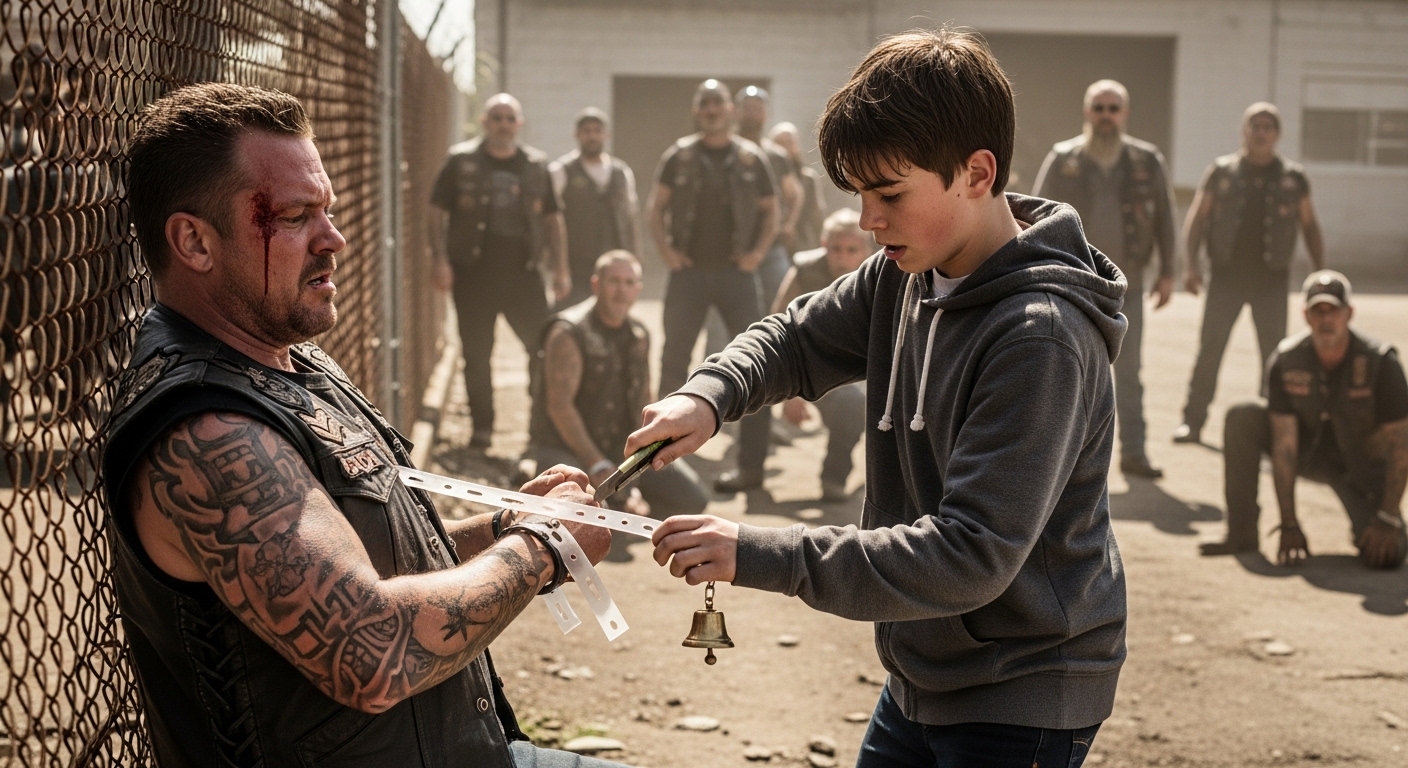
And before I had time to be brave or sensible or anything at all, I reached into my backpack, pulled out the box cutter I used at the hardware store, and heard myself say:
“Run.”
Nobody moved.
For half a second, not one of us breathed.
Then I lunged forward, grabbed the torn plastic restraint still hanging from his left wrist, and sliced through it.
The blade snapped shut.
The biker staggered free.
And behind us, someone shouted in pure shock, “The boy cut him loose!”
Everything that happened next blurred at the edges but stayed sharp in the center, the way the worst moments do.
Warren moved first—not toward me, but toward the men rushing in from the yard.
“Back off!” he roared.
The command cracked across the gravel so hard even Noah flinched.
For one stunned second, the others actually stopped.
The wounded biker—no, not just a biker, not anymore—caught himself on the fence and turned toward Warren with an expression I still think about sometimes when I wake up at night. It wasn’t triumph. It wasn’t victory.
It was grief.
“You should’ve let them think I was dead,” he said hoarsely.
Warren looked ten years older than he had a minute before. “I tried to get you out.”
“Tried?” the scar-mouthed man snapped. “He was handing over the whole chapter to Pike.”
That name hit the yard like a thrown match.
Several of the riders stiffened.
One of them, standing near a rusted drum, spat into the dirt. “Pike sold routes, names, storage spots. He sold all of it.”
Another muttered, “To save his own skin.”
The pieces didn’t come together all at once. They fell into place with awful slowness, each one changing the shape of the last.
Not a gang war over territory.
Not a public punishment for some sadistic outlaw.
A betrayal.
Inside the club.
The man I had freed was not the criminal being judged. He was the one being delivered.
And Warren—who I had been so sure was helping hunt him down—had actually been stalling, buying time, trying to keep the damage from becoming permanent before the wrong men arrived.
The wounded biker wiped blood from his mouth and looked at me. “My name is Jonah Creed.”
I knew that name.
Not from town gossip. Not from TV. From somewhere private, old, hidden.
Then I remembered.
A shoebox in my mother’s closet. Under winter blankets. Full of things she thought I had never seen.
Inside it, years ago, I had found a folded photo of three younger men standing by motorcycles on a dirt road under a hand-painted sign. My father had been one of them, smiling in a way I barely remembered. On the back, in faded ink, were four words:
Daniel, Jonah, Mercy Road, 2004.
My knees nearly gave out.
Jonah saw it in my face. He knew I had remembered.
“He pulled me out of a fire outside Little Rock,” Jonah said, voice rough with pain. “Truck stop job went bad. Place lit up. Your dad came back in when everybody else ran. Carried me out himself.” He glanced down at the bell still in my hand. “That was on his handlebars. Afterward he cut it off and tied it to mine. Said if either one of us ever heard it again, it meant we still owed the world one more act of mercy.”
Nobody in the yard spoke.
Even the men who had come ready for violence seemed unable to move.
Jonah swallowed, then added, “I kept it all these years. Not because it was lucky. Because your father was the only man I ever knew who could ride with wolves and still come home human.”
The world tilted quietly.
All my life I had been given a smaller story. A safer one. My father died in a wreck. End of sentence. End of man. End of questions.
But that wasn’t the whole truth.
He had once belonged to this world. Not the myth of it. Not the cheap rumors. The real one. Men with pasts, debts, loyalties, damage. Men who made bad choices and still sometimes did one impossible good thing in the middle of them.
My mother hadn’t lied because she wanted to erase him.
She had lied because she wanted to save what little of him she could keep clean.
Warren took off his gloves slowly, like his hands had started belonging to someone older. “Pike said Jonah was turning witness. Said the patch had to be stripped and the club handed over before federal heat came down.”
Jonah let out a broken laugh. “Pike was the heat.”
A murmur rolled through the riders.
Not loud. Worse.
A sound of men realizing they had aimed their loyalty at the wrong target.
Warren looked at me then, and the shame in his face was so naked I had to look away.
“I knew your father,” he said. “He saved my brother too. Not with fire. With money. Hospital money. Never told a soul.” He swallowed hard. “When I saw your face, I knew. And I still almost let this happen.”
Noah stared at me as if he didn’t know who I was anymore.
I barely knew myself.
Jonah stepped toward me, slow and unsteady, blood drying at his temple, one hand pressed to his side. He didn’t ask for the bell. He just looked at it. Then at me.
“Your dad once told me,” he said softly, “that if the world ever turned ugly enough to make good men stand back and watch, hope would probably come from somebody small enough to still think cutting a stranger free was the obvious thing to do.”
I couldn’t speak.
Because suddenly the whole day looked different.
The people driving by.
The woman with the dog.
The rumors.
The fence.
They had all seen a man displayed like a monster and decided the story for themselves.
I had almost done the same.
And now one by one, around that ruined freight yard, men in leather vests who had come ready to witness a leader’s fall began removing their gloves, their hats, even their patches from over their hearts.
No orders.
No performance.
Just silence.
Heavy, human silence.
Then Warren, the first to misunderstand and the first to know better, dropped to one knee in the gravel.
The others followed.
One after another.
Ten.
Twenty.
Forty.
Then more.
Until what felt like the whole yard had lowered itself in front of the man they had nearly handed over—and in front of the boy whose father had once carried him through fire.
By the time the last riders came through the gate, there were nearly a hundred bikers kneeling in the dust.
And all I could hear was the tiny brass bell trembling in my shaking hand.
The police came later.
By then Pike was gone.
So was half the certainty in town.
Stories changed fast after that, but not fast enough to erase what people had already revealed about themselves. The same mouths that had called Jonah an animal now whispered about corruption, informants, federal deals, old loyalties, and how close Marlow Ridge had come to hosting a murder in plain sight while pretending not to notice.
My mother cried when she saw the bell.
Not loudly.
That was never her way.
She just sat at the kitchen table with both hands over her mouth, shoulders shaking, while evening light thinned across the chipped wood and the city bus hissed below our window. I put the bell in front of her. She touched it like it might burn.
“Your father wore this for six months,” she said after a long time. “Said it annoyed everybody behind him at stoplights.”
I laughed.
Then she laughed too.
And that somehow hurt worse.
Because grief is strange like that. Sometimes the worst part is not the crying. Sometimes it’s hearing a dead person become funny again.
Over the next week, men from Mercy Road came by the hardware store one at a time.
Never in a crowd. Never to make a scene.
One brought flowers for my mother and left them without a card. One fixed the loose back step behind our building. One slipped an envelope under our door that paid three months of rent and disappeared before dawn. Noah’s uncle, who had spread half the rumors in town, stopped talking altogether when he saw Warren himself sweeping broken glass from the alley after a storm.
Jonah came last.
He looked older than he had in the freight yard, like survival had finally sent the bill for all the years he had outrun. He wasn’t wearing his vest. Just a denim shirt, faded jeans, and the kind of careful expression people have when they’re standing near a memory that belongs more to someone else than to them.
He brought me something wrapped in an old shop rag.
Inside was a burned-edged Polaroid.
Not the one from my mother’s closet. Another one.
In it, my father stood beside Jonah and Warren near a row of muddy bikes, grinning straight at the camera, one hand raised, the brass bell visible near the handlebar. On the back, in my father’s handwriting, were six words:
Still owe the world one more.
I stared at it for a long time.
“I couldn’t save him later,” Jonah said quietly.
I looked up.
He meant my father.
A thousand questions rose in me at once, but for some reason none came out. Maybe because I could already see the answer in his face: whatever had happened at the end had never stopped happening inside him.
“You saved me,” he said instead. “So maybe the debt just kept moving.”
We stood there in the dim apartment kitchen, with the old refrigerator humming and my mother pretending to fold towels in the other room so she could give us privacy without admitting she was listening. Outside, somebody honked in traffic. Somewhere farther off, a motorcycle passed and faded.
Ordinary sounds.
That was the strange part. After everything, the world had the nerve to keep sounding normal.
Before he left, Jonah placed the bell back in my hand.
“It’s yours now.”
I almost told him I didn’t want it.
Not because I was afraid of it. Because I finally understood it.
The bell had never meant danger.
It meant a debt of mercy traveling through damaged men, refusing to die.
Weeks later, I went back to the abandoned fence alone.
The weeds were taller. The blood was gone. Somebody had cut away the worst of the rusted wire. If you didn’t know what had happened there, you might have thought it was just another broken edge of town no one planned to fix.
But I knew.
I stood there with the bell in my pocket and realized the hardest thing to live with was not that evil could happen in public.
It was how easily people could mistake pain for guilt, silence for guilt, leather for guilt, blood for guilt—how badly we wanted the person tied to the fence to deserve the fence.
I had wanted that too, for a moment.
That stays with me.
Sometimes, late at night, I still hear that tiny brass chime in my head and feel that first terrible certainty all over again. The certainty that I understood what I was seeing.
I didn’t.
That was the whole story.
Not that a boy saved a biker.
Not that a hundred riders knelt.
Not even that my father had lived a life I was only beginning to understand.
It was this:
The man everyone thought was being punished was the last decent man in the yard.
And the smallest sound I had ever heard was the one that finally made me listen.
Follow for more stories that begin with judgment—and end with the truth no one saw coming.