The Father Mistaken for a Stranger on the Holiday – His Son’s Introduction Made Everyone Lower Their Heads
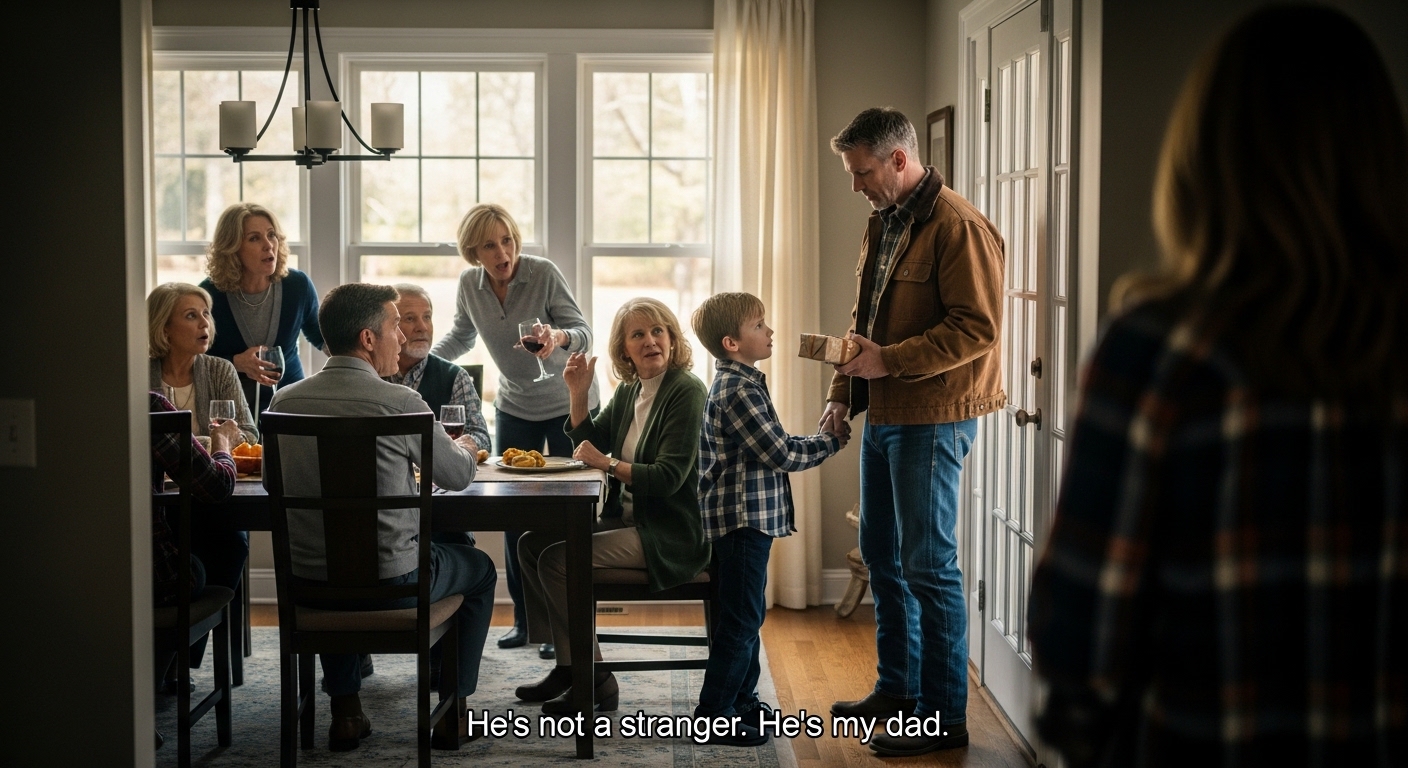
On Thanksgiving night, in a house full of relatives and warm laughter, they asked him who he was. They thought he didn’t belong. They didn’t know the little boy standing beside him was about to say something that would change everything.
It was my sister’s house in a quiet suburb outside Denver. Long wooden dining table. White linen. Candles burning low. The kind of evening people photograph and post with captions about gratitude.
He arrived late.
Brown jacket worn at the elbows. Work boots slightly scuffed. Hair touched with gray earlier than it should have been. He stood near the doorway holding a small gift box wrapped in simple paper, like someone unsure whether they had come to the right place.
A few cousins exchanged looks.
“Can we help you?” my sister-in-law asked politely, but with distance.
He smiled, the kind of smile that asks permission before it speaks. “I’m here for the holiday. For my son.”
The room hesitated.
Not one person stepped forward to greet him.
Because in recent years, he hadn’t appeared in the framed photos hanging in the hallway. He hadn’t been mentioned in the stories retold every November. He had quietly faded from the narrative.
Except he hadn’t faded from one heart.
At the far end of the living room stood Ethan, ten years old, eyes widening the moment he saw him.
The adults didn’t notice the boy’s expression.
They noticed the jacket.
The boots.
The unfamiliar presence.
And then someone whispered, softly but not softly enough, “Family only, please.”
I felt the air tighten.
Because I knew exactly who he was.
And I knew why many in that room preferred to forget.
They thought he was a stranger.
They didn’t understand that the child about to speak would correct that mistake.
And when he did, the silence that followed would be heavier than any accusation.
I’m fifty-eight now.
When I look back at that evening, I don’t remember anger first. I remember the quiet weight of assumption.
The man at the door was Mark. My sister’s former husband. Ethan’s father.
They divorced when Ethan was six. The separation wasn’t explosive. No screaming headlines. No public scandal. Just slow erosion.
Mark worked as a mechanic. Long hours. Grease-stained hands. No advanced degree. No tailored suits. In our extended family—where success was measured in titles and income—he was considered… ordinary.
That word carries more judgment than people admit.
My sister rebuilt her life quickly. New job. New circle. A partner who fit more comfortably into our family’s expectations. Over time, Mark’s presence at gatherings became irregular. Then rare.
It was easy to assume he didn’t try.
It was easy to tell ourselves that if he loved his son enough, he would “fight harder.”
But I had seen pieces of the story others hadn’t.
I had seen text messages left unanswered.
I had seen him wait outside Ethan’s school on days he wasn’t scheduled to visit, just to watch from a distance as children poured out into the afternoon light.
I had seen him save money for weeks to buy Ethan a secondhand bicycle, refusing help because he wanted it to come from him.
Mark wasn’t loud.
He didn’t defend himself at family meetings.
When relatives implied he lacked ambition, he nodded quietly.
When visitation schedules changed at the last minute, he adjusted.
He told me once, in a voice so steady it almost hurt, “As long as Ethan knows I’m here, that’s enough.”
But children grow inside the stories adults tell around them.
And the story told in that house was that Mark had drifted away.
That he hadn’t “shown up.”
So when he stood at the doorway that Thanksgiving night, gift in hand, posture careful, most of the room saw not a father—but an outsider.
And when someone repeated, gently but firmly, “This is a private family gathering,” I watched his shoulders shift slightly, like a man preparing to retreat.
He would have left quietly.
He would have turned around and walked back into the cold without argument.
But Ethan had already crossed the room.
And the way the boy reached for his hand told me this evening was about to change.
Not loudly.
Not dramatically.
But in a way that would make every adult present reconsider what they thought they knew.
Because sometimes, the truth doesn’t arrive with documents or speeches.
Sometimes, it arrives in the voice of a child who refuses to pretend.
And in that moment, I realized the most powerful introduction of the night was about to begin.
Ethan didn’t hesitate.
He ran straight across the living room and wrapped both arms around Mark’s waist.
“Dad,” he said loudly, as if correcting the room itself.
The word landed heavier than anything spoken that night.
Mark froze for half a second, then slowly placed his hand on the back of his son’s head. Not possessively. Just carefully. Like he wasn’t sure he was allowed.
Someone near the fireplace cleared their throat.
“Oh,” my cousin muttered. “We didn’t realize.”
But it wasn’t confusion in their voices.
It was embarrassment.
My sister stepped forward then. Her smile tight. Polished. “Mark, we didn’t know you were coming.”
“I texted,” he said quietly. “I thought it would be okay.”
There it was again. That careful tone. As if he were asking permission to exist.
The room shifted. Chairs scraped lightly against the hardwood floor. Conversations resumed in low, strained murmurs. But the air had changed.
Mark wasn’t a stranger.
He was just inconvenient.
My brother-in-law—my sister’s new husband—approached, hand extended with a firmness that felt rehearsed. “Good to see you,” he said. The words sounded formal. Territorial.
Ethan didn’t let go of his father’s hand.
“Dad came to watch me present,” Ethan announced proudly.
Present what?
A few of us exchanged glances.
Ethan had prepared something for the family dinner—a small speech about gratitude. My sister had mentioned it earlier in the week.
We assumed he would thank his mom.
Maybe his teachers.
Certainly the people who were visible in his life.
Mark stood near the wall now, unsure whether to sit. No one had made space at the table.
And that, more than anything, told the story.
“Maybe it’s better if we start dinner,” someone suggested lightly.
But Ethan shook his head.
“I want to do it now.”
The adults laughed gently. Indulgent. As if this were adorable.
They didn’t know it wasn’t.
Ethan walked to the center of the room, holding a folded sheet of paper. His small hands trembled slightly—not from fear, but from importance.
“I wrote about who I’m thankful for,” he said.
The room quieted again.
And for the first time that evening, no one was looking at the food.
They were looking at the boy.
And the man standing silently against the wall.
Ethan unfolded the paper carefully.
“I’m thankful for my mom,” he began, voice steady. “She takes care of me every day.”
My sister smiled.
“I’m thankful for Uncle Josh for teaching me how to throw a football.”
Josh nodded proudly.
“And I’m thankful for my stepdad for helping me with math.”
There was a small ripple of approval through the room.
Then Ethan paused.
He lowered the paper.
“I’m most thankful for my dad.”
The silence that followed was immediate and complete.
Mark looked down.
Ethan continued, louder now. “He’s the one who waits outside my school when it’s not even his day. He’s the one who fixes my bike even when it’s broken again. He’s the one who told me it’s okay if I don’t always win.”
I felt my throat tighten.
“Dad says he can’t always come inside because it makes things harder,” Ethan added, glancing toward the adults. “But he still shows up.”
No one moved.
No one interrupted.
“He saved money for months to come to my science fair,” Ethan said. “He said he didn’t need to be in pictures. He just needed to see me.”
Mark’s shoulders had begun to shake slightly. Not dramatically. Just enough to show he was no longer holding everything in place.
Ethan folded the paper.
“He’s not a stranger,” he said quietly. “He’s my dad.”
There are moments in life when truth doesn’t shout.
It simply stands there.
Every adult in that room understood what had just happened.
The story we had told ourselves—that Mark was distant, that he wasn’t committed, that he had drifted away—had been gently dismantled by a ten-year-old boy.
No accusation.
No anger.
Just facts.
My sister’s face changed first. Not defensive. Just unsettled.
My brother-in-law lowered his gaze.
Even the relatives who had whispered at the door shifted uncomfortably in their seats.
Mark didn’t step forward.
He didn’t claim vindication.
He just knelt down and hugged his son.
The room, which had once been so eager to decide who belonged, had nothing left to say.
And for the first time that night, someone pulled out a chair for him.
Not out of obligation.
But out of recognition.
When I think about that Thanksgiving now, I don’t remember the food.
I remember the correction.
How easily adults construct narratives. How quickly we accept versions of people that fit our expectations.
Mark had never defended himself in family meetings. He had never sent long emails explaining missed visits. He had absorbed judgment quietly, perhaps believing that arguing would only complicate Ethan’s life further.
He had chosen presence over pride.
And we had mistaken quiet for absence.
The most humbling part of that evening wasn’t the boy’s speech.
It was realizing how confident we had been in our misunderstanding.
We had judged the jacket.
The boots.
The timing.
We hadn’t looked at the waiting.
The saving.
The showing up from the edges.
There is something profoundly uncomfortable about being corrected by a child. Not because children are naïve—but because they often see without agenda.
Ethan didn’t care about adult reputations. He didn’t care about income or titles. He cared about who was there.
And who wasn’t.
After dinner, conversations were softer. More careful. My sister spoke to Mark quietly in the kitchen. I didn’t hear the words, but I saw something shift between them. Not reconciliation. Not instantly.
But acknowledgment.
Sometimes, justice doesn’t arrive in courtrooms.
Sometimes it arrives in living rooms, between mashed potatoes and folded napkins.
That night reminded me that dignity doesn’t always defend itself loudly. Sometimes it waits for the right voice.
And sometimes that voice belongs to a child.
If this story touched something in you, follow this page for more reflections like this. Some stories are quieter than others—but they stay with you longer.