The Maid Was Thrown Out of the Party for “Stealing” a Ring—20 Minutes Later, the Security Camera Exposed a Truth That Left the Whole Family Frozen
It happened in the middle of a fiftieth anniversary party, the kind with white roses everywhere, string lights glowing in the backyard, and soft jazz floating through an expensive house that seemed built more for appearances than comfort. The Whitmores had invited nearly forty people—neighbors, cousins, business friends, the pastor, even a local judge. It was the kind of night where every smile looked polished. Every laugh sounded practiced.
And in the center of that beautiful room stood Elena Cruz, the live-in housekeeper everyone called by her first name when they needed something and “the help” when they thought she couldn’t hear.
Elena was fifty-eight, slight, quiet, always moving with that careful, invisible grace people only notice when it stops. She had worked in that house for almost nine years. She knew who liked their coffee weak, who hid pills in vitamin bottles, which cabinet door squeaked, and which family fights began with silence long before they became words.
But none of that mattered now.
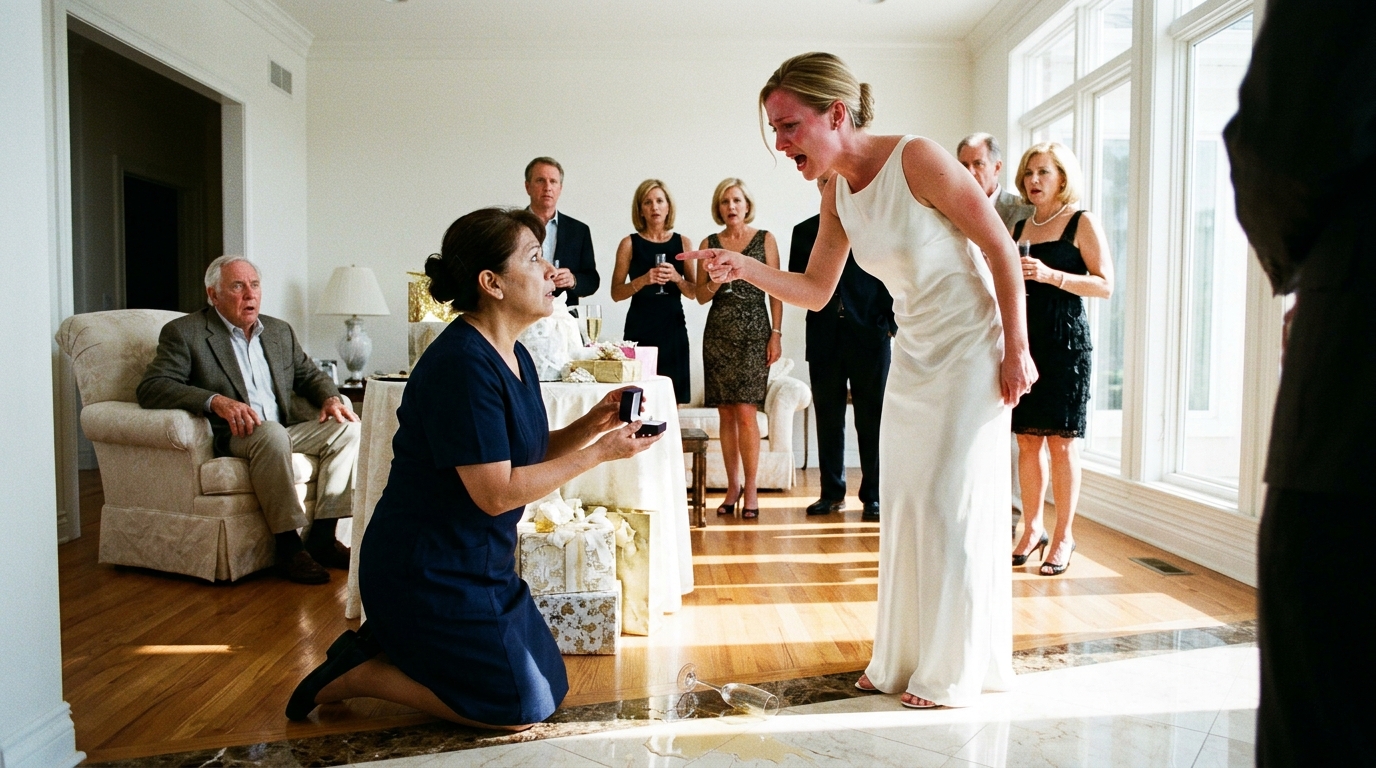
Because Claire Whitmore—young, elegant, perfectly dressed, with a voice sharpened by panic and pride—was pointing at Elena like she was pointing at a stain.
“My grandmother’s ring was in that box,” Claire said, breathless. “Now it’s gone, and she was the one standing here.”
People turned all at once. That cruel kind of turning. The kind that doesn’t look for truth, only for a target.
Elena slowly lifted her face. Her eyes were dark and stunned, but she didn’t defend herself fast enough. And in rooms like that, silence looks like guilt.
“Check her apron,” one aunt whispered.
“I always said this was a mistake,” another guest muttered. “You never really know people.”
Someone took Elena by the wrist. Someone else grabbed the ring box from her hand. Claire’s mother, Diane, pressed a hand to her chest as if she were the injured one. Even Henry Whitmore, the family patriarch, sat frozen in his chair, too shocked—or too proud—to interrupt the scene unfolding under his own roof.
Elena finally spoke, but her voice came low, almost swallowed by the music still playing in the next room.
“I didn’t steal anything.”
Claire laughed once. Hard. Disbelieving. “Then why were you hiding by the gift table with the box in your hand?”
Because that was the image now: the maid, the missing ring, the rich family humiliated in public.
No one asked why Elena looked more hurt than frightened. No one asked why her right hand was shaking. No one asked why, even while being accused, she kept glancing toward the hallway that led to Henry’s study.
They only saw what was easiest to see.
Diane stepped forward and pointed to the front door. “Leave. Right now. Before we call the police.”
The room went still in that terrible, satisfied way crowds go still when they believe justice is simple.
Elena looked at Henry once. Just once. Not begging. Not angry. Just tired in a way that made her seem suddenly older than anyone in the room.
Then she untied her apron with trembling fingers, folded it neatly over the back of a dining chair, and walked out while guests parted for her like she was something unclean.
As the front door shut behind her, Claire bent down to pick up the velvet ring box again.
And inside, tucked beneath the satin lining, was a tiny folded receipt no one noticed but Henry.
He stared at it.
Then, for the first time that night, his face changed.
At first, Henry said nothing. He simply slipped the small paper into his palm while Claire kept talking—too fast, too loudly, too certain.
“She had been acting strange all evening,” Claire said. “I saw her near the coat room, then near the gifts. She wouldn’t even look me in the eye.”
But Henry was no longer listening to Claire. He unfolded the receipt under the table, careful, almost secretive, like he was afraid the paper itself might say something the room wasn’t ready to hear.
It wasn’t a pawn ticket. It wasn’t proof of theft.
It was a pharmacy receipt.
A local one.
Time stamped forty-three minutes earlier.
Henry frowned. Two medications were circled in blue ink. One was his heart prescription. The other was the emergency refill his doctor had called in that afternoon and told him not to miss again.
His hand tightened.
He had forgotten all about it.
Elena hadn’t.
Across the room, the guests were still buzzing with that low, hungry gossip that fills the air after a public accusation. Claire was already retelling the story as if it had happened an hour ago, as if repetition could turn suspicion into fact. Diane kept apologizing to the guests for the “scene,” but not once for Elena.
Then Henry looked toward the hallway.
The study door was half open.
That was when he noticed something else. His pill organizer sat on the side table just inside the study, but next to it was a glass of water still sweating onto a coaster and a paper bag from the pharmacy.
Someone had brought his medicine home.
Someone had set it out before the party turned ugly.
He stood up so suddenly his chair scraped the floor.
“What is it, Dad?” Claire asked.
Henry didn’t answer. He walked to the study, picked up the pharmacy bag, and found Elena’s name on the pickup slip because she had used her own ID to collect the prescription when his assistant forgot. Underneath was a note written in careful handwriting on the back of an envelope:
Take this after dinner.
Do not let the champagne make you forget again.
– Elena
That should have ended it.
But families built on appearances do not surrender their pride that easily.
Claire followed him into the study. “So what? She picked up your medication. That doesn’t mean she didn’t take the ring.”
Henry turned. “Why was she in this room?”
Claire blinked. “What?”
“You said she was hiding by the gift table. But if she picked up my medicine and brought it here, then why did she have the ring box?”
Claire crossed her arms. “Maybe because she wanted both.”
It sounded thinner now. Meaner. Even she seemed to hear it.
Henry walked past her and into the security nook beside the kitchen where the indoor camera monitor fed into a tablet the family used whenever deliveries arrived. He tapped the screen with fingers that had begun to tremble—not from age this time, but from dawning shame.
Diane appeared behind him. “Henry, do we need this? The woman is gone.”
That was the first honest sentence anyone had spoken all night.
The woman is gone.
No name. No years of service. No mention of loyalty. Just gone.
Henry hit rewind.
On the screen, the party replayed in silence. Guests drifted in elegant clusters. Servers passed trays. Claire moved in and out of frame, one hand constantly near her neckline, where the antique ring had hung on a thin gold chain for safekeeping before the cake cutting.
Then came a moment no one in the room had seen.
Claire stepped into the downstairs powder room with her younger brother’s wife, Vanessa, right behind her. Claire looked upset. Vanessa shut the door. They argued—small, sharp gestures, the kind people use when they’re trying not to be noticed.
A minute later, Vanessa came out alone.
Then Claire emerged, face composed.
And then—there. On the camera near the hallway mirror.
Claire unclasped the chain from her neck, slipped the ring into the velvet box, opened it again, stared at it, and after a long, panicked second, pushed the box behind a stack of wrapped gifts.
A minute later, Elena passed by carrying the pharmacy bag, paused, noticed the half-hidden box, and picked it up.
That was when Claire turned, saw her, and screamed.
No theft.
No chase.
No search.
Just a terrified young woman, a hidden mistake, and the easiest possible scapegoat.
No one behind Henry spoke.
The silence this time felt different. Not triumphant. Sick.
Then Henry rewound a little further.
And what he saw next made the room even colder.
Before Claire hid the ring box, before the accusation, before the scream that split the party in two, the camera had caught something else in the powder room doorway when Vanessa stepped out.
Claire was crying.
Not dramatic crying. Not the kind meant to be seen. It was the kind that bends a person inward.
Vanessa had gripped her shoulders and said something the camera couldn’t hear, but Claire’s lips were easy enough to read.
I can’t tell them.
Henry stared at the frozen frame. Diane covered her mouth.
Then Vanessa, pale and rigid now, finally said it.
“She didn’t steal it,” Vanessa whispered. “Claire hid it.”
Claire’s voice cracked. “I was going to fix it.”
“Fix what?” Henry asked, and now there was steel in him.
Claire looked around the room as if searching for one ally and finding none. “The center stone was loose,” she said. “Last week I dropped the ring. I didn’t want Grandma to know. I didn’t want you to know. I took it to a jeweler, and he said the prongs were damaged. He told me not to wear it tonight.”
Diane stared at her daughter. “Then why bring the box down at all?”
“Because Grandma asked to see it before the toast. She tells that story every anniversary.” Claire’s voice broke harder now. “I thought I could pretend. I thought I could just show the box, close it, and put it away before anyone noticed.”
Henry’s face hardened. “And when Elena found it?”
Claire shut her eyes. “I panicked.”
Those two words landed heavier than any shouting had.
I panicked.
As if panic explained the violence of humiliation. As if fear could excuse handing another woman to a crowd.
Vanessa’s eyes filled. “There’s more.”
Of course there was.
Vanessa turned to Diane first. “Last winter, when your mother fell in the kitchen and cracked her hip, do you remember the specialist who agreed to see her without the six-week wait?”
Diane nodded slowly.
“It was Elena,” Vanessa said. “Her son-in-law drives for that doctor on weekends. Elena called in a favor and begged for help.”
Henry looked stunned.
Vanessa kept going, because once truth starts moving, it hates stopping.
“And when your insurance delayed the physical therapy approval, Elena paid for the first two sessions herself so your mother wouldn’t lose progress. I found the receipts when I was helping her file paperwork.”
Diane whispered, “Why would she do that?”
“Because she knew you were already paying for the party,” Vanessa said. “Because she heard you crying in the laundry room about bills. Because she didn’t want Mrs. Whitmore to suffer while everyone was waiting for paperwork.”
Henry sat down hard in the nearest chair.
But Vanessa still wasn’t done.
“The groceries that kept appearing on Elena’s day off?” she said softly. “Those weren’t for her. She’d been leaving them at the apartment of your former groundskeeper after his stroke. She never told anyone because she knew he’d be embarrassed.”
Now the whole shape of Elena changed in the room—not because she had changed, but because at last they had looked long enough to see her.
The quiet woman in orthopedic shoes.
The one who never sat down first.
The one who noticed who was hurting before they said a word.
The one they trusted with keys, medicine, family secrets, and aging parents—until one missing ring made them forget all of it.
Claire sank onto the sofa, mascara streaking down her face. “I didn’t mean for it to go that far.”
Henry’s answer came low and terrible. “It always goes that far for people like her.”
That sentence cut through the room more cleanly than any accusation.
Because everyone understood what he meant.
If Claire had been the one holding that box, it would have been confusion.
If Vanessa had found it, it would have been concern.
If one of the grandchildren had touched it, it would have been a misunderstanding.
But Elena?
Elena had been guilty before she even spoke.
Henry stood up, grabbed his coat, and headed for the door.
“Where are you going?” Diane asked.
“To bring her back,” he said.
But when he opened the front door, he stopped.
Elena was sitting on the stone bench beside the hydrangeas, still in her plain navy dress, hands folded in her lap, as if she had nowhere else in the world she needed to be more urgently than away from people who had just broken her dignity in public.
She had not run.
She had not called anyone.
She had not even left.
Only then did Henry understand the final, quiet truth.
She had stayed because she was worried he had not taken his medication.
The night had cooled. The music inside was off now. Even the house seemed ashamed.
Henry walked down the front steps slower than a man like him usually walked anywhere. Pride had been stripped out of him in twenty minutes.
“Elena,” he said.
She looked up, and for a second he saw the mark the apron strings had left on her neck. Such a small thing. Such a human thing. Somehow it hurt to look at more than tears would have.
“I’m sorry,” he said.
Not the polished version. Not the social version. The real one, rough and late.
Elena gave a tired smile that did not quite reach her eyes. “Did you take your pill?”
Henry almost broke on the spot.
Inside that question was everything she was and everything they had failed to be.
He nodded once. “I will now.”
Diane came out next, crying openly. Claire followed last, stripped of all her polish, looking suddenly much younger and much smaller than she had an hour before.
Claire’s voice shook. “I accused you because I was afraid.”
Elena looked at her for a long moment. “I know,” she said.
Nothing theatrical followed. No grand speech. No dramatic collapse into forgiveness.
Just the sound of party lights buzzing softly above them and dishes still untouched inside the house.
Henry asked Elena to come back in.
She stood, smoothing the front of her dress. “I’ll come in for Mrs. Whitmore,” she said quietly. “She shouldn’t be left wondering why the cake was never served.”
That was Elena. Even then.
Later, after the guests were gone and the roses had begun to wilt in their glass bowls, Henry’s mother found Elena in the kitchen wrapping slices of cake in foil. The old woman took off the ring from her own finger—a simple gold band, not the famous family heirloom—and pressed it into Elena’s palm just long enough for her to feel its warmth.
“Not for keeping,” she said softly. “Just so you know what family is supposed to feel like.”
Elena closed her fingers around it for one second, then gave it back with a small smile.
When she finally left near midnight, she paused at the door to hang her apron on the same hook where she always left it, neat as ever, as if dignity could be stitched back together by habit.
Maybe it can, a little.
And maybe some wounds stay because they should.
The next morning, the security camera clip was gone from the system. Henry deleted it himself. Not to protect Claire’s reputation. That had already been damaged by truth. He deleted it because Elena had suffered enough from being watched.
But some images do not leave.
A woman standing alone in a room full of people.
A family seeing too late who had been carrying them all along.
A question about a heart pill asked by the very person whose heart they had just bruised.
An apron folded carefully, even after humiliation.
A front bench under hydrangeas, where loyalty sat waiting in the dark.
Some stories do not end with justice. They end with recognition.
And sometimes that is the harder thing to earn.
If this story stayed with you, tell me in the comments: have you ever seen someone judged too quickly, only to learn the truth too late?