They Accused an Old Man of Stealing at Checkout—Then a Silent Biker Asked for the Cameras
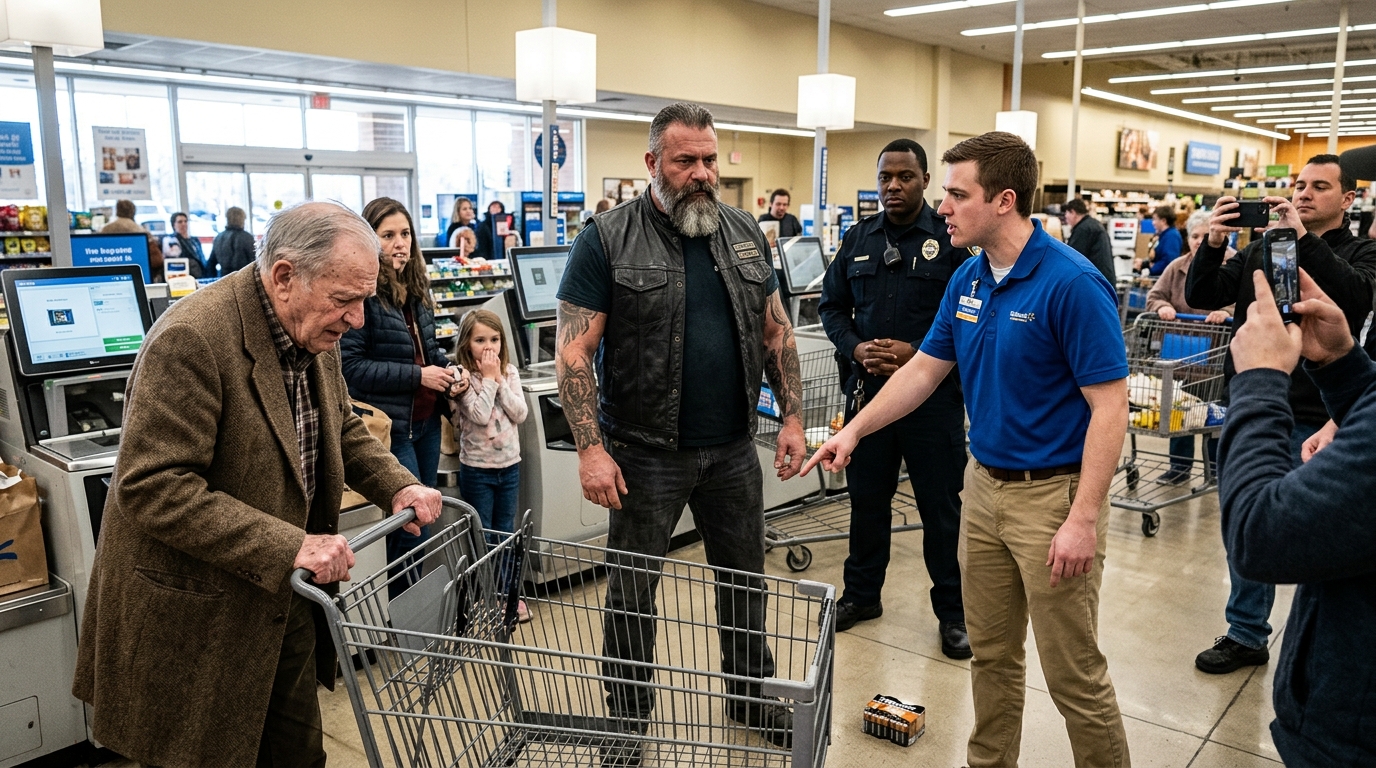
“Play the camera footage before you touch him,” the biker said, just as two store employees cornered a trembling old man beside the self-checkout and a pack of stolen batteries slid across the floor.
It happened at 6:17 PM on a cold Friday in February, inside a PriceWay Market on the south side of Tulsa, Oklahoma, where the fluorescent lights were too white, the aisles too narrow, and the checkout area always felt louder after dark.
The store was busy in that end-of-week way.
Mothers with overloaded carts.
Men in work boots buying frozen dinners.
A teenage cashier chewing gum too loudly.
A crying toddler near produce.
The hum of refrigerators.
The constant electronic chirp of scanners.
Nobody came to a grocery store expecting a public trial.
But that was what it became.
The old man stood beside Register 6 with one hand gripping the cart handle and the other shaking at his side. He was maybe seventy-eight, maybe older, with a paper-thin face, sparse white hair combed carefully across a pink scalp, and a brown coat so worn at the elbows the fabric had gone shiny. His groceries were painfully modest: white bread, canned soup, generic oatmeal, a gallon of milk, and a small bag of oranges. In the child seat of the cart sat a pharmacy envelope folded twice, and beneath that, a Veterans Affairs appointment card with tomorrow’s date.
The batteries had not been in his hand when anyone first looked.
That was the detail that would matter later.
But not yet.
At 6:17 PM, all anyone saw was a four-pack of AA batteries skating out from under the lower rack of his cart just as he stepped away from self-checkout. A young assistant manager named Bryce called out. A security guard hurried over. Bryce’s face took on that flushed, moral certainty some people get the second they think they’ve caught a thief. He said Sir, stop right there, loud enough for three lanes to hear, and once the room turned, it never turned back.
The old man stopped too fast.
Almost lost his balance.
A little girl waiting with her mother by the candy rack looked up with wide eyes and whispered, “Mom, what did he do?”
Nobody answered her.
Bryce stepped in front of the cart.
Security moved behind it.
The old man blinked as if his hearing had failed him before the sentence could land. “I paid,” he said.
“For everything?” Bryce asked.
The batteries lay between them on the scuffed tile, humiliating in their neat plastic pack.
The old man’s mouth opened, then closed.
That was enough for the crowd.
People always say they wait for proof.
They don’t.
They wait for hesitation.
A woman in line with two teenagers leaned sideways to see better. A man in a denim jacket actually took his phone out. Someone muttered, “Unbelievable.” Someone else said, “They all act confused.” The old man looked at the batteries like they had arrived from another life. His hand trembled harder. A thin red mark sat across one knuckle, fresh, like skin torn on metal or cardboard.
Then the front doors hissed open.
Cold wind slid across the entrance mats.
And a biker walked in carrying a gallon of oil, a loaf of rye bread, and the kind of presence that makes polite places tighten around themselves before a word is spoken.
He was big.
Not movie-big. Real big. Heavy through the chest and shoulders, close to fifty, white, thick-necked, with a rough beard threaded gray and old tattoos crawling from both wrists under a black thermal shirt cut off at the sleeves. A weathered leather vest hung open over it, road-patched and dark from use. His boots left wet prints from the parking lot. There was a pale scar through one eyebrow and a stillness in his face that looked, at first glance, like menace.
He took in the scene once.
The batteries.
The guard.
The old man.
The crowd enjoying itself more than it should.
Then he set the bread and oil on an impulse-buy display of gum and said, in a voice low enough to make people lean in and hard enough to make them wish they hadn’t—
“Play the camera footage before you touch him.”

Everything about the biker made the situation worse before it made anything better.
That was the problem.
He looked like the kind of man good stores preferred near the hardware aisle, not the front checkout where families could see him. The leather vest. The tattoos. The hard face. Even the way he stood—feet planted, shoulders square, saying very little—made the assistant manager instantly defensive.
Bryce turned first, already angry that his little moment of authority had acquired an audience he couldn’t control.
“This doesn’t concern you.”
The biker’s eyes moved once from Bryce to the old man and back again.
“It does now.”
That sentence snapped through the checkout lanes like something thrown.
A mother near the magazine rack pulled her daughter a little closer. The security guard, a tired-looking man in his sixties named Earl, adjusted his stance and glanced quickly at the biker’s hands. The old man behind the cart looked trapped between humiliation and confusion, his lips working faintly as if he were still trying to form the right explanation and had missed the chance.
Bryce gestured sharply at the batteries. “The item was concealed.”
“Under the cart,” the biker said.
“Yes.”
“By a man using a cart.”
“That’s still concealment.”
The biker said nothing to that.
Which was worse than arguing.
Because silence leaves room for doubt to do its work.
A boy of about ten in a puffy red coat had drifted near enough to hear everything now, his grandmother gripping his sleeve and whispering for him to stop staring. At Register 4, an elderly Black woman in a church hat shook her head softly and said to no one in particular, “This don’t feel right.” Nobody listened to her because the room preferred its faster story.
Bryce did what insecure men do when challenged in public.
He got louder.
“We watched him skip scan. Then he tried to leave.”
The old man flinched. “I didn’t try to leave. I was—”
Bryce cut across him. “Sir, stop talking.”
The biker’s face changed then.
Not much.
Just enough.
The shift was so small most people would have missed it. But Earl, the security guard, saw it at once. A flattening. Not rage. Control under pressure. The kind of expression men wear when they have spent too many years keeping their hands still while everyone around them says the wrong thing.
The biker set one palm on the gum display, as if anchoring himself there.
“Let him talk.”
Bryce laughed once, disbelieving. “Who exactly are you supposed to be?”
The biker didn’t answer that.
Instead he looked at the old man.
“Did you pay for the rest?”
The old man nodded too quickly. “Yes.”
“Receipt?”
The old man patted his coat, then his trouser pocket, then the cart handle, growing more disoriented with each second. “He took it,” he said finally, nodding toward Bryce.
Bryce held up a small strip of paper between two fingers. “Store policy during an active theft investigation.”
The crowd liked that phrase.
Active theft investigation.
It made the fluorescent grocery store moment sound official enough to excuse cruelty.
A teenage stock clerk rounded the endcap with a box cutter hanging from his apron and stopped cold at the sight of the biker. A little girl in pink rain boots asked her mother, “Is that man bad?” The mother didn’t answer, because mothers know that sometimes the man who looks dangerous is not the only danger in the room.
Bryce took one step toward the old man’s cart.
“We need him in the office.”
The old man gripped the handle tighter. “Please. I didn’t—”
Earl reached, lightly, for the back of the cart.
That was the moment the biker moved.
Not violently.
Not fast enough for panic, but fast enough for shock.
He stepped between the cart and the security guard in one deliberate motion, broad enough that the fluorescent light seemed to narrow around him. Two people gasped. The little girl in pink boots hid behind her mother’s leg. Bryce snapped, “Sir!”
The biker held one hand low, open, not touching anyone.
“Camera footage,” he said again.
Bryce’s face darkened. “You don’t get to make demands here.”
“Then call the police.”
That unsettled the room.
Because innocent bystanders usually try to calm things down. Guilty people try to avoid police. Men like this—big, tattooed, controlled—were not supposed to volunteer them.
Earl glanced at Bryce. Bryce glanced at the batteries. The old man swayed once on his feet and caught himself on the cart handle. The church-hat woman took a step forward now, concern finally outweighing etiquette.
“Honey,” she said to the old man, “you need to sit down.”
He shook his head.
Couldn’t. Or wouldn’t.
The biker noticed the pharmacy envelope tucked near the milk. His eyes dipped to it for half a second, then to the old man’s shaking left hand, then to the red mark on the knuckle.
A pattern forming.
Not complete yet.
But enough to make his voice go colder.
“You accused him fast.”
Bryce folded his arms. “We watched him.”
“From where?”
“Register monitor.”
“Who was working it?”
“I was.”
The biker nodded once, almost to himself.
And that simple nod, that refusal to fight on Bryce’s terms, made the assistant manager even more reckless.
Bryce took out his phone. “Fine. You want police? Great. Stay right there.”
He turned slightly away to call.
The biker did not move.
Neither did Earl.
Neither did the old man, except for the trembling.
Around them, the supermarket became something ugly and electric. People pretended to browse while watching. A woman whispered that bikers always backed each other up, as if any old white-haired man in a thrift-store coat could belong to this one. A teenager zoomed in on his camera. The red-coated boy asked too loudly if the old man was going to jail.
Then the old man said the one sentence that should have stopped everybody.
“My wife is waiting in the car.”
Not dramatic.
Not polished.
Just small and frightened and human.
The biker looked at him.
“How long?”
The old man swallowed. “She gets confused if I’m late.”
That landed.
You could feel it land.
Even Bryce heard it. He just chose not to let it matter yet.
Because public certainty is a hard thing to surrender once you’ve made people watch you perform it.
Sirens weren’t there yet.
But they were coming.
Everyone could feel that too.
And then Bryce, eager to prove control before the police arrived, did the thing that made the entire front end of the store tense at once—
he reached for the old man’s arm.
The biker caught Bryce’s wrist before anyone fully saw him move.
Not a punch.
Not a shove.
Just a hard, clean stop in midair.
The checkout area erupted anyway.
“Hey!”
“Don’t touch him!”
“Call 911 again!”
The little girl in pink boots started crying for real now. Her mother scooped her up and backed into the candy display. The boy in the red coat actually stumbled trying to get a better angle. Earl, startled, put both hands up immediately and took one step back. He had worked enough years in retail security to know the difference between a man starting violence and a man preventing it by a fraction of an inch.
Bryce did not.
He yanked against the biker’s grip.
“Let go of me!”
The biker released him at once.
That should have calmed things.
Instead it made Bryce stumble backward into the coupon rack, knocking paper flyers across the floor. The crowd gasped as if the biker had thrown him. A woman near frozen foods shouted, “He attacked him!” even though she hadn’t seen the beginning clearly enough to know.
Earl reached for his radio.
The biker didn’t retreat. Didn’t crowd forward either. He stood exactly where he was, body between the old man and the store staff, one hand down at his side, the other slightly flexed from the brief contact, and said the most dangerous-sounding thing he could have said in the calmest possible tone.
“You don’t put hands on him until you know.”
Bryce’s face had gone blotchy with humiliation.
“This is insane. He’s shoplifting and you’re assaulting staff in a grocery store.”
The biker looked at the batteries on the floor again, then at the register screen still showing a finished transaction, then at the self-checkout station where one blinking error light had not fully reset.
“Then show it.”
“Show what?”
“The video.”
Sirens sounded faintly outside now.
Closer than before.
Bryce laughed in a short desperate burst. “You think you can walk in here dressed like that and run my store?”
The biker ignored the insult.
That was becoming his most infuriating trait.
He glanced toward the old man, who had gone visibly paler. The church-hat woman had come all the way over now and placed one steady hand near the cart without touching him, a silent permission if he needed support. He was breathing too quickly. His left hand shook uncontrollably now, not with fear alone. Something neurological. Something old. The pharmacy envelope slid sideways and almost fell.
The biker caught it before it hit the floor.
In that instant, everyone saw the envelope in his tattooed hand and assumed the worst again.
“He’s taking his stuff!”
Bryce lunged verbally because he no longer had the room physically. “Put that down!”
The biker looked at the label. Then at the old man.
“Parkinson’s medication.”
The old man nodded once, ashamed for reasons that had nothing to do with theft.
“My hands—” he began, then stopped.
The biker set the envelope back gently into the cart.
That gentleness confused the room more than aggression would have.
The front doors opened again. Two Tulsa police officers entered with the familiar practiced caution of people expecting chaos and finding something stranger: fluorescent grocery light, scattered flyers, a crying child, a furious assistant manager, a trembling old man, and a biker who looked like the center of the problem while somehow standing stiller than everyone else.
Officer Renee Castro, first through the door, took charge immediately.
“Everybody stop.”
The sentence worked.
Mostly.
Bryce rushed to her. “He interfered with an active detention and grabbed me.”
The biker said nothing.
Officer Mark Delaney moved slightly toward him anyway, reading the vest, the tattoos, the scar, the size. Good cops still make first judgments with their eyes. They just try not to finish them there.
Castro looked at the old man. “Sir, are you injured?”
He blinked at her, struggling to keep the room in focus. “No. I don’t think so.”
“Did you take the batteries without paying?”
He looked at them on the floor.
Then at the register.
Then at the cart.
His confusion looked bad. Worse than guilt because guilt at least has shape.
“I don’t know,” he whispered.
Bryce jumped on that instantly. “There. You heard him.”
The biker turned then, not to Bryce, but to the officer.
“He scanned one-handed.”
Castro looked at him sharply. “How do you know?”
The biker nodded toward the old man’s left hand. “Tremor. Watch the station.”
Bryce spread his hands like the answer was obvious. “The batteries were under the cart.”
“And the scanner bagging area was faulting out,” the biker said.
That got Castro’s attention.
Self-checkout machines fail all the time.
So do people around them.
“Who was monitoring him?” she asked.
Bryce hesitated a fraction too long.
“I was.”
The biker finally said his name.
Not to the officers. To Bryce.
“Then you watched a man with Parkinson’s struggle through checkout and decided humiliation was faster than help.”
The whole front end of the store went quiet in a new way.
Not shock this time.
Recognition.
Because now the details had begun linking up in everybody’s head:
the trembling hand,
the pharmacy envelope,
the confused hesitation,
the batteries that could have slipped,
the manager too eager,
the camera footage no one had yet played.
Officer Castro turned toward the service counter. “Who has access to the surveillance?”
A cashier near the lottery display raised a timid hand. “Front office manager. Mr. Pell.”
“Get him.”
Bryce opened his mouth to object.
Castro shut him down with one look.
The biker stepped back then. Just one pace. Giving the officers the room he had spent ten minutes forcing everyone else to deny the old man. That mattered. Delaney noticed it. Earl noticed it. Even the church-hat woman noticed it, because she quietly moved closer to the old man and said, “Baby, if your wife’s in that car, somebody needs to go tell her.”
The old man’s eyes filled suddenly—not with tears exactly, but with the strain of too much public shame too late in life. “Her name is Elsie,” he whispered. “Blue Buick. Handicapped tag.”
The biker heard that.
Of course he did.
And for the first time since he entered the store, something changed in his face that had nothing to do with anger.
Not softness.
Memory.
Officer Delaney glanced toward the parking lot, then back to Castro. “I’ll check the car.”
The biker said quietly, before anyone could stop him or ask the right reason, “Space 14. Far left row.”
Every eye in the store turned toward him.
The old man looked up slowly.
And in the stillness that followed, before the cameras rolled, before the manager from the back office arrived with keys, before anyone had the truth they thought they wanted, the old man stared at the biker like a man recognizing a voice from a very long time ago and said—
“How do you know my wife’s car?”
The question didn’t land like the others.
It didn’t stir the crowd.
Didn’t trigger whispers or phones or outrage.
It just… stopped the air.
“How do you know my wife’s car?”
The old man’s voice wasn’t accusing.
It was searching.
Officer Delaney paused mid-step toward the doors.
Officer Castro turned back slowly.
Bryce went quiet for the first time since this began.
And the biker—
for the first time—
didn’t answer immediately.
He stood there under the fluorescent lights, broad and still, eyes fixed on the old man as if something inside him had been pulled backward through years he hadn’t planned to revisit in a grocery store aisle.
“Blue Buick,” the old man repeated faintly. “Space 14…”
The biker nodded once.
“I saw her when I came in.”
That should have been enough.
It wasn’t.
Because the way he said it didn’t match the simplicity of the answer.
The old man kept staring.
Then something shifted behind his eyes.
Not clarity.
Recognition trying to surface.
Officer Delaney pushed through the doors anyway, stepping into the cold parking lot. The wind followed him in briefly before the doors slid shut again. Inside, the store held its breath in a different way now—not just waiting for the police to decide, but waiting for something older to finish arriving.
Mr. Pell, the front office manager, appeared from the back hallway with a key ring and a frown that said he had already decided he didn’t like whatever this situation was.
“What’s going on?” he asked.
Officer Castro didn’t waste time. “We need the footage from Register 6. Last five minutes.”
Pell glanced at Bryce. “What happened?”
“Shoplifting,” Bryce said quickly. “And interference.”
Castro didn’t look at him.
“Footage.”
Pell hesitated only a second, then nodded and moved toward the office.
The old man’s hands were shaking worse now.
Not just the tremor.
Something else layered over it.
The church-hat woman leaned closer. “Baby, you need to sit.”
He didn’t move.
His eyes were still on the biker.
“Did you say… you saw her?”
The biker nodded again.
“She was waiting.”
The old man swallowed.
“Was she… worried?”
A strange question.
But not really.
Not to anyone who had ever loved someone who forgets.
The biker’s voice dropped slightly.
“She was looking at the doors.”
That was enough.
The old man closed his eyes briefly, as if bracing against something private and painful.
“She does that,” he murmured.
The crowd shifted uneasily.
Because now the scene felt different.
Not a crime.
Not even a misunderstanding.
Something more fragile.
Something people weren’t sure they had the right to watch anymore.
Officer Castro gestured toward the office. “Let’s go.”
The biker didn’t move.
Neither did the old man.
So Castro added, softer, “Sir, we’ll figure this out.”
The old man nodded, but his eyes never left the biker.
“Have we met?” he asked.
And again—
the biker didn’t answer right away.
The footage room was small.
Too small for the number of people who suddenly needed answers.
A monitor flickered on. Grainy black-and-white angles of checkout lanes appeared, timestamped in the corner. Mr. Pell fast-forwarded with impatient fingers while Bryce hovered behind him, arms folded, already preparing to defend himself.
Officer Castro stood closest to the screen.
Officer Delaney returned halfway through, breath visible from the cold.
“Wife’s in the car,” he said quietly. “Elderly female. Confused. Keeps asking where he is.”
The old man lowered his head.
The biker closed his eyes for half a second.
Then the footage stopped.
Register 6.
There he was.
The old man.
Alive again on the screen, but smaller somehow.
More fragile.
His left hand shaking visibly as he tried to scan items.
The scanner beeped.
Missed.
Beeped again.
Missed.
He leaned closer.
Tried to steady his hand with the other.
The system flashed a bagging error.
He hesitated.
Looked around.
No one came.
Bryce appeared in the corner of the frame—but didn’t approach.
Just watched.
The old man tried again.
Bread.
Scan.
Success.
Milk.
Scan.
Success.
Then the batteries.
He picked them up.
His hand trembled harder.
The barcode missed.
Twice.
Three times.
The machine beeped sharply.
He flinched.
Looked over his shoulder.
No help.
No patience.
Just waiting eyes.
Then—
he set the batteries down.
Not in the bagging area.
Not in his pocket.
On the lower rack of the cart.
A temporary move.
The kind anyone might make.
Then the machine beeped again.
Error.
He focused on fixing it.
On the screen.
On the payment.
Card.
Insert.
Remove.
Approved.
Receipt printed.
And then—
he pushed the cart forward.
The batteries still sitting below.
Unpaid.
Unnoticed.
Unintentional.
The room went silent.
Not shocked.
Not loud.
Just quiet.
Because now everyone saw it.
The hesitation.
The tremor.
The missed scans.
The lack of help.
The moment where someone should have stepped in—
and didn’t.
Bryce spoke first.
Too fast.
“He still left without paying.”
No one looked at him.
Officer Castro said, flatly, “He didn’t conceal anything.”
“It’s still theft.”
“No,” she said, turning slightly toward him, “it’s a system failure. And staff failure.”
That hit harder than yelling.
Mr. Pell shifted uncomfortably.
The biker said nothing.
He didn’t need to.
The footage had done everything.
Behind them, the old man stood in the doorway, watching his own confusion replayed back to him like evidence of something he didn’t remember committing.
“That’s me,” he whispered.
The church-hat woman touched his arm gently. “Yes, baby.”
He shook his head slowly.
“I thought I paid.”
“You did,” she said softly. “You just needed help.”
The old man’s face crumpled slightly.
Not dramatic.
Just… tired.
“I don’t want her to think I stole,” he said.
That line broke something in the room.
Because it wasn’t about the store.
Or the batteries.
Or the policy.
It was about the woman in the car.
Waiting.
Confused.
Trusting him to come back.
The biker turned away from the screen.
Walked past everyone.
Out of the office.
No explanation.
No acknowledgment.
Just movement.
Purpose.
They found him in the parking lot.
Kneeling beside the blue Buick in Space 14.
The old woman inside looked up at him through the window, eyes wide and uncertain, hands folded tightly in her lap like she had been waiting a long time for someone to explain the world again.
The biker tapped gently on the glass.
“Ma’am.”
She blinked.
“Where is he?” she asked.
The biker opened the door slowly.
“He’s coming.”
She studied his face.
Not afraid.
Not confused.
Something else.
Something older.
“You’re not from the store,” she said.
“No.”
She nodded.
“I don’t trust the store.”
That made him almost smile.
Almost.
“Fair.”
Inside the building, the old man stepped out through the sliding doors, supported lightly by Officer Delaney and the church-hat woman.
He saw the car.
Saw her.
And everything in him shifted forward.
“Elsie.”
She turned.
Her face lit in a way that erased the confusion for one brief, perfect second.
“There you are,” she said.
Like nothing had happened.
Like the world hadn’t just tried to rewrite him.
The old man reached the car slowly.
Carefully.
Like he was afraid she might disappear if he moved too fast.
“I’m sorry,” he said.
“For what?”
He hesitated.
Then said the only truth that mattered to him.
“For being late.”
She smiled.
“You’re always late.”
The biker stepped back.
Gave them space.
But Elsie’s eyes drifted back to him.
Studied him.
Longer this time.
Then—
softly—
“Have we met?”
The question hung in the cold air.
The old man looked at the biker too.
Waiting.
And this time—
the biker answered.
“Yes.”
The old man frowned slightly.
“Where?”
The biker glanced at the Buick.
At the parking lot.
At the man’s shaking hands.
Then back at him.
“1998,” he said. “Route 66. You fixed my bike outside Gallup.”
The old man went still.
Completely still.
Even the tremor paused.
Then his eyes widened.
“You were the kid,” he said slowly.
The biker nodded once.
“Wouldn’t start,” the old man continued, voice gaining strength, memory cutting through everything else. “You were heading west. Said you didn’t know where you were going.”
“That’s right.”
The old man stared at him.
Then at his hands.
Then back at his face.
“You paid me with your last twenty dollars.”
The biker shook his head slightly.
“You gave it back.”
Elsie smiled faintly.
“He always does that,” she said.
The old man’s eyes filled.
Not from shame this time.
From something else.
Recognition.
“You remembered,” he said.
The biker looked at him steadily.
“You helped me when I needed it.”
A long pause.
Then the old man nodded.
Slow.
Certain.
Like something important had been returned.
No one applauded.
No one made speeches.
The police handled the paperwork quietly. The store manager apologized in the careful, corporate way that never quite reaches the place it needs to. Bryce avoided eye contact with everyone and disappeared back inside.
The batteries were paid for.
That part barely mattered.
The old man sat in the passenger seat now.
Elsie beside him.
Her hand resting over his.
The tremor still there.
But softer.
Less alone.
Before closing the door, the biker reached into his pocket.
Pulled out something small.
Folded.
Old.
He placed it gently on the dashboard.
The old man looked at it.
A worn receipt.
Faded.
From a gas station.
Gallup, New Mexico.
Total: $19.87
Paid in cash.
The old man stared.
Then laughed softly.
“I thought I lost this.”
The biker shrugged.
“You didn’t.”
Elsie leaned closer.
“What is it?”
The old man smiled.
“Proof I wasn’t always late.”
She laughed.
And for a moment—
just a moment—
everything felt lighter.
The biker stepped back.
Put on his helmet.
Didn’t wait for thanks.
Didn’t stay for more.
He walked to his motorcycle.
Started it.
And rode away into the cold Tulsa evening.
Inside the car, the old man held the receipt in both hands.
Careful.
Like it might disappear again.
Elsie looked at him.
Then at the road ahead.
And said softly—
“Who was that?”
The old man watched the fading taillight.
And answered—
“Someone who remembered… when I couldn’t.”


