They Threw a Crying Mother Out of the Store—Then Five Minutes Later, the Roar of Engines Made Everyone Freeze

“Get her out before she starts begging,” the store manager snapped, just as a huge biker killed his engine beside the curb and stared straight at the sobbing mother on the sidewalk.
At 6:12 PM on a Thursday in late October, the wind outside a discount grocery store in Arlington, Texas, carried the smell of rain, gasoline, and fried chicken from the strip mall next door. The sky had already gone the color of bruised steel. Cars rolled through the parking lot with their headlights on, and shopping carts clattered loose near the far end of the curb.
Inside Value Fresh Market, people had been pretending not to stare for at least ten minutes.
The child had started crying in aisle seven.
Not the ordinary kind. Not the whining sound tired adults learn to tune out.
This was sharp. Desperate. A little girl’s cry that made shoulders tense and strangers glance up over cereal boxes.
The mother had tried everything.
She looked maybe thirty-two, maybe younger under better light, white, thin in the way that didn’t come from dieting, with tired blond hair twisted into a quick knot that had half-fallen apart. She wore a faded green hoodie, jeans gone white at the knees, and cheap sneakers darkened by old rain stains. She held one paper pharmacy bag under one arm and crouched to calm the little girl with the other hand.
“Emily, baby, look at me,” she whispered. “Just breathe with Mommy. One more minute, okay?”
The little girl couldn’t have been older than four. White. Small for her age. Strawberry-blond curls stuck damply to her cheeks. She clutched a worn stuffed rabbit by one ear and wailed hard enough to shake her whole body.
A woman near the dairy case muttered, “Some people shouldn’t bring kids out in public.”
A man in work boots said, louder than necessary, “If she can’t control her child, she needs to leave.”
The mother heard. Of course she heard.
I watched her jaw tighten. Not angry. Just embarrassed in that exhausted, cornered way that makes a person look like they’re using the last of themselves to stay upright.
Then the manager appeared.
His name tag said DEREK, though the whole store already knew him as the kind of man who corrected coupons like they were personal insults. Mid-forties. Broad shoulders softening into a gut. Red polo shirt stretched too tight across the chest. He walked up fast, not bothering to lower his voice.
“Ma’am, you’re disturbing customers.”
“She’s sick,” the mother said. “I just need to pay for this medicine.”
The pharmacy bag shook in her hand.
Derek glanced at the child like she was making noise on purpose. “Then come back later.”
“Please,” the mother said. “I already waited thirty minutes at the clinic. She has a fever.”
People were watching openly now. Not one person stepped in.
“She is upsetting the store,” Derek said. “You need to take her outside.”
The little girl cried harder when he reached for the cart.
The mother pulled it back fast. “Don’t touch her.”
That did it.
In a room full of people pretending to be decent, the air changed all at once. A woman gasped like a line had been crossed. A teenager near the freezer aisle lifted his phone. Someone whispered, “Oh my God.”
Derek straightened. “You can leave now, or I’ll call security.”
The mother looked around once.
That was the part I still remember best—not the child screaming, not Derek’s voice, not the crowd circling with their eyes—but that single look. She didn’t seem angry. She seemed humiliated. Like she already knew nobody here would help her and was trying to measure how much dignity she had left before it broke.
“Come on, baby,” she said quietly.
She abandoned half her groceries. Milk. Bread. A small box of crackers. Bananas. A can of soup.
She picked up the medicine bag, lifted the little girl into her arms, and walked toward the automatic doors while the crying echoed against bright fluorescent lights and everyone else returned to being innocent.
Outside, the wind had sharpened.
She sat on the curb near the cart return, her daughter trembling in her lap.
The child’s cries had thinned into ragged hiccups. The mother pressed the back of her hand to the girl’s forehead, then searched the pharmacy bag again like maybe the medicine had magically turned into enough money for everything else they’d had to leave behind.
It hadn’t.
Through the glass windows, Derek was still talking. Pointing once toward the doors. Probably explaining to customers that he had “handled the situation.”
Then the sound came.
Low at first. A vibration more than a noise.
Heads turned toward the entrance road.
One motorcycle. Then another. Then three more.
The engines rolled across the parking lot like thunder caught close to the ground.
A lifted pickup paused mid-turn. A woman loading bottled water into her trunk froze. Even Derek stopped talking when he saw them.
Five motorcycles came in slow and deliberate, black and chrome glinting under the lot lights just beginning to flicker on. Not speeding. Not weaving. Just arriving together with the kind of control that made people more nervous than chaos would have.
The first rider cut his engine nearest the curb.
He was big. Late forties maybe. Broad through the chest. White. Gray at the temples, beard trimmed short, tattooed forearms visible beneath a sleeveless black leather vest worn over a plain dark shirt. He took off his gloves without hurry and looked first at the mother, then at the child, then through the store windows toward Derek.
Nobody said anything.
The mother tightened around her little girl.
Someone behind the glass whispered, “Great. Now this.”
The biker stood beside his motorcycle, silent and unreadable, as if he had arrived for a reason nobody else understood.
And then he started walking toward the store.
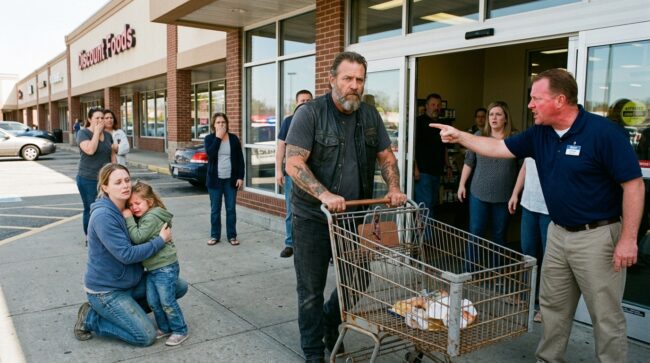
By the time his boots hit the sidewalk, the fear in the parking lot had already begun to organize itself into a story.
People love stories when they’re scared. They build them fast. Faster than truth.
A college kid near the vending machines stepped backward and said, “Did she call them?”
An older man loading groceries shook his head. “Looks like trouble found trouble.”
Inside the store, three customers hurried away from the front windows. A cashier with a nose ring craned to see past the register display. Derek moved toward the door, then stopped, maybe realizing that locking it now would look worse.
The mother stayed where she was on the curb, frozen with that dangerous mix of pride and fear people get when they’ve already been publicly shamed once in the same hour.
The little girl buried her face against her chest. Her crying had turned thin and weak.
The biker never looked at the crowd.
He passed the mother once, close enough for her to flinch, but he didn’t touch her. He didn’t speak. He didn’t even slow down. He just glanced once at the child, at the paper pharmacy bag slipping from the woman’s fingers, and at the abandoned cart still visible through the glass.
Four other riders dismounted behind him.
Different ages. All men. One Black rider around fifty with a medic patch sewn low on his vest. One Latino rider with a weathered denim jacket beneath his cut. One younger white rider, maybe early thirties, muscular and restless-looking, though even he stayed quiet. None of them laughed. None of them swaggered.
That should have made people feel better.
Instead it made everything worse.
Because loud men can be dismissed. Quiet men with purpose make people imagine the worst.
Derek finally pushed through the door with both palms up. “Store’s closed to whatever this is.”
The big biker stopped two feet from him.
Rain began as a fine mist, silver in the parking lot lights.
“Sir,” Derek said, voice tightening, “I’m asking you to leave the property.”
The biker’s eyes moved briefly to Derek’s name tag, then past him into the store.
“What?” Derek snapped. “You deaf?”
One of the cashiers hissed, “Derek—”
The biker said nothing.
He stepped around him.
Derek grabbed his arm.
The reaction from the crowd was immediate.
“Hey!”
“Call the police!”
“Oh, this is bad—”
The younger rider took one step forward, and two shoppers bolted toward their cars. A woman pulled a little boy behind her minivan door. Someone in the lot started filming with both hands raised.
But the big biker still didn’t lash out. He didn’t yank free. He only stopped walking and turned his head enough to look at Derek’s hand on his arm.
Not angry.
Not intimidated.
Just still.
It was somehow more unsettling than shouting would have been.
“Take your hand off me,” he said.
That was all.
His voice was low, calm, and stripped of emotion.
Derek let go, but his face burned even redder. “You don’t come in here acting like you own the place.”
The biker looked past him again.
From where I stood, I could finally see what he was staring at: the half-filled cart near register three. The milk sweating onto the metal rack below. The bananas. The bread. The crackers. The can of soup. The forgotten remains of a dinner that almost happened.
Then his gaze shifted to the pharmacy logo on the paper bag by the mother’s side.
Something changed in his expression.
Barely anything. A tightening near the mouth. But enough.
He turned back toward the curb.
The mother looked terrified now. “I don’t want any trouble,” she said quickly, as if she needed to say it before he spoke.
He crouched a few feet away from her, not close enough to crowd her.
“What’s her temperature?” he asked.
The mother blinked.
“What?”
“Your daughter. What’s her temperature?”
The question landed strangely in the lot. Too practical. Too specific.
“W-when we left urgent care it was one-oh-three,” she said. “They said I had to get the antibiotic filled tonight.”
He looked at the bag. “Did you?”
Her silence answered for her.
A hot wave of judgment passed through the crowd again, because people can smell poverty faster than smoke.
Derek folded his arms. “This isn’t my problem.”
The biker rose slowly.
The Black rider with the medic patch was already walking toward them. He knelt beside the little girl with professional caution and held out two fingers first so she could see them.
“Hey there,” he said softly. “Can I look at you, sweetheart?”
The mother looked from one man to the other, confused. “Who are you people?”
The big biker took out his wallet. Not dramatic. Not for show. He pulled out a card and handed it to her.
She read it twice.
Her face lost color.
I couldn’t see the card from where I stood, but I saw her eyes widen with the first crack of recognition—not full understanding, not yet, but enough to tell me this wasn’t random.
“What is it?” Derek demanded.
The mother looked up at the biker, then down at the card again. Her throat moved hard.
The little girl let out a weak sound and sagged against her shoulder.
Everything sped up after that.
The medic rider touched the child’s forehead and said, “She’s burning up.”
“She needs fluids,” the mother whispered. “She hasn’t kept anything down since noon.”
Derek made an irritated sound. “If this is some kind of setup—”
The biker turned toward him so suddenly that Derek stopped talking mid-sentence.
“Bring me that cart,” the biker said.
Derek laughed once, sharp and disbelieving. “Excuse me?”
“The cart she left.”
“You can’t order me ar—”
The younger rider moved then, not threatening exactly, but direct enough to close the distance between the door and the register line. Two customers backed away. One employee reached below the counter, probably for the silent alarm.
The parking lot felt electric. Ready to split.
The biker took one step toward Derek.
Not fast. Not dramatic.
But enough to change the air.
“I said,” he repeated, “bring me that cart.”
Inside the store, a woman near produce yelled, “Police are coming!”
And almost on cue, from somewhere beyond the gas station across the road, a siren began to rise.
The first patrol cruiser pulled into the lot at 6:21 PM, lights strobing red and blue across wet asphalt, chrome fenders, and the front windows of Value Fresh Market. Every face in the parking lot changed at once. Fear became righteousness. That’s how crowds work when authority arrives—they suddenly remember what side they were on.
“There,” Derek said, pointing before the officer had even stepped out. “That’s him. He came onto private property and started threatening people.”
The words were so quick, so eager, you would’ve thought he’d been waiting years to say them.
Officer Melissa Cain came out first. Mid-thirties. Dark hair pulled tight beneath her cap. Hand resting near, but not on, her holster. A second officer, younger and broader, moved around the passenger side and took in the motorcycles, the crowd, the mother on the curb, the medic kneeling by the child, and Derek practically vibrating with offended innocence.
“Everybody stay where you are,” Officer Cain said.
No one moved.
Rain thickened, dotting shoulders and windshields.
The big biker lifted both hands slightly away from his sides—not surrender, exactly, but control. Intentional control.
Officer Cain noticed. Good officers usually notice the small things first.
“Who’s in charge here?” she asked.
Derek answered before anyone else could. “I am. Store manager. This man barged in after we removed a disruptive customer and—”
“Removed?” the mother said, her voice cracking.
The little girl whimpered in her arms.
Officer Cain’s eyes flicked toward them. “Ma’am, are you hurt?”
“No,” the mother said. “My daughter’s sick.”
The Black rider looked up without standing. “Child’s running a high fever. Likely dehydrated. We need either EMS or we need to get meds and fluids into her right now.”
The younger officer stiffened. “Who are you?”
Instead of answering, the medic rider reached slowly into his vest pocket and produced identification.
Officer Cain took it, read it, then looked at him again with a different expression. “You’re a paramedic?”
“Retired fire-rescue,” he said. “Twenty-three years.”
That unsettled the crowd in a new way. Not enough to erase what they thought they’d seen, but enough to loosen it.
Derek jumped in quickly. “That doesn’t matter. They rolled in here like a gang and started intimidating my staff.”
The younger officer turned to the big biker. “Name?”
He gave it calmly. “Wade Mercer.”
“Hands visible, Mr. Mercer.”
“They are.”
“Why are you here?”
Wade glanced once at the mother.
Up close, under the patrol lights, she looked past exhausted now. She looked like someone running on instinct alone. Rain clung to loose strands of hair around her face. Her daughter’s stuffed rabbit had fallen partly into a puddle.
Wade looked back at Officer Cain. “Because she needed help.”
Derek let out a disgusted laugh. “That’s convenient.”
Officer Cain held up a hand for silence.
“What kind of help?” she asked.
Wade nodded toward the pharmacy bag. “Antibiotic. Child’s fever. She left half her groceries inside.”
The mother swallowed hard, as if every detail spoken aloud cost her pride she couldn’t afford to lose.
Officer Cain turned to her. “Is that true?”
She hesitated, then nodded. “I didn’t have enough.”
Enough for the whole thing. She didn’t say the rest, but everyone heard it anyway.
The younger officer shifted awkwardly. One woman in the crowd lowered her phone.
Derek crossed his arms. “People can’t just camp in my store creating scenes. Customers were complaining.”
The mother flinched like he’d slapped her.
And maybe that was the moment the whole situation might have cooled—if Derek had shut up, if the rain had stopped, if the little girl had not suddenly gone frighteningly still.
At first it looked like relief.
Then the mother’s voice tore through the lot.
“Emily?”
The child’s head rolled against her shoulder. Her crying had stopped completely.
The medic rider was moving before panic had time to spread. “Lay her down—easy, easy—”
The mother almost dropped the pharmacy bag trying to reposition her daughter on the dry patch of sidewalk beneath the awning.
Everything shattered.
Customers screamed. Someone shouted for an ambulance again, though the officers were already calling it in. Derek backed up so quickly he nearly slipped. The younger rider sprinted to one of the motorcycles and came back with a compact medical pouch. The Black medic was checking the child’s airway while the mother shook visibly, one hand over her own mouth to stop herself from falling apart.
Officer Cain crouched beside them. “Talk to me. Emily, can you hear me?”
No response.
Wade moved once, finally with force.
Not violence. Not rage.
Precision.
He strode straight past Derek, into the store, and before anyone could stop him, he took the abandoned cart himself.
Derek shouted, “You can’t just—”
Wade ignored him.
He pushed the cart back out through the automatic doors, wheels rattling hard over the metal track. Milk. Bread. Crackers. Soup. Bananas. All of it.
The crowd stared.
Then Wade reached to the checkout candy display just inside the entrance, grabbed bottled water and children’s electrolyte drinks off a side rack, pulled a box of electrolyte ice pops from a promotional freezer, and loaded them into the cart too.
“That’s theft!” Derek yelled, finally finding the courage to sound brave because police were present. “Officer, are you seeing this?”
Wade took out his wallet again, peeled off several bills, and laid them flat on the checkout counter without breaking stride.
“Ring it up,” he said.
Nobody moved.
The cashier with the nose ring looked from Wade to Derek to the money.
Wade’s voice stayed low. “Ring it up.”
Maybe it was the sirens getting louder in the distance. Maybe it was the child on the ground. Maybe it was the simple humiliation of seeing one silent man do the thing everyone else had found excuses not to do.
Whatever it was, the cashier finally started scanning.
Beep.
Beep.
Beep.
Outside, under the awning, the mother was crying openly now.
Officer Cain asked her for the child’s last name, age, clinic information. The medic rider spoke in clipped, steady phrases meant to keep people alive and keep panic from spreading. The younger biker held the medical pouch ready without saying a word. Rain drummed harder on the lot.
And Derek, still not understanding the room had moved beyond him, pointed at Wade and said the worst possible thing.
“So what is this?” he snapped. “You know her or something?”
Wade stopped.
Just stopped.
The cashier froze mid-scan.
The mother lifted her head.
Even Officer Cain turned.
For the first time since arriving, Wade didn’t look at the child. He looked at the mother.
There was something in that silence. Recognition, yes. But not fresh recognition. Old recognition. The kind that carries years inside it.
The mother stared back at him with a strange, dawning horror, like a memory had just risen up from somewhere she had worked very hard to bury.
Wade reached into the inside pocket of his vest and pulled out something small.
Not a weapon.
A folded piece of paper gone soft at the edges from being carried too long.
He held it in his hand for one second. Two.
The mother saw it and went completely still.
“Where did you get that?” she whispered.
Wade didn’t answer.
The wail of the ambulance grew louder, turning into the lot.
And every person standing in that rain understood the same thing at once:
the man everyone had mistaken for danger had not come here by accident—
he had come because of her.
The ambulance doors opened before anyone in the parking lot found their voice again.
Two EMTs came out fast with a pediatric bag and a stretcher, their shoes splashing through shallow rainwater, their questions clipped and practiced.
“Age?”
“Four,” Officer Cain answered.
“Responsive?”
“Barely.”
The retired medic was already giving them what they needed. “High fever. Likely dehydration. Vomiting since noon. Urgent care visit about thirty, maybe forty minutes ago. Antibiotic not started yet.”
One EMT knelt beside Emily. The other began prepping a small oxygen mask.
The mother didn’t let go of her daughter until they physically had to move the child from her arms.
That was the first sound she made that cut deeper than anything else that night.
Not a scream. Not exactly.
Just a broken, helpless sound that seemed pulled out of somewhere below language.
“Please,” she whispered. “Please, don’t let her—”
“We’ve got her,” one EMT said. “Stay with me, okay? What’s her name?”
“Emily.”
“Okay. Emily. Good. Stay with us.”
Under the awning, with patrol lights flashing over the wet concrete, the entire parking lot stood still and watched strangers work to save a child they had judged only minutes earlier as an inconvenience.
Wade stayed where he was.
Not hovering near the stretcher. Not trying to insert himself. Not giving orders.
He stood beside the checkout counter with rain darkening the shoulders of his shirt, one hand still holding that worn folded note.
The cashier finished ringing up the groceries with shaking fingers.
Beep.
Beep.
Beep.
The small sounds felt unnaturally loud now.
Officer Cain noticed the paper in Wade’s hand. “Sir,” she said, quieter this time, “what is that?”
He looked at it once before answering.
“Something her husband gave me.”
The mother stared at him as if she had stopped breathing.
“My husband?” she repeated.
Wade finally met her eyes fully.
“Yes.”
The words didn’t land like a revelation. They landed like impact. Heavy. Dull. Irreversible.
The mother shook her head slowly. “No.”
It wasn’t denial in the dramatic sense. It was the stunned refusal of a person trying to force reality back into its former shape.
“No,” she said again, but weaker. “No, that’s not possible.”
Officer Cain rose halfway from her crouch. “You know him?”
The mother’s lips parted, but for several seconds she couldn’t answer.
Then she said, “I know that voice.”
A sharp silence moved through the crowd.
The younger officer glanced between Wade and the woman, now visibly unsure where to place his suspicion. Derek looked openly irritated that the scene had become more complicated than the simple version he preferred.
The EMTs loaded Emily onto the stretcher. The little stuffed rabbit was left near the curb, damp and muddy at one ear. Wade noticed it before anyone else did. He bent, picked it up, and set it carefully beside the mother without a word.
Her eyes dropped to the rabbit, then to the folded paper in his hand.
“What is that?” she asked.
He hesitated.
Not because he was hiding something. Because he seemed like the kind of man who understood that certain truths, once spoken aloud, could not be folded back up.
“It’s a note,” he said.
“From who?”
“From Daniel.”
Her face changed at the name.
Not everyone in the parking lot understood. But the officers did. So did the EMT who glanced up while securing the stretcher. The name made the scene intimate in a way that was suddenly painful to witness.
The mother rose to her feet too quickly, one hand braced against the ambulance door.
Daniel.
Her husband. Or maybe late husband. That hadn’t been said yet, but the shape of grief was already visible in how she held herself.
“He died,” she said softly, almost angrily. “Three years ago.”
Wade nodded once.
“I know.”
The mother took a step toward him. Rainwater slipped from her hairline down the side of her face, but she didn’t wipe it away.
“So how do you have something from him?”
Wade looked at the note again.
Then, for the first time that night, his control slipped just enough for people to see that whatever connected him to this woman had not been light, and it had not been easy.
“Because,” he said, “I was with him at the end.”
No one spoke.
The sirens softened as the ambulance crew prepared to move.
Even Derek went quiet.
And in the silence that followed, all the tension that had seemed built around noise, fear, bikers, police, and public humiliation shifted into something smaller and far more dangerous:
memory.
The rain eased to a thin mist, the kind that hangs in the air instead of falling cleanly, and Wade stepped back beneath the edge of the awning as if giving the woman room to absorb what he had said.
She didn’t look like she believed him.
She looked like she wanted to.
That was worse.
“My husband was in Afghanistan,” she said, her voice unsteady. “He was killed outside Kandahar.”
Wade’s eyes didn’t leave her face. “Yes.”
“Then how do you know him?”
Officer Cain started to say something, then stopped. She had the good sense to recognize when a scene no longer belonged to law enforcement.
The EMT at the rear doors called, “We need to transport now.”
“I’m coming,” the mother said automatically, but she still didn’t move.
Her attention was locked on Wade.
Wade opened the folded paper with careful fingers. The page was weathered, creased, and stained faintly at one corner. It looked as if it had been read many times, then put away, then carried again, over and over, by a man who did not throw important things away.
He didn’t hand it to her yet.
Instead he said, “Daniel Mercer served in my unit.”
That made her blink.
Mercer.
The same last name.
I saw the realization hit her in pieces.
“You’re his brother,” she said.
Wade nodded.
The sound that came out of her then was barely a breath.
“Oh my God.”
The younger officer looked toward Officer Cain. Derek shifted his weight awkwardly. A woman near the entrance lowered her phone completely and slipped it into her purse.
The mother’s eyes filled again, but differently now.
“Daniel told me…” She swallowed. “He told me he had a brother. Once. Maybe twice. He said you two stopped speaking.”
“We did.”
“Why?”
Wade looked out toward the rain-dark parking lot, toward the line of motorcycles gleaming under the lights.
A long second passed.
Then another.
“When our father died,” he said, “Daniel went into the Army six months later. I stayed home. We said things that don’t leave once you say them.”
The mother stood very still.
“He thought you hated him,” she whispered.
Wade’s jaw shifted once. “I know.”
That answer was so quiet it almost disappeared under the hiss of tires on wet pavement from the street beyond.
The mother pressed one hand to her mouth.
Wade continued, not as confession, not as defense. Just fact.
“The last time I saw him before deployment, we fought in our mother’s driveway. I told him not to come back unless he was ready to act like family.”
No one in the lot moved.
The sentence landed harder because Wade did not decorate it.
No excuse. No softened edges.
“I got a call sixteen months later,” he said. “He was alive for a little while after the blast. Long enough to talk. Long enough to leave instructions.”
Her eyes dropped to the note.
Wade unfolded it fully now and handed it to her.
She took it with both hands.
The page trembled.
Officer Cain turned her face slightly away, giving privacy without stepping out of earshot. The EMTs waited a few seconds longer than protocol probably allowed. Even Derek had gone pale.
The mother read silently at first.
Then her lips moved.
Not enough for the whole note to be heard, just fragments.
If you ever find them…
don’t let pride…
she won’t ask…
Emily may never know my face…
Her shoulders collapsed.
The little girl’s name seemed to empty the air from the world.
Wade spoke into that silence.
“She was born after he died.”
The mother nodded once, eyes still on the paper.
“He never met her.”
“No.”
“I named her Emily because that was the name he wanted if we had a girl.”
Wade looked toward the ambulance, where Emily lay strapped small and motionless beneath warm blankets. “He wrote that too.”
The mother shut her eyes.
The folded paper crumpled slightly in her hand before she forced herself to smooth it back out, as if afraid of damaging the last thing Daniel had touched with intention.
“When did you find us?” she asked.
“Six months ago.”
She looked up sharply. “Six months?”
“I didn’t come right away.”
“Why not?”
At that, something raw passed over Wade’s face.
“Because I didn’t know if I had the right.”
The honesty of it cut through everything.
This was no dramatic rescue planned by a hero.
This was a man who had spent years carrying a dead brother’s last request like a weight he didn’t feel worthy to put down.
He went on.
“Daniel left your last known address. It was old. I tracked down the apartment complex. You’d moved. Then I found clinic records through a veterans’ family outreach contact that still had your emergency contact form from years back. After that, I knew the county. Then the school zone. Then the pharmacy.”
The mother stared at him.
“You followed me?”
“No.” His answer came instantly. “I looked for a way to help without walking into your life unless I had to.”
That mattered. You could see it matter.
She blinked rain from her lashes. “Then why tonight?”
Wade looked toward the store windows.
“Because you were about to walk away without the medicine,” he said. “And Daniel asked me not to let pride be the reason his family suffered.”
The note trembled again in her hands.
Behind them, Derek shifted uncomfortably and muttered, “I didn’t know any of that.”
No one answered him.
No one cared what he knew.
The EMT at the ambulance doors said, “Ma’am, we have to go now.”
The mother nodded, but before climbing in, she turned back to Wade with the note still in her hand.
“There’s something else,” she said.
Wade waited.
The wind picked up once across the lot, moving the plastic flags above the gas station and rattling a loose cart near the edge of the curb.
Her face had changed again.
Not softer. Not healed. Just more exposed than before.
“Daniel didn’t just stop talking about you because of the fight,” she said. “He stopped because of me.”
Wade frowned slightly.
“What do you mean?”
She looked down at Emily through the open ambulance doors, then back at him.
“When Daniel deployed, I was two months pregnant and terrified. We were behind on rent. He wanted to send money to your mother. I told him no. I told him we had to think about ourselves.”
Wade said nothing.
“I knew he felt guilty about not speaking to you. I knew he wanted to call. And I made it easier not to.” Her voice began to shake, but she kept going. “Every time he brought up home, I pushed it away. I told him the past was the past. I told him family only showed up when they wanted something.”
The rain had almost stopped now. The flashing lights painted everyone in pulses of red and blue and white.
“He wrote me one last email before…” She swallowed hard. “He said if anything happened, I should find you. He said you were the one person who would come if it mattered.”
Wade looked like he had forgotten how to stand comfortably inside his own body.
“But I didn’t,” she said. “I was angry. And ashamed. And after he died, I couldn’t bear the idea of facing the brother I helped him lose.”
Her hand closed around the note.
“So when things got bad, I told myself it was too late.”
A long silence followed.
Then Wade asked the question no one else would have dared ask.
“How bad?”
She laughed once, and the sound was brutal.
“Bad enough.”
There it was again—poverty refusing to perform itself for strangers.
She could have listed everything. The unpaid bills. The eviction. The motel months. The secondhand clothes. The jobs that disappeared when Emily got sick too often. The clinic visits postponed. The food counted item by item in grocery aisles. The humiliation of standing at a register knowing exactly what would have to go back.
She said none of it.
She didn’t need to.
Wade nodded toward the store.
“Why’d they put you out?”
“Emily got overwhelmed.” She wiped at her face with the heel of her hand. “She doesn’t do well with noise when the fever gets high. She cried. I couldn’t calm her. I only had enough money for the antibiotic or the groceries, not both. I thought maybe if I put some food back at the register, I could still get the medicine.”
Her voice cracked.
“But Derek started talking, and everyone started looking, and then Emily got scared, and then I got scared, and…” She glanced at the store entrance as if the memory itself stung. “I just left.”
Wade looked through the glass at the half-emptied front end, the cash register lights, the bright aisles where so many people had watched and decided.
Then he said something so quiet most of the crowd probably didn’t hear it.
“He was right about one thing.”
She frowned. “Who?”
“Daniel.”
She stared at him.
Wade’s gaze shifted to Emily.
“She has his eyes.”
The mother broke.
Not dramatically. Not with loud sobs.
She just bent forward as if the weight of the last three years had finally found the exact place to land.
Officer Cain took one step closer, then stopped when Wade moved first—but only enough to hold out the grocery receipt, the paper note, and the stuffed rabbit she had forgotten in the chaos.
Three small things.
Food. Memory. Childhood.
The mother took them all.
Then Wade reached into the inner pocket of his vest again.
This time he removed a thin envelope, sealed, older than the note.
“For her,” he said.
“For Emily?”
He nodded.
“What is it?”
“Daniel wrote two letters before deployment. One for you. One in case there was ever a child.”
The mother looked at him in stunned silence.
“I didn’t know if I should bring it,” Wade said. “Tonight I decided I should.”
That was the deepest turn of all.
Not that Wade was Daniel’s brother.
Not that he had been carrying guilt.
Not even that he had spent months searching for them.
It was this:
the crying child dragged out of a grocery store had been standing, without knowing it, within reach of her dead father’s last words for her entire life.
And the man everyone feared in the parking lot had carried them there.
The ambulance doors were still open.
The EMT said, more gently now, “Ma’am?”
She nodded and climbed inside.
Before the doors closed, she looked back once.
Not at the crowd.
Not at Derek.
At Wade.
He didn’t wave. Didn’t step forward. Didn’t try to say anything large enough to ruin the moment.
He only said, “Go with her.”
So she did.
The doors shut.
The siren did not start immediately. For one strange second, everything in the lot held still—police lights flashing, rainwater sliding down the windshield of the cruiser, grocery bags sitting in the cart, customers silent under the awning as if ashamed to move first.
Then the ambulance pulled away.
Its lights washed over Wade’s face and disappeared out toward Cooper Street.
No one spoke for several seconds.
Officer Cain was the first to break the silence.
She turned to Derek.
“I’m going to need your full statement,” she said.
The way she said it made clear that the night had not gone the way he expected.
Derek opened his mouth, then closed it again.
The younger officer bent to pick up a crushed store flyer blowing across the wet sidewalk. One of the cashiers quietly carried the grocery bags outside and set them beneath the awning. The woman who had filmed earlier walked to her car with her head down and did not look back.
Wade took the receipt from the counter, folded it once, and tucked it into his pocket like it mattered.
Maybe it did.
The younger biker asked, “You riding to the hospital?”
Wade looked in the direction the ambulance had gone. “In a minute.”
The retired medic zipped the medical pouch and rested a hand briefly on Wade’s shoulder. No words. None were needed.
One by one, the other riders moved back toward their motorcycles.
Still no swagger. Still no performance.
Just men who had shown up because one of them asked.
Officer Cain approached Wade before he reached his bike.
“For what it’s worth,” she said, “I’m sorry.”
He gave a small shrug. “For which part?”
It wasn’t sarcasm. That was what made it land.
She exhaled through her nose. “Most of it.”
He nodded once.
Then he glanced down and noticed something near the curb: one small banana from the abandoned groceries, split at the stem and lying in a shallow puddle. He bent, picked it up, and set it gently in the trash beside the cart return.
Such a small act.
So ordinary it almost hurt.
Inside the store, Derek stood under fluorescent light, suddenly looking much smaller than he had an hour earlier.
Wade didn’t look at him again.
He straddled his motorcycle, but before putting on his gloves, he paused and pulled the folded note from his pocket one last time.
The note Daniel had written to him.
The one he had carried through years of silence, anger, shame, and delay.
He read only the final line.
Then he folded it back with the same care.
The engines started one at a time.
Low. Controlled. Familiar now.
Not a threat.
Not anymore.
As the riders pulled out of the lot, the cashier with the nose ring stepped just outside the doors and called after him, “Hey!”
Wade stopped and turned his head slightly.
She held up the little stuffed rabbit.
A second one.
Dry. Cleaner. Newer than the first.
It must have been tucked beneath the bottom rack of the cart the whole time.
“Her other one?” the cashier asked.
Wade looked at it for a second, then nodded.
She walked it over and handed it to him carefully, like passing something fragile between strangers.
He took it, tucked it inside his vest, and rode off toward the hospital under a sky finally beginning to clear.
Later that night, after the officers were gone and the parking lot emptied and the rain dried in patches beneath the lot lights, people would tell the story wrong before they told it right.
They would begin with the motorcycles.
With the fear.
With the scene.
With the moment a giant biker stepped out of the rain and seemed to make everything worse.
Only later, if they were honest, would they mention the truth.
That a mother had been thrown out for not having enough.
That a child had nearly collapsed in front of people too uncomfortable to care.
That the man everyone judged first had been the only one who arrived already carrying food, memory, and a promise.
And somewhere in a hospital room across town, a little girl named Emily would wake to find two rabbits by her bed, a bag of groceries waiting in a plastic chair, and an envelope with her father’s handwriting on the front.
Wade would not be in the room when she opened it.
That seemed right.
Some men are loud when they help.
Some need witnesses.
Some need to be thanked.
Wade Mercer only stood once in the hallway outside intensive observation, helmet in hand, listening through the partly open door as a mother began to cry over words written years before.
Then he set the second rabbit quietly on the floor beside the doorway for Emily to find in the morning, turned, and walked back toward the dark parking garage without looking over his shoulder.
The only sound he left behind was the fading echo of his boots.
And, much later, the engine starting below.