They Took a Boy’s Shoes for an Unpaid Fee—The Next Morning, the Entire School Froze
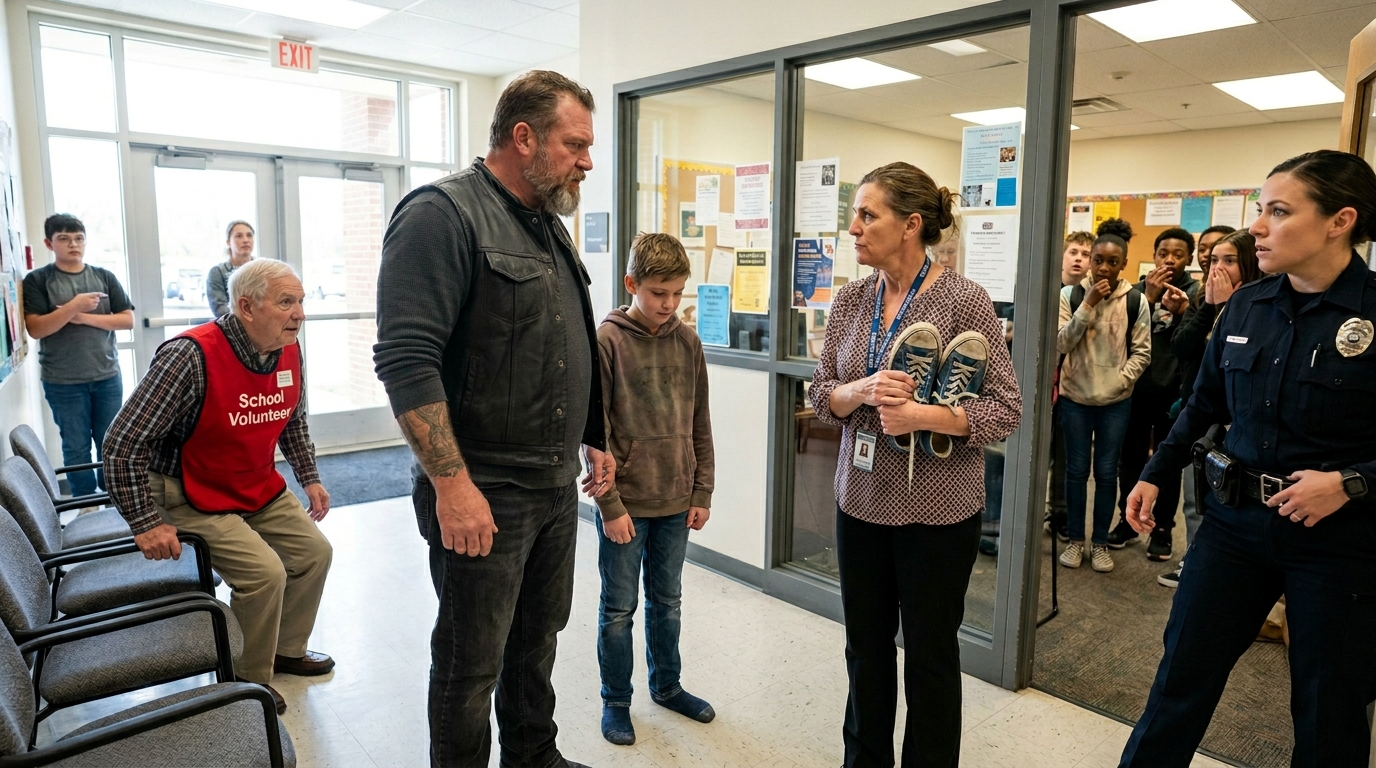
“Put those shoes on the desk, son,” the secretary said, just as a tattooed biker in a sleeveless leather vest stepped through the school doors and stared at a barefoot boy standing in the front office.

Nobody in Jefferson Middle School expected a biker before first period.

Especially not one like him.

It was 7:41 AM on a damp Tuesday in late November, in Dayton, Ohio, the kind of morning when the sidewalks still held last night’s rain and parents hurried children through the drop-off lane with coffee cups in one hand and impatience in the other. The front office smelled like printer toner, wet jackets, and institutional air freshener. A fake wreath hung crooked near the attendance window. The heater rattled in the corner but never quite warmed the tile.

Most mornings there followed a script.

Late slips.
Forgotten lunches.
A parent arguing over bus routes.
Someone crying quietly over a missed assignment.

This morning was different.

Twelve-year-old Noah Bennett stood in the center of the office in mismatched socks, shoulders rounded, eyes fixed on the blue-and-white sneakers he had just been told to surrender. They were not new. The soles were thinning at the edges. One lace had been knotted in the middle where it had snapped and been tied back together. But they had been cleaned. Carefully. The canvas still held the faint damp shine of someone who had scrubbed them by hand the night before and left them by a radiator hoping they would dry by morning.

Noah had that look some boys get when they have learned too early that embarrassment becomes worse if you fight it. Small for seventh grade. Pale. Hair cut by somebody at home with patient but untrained hands. His hoodie sleeves tugged over his wrists. His backpack sat slumped near the plastic chair by the wall, one strap stitched twice in black thread.

Across from him stood Mrs. Kline, the office secretary, a woman in her fifties with sharp lipstick, a lanyard full of keys, and the kind of brittle school-authority voice that always sounded most confident when aimed at children.

“You’ve had three notices sent home,” she said. “Gym uniform fee, locker fee, and athletic equipment penalty. School policy is clear.”

Noah swallowed. “I’m not even on a team.”

“That’s not my concern.”

He glanced once toward the glass doors, where students were streaming in under umbrellas and backpacks and ordinary morning problems. “My mom said she can pay next week.”

Mrs. Kline sighed in the way adults sigh when they want witnesses.

“Then your mother should have thought about that before now.”

The vice principal, Mr. Darrow, stood behind the counter pretending to review attendance paperwork while very obviously listening. He was younger than most administrators, maybe thirty-eight, broad in the shoulders, carefully shaved, always speaking in polished phrases about accountability and standards. He stepped forward at exactly the moment authority benefits most from reinforcement.

“If students can ignore financial obligations,” he said, “then rules stop meaning anything.”

Noah looked at the shoes again.

“Those are my only ones.”

The room did not soften.

That was the worst part.

Not cruelty exactly. Something colder. Procedure.

Mrs. Kline pointed to the desk. “Shoes.”

A sixth-grade girl seated nearby with an ice pack on her wrist stared openly, her mouth slightly parted. Beside her sat an elderly volunteer named Mr. Raymond Ellis, a retired custodian who came in three mornings a week to help sort library returns. He had hearing aids, a wool cap folded in his hands, and the slow, watchful expression of a man who had spent forty years noticing which adults enjoyed power too much.

He shifted in his chair but said nothing yet.

Noah bent down.

Untied the first shoe.

Then the second.

He placed them on the secretary’s desk as if setting down something heavier than canvas and rubber. His socks were damp at the toes. One had a hole just above the big toe. The sixth-grade girl looked away first because children often understand humiliation faster than adults do.

Mrs. Kline reached for the shoes.

Then the front doors opened.

Cold air swept in.

And with it came a man who did not belong in that office or any office that liked its authority unchallenged.

He was tall. Easily six-two. Thick through the chest and shoulders. White, maybe in his late forties, with a weathered face, close-cropped dark hair graying at the temples, and a rough beard cut short enough to look deliberate but not polished. He wore a black leather vest over a charcoal thermal shirt with the sleeves ripped off at the shoulder seam, exposing tattooed arms that ran from wrist to bicep in dark, old-school ink. A chain hung from his belt. His boots were wet from the parking lot. He carried his helmet low at his side, scarred matte black with one long scrape across it like history dragged over asphalt.

He took in the room fast.

The boy.
The socks.
The shoes on the desk.
The adults standing over him.

Then his eyes settled on Noah with such immediate recognition that, for one strange second, it felt like the office had missed the beginning of a story already in progress.

Mrs. Kline stiffened.

The sixth-grade girl shrank lower in her chair.

Mr. Darrow’s polished posture became careful.

The biker set his helmet down on the floor by the door and said, in a voice rough enough to sound like a threat before anyone even processed the words:

“Whose idea was it to take a kid’s shoes?”

The room didn’t answer right away.

It recoiled.

Not physically at first. Emotionally. The way institutions do when a person enters who cannot be categorized quickly enough to control. The biker looked like trouble before he moved, before he raised his voice, before anyone knew his name. It was there in the leather, the ink, the road-worn boots, the scar at his eyebrow, the stillness that did not ask permission.

Mrs. Kline recovered first.

“Sir, you need to sign in.”

He didn’t look at the clipboard.

“I asked a question.”

Mr. Darrow stepped around the counter with professional firmness already rising in his face. “This is a school office. You cannot walk in here and confront staff.”

The biker’s gaze shifted to him. Calm. Flat. Worse than angry.

“And you can strip a boy barefoot before first period?”

That made the sixth-grade girl start crying.

Not loudly. Just enough to sharpen the room.

Mr. Ellis rose halfway from his chair, one hand on the armrest, his old knees protesting. “Maybe we ought to slow this down,” he muttered.

But slowing down is not what public shame does once witnesses gather.

Outside the office windows, students passing in the hallway began to notice. Heads turned. A few slowed. Someone mouthed to a friend. A cluster formed near the trophy case beyond the glass. Phones appeared the way they always do now, not always recording but always ready.

Mrs. Kline set the sneakers farther back on her desk, an oddly territorial movement.

“This child owes school fees,” she said, louder now, for the benefit of the room. “We are handling it according to policy.”

Noah’s face changed at the phrase this child.

It was a small thing.

But the biker saw it.

The secretary saw him see it and disliked him more for that.

“Policy?” he said.

Mr. Darrow folded his arms. “Who are you?”

The biker ignored the question.

Noah stood perfectly still in his wet socks, every instinct in him screaming not to make this worse, not to become the center of a story the entire school would repeat by lunch. He should have hated the man who had just made that impossible. Instead he looked confused. Not frightened exactly. Just confused in the way kids get when a stranger seems angry on their behalf in a language they’ve never heard adults use.

Behind the check-in counter, the school nurse stepped into view from the hallway, alerted by voices. So did Officer Leanne Brooks, the school resource officer, hand resting near her radio but not yet on it. She was in her forties, observant, steady, the kind of cop who had learned that the loudest person is not always the most dangerous one.

“What’s happening?” she asked.

Mrs. Kline answered immediately. “This man is interfering with school policy.”

The biker finally turned, just slightly, at the sound of a uniform.

That was enough for the hallway audience to grow.

A boy outside whispered, “Dude, biker gang or something?”

Another said, “He’s gonna flip that desk.”

He wasn’t.

But people like a story that confirms what they already fear.

Officer Brooks looked from the biker to Noah’s bare feet to the shoes on the desk. Something in her expression tightened, then disappeared behind procedure.

“Sir,” she said, “I need you to tell me who you are and why you’re here.”

The biker’s jaw flexed once. “I was dropping off paperwork.”

“For who?”

He reached into the inside pocket of his vest.

Three people reacted at once.

Mrs. Kline gasped and stepped back.
The nurse said, “Sir—”
Officer Brooks’ hand moved to the radio.

The movement was so familiar, so automatic, so rooted in what the man looked like, that even Noah seemed to notice it. His eyes widened—not because he feared the biker had a weapon, but because he understood the sudden shift in everybody else.

The biker stopped mid-motion.

Held his empty hand in the air.

Then, very slowly, pulled out a folded envelope.

Nothing else.

He handed it to Officer Brooks without a word.

She opened it, glanced down, and whatever she read there did not calm her. If anything, it complicated her.

Mr. Darrow leaned. “Well?”

Brooks didn’t answer him.

Instead she looked up at the biker. “You should not have come in like this.”

“Like what?”

“Unannounced.”

His eyes flicked once toward Noah’s socks on cold tile. “He didn’t have time for announced.”

That line moved through the room differently.

Not like anger.

Like accusation.

The hallway crowd pressed closer to the glass.

The nurse looked at Noah now with a discomfort she had not shown before. “He needs shoes if he’s going back into the hall.”

Mrs. Kline bristled. “Not until this matter is resolved.”

The sixth-grade girl with the ice pack made a soft, horrified noise. Mr. Ellis took one more step forward, enough to place his old body a little nearer Noah than before.

Then the biker did the thing that made everyone decide he was exactly as dangerous as he looked.

He walked past the counter.

Not fast.

Not lunging.

But directly.

Toward the secretary’s desk.

Officer Brooks moved instantly. “Stop.”

So did Mr. Darrow. “You do not cross that line in my office.”

The biker stopped only when he stood beside Noah.

Too close, from the staff’s point of view.
Protective, from Noah’s.

The difference depended entirely on what story you wanted to tell.

He looked down once at the wet socks. Then at the blue-and-white sneakers on the desk. Then at Mrs. Kline.

“Give them back.”

“No.”

Not hesitation. Not explanation. Just no.

The office hardened around that word.

Officer Brooks stepped nearer. The nurse pulled the crying sixth-grade girl behind her chair. Mr. Ellis’ old face darkened with something that looked a lot like disgust, though not at the biker.

Noah whispered, barely audible, “Please don’t.”

At first nobody knew which adult he meant.

The biker heard him anyway. He did not touch the child. Did not speak to him. He only drew one slow breath through his nose, as if counting down from somewhere the room could not see.

Outside in the hallway, a teacher tried to disperse students. It didn’t work. Too late now. The story had legs.

Mrs. Kline snatched the sneakers off the desk and held them against her chest like evidence.

That image—grown woman clutching a poor boy’s shoes from a tattooed stranger—would later be remembered differently by everyone who saw it.

At the time, it just poured gasoline on the room.

Mr. Darrow lifted his voice, eager now for order to be visibly on his side. “Brooks, remove him.”

Officer Brooks didn’t move yet.

She was looking at the envelope still in her hand.

Then at Noah.

Then back at the biker.

“Sir,” she said carefully, “if I ask you to step outside, will you cooperate?”

“Yes.”

Everybody relaxed half an inch.

Then he added, “After he puts his shoes back on.”

There it was.

The line in the pavement.

Noah stared at the floor.
Mrs. Kline clutched tighter.
Mr. Darrow said, “Absolutely not.”

And for the first time, the biker’s voice lost its rough restraint and turned cold enough to stop the entire office.

“Then call whoever wrote that policy and tell them to come take them from him themselves.”

Silence hit the front office like a slammed door.

Even the hallway outside quieted for a beat.

Because this was no longer about unpaid fees. Not really. It had become one of those ugly little public trials people don’t realize they’re participating in until someone refuses to let the script continue.

Officer Brooks straightened. “Sir, lower your voice.”

He had not shouted.

That made it feel worse.

Mr. Darrow stepped forward with the confidence of a man who believed institutions protected his version of events. “You are threatening staff in front of minors.”

The biker turned his head and looked at him long enough that Darrow’s next sentence died before it formed.

Then he said, almost quietly, “If I meant to threaten you, you’d know.”

The nurse inhaled sharply.

A mother dropping off medication at the side window gasped and backed away, pulling her little daughter with her. In the hallway, two boys actually started filming now. Mrs. Kline said, “That’s it,” with vindicated fear already sharpening her voice. “Brooks, do something.”

Officer Brooks keyed her radio.

That was the moment the room fully tipped.

Not because backup was coming. Because Noah, who had endured everything up to now in silence, suddenly bent down and stepped back from the biker at the exact wrong moment, as if to make himself smaller, as if to remove himself from the conflict his existence had caused.

His damp sock slid on the polished tile.

He lost his footing.

And one of the cold office chairs tipped backward with a cracking scrape loud enough to make three people shout at once.

The sixth-grade girl cried out.

Mrs. Kline shrieked that he’d pushed the boy even though he hadn’t touched him.

Mr. Darrow lunged forward as if chaos itself were proof of his righteousness.

Officer Brooks grabbed the biker’s arm.

The biker didn’t yank away.

Didn’t square up.

Didn’t do any of the things the room expected from a man who looked like him.

He moved one step—not toward Darrow. Not toward the secretary. Toward Noah, who was on the floor on one hand and one knee, face red with humiliation, one sock now streaked gray from the dirty tile.

Mr. Ellis got there first.

The old volunteer bent awkwardly and set a steady hand on Noah’s shoulder. “Easy now, son.”

The biker stopped instantly the moment he saw the older man had him.

That should have changed the mood.

Instead it only confused it.

Because dangerous men are supposed to escalate when interrupted. He didn’t. He froze like discipline had hold of his spine.

Officer Brooks noticed. So did the nurse.

Mr. Darrow did not.

“You’re done here,” the vice principal snapped. “I want him removed from school property now.”

The biker slowly turned back toward the desk.

Mrs. Kline still had the shoes against her chest.

Noah, on the floor beside Mr. Ellis, whispered the sentence that should have stopped every adult in that room.

“It’s okay. I’m used to it.”

That did more damage than any yelling.

The nurse covered her mouth.

One of the boys filming in the hall lowered his phone.

Even Officer Brooks’ grip shifted.

But Mr. Darrow, who heard the line and misread it completely, rushed to reclaim authority before empathy could spread. “Mrs. Kline, secure those. Brooks, escort him out.”

The biker looked at Noah then.

Really looked.

At the wet sock.
The bent posture.
The boy trying to disappear in front of a crowd.

Something old and hard passed through the biker’s face.

Not temper. Worse.

Memory.

He reached slowly into the back pocket of his jeans and pulled out a worn leather wallet, thick and darkened with use. He took out a stack of folded bills and placed them on the counter.

“Fees,” he said.

Mrs. Kline stared. “That is not how—”

He added more.

“Shoes.”

Mr. Darrow stepped in immediately. “We cannot accept money from an unidentified individual on behalf of a student without—”

The biker placed one more item on top of the bills.

A silver key ring with a small metal tag.

The kind soldiers and mechanics carry.

Engraved on one side were two initials. On the other, a date.

Noah saw it from the floor and went completely still.

The biker noticed.

So did Mr. Ellis.

The old volunteer’s eyes narrowed with sudden recognition, not of the object itself but of the look on the boy’s face—the way grief sometimes shows up before understanding does.

Officer Brooks loosened her hold. “Who are you?”

The biker didn’t answer her.

He looked only at Noah and said the first words he had directed to the boy all morning.

“You still keep your left heel turned in when you’re scared.”

The office went dead silent.

Noah’s face drained.

No one else understood the sentence.

But it hit him like something physical.

He stared at the key ring.

Then at the biker’s face.

Then, unbelievably, at the scar near the man’s eyebrow as if he had seen it somewhere before in a photograph, in a reflection, in a memory too old to trust.

Mr. Darrow heard the danger in the silence and rushed to fill it.

“This is inappropriate,” he said sharply. “Brooks—”

But Officer Brooks held up a hand.

The whole office had changed shape now.

The nurse no longer stood with Darrow.
Mr. Ellis no longer looked uncertain.
The crying sixth-grade girl had stopped crying and was just watching, wide-eyed, from behind the chair.

Mrs. Kline still clutched the sneakers, but with less certainty now, as if the shoes themselves had become hotter than she expected.

Noah pushed himself slowly to his feet. Mr. Ellis helped him, one careful hand under his elbow. The boy did not look at the staff. Only at the man beside the counter.

“My mom,” Noah said, voice paper-thin, “where did you get that?”

The biker’s face didn’t change. But his hand closed once over the metal tag before he answered.

“She gave it back to me the night before she died.”

The room stopped breathing.

Not metaphorically. Physically. A visible pause in lungs and posture and thought.

Noah blinked as if he had heard the sentence in the wrong order.

Mr. Darrow looked from boy to biker to key ring and realized, too late, that he was no longer controlling the story in the room.

Officer Brooks lowered her radio slowly.

Mrs. Kline loosened her grip on the shoes by accident.

And before anyone could decide what to say next—before Darrow could revive procedure, before the hallway could turn the moment into rumor, before Noah could step backward from what his own face had already revealed—the front office door opened again.

A woman rushed in, breathless, hair still damp from the rain, hospital scrubs half-hidden under a cheap winter coat.

Noah turned.

“Mom?”

She saw the biker.

Stopped dead.

And whispered, with the kind of fear that comes only from the past catching up in public:

“You should have stayed gone.”

No one in the office moved after that.

Not Mrs. Kline with the sneakers still pressed awkwardly to her chest.
Not Mr. Darrow halfway through his next breath.
Not Officer Brooks with her hand lowered from the radio.
Not even the students crowded outside the glass, because children know when adults have stepped into a silence they no longer control.

Noah’s mother stood just inside the doorway in pale blue scrubs and cheap black flats darkened by rain. She looked thirty-four, maybe thirty-five, but stress had added years under her eyes. A hospital badge hung from a retractable clip at her waist. Her coat was unzipped. Her hair, hurried into a knot, was already coming loose.

She did not look at her son first.

She looked at the biker.

That was the detail that changed the room.

If she had stared at him with confusion, the office might have regained its balance. If she had asked, Who is this? then Mr. Darrow would have had his authority back, Officer Brooks would have resumed procedure, and Mrs. Kline would have found her moral certainty again.

But she didn’t.

She whispered, “You should have stayed gone.”

And suddenly every adult in that office understood the man was not random.

He belonged to the story.

Noah stared at his mother with the expression children wear when the world tilts under facts they were never given. “Mom?”

She blinked as if she had forgotten he was in the room.

Then she saw his socks.

The filthy toe.
The empty feet.
The shoes in the secretary’s arms.

The whole morning returned to her face at once—fear, anger, exhaustion, and beneath all of it, something worse.

Shame.

“What happened?” she asked.

Mrs. Kline began answering immediately, too quickly. “Your son has been repeatedly notified about unpaid fees and—”

“Why is he barefoot?”

The room did not like that question because it was too plain.

Mr. Darrow stepped forward in the calm administrative voice he used when he thought he could outlast emotion. “Mrs. Bennett, school policy—”

“I asked,” she said, not loudly, “why is my son barefoot?”

Her voice did not crack.

That made it stronger.

The sixth-grade girl near the chair started crying again, softly this time, as if the scene had become more painful now that a mother was in it. Mr. Ellis took off his wool cap and held it in both hands. The old man looked tired in a way that had nothing to do with age.

Officer Brooks looked from the secretary’s clenched fingers around the sneakers to Noah’s damp socks on tile.

“No one should have taken his shoes,” she said.

Mrs. Kline turned. “Excuse me?”

“You heard me.”

That small shift mattered more than anything shouted earlier. Because once one adult inside the system admitted it was wrong, the rest of the room lost its shelter.

Noah’s mother crossed to him fast and crouched, checking his arms, his shoulders, his face as if she expected to find some injury deeper than humiliation. “Are you hurt?”

He shook his head.

But he would not look at her.

Instead, his eyes kept sliding to the biker.

To the scar at the eyebrow.
The road-worn boots.
The key ring on the counter.

The man had not moved since she entered.

He stood where he was, broad and still, leather vest damp from the rain outside, tattoos dark against his forearms, looking less like a threat now than a problem the past had postponed too long.

“Melanie,” he said.

Noah’s mother closed her eyes.

Nobody in the room missed that either.

Mrs. Kline, realizing the ground had shifted beneath her, tried to recover it the only way she knew. “Do you know this man?”

Melanie opened her eyes and stood.

“Yes.”

“How?”

The biker spoke before she could.

“That isn’t her first problem right now.”

He nodded once toward Noah’s feet.

That silenced everyone again.

Because for the second time that morning, the roughest man in the room was the one refusing to let adults dodge the child at the center of it.

Melanie turned to Mrs. Kline and held out her hand. “Give him his shoes.”

The secretary stiffened on instinct. “Not until the fees are—”

Officer Brooks stepped in.

“Mrs. Kline.”

Just her name.

A warning with no room left in it.

Mrs. Kline hesitated, then slowly extended the sneakers toward Noah without looking him in the eye. He took them carefully, like something returned after public damage is always more fragile than before it was taken.

He sat in the nearest plastic chair and bent to put them on.

One lace knotted in the middle.
Canvas still worn thin.
Hands trying not to shake.

The biker watched for half a second, then looked away to give the boy privacy that the room had already stolen.

Melanie noticed that too.

So did Mr. Ellis.

Noah tied the first shoe. Then the second.

Only after he stood did the room seem willing to move again.

Mr. Darrow cleared his throat, desperate to restore shape to the morning. “Mrs. Bennett, whatever prior connection you may have to this individual, this is still an inappropriate disruption of school operations.”

The biker almost smiled.

Almost.

But there was no humor in it.

“Operations.”

Mr. Ellis muttered, “God help us,” under his breath.

Melanie turned slowly toward Mr. Darrow. She looked like a woman who had worked an overnight hospital shift, gotten three missed calls from her son, raced through wet traffic, and arrived in time to discover that procedure had stripped a child barefoot in front of witnesses.

Whatever patience she once had for polished men with good posture was gone.

“You took his shoes over ninety-three dollars?”

Mr. Darrow lifted his chin. “Over repeated noncompliance.”

Noah looked smaller hearing his debt translated into adult language.

The biker noticed that too.

He said only one sentence.

“Ninety-three dollars is what broke this place?”

No one answered.

Then Melanie did something strange.

She looked at the envelope Officer Brooks still held. Then at the key ring on the counter. Then finally at the biker with a weariness so old it seemed to belong to another decade.

“You brought it here,” she said quietly.

“Yes.”

“Why now?”

He looked at Noah.

“Because he’s old enough to hear it from someone who was there.”

That unsettled the room in a different way.

Not threat.
Not anger.

History.

Officer Brooks glanced at the envelope again. “What exactly is in this paperwork?”

The biker answered without taking his eyes off Noah. “The part of his life they left off school forms.”

Noah stopped breathing properly for a second.

Melanie shut her eyes again, just briefly.

And in that brief silence, Mr. Ellis saw what the others were only starting to understand: this was not a confrontation that had entered the office.

It was a story returning.

They moved to the conference room because schools like uncomfortable truths to happen behind frosted glass.

The hallway had already turned electric by then. Students whispered in clusters. A teacher tried to disperse them with limited success. Someone had definitely posted a short video clip. By lunch, half the building would have a version of what happened, and most of them would be wrong.

Inside the conference room, the fluorescent lights buzzed faintly above a round table scarred by years of coffee cups and hurried signatures. Officer Brooks stood by the door. Mr. Ellis took the chair in the corner without asking permission and no one dared object. Mrs. Kline was not invited. Mr. Darrow came anyway.

Noah sat beside his mother, fully shoed now but still holding himself as if the room might strip something else from him.

Across from them sat the biker.

He had given his name at last.

Cal Redd.

Forty-eight.
Former mechanic.
No criminal flags on the quick check Brooks had quietly run from the front office.
One old reckless-driving charge fifteen years ago.
Nothing else.

That surprised Mr. Darrow more than it should have.

Officer Brooks laid the envelope on the table. “I need this explained clearly.”

Cal nodded once. “Fair.”

Melanie looked like she wanted to be anywhere else.

Noah looked like he understood, instinctively, that the next few minutes would change the shape of his life more than any school fee ever could.

Brooks opened the envelope and removed three items: a folded legal document, a photograph, and a yellowed hospital discharge bracelet attached to a key ring with a small silver tag.

The photograph went down first.

A much younger Melanie sat on a hospital bed, pale but smiling through exhaustion. In her arms was a newborn wrapped in a striped blanket. Beside her stood a man with longer hair, less gray, and no beard—still broad-shouldered, still unmistakably Cal—but younger in the face, less worn, less closed.

Noah stared.

His own features did what family features do when people finally line them up honestly: they began revealing themselves all at once.

The jaw.
The brow.
Even the way the mouth pulled tighter on one side when uncertain.

Melanie saw him see it and covered her face with one hand.

Noah whispered, “That’s you.”

Neither adult answered quickly enough.

So he looked at Cal.

Then at his mother.

Then back to the photo.

And understood the word before anyone said it.

“You’re my dad.”

There it was.

No echo. No dramatic swell. Just a boy at a conference table saying the truth in a voice too small for how large it was.

Cal did not rush to claim it.

“Yes.”

Melanie cried then. Quietly. Furiously. Like she hated herself for being relieved the word was finally in the room.

Mr. Darrow shifted, visibly uncomfortable now that the unpaid-fee situation had opened into something no policy manual could manage.

Officer Brooks unfolded the legal document.

It was not an adoption paper.

Not exactly.

It was a notarized guardianship agreement from twelve years earlier granting temporary medical and custodial authority to Melanie Bennett’s sister—Noah’s aunt, Rebecca—during a prolonged hospitalization. Attached behind it was a death certificate.

Rebecca Bennett.
Age 29.
Complications from metastatic ovarian cancer.
Died eleven years ago.

Brooks looked up slowly. “Who was Rebecca Bennett?”

Melanie wiped her face. “My sister.”

Cal’s voice stayed level. “The woman who raised him.”

Noah turned to her sharply. “Raised me?”

Melanie looked at him like there was no version of this that did not wound him. “I told you she was your mother because you were five and she had just died and I didn’t know how else to make the ground stay put.”

The boy went white.

Not dramatic white. The slow draining color of a child realizing that even the safest words in his life had been rearranged by adults before he knew enough to question them.

“My mom,” he said carefully, “was Aunt Becky?”

Melanie shook her head.

“No.”

She pointed, with shaking fingers, to the photograph.

“Your mother was me.”

The room held that.

Then she turned toward Cal, and the next sentence cost her more.

“And your father was supposed to come home before you were born.”

Noah looked between them with the stunned, unprotected focus of a child forced to build a family tree from splinters.

Cal spoke into the silence.

“I was already on the road when the call came.”

“What road?” Noah asked.

Cal glanced down at his hands. Tattooed knuckles. Old scars across two fingers. The hands of a man who had built a life around engines and repair because some kinds of silence are easier to manage when your hands stay busy.

“Cross-country ride. Charity run. Veterans and children’s hospitals.”

Mr. Ellis, in the corner, nodded faintly as if that part tracked with something he had already suspected.

Cal continued. “Truck crossed the line outside Tulsa. Took out three bikes. Killed one man on impact. I woke up in ICU four days later.”

Noah didn’t move.

Melanie stared at the tabletop.

Cal said, “By the time I got back to Ohio, your mother was gone.”

Noah looked at her.

“Gone where?”

Melanie answered through tears. “Cardiac arrest after delivery. They brought you out alive. They couldn’t bring me back.”

The sentence landed strangely even though she was right there saying it. Because what she meant was the woman she had been—the one in the photograph, the one Cal had known, the one who gave birth to Noah—had not survived that night. What lived afterward was something altered by grief, illness, and choices made in panic.

Brooks frowned. “Then how—”

Melanie shook her head. “Postpartum cardiomyopathy. I coded. They revived me. I was never the same after. Couldn’t work for months. Could barely hold him without shaking. My sister moved in and took over everything.”

The room changed again.

Noah whispered, “Then why didn’t he stay?”

That question went to Cal like a blade placed gently.

He answered it anyway.

“Because your aunt told me to disappear.”

Mr. Darrow made a faint sound of disbelief, but no one looked at him.

Melanie stared at Cal, not angry now so much as exhausted by the weight of choices that had survived too long.

“You showed up drunk,” she said.

Cal flinched once. The first visible crack in him all morning.

“I showed up two weeks after waking up from a coma and finding out the woman I loved had died.”

“You scared Rebecca.”

“I scared everybody.”

That, at least, was true enough that no one challenged it.

Melanie looked at Noah.

“Your aunt thought he’d either leave again or drag chaos in with him. She wanted you safe. Stable. She said you needed one story, not three broken ones.”

Cal’s eyes stayed on the table. “And she wasn’t wrong about how I looked.”

Noah looked at the man across from him then—not as the huge biker from the front office, not as the stranger who defied staff, but as someone who had once been kept out of the story on purpose.

“You didn’t come back?”

Cal swallowed. “I did. Twice. Both times I got told the same thing. That you were better off without me.”

“Did you believe them?”

“No.”

“Then why’d you stop?”

There it was again. The child’s cleanest knife. No performance. No adult padding around the wound.

Cal took a long breath.

“Because I started thinking maybe loving you wasn’t the same as being good for you.”

Nobody in that room had an immediate answer to that.

Least of all Noah.

The rest could have stayed there—painful enough, human enough, tragic in the plain American way families break: not with villains, but with fear, bad timing, and adults guessing wrong under pressure.

It would have been enough.

Then Mr. Ellis spoke from the corner.

“What’s the date on the tag?”

Everybody turned.

He pointed with two bent fingers toward the silver key ring still lying beside the photo and bracelet. Officer Brooks picked it up and read the engraving aloud.

N.B. — 11/22/13

Noah frowned. “My birthday.”

Cal nodded once.

Mr. Ellis looked at him with old-man patience and very little mercy. “Other side.”

Brooks turned it over.

The room went still all over again.

Because the second engraving was not a memorial phrase or a serial number.

It was a sentence.

FOR THE SECOND CHILD

Melanie made a sound like air leaving a punctured thing.

Cal shut his eyes.

Noah looked from one face to another and knew, before anyone said it, that the story was not done hurting yet.

“What second child?”

No one wanted to answer.

That was obvious.

So he asked again, louder this time.

“What second child?”

Melanie bowed forward, elbows on the table, face in her hands.

Cal answered because he understood, maybe better than the others, that silence turns children cruel toward themselves.

“A girl.”

The conference room seemed to get smaller.

“Your twin sister.”

Noah did not react at first.

Shock is quiet when it’s real.

Officer Brooks, who had dealt with fights, overdoses, domestic disputes, and every ordinary kind of school emergency, looked genuinely unprepared now.

Mr. Darrow sat perfectly still, stripped of all usefulness.

Cal continued in the same rough, disciplined tone.

“She was born six minutes after you.”

Noah whispered, “Where is she?”

Melanie broke.

The sound that left her was not cinematic grief. It was the raw, ugly sound of a woman who had buried the same truth in multiple places and spent twelve years stepping around the ground above it.

“She died before sunrise.”

Noah stared.

Not crying yet.

Just staring.

Cal reached toward the key ring, but stopped short of touching it, as if even now he wasn’t sure what belonged to him in the room.

“Rebecca gave me that tag in the hospital parking lot,” he said. “Said the nurses had written it by mistake because they were preparing for two bassinets and only one came upstairs.”

Melanie looked up, devastated. “I never knew you kept it.”

“I kept everything.”

That line landed harder than any of the others.

Because suddenly the biker in the front office, the threat staff had projected onto him, the man everyone thought came to bully a school over shoes, became something else entirely:

a father who had kept proof of two children, one buried and one hidden.

Noah’s face finally changed.

A tremor at the mouth.
A tightening near the eyes.

“My whole life,” he said, “I thought I was just… me.”

It sounded foolish the instant it left him. Which is why it hurt.

Melanie reached for his hand. He let her hold it, but barely.

Cal said nothing.

Then Noah asked the question that cut deepest of all.

“Did she have a name?”

Melanie covered her mouth again.

Cal answered in a voice that had gone quiet enough to fray.

“June.”

“Why?”

He almost smiled this time, but grief interrupted it.

“Your mom said if she made it through November, she wanted to name something after warmth.”

Noah bowed his head.

At some point during all this, the conference room door had opened slightly. The nurse stood outside, one hand against the frame, listening with tears in her eyes she did not bother to hide. She had probably come to pull a child for class or ask whether anyone needed water. Instead she had become one more witness to the small public collapse of a story adults had mangled trying to survive it.

Noah looked at the photograph again.

Then at Cal.

Then at Melanie.

And for the first time since the morning began, the question in his face was not Who are you?

It was What do I do with all of this?

No one could answer that for him.

Not honestly.

The school day went on without them.

Bells rang.
Announcements played.
Somewhere a seventh-grade science class argued over a lab worksheet.
Somewhere else kids repeated versions of what they thought they had seen in the office: a biker yelling, a cop with a radio, a poor kid crying over shoes.

Most of them would never know the real story.

That felt right somehow.

By early afternoon, Noah was excused from classes. Officer Brooks personally walked a typed correction notice to the front office and had every school fee attached to his name suspended pending review. Mrs. Kline would keep her job, though not her certainty. Mr. Darrow would spend the next week explaining policy language to the district office and discovering, too late, how cold procedure sounds once witnesses stop being impressed by it.

None of that mattered much to Noah.

He sat on a bench outside the school under a bare maple tree while buses hissed in the loop and damp wind moved wrappers along the curb. Melanie sat beside him, not speaking. Cal stood several feet away near his motorcycle, helmet in one hand, giving the boy space because space was the only thing he knew for sure how to offer without doing damage.

For a long time no one said anything.

The silence was different now.

Not hostile.
Not frightened.

Just full.

Finally Noah looked down at his sneakers.

“They still feel weird.”

Melanie turned. “What does?”

He nudged the toe of one shoe against the concrete. “Having them back.”

No adult answered. There was no answer that wouldn’t cheapen it.

After another minute, Noah asked without looking up, “Did Aunt Becky love me?”

Melanie closed her eyes once. “With everything she had.”

“Did she lie?”

“Yes.”

“Did you?”

A pause.

“Yes.”

The honesty seemed to help him more than comfort would have.

He nodded faintly.

Then he looked at Cal. “Did you keep my baby stuff too?”

Cal’s grip tightened on the helmet strap. “Most of it.”

“Why?”

“Because I didn’t know what else to do with love that had nowhere to go.”

The wind moved through the tree above them, dry and thin. A few last leaves scraped across the pavement.

Noah considered that.

Then asked, “Do you still ride in the rain?”

Cal glanced at the wet parking lot. “Sometimes.”

“You hate it.”

A tiny shift passed over Cal’s face.

Not shock.

Recognition.

There had once been a woman who knew that too.

“Yes,” he said.

Noah nodded as if confirming something to himself. Then he stood and walked the short distance to the motorcycle. Not all the way close. Just close enough to study the scrape on the matte-black helmet resting against the seat.

“My mom told me,” he said slowly, “that my real dad was dead.”

Cal did not correct the phrase.

Instead he answered the truth beneath it.

“I know.”

Noah put one hand on the bike seat. The leather was cool now.

“I think,” he said, still looking at the helmet, “that maybe she meant a different version of you.”

That was the nearest thing to grace anyone had offered all day.

Cal looked away before the boy could see what it did to him.

Melanie began crying again, but softly this time, almost with relief.

Noah turned back to her. “I’m still mad.”

“I know.”

“I might be mad for a long time.”

“I know.”

Then he looked at Cal. “You too.”

Cal nodded once. “Fair.”

Noah stood there another few seconds, the three of them arranged in the cold afternoon like people who shared blood, grief, and too many missing years without yet knowing the correct distance between them.

Then he did something so small none of the adults would forget it.

He untied one shoe.

Just one.

Slipped it off.

And handed it to Cal.

The biker frowned slightly, confused for the first time all day. “What’s this?”

Noah, standing in one shoe and one sock on the school sidewalk where that morning he had stood humiliated in both socks, said, “So next time you leave, you have to come back.”

Melanie pressed her hand to her mouth.

Cal stared at the worn sneaker in his large tattooed hand as if it weighed more than iron.

No speeches followed.

No promises.

He simply set his helmet down on the motorcycle seat, took the shoe carefully—carefully, as though handling something alive—and nodded.

“I’ll come back.”

Noah slipped his foot back into the other sneaker and waited while Cal handed the first one over again. The boy put it on slowly, retied the frayed lace, then stood.

Wind moved across the parking lot.
Students shouted somewhere in the distance.
A bus folded its door shut with a sigh.

Cal picked up his helmet, but did not start the engine yet.

Melanie rose from the bench and placed one hand on Noah’s shoulder.

Together, the three of them stood there in the gray Ohio afternoon, not healed, not forgiven, not finished—just finally inside the same truth.

And that, for one day, was enough.

Để lại một bình luận

Email của bạn sẽ không được hiển thị công khai. Các trường bắt buộc được đánh dấu *

Back to top button