A Ten-Year-Old Asked Our Motorcycle Club to Find Her Dog—We Brought Him Home, but She Was Gone and His Collar Held the Reason Why
I stopped the video before the man finished signing.
The dog lifted his head at the sudden silence.
Across the clubhouse table, Luis kept his hands away from the little card reader.
“Tell me that’s not what it looks like,” he said.
I couldn’t.
On the screen, Adam Mercer sat at a kitchen table beneath a hanging plant. A woman’s signature lay beside his hand. He was copying it onto another page.
Nora’s stepfather.
The man who had told the shelter his wife could no longer manage a dog.
I called the deputy who had helped us verify Otis’s intake record. I described what we had found, where we had found it, and the fact that we had played part of one file.
He asked us to stop.
We did.
Luis unplugged nothing until the deputy told him how he wanted the equipment left. Nobody forwarded the recording to the club’s group chat.
We had spent a day and a half searching three Missouri counties for a missing dog.
We weren’t qualified to investigate a missing child.
That distinction became very clear when I tried to explain why we hadn’t called sooner.
Nora’s mother was alive.
She was in a rehabilitation unit after a car wreck.
Her aunt had said the move was planned.
There had been no broken door, no overturned furniture, no obvious reason to turn an empty rental house into a crime scene.
Just the little girl who asked us to bring Otis home.
We had left a message with the school contact listed on her letter and asked the deputy to check the situation. Nobody had reported seeing her in danger. I kept replaying those choices, looking for the minute when concern should have become something louder. The video made every earlier hesitation feel like a failure.
And no little girl waiting when we did.
The deputy arrived with another officer. They photographed the collar, the tiny stitched pocket, and the memory card beside it.
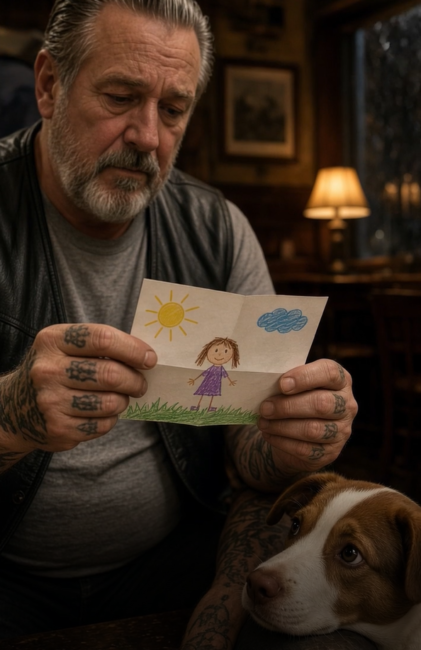
I gave them Nora’s original letter.
Three folds.
One crooked heart.
A sentence written so hard the pencil nearly tore the paper.
Please don’t let him think I stopped loving him.
My name is Walt Brennan. I repair school buses and ride with twelve people who call themselves the Lantern Road Riders.
I had thought our biggest decision that week would be whether a charity breakfast needed two coffee urns.
Now an officer was asking which of us had touched evidence.
I listed everybody.
Then he asked whether the man in the recording could have been filling out a form with his wife’s permission.
I looked at the frozen picture.
I wanted the answer to be no.
Wanting wasn’t proof.
The deputy found a telephone number for Elise Carter, Nora’s mother. He called through the rehabilitation unit’s front desk.
She answered.
He put her on speaker after explaining who was with him.
I expected fear.
Instead, she sounded embarrassed.
“I know about the paperwork,” she said. “I asked Adam to help.”
Nobody moved.
Then she asked whether he had already taken Nora to the airport.
Otis put one paw on my boot.
What kind of rescue had we started if the child’s own mother had approved the journey?
Six months earlier, Nora had sat at the same clubhouse table with both feet hooked around a chair leg.
Her mother kept the books for our charity rides. She brought Nora when school was closed and couldn’t find a sitter.
Otis slept beneath the table while twelve grown adults argued about breakfast sausage.
Nora slipped him a pancake.
“Don’t feed our auditor,” Elise said.
Nora laughed so hard milk came out of her nose.
Then her mother handed me a receipt book with a yellow sheet beneath each white one.
“The yellow one remembers,” she told Nora, pressing a pen against the top page.
Nora lifted it and gasped at the copied lines underneath.
A few minutes later, she tried to show me how to fold a letter so its point tucked into its own paper pocket.
“No tape,” she said. “Tape means someone else opened it.”
Those were the things I remembered while the deputy spoke to her mother.
Not the money.
Not the signatures.
A little girl discovering that paper could keep a secret.
Elise said her sister Beth had offered to help after the wreck. Adam would take Nora on a short visit to relatives in Canada while Elise recovered.
The trip had been discussed before the accident.
She had signed a permission letter.
She knew her husband was clearing out their rental because the stairs would be difficult when she came home.
Each fact arrived like another chair being pushed between us and the child.
“Did you approve giving away Otis?” I asked.
“No.”
Her voice changed.
“Adam told me he slipped out.”
I looked at the dog.
Seven years old. Brown and white. One ear folded at the tip. A thin patch of fur where he had been licking his thigh.
The shelter had scanned his chip and found Elise’s registration, but her old phone number no longer worked. Adam had left him with a signed surrender statement claiming permission from the owner.
Elise had authorized our pickup after the shelter reached her through the hospital.
She thought we were collecting a stray.
She hadn’t known somebody had delivered him there.
The deputy asked her to stay available.
Then he went outside to make another call.
Our search had started with a postmark and a flyer from last year’s toy ride. Nora had copied the clubhouse address beneath the words NEAREST MOTORCYCLE CLUB.
We split the work.
Three counties.
Shelter lists. Intake photographs. Calls during business hours. Two riders drove to facilities that couldn’t send pictures.
No one raced through fields calling a dog’s name.
At a holding shelter in Webster County, a clerk recognized Otis’s bent ear.
The intake photograph showed him pressed against a plastic water bowl.
Nora had described exactly how he slept.
She also said he sneezed when somebody shook a blanket and refused to cross the kitchen floor unless the light was on. The shelter clerk checked those details against the intake notes before Elise authorized release. We didn’t choose the saddest dog and decide he belonged to our story. We waited until the identification held.
Left paw over his nose.
As if covering a secret.
After the deputy left with the card and collar, Luis sat down beside him.
He touched the bent ear.
“If they told her he ran away,” he said, “what did they tell her about us?”
I looked at the empty place where her letter had been.
Had Nora mailed us a request for a dog, or the only warning she knew how to send?
The first update made Adam look less guilty.
The second made Beth look much more important.
Detective Maren Shaw called that evening. She said the recording had been made with an old action camera Nora used for school projects.
There were ordinary files on the card too.
Otis stealing a mitten.
A crooked tour of the kitchen.
Nora demonstrating a paper frog that wouldn’t jump.
The officers were preserving and reviewing the files. Shaw didn’t want us treating a fragment as a complete story.
Elise confirmed that she had asked Adam to sign some routine household documents while her right wrist was immobilized.
She had also given him travel permission.
A man copying a signature could be doing something improper.
He could also be carrying out an instruction.
“What matters is which document and what authority he had,” Shaw said.
I didn’t like the uncertainty.
I liked that she refused to hide it.
Then she asked who had told us Nora was moving.
“Her aunt.”
Beth Carter had met us at the rental house in a cream raincoat, holding a ring of keys.
There were hooks on the wall where pictures had hung. A little pink sock lay behind the refrigerator.
She said Nora and Adam had left early.
“Elise needs a fresh start,” she told us.
I asked where to take Otis.
Beth said she would call when they were settled.
“Leave him with me if you’re tired of dealing with this.”
Otis stepped behind my leg.
I said we weren’t tired.
At the time, Beth looked like somebody holding a family together while the mother couldn’t walk.
Now Shaw asked whether Beth had handled the travel arrangements.
I didn’t know.
But Luis remembered an envelope on the kitchen counter. A travel agency’s return address. Beth had scooped it into her handbag when we asked about Nora.
He told Shaw.
Then we stopped talking about it among ourselves.
I made sandwiches nobody wanted.
Outside, somebody started a motorcycle and immediately turned it off again. The sound seemed rude.
Elise called me directly.
“I told them you’re safe,” she said.
“Who thought we weren’t?”
“Adam says Nora got frightened after talking to men at your clubhouse.”
I looked at Otis sleeping under the chair Nora used to choose.
“She mailed a letter, Elise.”
“I know.”
“Nobody asked her to.”
“I know.”
But her voice had become small.
Adam had also told her Beth was handling the paperwork because he couldn’t keep up with the hospital, the move, and Nora’s school.
The signatures weren’t his idea.
That was his explanation.
It offered everyone a smaller mistake to believe in.
A helpful aunt.
An overwhelmed husband.
A mother who had consented.
Elise had spoken to Nora briefly that morning. Beth held the telephone, and the conversation lasted less than a minute. Her daughter said she missed the dog. Elise thought that explained the small voice and the long pauses. Now she was trying to remember whether anyone had answered a question before Nora could.
Then Shaw called again.
The recording contained a second voice.
A woman standing outside the frame, telling Adam which page to copy.
Beth.
Why was the woman arranging a harmless family visit instructing him not to show Nora the other set of papers?
We didn’t get to watch the entire recording.
Shaw explained the relevant portions to Elise with me present because she asked me to stay.
The camera had been on a low shelf near Otis’s bed.
Nora apparently placed it there to film the dog while she worked on a school assignment. At some point, she left it running.
Through chair legs, the lens caught the table, Adam’s face when he leaned forward, and documents he moved into view.
Beth stood mostly outside the picture.
Her voice carried.
“Not the permission letter. The declaration.”
Elise closed her eyes.
Shaw asked whether she had authorized anyone to describe Adam as Nora’s sole legal guardian.
“No.”
Whether she had approved a permanent move outside the country.
“No.”
Whether she had authorized use of an account held for Nora after her father’s death.
Elise didn’t answer.
Shaw waited.
Then Elise asked for water.
That was the first moment I understood there were two emergencies in the room.
A child on her way somewhere.
A mother afraid of the papers that might bring her back.
In the corridor, an orderly pushed a cart with clean towels past us. Someone complained that the elevator was slow. I kept watching normal things happen while a detective stood on the other side of a door, asking questions that might decide whether a child came home. The waiting felt louder than any engine.
Shaw didn’t pressure her in front of me. She asked me to step outside while another officer stayed.
I went to the vending machines.
I bought pretzels because my hands needed a task.
Later, I learned what the investigators had found.
The proposed destination wasn’t the relatives Elise knew.
Travel confirmations, obtained during the investigation, showed a different itinerary. The departure was still ahead of us.
Documents in Beth’s possession presented a different account of Nora’s guardianship. Financial records showed transfers connected to her late father’s money and a business Beth managed.
It wasn’t a confusing school form.
It wasn’t a tired husband signing a grocery reimbursement.
The plan required a child to leave with adults who were lying about who could make decisions for her.
The dog had been an obstacle.
Nora wouldn’t go anywhere without him.
Adam had removed that obstacle.
Then he told her Otis had run away because she wasn’t careful.
I learned that last part from Nora much later.
For the moment, I knew only that Shaw had asked Elise to identify several signatures and that my friend’s face looked gray when she came out.
“What can I do?” I asked.
“Keep the dog,” she said.
I nodded.
It was such a small request beside everything else.
But it was one I could answer without waiting for another person’s permission.
Back at the clubhouse, Otis refused his food until I sat on the floor beside the bowl.
I stayed there while he ate.
Luis washed the empty dish.
Then our club treasurer showed me a post circulating in a local neighborhood group.
My face.
Our motorcycles.
A warning about adults who used rescued animals to gain access to vulnerable children.
Who had decided we needed to become the danger just as the real paperwork began to surface?
The post used photographs from our toy ride.
Nora was cropped out.
That hurt more than the rest.
In the original, she stood between me and Luis, holding a stuffed rabbit against her chin. Somebody had cut away the child and kept our leather vests.
The caption warned people to protect their families.
It didn’t name us at first.
The replies did.
Our landlord called. A sponsor asked whether the upcoming breakfast should be postponed. One woman demanded to know why a motorcycle club had possession of a child’s dog.
I sent the shelter release to the person who actually needed it.
I didn’t put Nora’s mother’s medical information on the internet to win an argument.
Then Beth called.
She sounded calm.
“I think everyone should take a breath.”
I put the phone on speaker with Luis beside me.
“Where’s Nora?”
“With family.”
“Where?”
“We’re not giving you an address after this behavior.”
Otis lifted his head at her voice.
Beth said Adam had been frightened by our visit. He was considering a complaint.
I asked her to speak to Detective Shaw.
“I already have.”
Then she changed subjects.
“The collar belongs to Nora. You need to give it back.”
My eyes went to the empty hook beside the door.
“Police have it.”
A pause.
“Why would police have a dog’s collar?”
“Ask them.”
She hung up.
Luis wrote down the time.
Nobody spoke for a while.
Then one of our younger riders offered to follow Beth.
I said no.
He looked angry.
So was I.
That didn’t make following her useful.
Shaw had asked us to keep out of the way. They were working with other agencies to locate Nora and verify the travel information.
We could give them facts.
We couldn’t become another moving part they had to manage.
That night, somebody pushed an envelope beneath the clubhouse door.
No stamp.
Inside was a note supposedly from Nora.
I’m okay. I don’t need you to find my dog anymore. Please stop.
The words were neat.
Too neat wasn’t proof.
Neither was the tape sealing the fold.
But I remembered her small hands making the paper pocket.
The first letter had been full of crossed-out words and a drawing of Otis with an enormous head. This one used tidy sentences about respecting family privacy. A frightened child could write differently. Somebody could also write differently for her. I gave Shaw both possibilities instead of announcing that I knew.
Tape means someone else opened it.
I photographed the envelope where it lay and called Shaw.
She arranged collection.
I kept thinking about the person who had walked up to our door while we were sitting inside with every light on.
A child was gone, and somebody still had time to make us look unreasonable.
Near midnight, Elise called.
She said Beth had sent her a message about the missing money.
“If I tell them everything,” she asked, “will they still let me be her mother?”
I sat down slowly.
Outside, Luis was checking the locks.
What had Elise signed before the wreck that made her more afraid of telling the truth than of trusting her sister?
Elise asked for a lawyer before making the fuller statement.
Shaw helped arrange the conversation.
I respected her more for that, even while part of me wanted every answer immediately.
The truth came in pieces afterward.
Beth had managed financial paperwork for the family following Nora’s father’s death. When Elise fell behind on rent and medical bills, her sister offered a way to move money out of an account reserved for Nora.
Temporary.
That was the word they used.
Elise signed invoices describing expenses that hadn’t happened.
She knew they weren’t accurate.
She told herself she would replace the money before anybody noticed.
“How much?” I asked when she told me.
She named an amount larger than my truck was worth.
I looked at the hallway floor.
“And Adam?”
“He knew.”
Beth had used those signatures to keep Elise quiet.
Once the accident left her dependent on other people for transportation, medication schedules, and access to her paperwork, quiet became easier to enforce.
But Elise hadn’t been helpless at the beginning.
She said that before I could.
“I wanted the bills to stop coming,” she whispered.
I didn’t tell her that made it all right.
She had kept the charity ride accounts clean down to the last box of napkins. I had trusted her with cash drawers and sponsor checks. Seeing her admit to something uglier didn’t erase the person I knew. It meant I had to stop using the person I knew as an excuse to ignore what she said.
It didn’t.
I asked whether she had understood that Nora was being moved permanently.
“No.”
Whether she had suspected Adam wasn’t taking her where he claimed.
“Not until he stopped letting me talk to her alone.”
“Why didn’t you call someone?”
Her face folded.
“Because Beth said I’d lose her.”
I let that sit between us.
Then I told her the truth I could manage.
“Tell them anyway.”
She did.
She provided the account information, the devices she could access, and messages she had been too ashamed to show investigators earlier. She formally withdrew any travel permission and made clear that Nora needed to be located immediately.
There was no instant promise that she wouldn’t face consequences.
There was movement.
The itinerary could be matched to the names and documents investigators were examining. Officers located the adults at a hotel serving the Springfield airport.
I wasn’t there.
Neither were the motorcycles.
Shaw called before dawn.
“Nora is safe.”
For a moment I couldn’t understand the sentence.
Then I asked whether she was hurt.
“She’s being assessed. We’ll tell her mother what happens next.”
I carried the phone to Otis.
He was asleep on an old blanket beside the radiator.
“They found her,” I told him.
He opened one eye.
Then closed it again.
I laughed once, badly, and sat down against the wall.
Later, a child specialist explained why Nora hadn’t simply told a teacher about the camera.
Adam had told her the money problem was her mother’s fault. If she talked, her mother would go to jail and never come home.
She didn’t know which grown-ups were safe.
So she mailed a request about the one thing she knew wasn’t wrong.
Her dog.
When officials finally asked what she wanted, her first question wasn’t about a flight or a courtroom.
“Did the motorcycle people find Otis?”
How were we supposed to tell her yes without making another promise the adults in her life might break?
We brought Otis in Luis’s pickup.
He rode secured in the back seat beside me, his nose pointed at a window that didn’t open far enough for his liking.
The meeting happened in a quiet room with a child specialist present.
Not on the courthouse steps.
Not beside twelve running motorcycles.
Nora stood behind a chair when we came in.
Otis saw her.
His whole body bent.
He didn’t leap. He hurried in little sideways steps, nails clicking, until she dropped to her knees.
Then he put his left paw over his nose.
She started laughing and crying at the same time.
I looked at the ceiling.
Nobody asked her to thank us. Nobody asked her to describe the trip while her face was buried against his neck. The specialist moved a box of tissues within reach and waited. For once, the adults in the room let a little girl finish doing the one thing she had chosen for herself.
Luis suddenly needed to study a shelf.
Nora asked whether Otis was mad at her.
I said he had been very rude about the food at our clubhouse.
She wiped her face.
“He likes someone sitting there.”
“I figured that out.”
After a while, she told the specialist about the card.
She had watched enough of the camera recording to know Adam was writing her mother’s name. She heard Beth say Nora would learn the new story once they were gone.
She removed the card before anyone checked the camera.
The little pocket inside Otis’s collar had once held a folded emergency number. Elise sewed it there after a camping trip.
Nora used it because Adam wouldn’t let her keep her school bag with her.
She thought she could collect the card later.
Then Otis vanished.
She believed she had lost both of them.
The case took months.
Investigators recovered devices, compared the documents, traced transfers, and interviewed shelter staff. The card was important, but it wasn’t asked to carry the entire truth alone.
Elise gave evidence through her lawyer and faced a separate process for her own conduct.
At trial, Beth looked offended rather than frightened.
Her defense was that she had managed arrangements, not fabricated them. Adam had exceeded her instructions. She had never knowingly put Elise’s signature on a false declaration.
The prosecutor placed the original document set on a screen.
White top sheet.
Yellow copy underneath.
I remembered Nora lifting a receipt page and discovering the marks below it.
The yellow one remembers.
Beth said she couldn’t identify who had completed the papers.
Then the prosecutor showed a close image of the yellow sheet, including an indentation beneath the disputed signature.
Beth leaned toward her microphone.
“That copy wasn’t supposed to leave the kitchen.”
The room went still.
The prosecutor asked why.
“Because that was the signature I told Adam to redo.”
She stopped.
Her attorney moved.
But the sentence was already there.
It didn’t create the transfers or the recording. It didn’t replace the document examiner’s work.
It took the word unknowingly out of the story she had offered.
I watched her look toward Adam.
For once, neither of them had a smaller mistake ready for the other one to believe.
Nora wasn’t in the courtroom.
She was at school, learning fractions.
Would the verdict give her anything she could use on an ordinary Tuesday afternoon?
It gave her fewer reasons to listen for a car outside.
That was the first change I noticed.
Adam and Beth were convicted of offenses arising from the attempted abduction, false documents, and related conduct. The financial investigation brought its own findings and consequences.
Elise’s cooperation mattered.
So did the false invoices she had signed.
I didn’t ask anyone to erase one truth because another was worse.
Nora didn’t return to the old rental house.
For a while, she and Otis stayed with an approved relative while Elise completed rehabilitation and the family worked through the reunification plan.
We visited when invited.
There were practical things to solve that didn’t belong in a photograph. A school enrollment. A ride to an appointment. Shoes that had become too small during a month when nobody remembered to check. Our club made a schedule for the errands Elise approved. We learned that helping sometimes meant arriving without our motorcycles.
Sometimes Nora wanted stories about the search.
Sometimes she wanted us to stop telling it.
We learned to ask.
Otis’s licking had left a bald patch on his thigh. His veterinarian treated the irritated skin and helped the family manage the stiffness that made mornings slow.
Nora put a small rug beside the bed so his feet wouldn’t slide when he stood.
She took that job seriously.
A child could arrange a rug.
She shouldn’t have needed to arrange her own rescue.
The neighborhood posts faded unevenly. Our sponsor came back. One rider still wanted a public apology from everybody who had shared them.
I understood.
I also had a ten-year-old who asked whether breakfast would still happen.
We bought the second coffee urn.
At the first fundraiser after everything, nobody asked Nora to stand on a stage.
There were no giant photographs of her face.
She helped carry napkins until she got bored, then sat beneath a table beside Otis and taught him absolutely nothing.
He accepted payment anyway.
Elise arrived using a cane.
She stopped in the doorway, looking at the familiar chairs.
I handed her a paper plate.
“There’s sausage.”
She took it.
That was as much forgiveness as I could offer that morning.
It was enough to let her sit down.
Later, Nora brought me a clean sheet of paper.
She wanted to write the shelter clerk a thank-you letter.
I found a pencil.
She folded the finished page into its own little pocket, pushing the point beneath the flap with a thumbnail.
Then she reached for the tape.
I looked at her.
She shrugged.
“So nobody loses it.”
I tore off a strip.
Outside, motorcycles rumbled as two riders left for work. Otis raised his head, checked where Nora was, and settled again with his paw across his nose.
She drew a crooked heart on the envelope.
The same shape as the first one.
This time, she didn’t press hard enough to tear the paper.
“Will you mail it?” she asked.
“I will.”
“And come back?”
I set the envelope beside my keys.
“Every time I can.”
She considered that answer.
Then she nodded and went to find her mother.
I stayed at the table until the coffee finished dripping.
What would the next letter ask for, now that it no longer had to ask for help?