A BOY DUMPED NOAH’S BACKPACK ON THE SIDEWALK—THEN FORTY BIKERS PULLED UP AND THE BOY FROZE WITH THE EMPTY BAG STILL RAISED.
THE BOY’S BACKPACK WAS UPSIDE DOWN. FORTY BIKERS PULLED UP, AND THE BIGGEST ONE KNELT TO TIE HIS SHOE.
On the last Friday of school in May, Laura Bennett reached the gate of her son’s elementary school in Chillicothe, Ohio. Noah was ten. He’d made it through the whole year with the same blue backpack, although Laura had sewn the front pocket shut in February after the zipper tore.
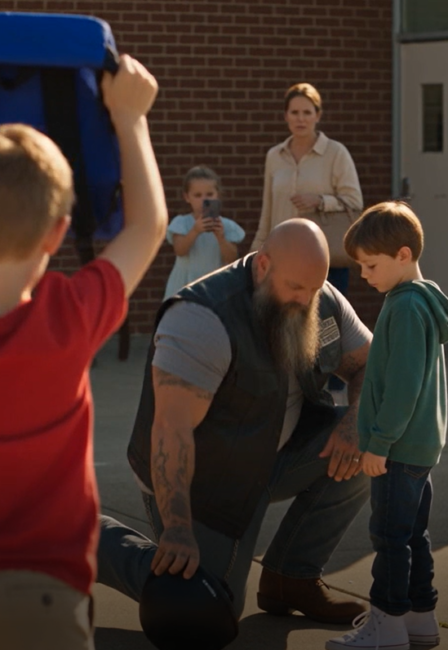
“Nobody’s coming for you!” Caleb shouted.
He tipped Noah’s open backpack until a plastic pencil box and a stack of worksheets slid onto the sidewalk. The pencil box landed flat. Noah watched it skid away from him, past the loose lace on his left sneaker. A girl in a purple shirt drew her feet back to let it pass. She looked up at Caleb before she looked at Noah.
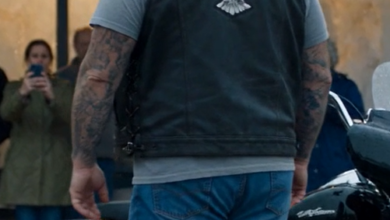
Forty motorcycles rolled to a stop along the street outside the fence. Helmets turned. Parents lifted their phones. The broadest rider shut off an old black cruiser, stepped down, and pulled off his helmet. He let it hang by his thigh. Laura could hear the tick of cooling metal.
Caleb held up the empty backpack. A parent glanced from it to the man in the short-sleeved leather jacket and told her daughter to stand back. Laura started toward Noah. She’d spent a year listening to adults describe things as horseplay after one boy had already laughed and the other had gone quiet.
The biker walked over and lowered himself onto one knee in front of Noah. He set his helmet down beside his boot. For a second Laura could see the white bridge patch across his back, with a broken rail near the middle. Then he bent over the sneaker. He drew the loose lace out from under Noah’s sole and made two big loops. He crossed them slowly, holding one steady while he pulled the other through. Noah spread his fingers against his jeans. Everybody had been looking at the papers. Now they were looking at his shoe.
Laura knew why the riders were there. The school had approved their stop to collect boxes for the summer pantry, and she’d given the office permission for Noah to meet the lead rider by the gate. She’d kept a copy of the form in her purse.
The biker drew the bow snug. Noah stared at the two loops for a beat, then looked up at him. “You remembered.” His own voice seemed to surprise him. Over his shoulder, Caleb went still with the empty backpack in his hand.
Part 2
The biker tucked the ends of the lace under the two loops and took his hands away.
“Walk a step,” he said.
Noah did. The bow held.
Laura stopped beside him. All week she’d rehearsed how she might introduce Marcus again, what she’d say if Noah didn’t remember him, what she’d do if he did and immediately asked to leave. Then Noah hooked a finger through one of the loops and said the word he’d been practicing in the back of her car.
“Dad?”
Marcus looked up.
“Hey, bud.”
He stayed on one knee. Parents lowered their phones by inches. The woman who’d asked her daughter to step back glanced down at her own screen, as though she’d recorded something other than what she’d expected.
Caleb set the empty backpack against the fence. He did it carefully, laying the strap over the top.
“My dad said you couldn’t come here.”
“Your dad didn’t make the arrangements,” Laura said. “I did.”
Caleb looked at her. At breakfast he’d asked if he could have the last of the orange juice. She’d pushed the carton toward him, and Noah had eaten his cereal without lifting his head. Laura had known there would be a reckoning between the two boys. She’d pictured it happening in a living room where they could all sit down.
A teacher named Ms. Ortiz came through the gate with a radio in her hand. A breeze lifted one of Noah’s worksheets, and Marcus put two fingers on a corner before it got away.
“Noah?” she said. “Would you like to come inside with me?”
“Can he come?”
Ms. Ortiz looked at Laura.
“I’ll come with him,” Laura said. “Marcus can wait out here if that’s what you need.”
Marcus handed Noah the paper he’d caught. It was a multiplication sheet with one problem circled in purple. Years ago, before Marcus went to prison, he’d taught Noah the two-loop method because Noah couldn’t hold a small loop pinched in one hand long enough to wrap the other lace around it. Marcus used to tell him a knot could look funny and do its job all the same. Laura remembered finding him in the kitchen once, both of his work boots on the table, trying to see how big he could make the loops.
He’d been home twelve days. Noah had seen him twice on video and once from the passenger seat of Laura’s car, when Marcus was getting a toolbox out of his sister’s garage. Both times they’d talked on the phone, Noah had asked whether Marcus still had the big black bike. He had never asked whether Marcus remembered his shoes.
“Do you want me out here?” Marcus asked him.
Noah thought about it.
“Will you be here when I come back?”
“Yeah.”
Marcus sat on the low wall by the gate. On the street, the riders were taking flattened boxes out of a support pickup. Laura had told their organizer to expect a quick handoff. Now the man simply carried an empty cart toward the school doors and held it clear while she and Noah went through.
Caleb had picked up the pencil box. He ran his thumb over one of the hinges.
“I need that,” Noah said.
Caleb handed it over. Then he looked past Laura, toward the office where his father sometimes went to drink coffee with the principal.
“Could you tell Ms. Ortiz before my dad gets here?” he asked Noah. “About the part where he told me to say it was a joke?”
Part 3
Ms. Ortiz asked the boys to wait in separate rooms. Noah went with Laura into a reading room that smelled like dry-erase markers and wet paper towels. He put the pencil box on the table and opened it. One hinge had cracked. He kept opening and closing the lid at an angle that made it catch.
“Did your dad say that today?” Ms. Ortiz asked Caleb from the room across the hall. The door shut before Laura heard his answer.
Noah lined up his pencils, erasers first.
“You can tell me what happened outside,” Laura said. “You can also wait until we get home.”
“Which home?”
Laura had no quick answer for that. Darren’s pickup was in the driveway at the house they shared. Caleb’s red shirt had come out of her dryer that morning. The apartment where Marcus was staying with his sister had a sofa bed and a window that faced an alley. Noah had never been inside it.
“We can go to Aunt Rachel’s for supper,” she said. “You and me. We can decide the rest from there.”
He put another pencil in line. “Can you tell her I like the noodles without the green stuff?”
“I will.”
She wanted very badly to hear him say he’d never been afraid to go home. As soon as she recognized the wish for what it was, she stopped herself from asking the question that might have handed him the answer.
“What happened to the zipper in February?”
“Caleb and Mason put it over the fence by the bus lane. I pulled it down.”
“You said it caught on a nail.”
“Caleb said the school would call Dad. And Dad would ask why I was making problems in front of his friends.”
Darren had long ago asked Noah to call him Dad around the house. He’d told Laura the boys should hear the same word from each other. She remembered nodding while she folded a fitted sheet, occupied with getting the corners lined up.
“Did Darren ever tell you that himself?”
“Once. At dinner. He said I could handle a joke without a report.”
Laura remembered the dinner. Spaghetti. Caleb had laughed with his mouth full and she’d told him to swallow before he spoke. She had asked Darren later if he and Noah were having trouble, and Darren told her he and Ms. Ortiz already had it sorted. Laura should have called Ms. Ortiz.
The principal came in holding a folder. She sat at the table instead of behind the little desk.
“I have three ride volunteers waiting for pantry boxes,” she said. “And your husband is on his way. He asked us to call his dispatcher about a disturbance.”
“What disturbance?”
“He said a man who’d been told to stay off campus came to collect a child.”
“I’m the one collecting Noah.” Laura set the permission form on the table. “Marcus was there to meet him, with me present. Check the email I sent.”
The principal picked up the form. “I will.”
“And there are people outside who filmed what happened. Please ask them for the original clips, starting before the bikes came in.”
The principal paused at the door. “I’m going to ask Mr. Price to wait in the office.”
Noah looked at the form after she left. His gaze stayed on the empty space where a second signature could have gone.
“Darren told me he took Dad away once already,” he said. “He said he could do it again.”
Laura had known Darren arrested Marcus. She’d been standing in their driveway when it happened. She’d never told Noah who the officer was.
Part 4
The front office had a row of molded chairs attached to a metal bar. When Laura went out, Darren was standing in front of them in his police uniform, tapping his car keys against his palm. He set the keys down as soon as he saw her.
“Where’s Noah?”
“With Ms. Ortiz.”
“I’m taking both boys home.”
“Caleb’s mother is on her way. Noah and I are going to Rachel’s.”
Darren gave a short laugh. “Since when?”
“Since he asked me which home I meant.”
He turned toward the office window. A secretary was talking on the phone with one hand over her other ear. Laura could see two pantry volunteers through the glass doors, wheeling boxes toward the pickup. Marcus was where he’d said he’d be, on the low wall. His helmet sat between his boots.
“He brought forty men to an elementary school,” Darren said. “You realize what it looked like?”
“Yes. I was there.”
“Call anybody who saw them come up.”
“I asked the principal to.”
An officer from a neighboring agency arrived to respond to the reported disturbance. Darren started across the office to meet her. She asked him to sit down so she could speak to witnesses individually. For a second Laura thought he might argue. He sat at the end of the chair bar and slid his keys into his pocket.
Laura was still carrying the backpack permission form. She turned it over and found the grocery list she’d written on the back while Noah was getting dressed that morning. It said bananas, milk, and sandwich bags. She read it twice while the officer listened to the principal.
Darren had arrested Marcus five years earlier, when he was a detective. Marcus had helped sell stolen equipment through the shop where he worked. He’d told Laura he suspected where the tools came from and had taken his cut anyway. He pleaded guilty, served his time, and called her after sentencing to ask whether she’d let Noah keep the red toolbox he’d bought him. Laura had said yes. That winter Noah used it to carry his crayons.
She met Darren again two years later at a parent event. By then he could tell when a difficult story ought to be left alone. Or so she’d thought. After they married, he started talking about the arrest as if it were one of the useful things he brought to the household, along with knowing how to reset the furnace and which roads to avoid after a snowstorm.
The visiting officer came back from watching video with the principal.
“Mr. Reed stayed on the public side of the gate,” she said. “He approached with a parent present. The motorcycle group was on the activity schedule. I still need statements about the backpack.”
“What about my request to have him removed?” Darren asked.
“Is there a court order or an active school restriction you can show me?”
Darren said nothing for several seconds.
The secretary lifted her hand from the desk. “I have a message from March. I printed it when you asked me to change the pickup file.”
Laura turned. “You changed Noah’s pickup file?”
“We left Marcus off, which was already your instruction then,” the secretary said. “What I added was the note about police contact if he came to the school. I thought it was official. It came from the chief’s email.”
“Can I see it?” Laura asked.
The secretary opened a drawer. “I can show you the original. There’s something else in the folder, too. It’s the first report we got about Caleb.”
Part 5
The first report was dated September. Laura remembered that week because she’d sewn a button onto Caleb’s school picture shirt while Noah stood beside the kitchen table with a damp paper sack. She’d thought his milk carton leaked. The report said his lunch had been pushed into the water fountain. A lunch aide named Mrs. Kim had seen Caleb and another boy carrying the bag back toward Noah’s table.
September. There were still peaches at the produce stand in September. Noah had been carrying this for almost a whole school year.
The secretary, Jean, brought the principal into the records room. Jean had pulled up the entries while the visiting officer made her notes. The screen showed the lunch aide’s report and a later status entry. It said the matter had been handled at home.
“Did someone speak to me?” Laura asked.
Jean looked through the messages. “The assistant principal spoke to Darren. He said he’d spoken to you.”
“He told me a carton leaked.”
The principal put her glasses back on. “The report should have gone to both households. Caleb’s mother should’ve heard about it, too.”
Laura thought of Tessa, who worked early mornings and always packed a snack in Caleb’s bag on exchange days because he got hungry in the car. At Christmas, Tessa had asked if things were going all right between the boys. Laura had said they were still figuring out how to be brothers. She’d meant it kindly. It sounded terrible to her now.
Jean brought over the March email. Darren called Marcus a potential safety concern and asked that any contact between him and Noah be referred to the department. Attached was an old case page that showed the arrest, his title at the time, and the date. It contained no order about Noah.
“I filed it under the student safety notes,” Jean said. “He’d done our lockdown training. When the message came from him, I treated it like anything else we got from his office.”
“Did it go anywhere besides that file?” the visiting officer asked.
Jean checked. “The assistant principal forwarded it to two staff members. Both had been working with the boys.”
Laura asked for the relevant school records through the principal. The visiting officer asked the principal to preserve the original messages and made a separate note of how the school had received Darren’s instructions. Laura could hear her voice change as she got down to dates and names. It was the first time all afternoon that Darren’s job sounded like something someone could ask him to account for.
Across the hall, Caleb’s mother arrived in work pants with a flour smudge at one knee. Darren met her by the chairs. Laura could hear him say that Caleb was upset and needed to go home.
“Which part upset him?” Tessa asked.
Darren lowered his voice. Tessa didn’t lower hers.
“I’ve got time,” she said. “Start at the beginning.”
Later, while Tessa was with Caleb, Ms. Ortiz brought Noah a new pencil box from a supply cabinet. He opened it, put the lid back on, and handed it to Laura to hold. He said he wanted his old one for the weekend. Then he went over to the window to see if Marcus was still there.
Jean had one more email open. It was dated in March, the same day as the warning about Marcus. A teacher had asked why two pages of Noah’s family reading project were missing from the folder after it went home for a signature.
Jean found the reply and tilted the screen.
Please remove Mr. Reed’s letters from the project. I’ve dealt with the originals.
Part 6
Rachel set two bowls of noodles on the table and left the parsley in a dish by the stove. Noah ate half his bowl before he asked if Marcus could come over. Laura said she’d call him when they finished eating. The first thing Noah did was find an extra fork.
When Marcus arrived, the black cruiser was already loaded into his sister’s garage. One of the riders had dropped him off in a pickup. He brought a paper grocery bag, which he set on the floor beside his chair.
“Aunt Rachel’s sink makes a noise,” Noah told him.
“Pipes or drain?”
Noah thought about it. “Underneath.”
“Show me after we eat.”
Marcus asked for a small serving. Rachel gave him the same amount as everybody else. Laura kept looking at the paper bag. The top had been folded down twice and pressed flat.
“I saw the email about the reading project,” she said finally.
Marcus set down his fork.
“You wrote to him?”
“Most Sundays.”
Laura had changed apartments when Noah was six and moved again when she married Darren. She’d told Marcus to use the post office box her sister maintained for the family. Darren had picked up that mail for nearly two years. Laura remembered finding stamps in his truck console and teasing him about keeping them there through a summer heat wave. She’d thought he was mailing bills.
“How many did you get back?” she asked.
“Three. Then I got one through.”
Noah looked up. “I found that one.”
Marcus lifted his eyes from the table.
“It was in the recycling. With the coupons.” Noah rolled the handle of his fork against his thumb. “I put it in my reading folder because it said I was learning cursive. Mrs. King would give me credit if I read a letter and wrote a summary.”
“Did you finish it?” Marcus asked.
“Most of it. I couldn’t read the part after the lawn mower.”
“That says ‘carburetor.’”
Noah considered this. “I wrote ‘car battery.’”
“Close enough for what I was doing.”
A small smile passed between them. Laura watched Noah fight to keep it as he asked the next question.
“Did you really write every Sunday?”
Marcus picked up the grocery bag. Inside were copies with dates at the top, folded as if he’d mailed those, too. He’d made most of them by writing a second copy on the same ruled paper. On one, a sketch showed two hands holding two loops. The hands had four fingers each. He’d drawn the thumbs in afterward, small and crooked.
“I wrote when I had something to say,” he said. “Some Sundays all I could think of was what they served for breakfast.”
“What did they serve?”
“Oatmeal.”
“Good oatmeal?”
“No.”
Noah pulled the packet closer. “Can I take one upstairs?”
“Take what you want.”
After he went up, Laura found a short letter near the bottom. Marcus had addressed it to Darren by name. In it he said he knew why Laura might be slow about visits and that he would respect her decision. He asked Darren to pass on a birthday card anyway. He’d drawn a cheap little bicycle beside his signature.
“Did Darren ever answer you?”
“Once,” Marcus said. “He said he’d read the card and decided Noah didn’t need it.”
Rachel looked away toward the sink. Laura picked up her phone and dialed Tessa. They had agreed to talk after the boys were asleep. Tessa picked up before the first full ring.
“I asked Caleb to tell me what he meant about calling it a joke,” Tessa said. “Laura, did you know Darren had him reading Noah’s letters, too?”
Part 7
They met at the school the following week. Laura and Tessa sat on the same side of the table, with the principal across from them and a district administrator between two stacks of paper. The boys waited in separate rooms. Marcus stayed at Rachel’s with his phone on because Noah had asked him to keep it nearby.
Tessa had brought a red folder from Caleb’s bedroom. The corners had gone white from being pushed under a drawer. She rested her hand on it while the administrator asked how she’d found it.
“Caleb gave it to me,” she said. “He asked if he’d have to give it back to his father.”
Darren came in wearing a blue button-down and carrying nothing. He stopped when he saw the folder. Laura knew he recognized it before he sat down. She’d seen him use the same file for insurance paperwork at home, with a coffee stain down one side.
The administrator put three reports on the table. The lunch bag. The backpack at the fence. A gym-class incident in which Caleb had called Noah a name used for children whose parents were locked up. Each report had been closed after a conversation with Darren.
“Why did you tell us these were resolved at home?” the administrator asked.
“Because I live with both boys. I figured I knew what they needed.”
Tessa opened the folder. There were four envelopes with Noah’s name on them. Two still contained letters. One contained the birthday card Marcus had drawn the bicycle on. The last had a single sheet of notebook paper Caleb had tucked inside. It held three phrases, copied in a child’s handwriting. One said You’ll get tired of waiting. Another said Nobody’s coming for you.
Laura felt the paper under her thumb before she knew she’d reached for it.
“What was this for?” she asked.
Tessa told her what Caleb had said. Darren let him read the first letter one evening while Laura and Noah were out buying school supplies. He told Caleb to listen for Noah repeating anything he’d read and report back. Caleb thought it meant his father trusted him with something important. When he started teasing Noah about the letters, Darren told him to call it a joke if somebody asked. Tessa said Caleb had copied the lines on the sheet after a night when Darren told him Noah needed to quit expecting his father to show up.
Darren reached toward the folder. Tessa closed it.
“I was trying to keep one house together,” he said.
Laura remembered how often Darren had offered to handle the next call, the next conference, the next question from Noah. At first it had felt like somebody taking a turn carrying groceries up the stairs.
“Did you tell him Marcus couldn’t come to the school?” Laura asked.
Darren looked at the administrator. “He’d just gotten out.”
“Did you tell Caleb he couldn’t come?”
“Yes.”
The district administrator said she was reopening the reports and arranging separate support plans for the boys. She asked both mothers what their children needed before fall. Then she told Darren that the district had preserved his messages and notified the city of the concerns about the use of his office. The city’s review would proceed separately. Laura watched him turn his wedding ring once. He didn’t ask to see Noah.
Near the end of the meeting, Ms. Ortiz knocked. She had asked each boy whether he wanted to write anything down. Noah had given her a ruled sheet folded into quarters. On it he’d written that he wanted his backpack back when someone took it, that he wanted adults to call his mom themselves, and that Caleb could talk to him about the dog anytime. They’d both taught the dog to jump over a rolled towel in the hallway. Caleb had made it jump one way and Noah the other.
There was one more line at the bottom. Ms. Ortiz asked Laura to read it to herself.
Can I have my dad’s letters in front of me while Caleb says sorry? I want him to see what they were actually about.
Part 8
Caleb apologized two weeks later, with both mothers and Ms. Ortiz there because Noah had said he’d like them to stay. He brought the blue backpack with the front pocket still sewn shut. He’d found two of the missing worksheets in his desk. He put them in the main compartment and left the zipper open for Noah to see.
“I liked it when Mason laughed,” he said.
Noah sat with one of Marcus’s letters on the table in front of him.
“I know,” he said.
Caleb picked at a scuff on the pencil box. “I shouldn’t have told everybody your dad didn’t want you.”
Noah unfolded the letter. It was the one Marcus had written about a lawn mower. Noah showed Caleb the word they’d argued over that night at Rachel’s.
“It says carburetor.”
Caleb leaned closer. “That’s a weird way to write a B.”
“That’s what I said.”
Laura was glad neither boy had to promise how he would feel next week. They were given a plan for the fall, with separate spaces at lunch and a counselor either of them could ask for. Tessa took Caleb home. Noah asked if he and Laura could get a milkshake on the way to Rachel’s. He picked vanilla and drank about a third of it before handing her the cup to finish.
By August, the city had removed Darren as chief following its review of the official messages and his attempt to involve the department in the school pickup. The district withdrew his role in school safety training and revised how it recorded family-related restrictions. Laura took a small apartment near Rachel’s. She and Darren arranged to exchange belongings when the boys were out. There were days she missed their kitchen and days she wondered how she’d gone so long without asking Noah what happened when she left it.
Marcus took a job repairing farm equipment. He worked Saturdays until noon. Most weeks, Noah met him after lunch and spent some of the afternoon sorting sockets into a tray. He liked the little ones best. Marcus let him keep the empty pencil box on the bench for any he found loose.
The riders came back to the school for another pantry collection before classes started. They brought pickups that time because the school had twice as many boxes. Laura watched the woman who’d filmed at the gate walk a carton out to Marcus. The woman had once told her daughter to step away from him. Now she asked where he wanted the canned peaches.
“Put them where you can reach them first,” he said. “Those boxes are heavy.”
Laura thought about how fast a hand could go to a phone when a tattooed man stepped off a motorcycle. She was glad someone had kept recording long enough to see what he did when he reached the boy.
On the first morning of fifth grade, Noah met Marcus by the gate. Laura was close enough to hear them without pretending to adjust her purse. Noah set his backpack on the low wall and put his left foot beside it.
“Watch,” he said.
He made two loops. One came out much bigger than the other. He crossed them, pulled the knot firm, and tucked both ends underneath. Then he turned toward Marcus, whose boot had come untied while they stood there.
“Your turn,” Noah said.
Marcus put his boot on the wall. Noah reached for the lace, and Marcus let him.
Follow this page for more stories about the people who show up.