A Little Girl Brought Birthday Cake to Her Grandfather’s Grave—But the Biker Beside Her Recognized the Name, the Birthday, and the Son Who Had Buried Him
Tom lowered himself onto the wet grass, keeping a full arm’s length between himself and the little girl. His bad knee clicked. Willa watched his face, then looked back at the name carved into the stone, as if one of them might correct the other.
“Is this a joke?” she asked.
“No, sweetheart.”
“My dad doesn’t do jokes about dead people.”
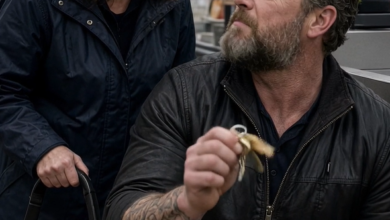
Tom looked at the cake. Its clear lid had fogged around the edges. A single yellow candle lay beside it, bent slightly at the top. He had brought flowers for Ray Sullivan, whose burial had taken place the previous Friday. This was his first visit to Ray’s plot. He had not known what stood beside it.
Willa’s mother was twenty yards away, helping an older woman lift a folding chair from a car. Willa pointed her out immediately when Tom asked who had come with her. He stayed where he was.
The woman approached quickly once she saw his vest and the look on her daughter’s face.
“Willa?”
“Mom, he says that’s his name.”
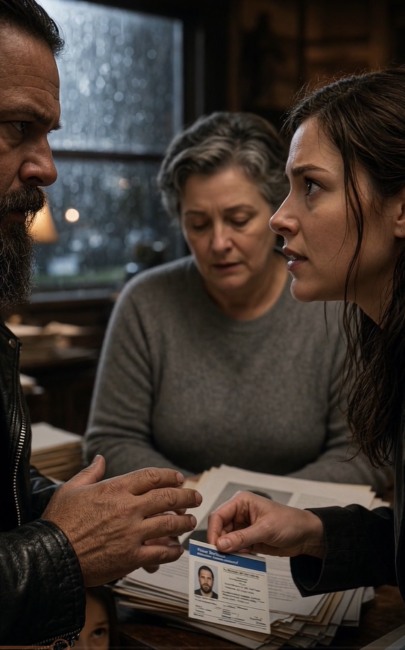
Claire Rourke looked from Tom to the marker. Her hand came down on Willa’s shoulder, protective but not rough. Tom gave her his driver’s license without moving closer.
She read it twice.
The birth date matched the stone.
The photograph matched the man.
But the death date was ten years old.
Claire took out her phone.
“Daniel, I need you to call me.”
Tom knew his son’s voice from the outgoing greeting. Older, smoother, with none of the breathless hurry he remembered. Hearing it made his chest hurt before the unanswered call ended.
Claire asked whether he had identification besides the license.
“At my motel. Discharge papers. Old photographs.”
“What are you doing in Ohio?”
“Burying a friend.”
He gestured toward Ray’s fresh flowers. Claire followed the movement. She had expected a story that required more explaining.
Willa crouched beside the cake and straightened the candle.
“Grandpa’s birthday was today,” she said.
“Is,” Tom answered, then regretted correcting her.
Claire noticed his shaking hand. So did he. He pressed it against his knee.
Daniel had once told relatives that his father confused events when he was drinking. Tom had not had alcohol in six years, but that history remained available to anyone who wanted it. Looking at his own name on stone, he found himself wondering whether some important piece of his life had happened without him.
Claire’s phone rang.
She put it on speaker.
“Take Willa home,” Daniel said before she finished explaining. “That man used to approach families. My dad warned me about him.”
Tom closed his eyes.
“Dan. It’s me.”
Silence.
Then Daniel said, “Don’t let him near my daughter.”
Claire ended the call.
For several seconds she stared at the screen. Then she asked Tom to wait while she spoke to the cemetery office, and asked an attendant to remain nearby.
Claire crouched to explain that they were checking something important, not deciding whether Willa had done anything wrong. The girl nodded without looking convinced. Tom recognized that expression from Daniel’s childhood: the solemn agreement children give adults when they have stopped expecting a clear answer.
Willa lifted the cake off the grass.
“If you’re him,” she said, “why didn’t you come before?”
Tom looked at the little girl holding a birthday he had never been invited to.
Which truth was he supposed to tell her first?
Twenty-six years earlier, Daniel had stood on a kitchen chair beside his mother, Mae, cutting stars from rolled dough.
Tom came home from the machine shop with a brass cutter he had made during lunch. One point was shorter than the others because he had measured badly.
Daniel inspected it.
“That’s not a star.”
“It’s a star with a job.”
Mae laughed so hard she dusted flour over the counter.
They used it on every birthday afterward. A little pastry star went on top of the cake. Whoever was celebrating got the corner beneath the short point.
“Crooked corner first,” Tom always said.
That afternoon, Daniel also helped him repair Mae’s recipe tin. The latch had loosened. The boy fitted a small copper washer beneath the screw, then scratched a D into it with a nail.
“So you know who fixed it.”
Tom kissed the top of his head.
“How could I forget?”
Daniel lifted the cardboard liner and slipped his birthday dollar underneath.
“False bottom,” he whispered.
Mae made him put the money in his piggy bank, but left the liner. For years afterward, every lost recipe prompted the same instruction: check beneath Daniel’s secret compartment.
Years later, after Mae died, that tin held more than recipes: receipts, folded photographs, and the small papers people keep because throwing them away feels like another death.
The cemetery office smelled of damp carpet and printer toner.
Willa sat beside Claire, eating a cracker from her mother’s bag. Tom remained in the chair closest to the door. He had called his friend Luis, a retired transit mechanic from his riding club, and asked him to bring the documents from his motel.
The cemetery manager, Patricia Cole, listened without interrupting.
“This is a private cemetery,” she explained. “The veterans section includes burial plots and memorial markers.”
Claire leaned forward.
“What’s the difference here?”
Patricia opened the original order.
“No interment. No ashes deposited. This is a memorial-only placement.”
Tom looked at her.
“So it’s empty.”
“There’s no burial beneath that marker.”
Willa stopped chewing.
Claire asked Patricia to repeat it, then asked that further details wait until her daughter was outside.
Luis had arrived by then. He offered to sit with Willa on the bench directly outside the office window, where Claire could see them. Willa agreed after her mother promised not to leave without her.
Tom handed over his discharge papers and an old photograph of himself beside Mae.
Claire studied Mae’s face.
“We have this picture,” she said.
“Where?”
“In Daniel’s desk. He said it was the last one.”
It wasn’t. Tom had sent others, years before. He did not say so yet.
Patricia explained that Daniel had purchased the marker. He had selected the wording, supplied the dates, and requested a location near the veterans memorial walkway. No government burial agency had arranged it.
Nothing about the empty ground was improper by itself.
People placed memorials for relatives lost at sea, donated to science, buried elsewhere.
But Claire had been told there was a coffin.
She had stood there every Memorial Day.
Daniel had explained that his father died before they met.
Tom turned the old photograph over. Mae’s handwriting crossed the back.
Their son had inherited her recipe tin.
If the cemetery had never claimed to bury Tom, who had taught his granddaughter to imagine him under the grass?
Daniel arrived that afternoon wearing the navy pullover he used for volunteer events. He brought Willa’s favorite takeout noodles and a folder thick enough to suggest that facts had already been organized.
Claire met him at their house. Willa was with her maternal grandmother. Tom and Luis had gone back to the motel.
“I needed you to tell me before you came home,” Claire said.
Daniel set the food down.
“I wanted to protect her.”
“From your father?”
“From someone claiming to be him.”
She showed him a photograph of the driver’s license.
He looked at it for a long time.
Then he sat.
“The funeral director told me Dad was gone.”
The folder contained a death certificate copy, a cremation invoice, and correspondence from a man named Martin Bell, who had operated a funeral-services business that later closed.
Daniel described a confusing month. His father had stopped answering calls. Bell contacted him after an apparent identification. There were official papers. Daniel had been ashamed of their estrangement and eager not to discuss the circumstances.
“I should’ve asked more questions.”
For the first time, Claire saw a version in which he had been deceived.
He had been twenty-eight then. His mother was dead. His father was drinking. A confident professional had presented a problem that could be solved by signing.
“Why did you tell me there was a coffin?”
He rubbed his face.
“Because I didn’t want to explain any of it.”
It was a lie. But it sounded like a smaller lie than inventing a death.
Claire agreed to examine the papers before accusing him again.
The following morning, with Tom’s permission, she met him at a library study room. Daniel’s folder lay between them.
Tom recognized Bell’s name.
“He handled Mae’s arrangements.”
Claire’s stomach tightened.
That explained how the funeral business could have known the family. It also meant someone outside it had access to personal details.
Luis found an old news report about the business closing after complaints involving prepaid accounts. It did not establish what happened to Tom. Still, it gave Daniel’s explanation somewhere to stand.
Claire called her husband.
“Did you pay him?”
“Yes. Everything’s there.”
The invoice looked professional.
The certificate copy carried a seal.
Tom stared at the papers with a weariness that worried her.
“I don’t know what you need from me,” he said.
“Nothing today.”
“No. Tell me. A man can get tired of being explained around.”
She apologized.
Then a folded statement slipped from the back of the folder.
It came from an insurance company.
The heading referred to a private survivor-income policy through Tom’s former employer. Daniel was the named beneficiary.
Claire read the payment line.
Then the next one.
“This isn’t a funeral payment,” she said.
She looked at Tom, who had never heard that his policy had begun paying anyone.
Daniel had described a mistake made ten years earlier.
Why was money still arriving last month?
Tom remembered the policy after Luis drove him to collect an old employment folder from a storage unit across town.
He had bought the coverage when Daniel was small. It was meant to provide regular income to a named beneficiary if he died during the covered period. After Mae’s death, he had updated the beneficiary.
Daniel.
The premiums had been arranged long before Tom’s life narrowed into temporary work and cheap apartments. He had not examined the policy in years.
He was embarrassed to say that aloud.
Claire was embarrassed by something else.
She recognized the payment amount.
Every month, money entered the household under a transfer Daniel called his overtime adjustment. She had budgeted groceries, school shoes, and mortgage payments around it.
Her bookkeeping had been careful.
The description had been false.
They did not log into Daniel’s accounts or search his work computer. Claire gathered the statements she was authorized to access. Tom contacted the insurer about his own identity and policy. Both kept copies of what they provided.
The company opened a review.
The policy promised a scheduled series of payments after a covered death. It had been one of the few financial arrangements Tom made while he was still good at planning ahead. Seeing it used this way unsettled him: an effort to protect his son had become the instrument his son used to erase him.
A representative called Tom back after checking identifying information and requested further documentation. She did not declare him legally alive or dead over the phone. She arranged a process for resolving why the company’s records said a death claim had been paid.
The distinction irritated him until Luis said, “You want them careful this time.”
Claire hired an attorney.
Within days, she learned that the cemetery invoice in Daniel’s folder had a problem.
Patricia’s original records described a memorial marker and installation.
The copy Daniel supplied also listed an urn placement.
Someone had added a service the cemetery had never provided.
The funeral invoice was worse.
Its reference number belonged to Mae’s arrangements, with dates and descriptions altered on the copy.
Bell had handled a real death.
It was not Tom’s.
Claire sat in the attorney’s office with both versions on the table.
For ten years, Daniel had kept paper that made one dead parent look like two.
The insurer’s investigation took longer. But the material eventually disclosed to the investigating authorities included Daniel’s signed claim statements and later communications affirming that nothing affecting his eligibility had changed.
There was no single misplaced form to blame.
There were repeated decisions.
When Claire confronted him at home, he pointed toward the kitchen.
“The payments kept this place.”
“This place has a mortgage. It isn’t an explanation.”
“You think your paycheck covered all of it?”
She looked at the school calendar held to the refrigerator with magnets Willa had painted.
The money had become ordinary inside their life. That made it harder to see and harder to remove.
Daniel lowered his voice.
“If you turn this into a criminal case, she loses her father.”
Claire’s hands went cold.
She had heard promises, excuses, and one plausible mistake.
Now she was hearing a threat wrapped around their daughter.
How much of the life she had trusted had been built on keeping one living man dead?
The first photograph appeared in a neighborhood group before breakfast.
Tom stood beside the cemetery bench, leather vest open, face drawn with shock. Willa was visible near the edge, holding the cake.
The caption warned about a disturbed stranger approaching a child in the veterans section.
It did not mention the name on the marker.
Claire received three calls before she finished making toast.
By noon, Daniel had told relatives that Tom was unstable and that Claire was being manipulated. He said a lawyer was helping them establish boundaries.
Claire had also consulted a lawyer.
The similarity made people hesitate.
At Willa’s school, staff followed their usual pickup procedures and checked the authorized list. Claire asked that no information about Willa be shared with callers merely claiming to know the family.
Tom was not on that list.
He did not ask to be.
Instead, he stayed at the motel while Luis brought groceries.
By the third day, two riding friends wanted to confront Daniel at work. Tom told them no. One accused him of letting his son humiliate him.
Tom looked at the man’s hands.
They were fists already.
“I need you useful,” he said.
The man left angry, then returned that evening with a replacement tire for Luis’s truck.
Meanwhile, Daniel asked Claire to sign a statement saying she had misunderstood the account transfers. He placed it beside Willa’s homework and said it would keep everyone calm.
She photographed the page, sent it to her attorney, and declined.
That night she took Willa to her mother’s house.
She explained the move without discussing insurance.
“Dad and I have grown-up things to sort out. You’ll still have your clothes and school.”
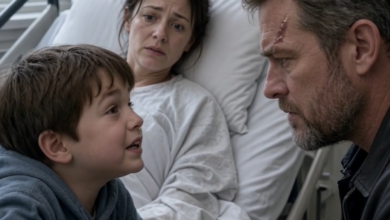
“Is Grandpa dangerous?”
The question hurt more than the packed bags.
“I don’t believe he is.”
“Then why did Dad say?”
Claire sat on the bed beside her.
“I don’t have an answer that makes that okay.”
Willa folded the empty cake box flat. She had refused to throw it away.
“Do I still get to have a grandpa?” she asked.
Claire put down the sweater she was packing.
“If you want to know him, we’ll find a safe way.”
“And if Dad gets mad?”
“That’s for me to handle.”
Willa traced the cardboard crease with her thumbnail, waiting until her mother repeated it.
Later, Tom called to ask whether the girl was all right.
Claire told him about the question.
He did not speak for several seconds.
Then he said, “I’m not going to make her choose.”
The following morning, a local reporter contacted Claire after seeing the photograph. She declined to put Willa on camera and asked that the child’s image be removed from further coverage.
The story still spread.
Tom’s motel manager received complaints.
One caller said he was impersonating a veteran.
Luis sat with him while he assembled service records, tax documents, employment records, and the tedious evidence of a decade spent alive.
At the bottom of his folder lay a returned birthday card, unopened.
Claire noticed the postal date.
It was only five years old.
She had thought father and son lost all contact ten years earlier.
If Tom had known where Daniel lived five years ago, what else had he known about the family he had never visited?
Tom laid the card on the motel table.
The envelope was addressed to Daniel. Inside was a photograph of a rebuilt motorcycle and a note written after Tom finished his first year sober.
Claire asked whether he had mentioned Willa.
“No.”
“Did you know about her?”
He rubbed the seam of his jeans.
“Yes.”
The air conditioner clicked on.
He had seen a photograph through a former neighbor. Daniel beside a hospital bassinet. Claire smiling in a blue gown. A baby with one fist against her cheek.
Tom had asked the neighbor to confirm the name.
Then he had folded the printout into his wallet.
He had carried his granddaughter for years without trying to meet her.
“I thought you had no idea,” Claire said.
“I know.”
“You let me think it.”
“Yes.”
His honesty did not make her less angry.
Tom described the years after Mae died without asking her to make them smaller. He had drunk through missed work, missed calls, and a winter when Daniel drove across two states to collect him from a rented room.
Once, Daniel found him too intoxicated to attend an appointment they had arranged together.
Another time, Tom borrowed money he did not repay for years.
“He didn’t invent being hurt,” Tom said.
Claire looked toward the closed curtains.
“That doesn’t give him permission to do this.”
“No.”
“So why stay away after you got sober?”
“Because I could call it respecting his wishes.”
“And was it?”
“Some of it.”
The rest had been fear.
A returned card was easier to survive than a door closing in his face. Tom had allowed one attempt to stand in for all the difficult ones he did not make.
Claire stood up.
“I need a minute.”
He let her leave.
In the parking lot, she called her mother and asked whether Willa was asleep. Then she walked until she could return without saying something she would want to take back.
Tom was still at the table.
“I won’t tell her you couldn’t find her,” she said.
“Don’t.”
“I won’t tell her this was all taken from you.”
“It wasn’t.”
He took the photograph from his wallet. Its fold crossed Daniel’s shoulder.
“Can I give her this?”
“Not yet.”
He nodded.
A week later, in a supervised family meeting arranged through Claire’s counselor, Tom answered Willa’s questions in small pieces.
He had not died.
He had been sick in a way that affected how he behaved.
He had gotten help.
He had also been afraid to come.
“Of me?”
“No. Of not being wanted.”
She considered that for a long time.
“I didn’t know you were available.”
Tom pressed his palms together until the knuckles whitened.
Afterward, Claire received a message from Daniel’s attorney concerning the growing investigation.
Daniel still maintained that he had relied on someone else’s paperwork.
His account now included a claim that the insurance notices came from an unopened bundle in Mae’s tin. Claire remembered seeing that tin on his desk every tax season. She had never wondered why the recipes were elsewhere. Now even a domestic detail required her to ask what she had actually witnessed.
But how would that story survive the little copper washer inside the recipe tin he claimed never to have opened?
The case reached a courtroom the following year.
By then, Willa was ten. She did not attend the trial. Claire refused to make her daughter sit through adults arguing about which lies had paid for her childhood.
Tom testified on a Tuesday.
He wore a gray suit borrowed from Luis and boots polished until they looked uncomfortable.
The prosecutor asked where he had lived during the years the insurer believed he was dead. Work records, medical visits, and other documents had already supplied a timeline.
His answers supplied the man.
Daniel’s lawyer asked about drinking.
Tom answered.
About estrangement.
He answered that too.
About the returned card and his failure to visit.
“Yes,” Tom said. “I was afraid.”
He did not look toward Claire when he said it.
Later, Daniel chose to testify.
He said he had trusted papers found among family documents. He denied knowingly fabricating the death claim. He said the altered invoices might have come from the closed funeral business.
The prosecutor asked about Mae’s recipe tin.
Daniel said he had taken possession of it after her death but had not examined its contents closely.
Claire had provided the tin through investigators after preserving it from the house. Inside were recipe cards, old receipts, and an insurance mailing dated after Tom’s supposed death.
The mailing acknowledged information Daniel had supplied.
Its pages had been folded beneath the bottom stack of recipes.
Daniel said he had never seen it.
The prosecutor displayed a photograph of the tin as it had been received.
Its latch was partly open.
A small copper washer sat beneath the screw.
Daniel leaned toward the microphone.
“That doesn’t prove anything was under the false bottom.”
The prosecutor paused.
“What false bottom?”
Daniel looked toward his lawyer.
There was no manufactured compartment. Only a removable cardboard liner Mae had fitted to keep recipe cards from catching on the metal seam. As a boy, Daniel had called it the false bottom.
Tom remembered him hiding birthday money beneath it.
No witness had used that childhood name in court.
The prosecutor asked whether Daniel had removed the liner.
“I used to. When I was a kid.”
“Recently?”
“No.”
She showed the next photograph.
The insurance acknowledgment had been found beneath that liner. The original record of its location had not been included in the photograph shown to Daniel.
His lawyer objected to the implication.
The judge allowed the prosecutor to continue asking about his knowledge.
Daniel changed his answer.
He might have moved papers. He did not remember when.
Then the prosecutor returned to the messages he had sent the insurer, the account receiving payments, the altered invoices, and the marker order bearing his signature.
The tin was not the case.
It was the place his account of never looking inside stopped holding together.
“Why buy a memorial?” she asked.
Daniel stared at the table.
“For closure.”
“For whom?”
His voice sharpened.
“So people would stop asking where he was.”
Across the courtroom, Tom lowered his eyes.
Daniel looked at him.
“You left anyway.”
The words hung there, carrying an old injury and a new admission that did not excuse what followed.
After ten years of payments and one empty patch of ground, would the court see the difference between a son who had been abandoned and a son who had chosen fraud?
The jury did.
Daniel was convicted of offenses arising from the fraudulent claim and supporting documents. Sentencing came later, with arguments about restitution, the amount paid, and the damage his conduct had caused.
Claire attended.
Tom did not speak for a harsher sentence.
He also did not write the letter Daniel requested asking that the whole matter be treated as a family misunderstanding.
“It wasn’t,” he told the attorney who called.
The money took longer to sort out than the verdict.
Claire separated her finances, provided records, and worked through obligations with legal advice. Some possessions were sold. The house went on the market.
Willa moved into a smaller bedroom at her grandmother’s home.
She complained about it.
Claire was relieved to hear an ordinary complaint.
Daniel remained her father. Contact continued under arrangements made by the adults responsible for her care, with attention to what she could manage. Nobody asked her to decide whether she loved him enough.
Some days she wanted to talk.
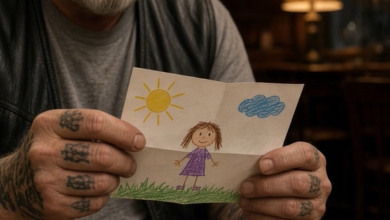
Some days she wanted to draw.
Tom learned not to ask what Daniel had said.
He moved back to Ohio after finding part-time work repairing equipment for a landscaping company. The apartment he rented had a kitchen table, two mismatched chairs, and enough space for Willa to spread out a project.
Claire did not give him a key to her house.
He did not request one.
Trust arrived in errands first.
It did not arrive evenly. Once, Tom forgot to charge his phone and missed Claire’s call by an hour. She canceled the following visit. He wanted to argue that one mistake should not erase everything, then remembered how many times Daniel had heard that defense. He bought a kitchen charger and called when he said he would.
A repaired bicycle brake.
A ride Claire approved.
A Saturday afternoon that ended exactly when he promised it would.
At the cemetery, Patricia arranged for the false memorial inscription to be removed from display while the family decided what should happen to the marker. Ray’s grave remained beside the empty ground, now without Tom’s name.
Tom visited Ray alone for several months.
Then Willa asked to come.
She brought flowers this time.
“These are for your friend,” she said.
He helped her place them without correcting how she held the stems.
They did not bring a cake.
The following spring, on Tom’s birthday, Claire arrived at his apartment with grocery bags.
Willa carried Mae’s recipe tin.
It had been released after the case. The copper washer still held the latch slightly crooked, and the little scratched D remained visible if the light hit it correctly.
Nobody replaced it.
Willa wanted to make the cake herself.
She measured flour too quickly, dropped an eggshell into the bowl, and informed Tom that he was not allowed to supervise his own birthday.
He sat down.
When the cake cooled, she used the old brass cutter to make a pastry star. One point was shorter.
“That’s broken,” she said.
“Always has been.”
She set it on the frosting.
Claire put three plates on the table.
Tom reached for the knife, then stopped.
The first cake Willa had brought him had rested on wet grass above an empty grave.
This one stood between their elbows.
She pointed to the corner beneath the short star point.
“That one’s yours.”
He cut it carefully.
Willa picked up the bent yellow candle she had saved in a drawer for a year.
She straightened it as much as she could.
Then she looked at him.
“Can I sing to you this time?”