The Boy Who Wore His Late Father’s Oversized Suit to Prom Was Laughed At — Then the Band Suddenly Stopped Playing
PART 1
The drummer had his stick in the air when the man with the guitar looked down at Eli Carter’s sleeve and cut off the music in the middle of a chorus.
Until then, Eli had been grateful for how loud the band was. The music covered most of the laughter. Now he could hear the ice settle in a plastic cup on the edge of the stage. Somebody near the photo backdrop let out one more laugh, alone this time, and stopped.
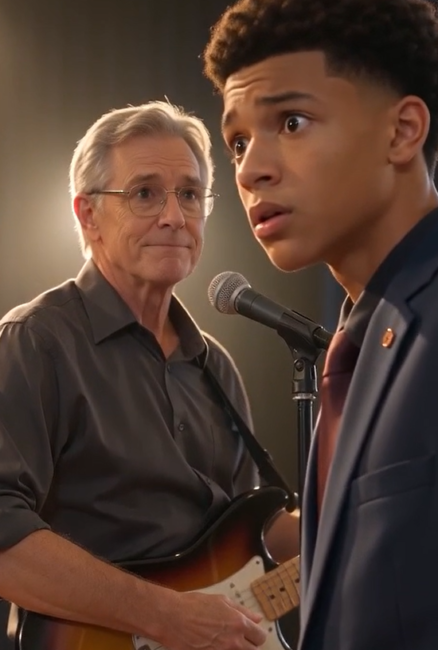
Eli still had his arm out. Nate had taken the car key, but the cuff of the navy jacket had folded back against Eli’s wrist. Three red stitches showed where the lining had once torn. He tucked his thumb into the cuff to straighten it.
“Leave it a second,” the bandleader said.
The man bent down far enough that Eli could see the little pads on his silver glasses. His guitar tapped the microphone stand. He looked at the stitches, then at the one amber button on the front of the jacket. The others were dark.
Eli had spent all evening hoping nobody would notice that button. This man looked as if he knew where it had come from.
PART 2
The rental shop wanted eighty-nine dollars before alterations. Eli had forty-two dollars left from bagging groceries after school. On the way home from the shop, he watched his mother ease the car around a corner so the gas needle wouldn’t drop all the way to empty. He waited until they pulled into their parking space before telling her he’d found something to wear.
His father’s suit was in the hall closet, between two winter coats. Eli had opened the closet several times since Marcus died eight months earlier. He’d moved the coats. He’d taken down a box of light bulbs. He’d always shut the door with the suit still on its hanger.
This time he took it out.
At seventeen, Eli was almost as tall as his father had been. The resemblance ended at the shoulders. Marcus had filled out a jacket from the day he started hauling amplifiers for weekend gigs. On Eli, the navy fabric sagged past the place where his arms began. The sleeves covered half his hands. He had short dark curls like his father’s, though his own had a habit of flattening on one side while he slept.
His mother, Renee, stood behind him in the bathroom doorway. She was forty-three and still in the blue scrubs she wore to work. She put both hands on his shoulders and tugged the jacket into place.
“I can turn the cuffs up,” she said.
“Can you leave them?”
She took her hands away. When he’d been little, Marcus used to pull a sleeve down over Eli’s fingers before walking him into school on cold mornings. Eli had forgotten about it until he put on the jacket.
Renee noticed the amber button when he tried to fasten it. She rubbed the edge with her thumb.
“That came off my coat,” she said.
Eli waited for the rest, but her phone buzzed. The coworker covering the first hour of her shift needed her to come in early. She took a picture of him by the apartment door and offered to drive him to the ballroom on her way.
Just before he got out of the car, she reached for his left sleeve again. This time she only smoothed it.
“If anybody asks,” she said, “your dad wore it with that button, too.”
PART 3
Ashford High held prom at the Mill Street Ballroom in Dayton. A few of the high windows still had daylight in them when Eli arrived. The band was playing under warm bulbs, and people were lining up beside a paper moon that looked fine from the dance floor and creased down the middle up close.
Eli had arranged to meet two friends by the photo backdrop. One was with his date. The other sent a text saying he’d gone back to the car for his tickets. Eli stood where they’d agreed to meet and tucked his hands into his trouser pockets. It pulled the jacket tight enough that the shoulders looked even wider.
Nate Collins saw him from the edge of the dance floor. Nate was eighteen, with brown hair he’d parted so carefully that the line still showed under the ballroom lights. He wore a gray suit and a burgundy tie. Earlier that week he’d held up the grocery line to ask Eli which of two cheap flower bunches looked better.
Now he called out, “How many people fit in that jacket?”
A group by the backdrop laughed first. Then the laugh traveled far enough that kids who hadn’t heard the joke turned to see what they’d missed. A girl with her phone up lowered it when Eli looked at her. Her friend kept smiling for another second, then seemed to realize she was the only one looking at him.
Eli took his hands out of his pockets. He could have told Nate what the suit was. He could already hear the change in everybody’s voice if he said it belonged to his dad. He didn’t want to stand there while they worked out what expression to make.
He turned toward the exit. His mother wouldn’t be able to pick him up for hours. There was a bench at the bus stop, and he knew which end stayed dry.
Then something metal skittered past his shoe.
PART 4
It was a silver car key with a blue rubber cap. Eli recognized it. Nate had held it up outside the grocery store two days earlier, proud that his father was letting him take the sedan to prom. He’d said he was more worried about losing the key than denting the car.
Eli looked toward the door. A chaperone was letting a couple back in after they’d gone outside for pictures. He could have handed her the key. He could also have walked right past it. Nobody had seen where it landed.
He remembered Marcus coming home once with an extra twenty in his change from the hardware store. They were already halfway through dinner when he noticed. Eli had asked why he couldn’t take it back the next day. Marcus said the cashier would be counting her drawer that night. He put his shoes back on. Eli had gone with him because he wanted to finish telling him something about school.
Eli picked up the key and walked back across the floor.
Nate was standing by the stage, patting his trouser pocket through his jacket. He had the stiff smile of somebody trying to finish a conversation while he worked out how much trouble he was in.
“You dropped this,” Eli said.
Nate took the key. “You could’ve left it.”
Eli had thought he’d feel better if Nate sounded embarrassed. Mostly he wanted to get outside while he could still see the last of the daylight through the windows. He started to turn.
His cuff folded open. Above him, a guitar bumped a microphone stand. Eli glanced up and saw the gray-haired bandleader staring down at the red stitches.
The man raised his right hand. The keyboard dropped out first. Then the bass. The drummer caught the signal with his stick still up.
“Leave it a second,” the man said.
Eli stopped pulling at the cuff.
PART 5
The bandleader wore a charcoal shirt with the sleeves rolled to his elbows. A guitar pick stuck out from under the strings near the headstock. Eli could see the man’s name, Walter Dean, on the printed program somebody had left by a stage monitor.
“What’s your last name?” Walter asked.
“Carter.”
Walter took off his glasses and rubbed one lens with his thumb. Then he put them back on, looked over at the keyboard player, and said, “Get the brown book.”
She reached under her bench and pulled out a faded binder. There were white marks on its corners where the cardboard showed through. When she opened it, she turned straight past the printed set list to a page with a paper clip on it. Nate, standing close enough to see, caught the year in one corner. It was six years before Eli was born.
Walter came down the side steps. Eli thought the man might offer him a safety pin or suggest he take the jacket off. Instead, Walter tapped his own left wrist.
“Your mom stitched that in a dressing room,” he said. “She only had red thread.”
Eli’s hand went still. At school, people asked how his mother was doing. They asked how he was holding up. It had been months since a stranger told him something about either of his parents that he hadn’t known.
Nate said, “I’m sorry,” from just behind him.
Eli heard him. He gave one small nod and kept looking at Walter.
A chaperone asked if everything was okay. Walter told her they were changing the next song. Then he asked Eli if he’d come up the side steps with him.
“Your dad stood right there the last night we played together,” he said.
PART 6
Eli had known his father moved amplifiers. He remembered cords in the garage and a dented speaker cabinet Marcus used as a shelf for motor oil. He’d assumed his dad had been the guy who set things up.
“He was our singer,” Walter said. “He could play rhythm, too. Better than me when he remembered to bring his guitar.”
The last show had been in this room, at a fundraiser for Ashford’s music program. Marcus caught his sleeve on a cymbal stand during sound check. Renee sewed the lining while he wore the jacket, because there was nowhere clean to put it down. The front button had come off earlier. She’d taken one from her coat so he could close the jacket for a photograph.
Eli pictured her in the bathroom doorway that afternoon, rubbing the amber button. She’d known what room he was going to. She’d never said she had been there with Marcus.
On the stage, the keyboard player held the brown binder open. Eli saw his father’s handwriting at the top of the page. Marcus crossed his sevens, even on grocery lists. There was one in the date. Beneath it, somebody had drawn a line through a title and written another in pencil.
Walter said Marcus had brought in the song that afternoon. The rest of the band had heard it once in rehearsal. At the end of the show, the school choir director asked whether he’d let her use it with her students.
“He said she could have it if she put it in a key the kids could sing.”
The penciled title was hers. The original one, Eli could just make out, was Side Door. Marcus had missed his own senior send-off because the garage where he worked wouldn’t let him leave early. A custodian let him in through the side door while everyone was stacking chairs. He’d remembered the man waiting there with the door propped open.
Eli turned the page. His father had drawn a box around four words in the margin. Leave room for them.
“For the choir?” Eli asked.
“For whoever came in late,” Walter said. “He wanted them to get a line they could come in on.”
The school kept the song. The band split up. Marcus took weekday hours at the garage because the work came with steady pay. For years, whenever Walter and Marcus crossed paths at Ashford, it was at the senior send-off. Marcus would stand by the gym doors and wait for the music. He’d slipped in there during Eli’s freshman year, too. Eli had been up on the bleachers with his class and never seen him.
The keyboard player set both hands over the keys. Walter leaned toward Eli and moved the microphone away.
“Can I tell them whose jacket that is?”
Eli looked down at the sleeves. Then he nodded.
PART 7
Walter brought the microphone back. He told the room the jacket belonged to Marcus Carter, and that the boy beside him was Marcus’s son.
“You’ve been singing his song since you were freshmen.”
The girl by the photo backdrop lowered her phone again. This time she set it on a chair. Nate stood with the key clenched in his hand.
Walter sang the first line without the band. Eli didn’t recognize it at first. Walter sang it slower than the choir did. Then the keyboard came in, and Eli heard the four notes that opened every Ashford senior send-off.
He knew exactly when to breathe.
Leave a little room beside you.
A girl near the stage sang the next line. Two more voices came in from the back, then most of the dance floor. Eli had sung those words every spring since freshman year. Once he’d mouthed them because he wanted to get out of the gym and beat the lunch line. His father could have been at the door that day.
When the song ended, Walter let the last chord fade. Eli stepped back from the microphone and slid his left hand inside the jacket to flatten the lining. His fingers caught on the corner of something stiff.
PART 8
It was an envelope tucked into the low inside pocket. Eli had felt along the outside pockets before leaving home. He hadn’t even known this one was there.
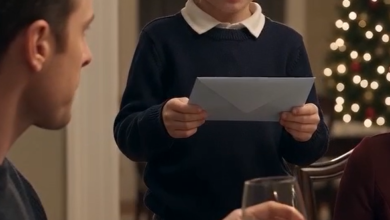
His name was on the front. On the back, Marcus had written Whenever you wear this. Eli sat on the side steps and opened it with his thumbnail.
There was no date. His father had written that he hoped Eli would get the sleeves taken up if they bothered him. Then he’d crossed out if they bother you and written if you want to. Eli ran his thumb over the two versions.
A second page was folded inside. It had the familiar chorus across the top and a blank space where the next verse should go. Under it, Marcus had written down something Eli used to ask when he was six and his father worked late.
Can we leave the door open till everybody’s home?
Below that, in smaller writing, was one last line.
The school has my verse, Eli. I’ve been waiting to hear what you’d do with yours.
If Eli’s story stayed with you, follow our page for more true-to-life stories about the things people leave behind for us to find.