After Fifteen Years in Prison, I Found My Lost Love Serving Coffee—Then Her Daughter Called My Most Faithful Visitor Dad, and Everything He Told Me Began to Unravel
Owen stopped beside the counter with his hand still raised in greeting.
For fifteen years, that hand had waved at me across a prison visiting room.
Now June leaned against his shoulder.
“Dad, you know him?”
“Old friend.”
He said it easily.
I couldn’t remember how to move my mouth.
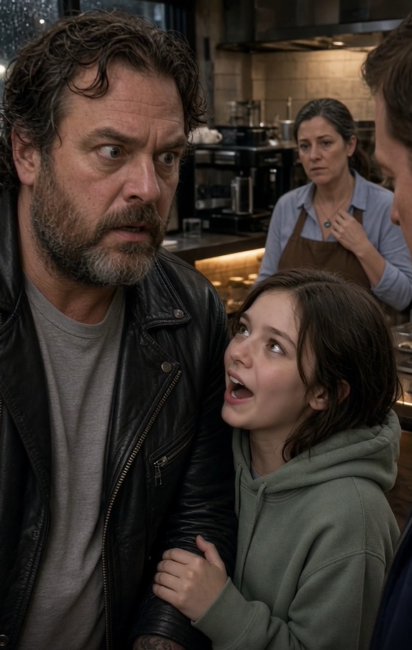
Claire knelt behind the counter, gathering pieces of the cup she dropped. Her apron brushed the coffee. She kept reaching for the same piece without picking it up.
I wanted to help.
I wanted to leave.
Mostly, I wanted someone to tell me the room had made a mistake.
Owen looked at my leather jacket.
“Duke get the bike running?”
I nodded.
My first personal stop after release appointments. A borrowed helmet. My old Harley, kept alive by a man who never told me he expected payment.
I came to the truck stop outside Terre Haute because Claire once said yes in the third booth from the window.
I hadn’t expected her to be there.
Owen had told me she moved away.
He had told me she married somebody reliable.
He hadn’t mentioned himself.
I remembered him arriving one winter with snow melting on his cuffs, apologizing because the drive took longer than usual. I had thanked him for coming. Now I wondered whose breakfast he had left on the kitchen table, and whether June asked where he went.
June looked between us.
“What old friend?”
“Garage days,” Owen said.
Claire finally stood.
There was a little gray in her dark hair now. She was forty-four. I knew because I had counted every birthday I couldn’t write to her.
“June, get the mop.”
The girl hesitated, then went.
Owen lowered his voice.
“We should talk outside.”
I stayed where I was.
“How old is she?”
He looked toward the hallway.
“Fourteen.”
I counted backward.
Then did it again.
Fifteen years inside. Fourteen years of a child growing up outside. There was room between those numbers for the last summer Claire and I had together.
There was also room for me to invent something because I needed those years to mean less.
Eyes weren’t a test.
A familiar tilt of the head wasn’t evidence.
I knew how wanting could turn a resemblance into a certainty.
On the wall behind June, a photograph showed her holding a cake with fourteen candles. Owen stood beside her. Claire stood on the other side. My friend had carried that whole life out of the visiting room every time he told me there was nothing new.
Owen put a folded bill on the counter.
“Let’s not make her mother clean up two messes.”
I looked at him.
He smiled, but the sentence stayed cold.
I asked Claire whether she wanted me to leave.
“No,” she said.
It came out so quietly I nearly missed it.
Owen’s smile changed.
June returned carrying the mop. Her eyes were gray-green, with a wedge of brown in the right iris.
Like mine.
She looked directly at me.
“Did you just get out of prison?”
I nodded.
“Did my dad know you there?”
Owen answered before I could.
“I tried to help him.”
He had helped.
Thirty-five dollars on my account when my boots split. Visits at Christmas. News about people who stopped writing.
I had thought his testimony was a terrible mistake.
I hadn’t known he needed me to keep believing that.
Claire placed a clean cup in front of me.
Her hand shook.
What else had Owen brought through those visiting-room doors besides a story I was supposed to live inside?
The booth had been green in 2011.
Now it was red, and somebody had repaired the seat with black tape.
I remembered Claire standing beside it at the end of her shift, counting tips while I tried to propose without dropping the ring.
It wasn’t a proper ring.
A blue-painted washer from the garage, polished smooth, with one notch where the drill slipped.
“Until I can afford the real thing.”
She put it on a chain.
“This one fits.”
Outside, my pickup’s driver window refused to move.
It had been fastened shut after a break-in. I was too broke to replace the damaged mechanism.
Claire tapped the glass and made me open the whole door for a goodbye kiss.
“Very grand,” she said.
I bowed.
She laughed.
That was three weeks before the arrest.
The memory lasted less than a minute. I kept my eyes on the present booth until it stopped pulling me backward.
June sat opposite me after Claire asked whether she wanted to.
Owen had gone outside to take a call.
“I don’t have to stay,” I told her.
“I know.”
She studied my right eye.
“Does yours look brown in photographs too?”
“Sometimes.”
“Mine ruins the flash.”
I laughed.
Then stopped, as if I had taken something without permission.
Claire brought water.
She didn’t sit.
I asked June about school because it was the only ordinary question I could find.
She liked biology. Hated running laps. Wanted to know whether a motorcycle was harder to steer than a bicycle.
“A lot heavier when you park it badly.”
She smiled.
A small thing.
Enough to make me afraid of losing it.
Then she asked why I had come there.
“I remembered the coffee.”
“My mom says it’s terrible.”
“Your mom used to say that.”
Claire’s hand tightened around the pitcher.
June noticed.
She glanced at the cup, then at the empty place beneath her mother’s collar where a chain disappeared. I could almost see her sorting familiar things into unfamiliar positions. The stranger wasn’t the only person in the room learning that somebody had left important pieces out.
She was fourteen, not furniture.
“Did you two know each other too?”
“Yes,” Claire said.
The word stood alone.
Owen returned before the next one arrived.
He placed a hand on the back of June’s chair.
“Your mother’s shift is nearly over.”
It wasn’t.
I could see the schedule behind the register.
But I didn’t say so.
Claire asked June to wait by the office. Then she took the seat across from me.
Owen remained standing.
I asked whether she had ever received my letters.
She looked at him.
He looked at me.
I knew the shape of the answer before anybody spoke.
“He said you didn’t want me writing,” Claire said.
“Who said?”
Owen exhaled through his nose.
“Ray, this is more complicated than you’re making it.”
I hadn’t made it anything yet.
Claire touched the chain beneath her collar.
Something blue showed between her fingers.
Fifteen years, and she had kept the washer.
What had she kept believing because the man beside her delivered both sides of every conversation?
Owen offered to meet with a lawyer.
That was his first good move.
His second was producing a letter I had actually written.
I recognized the cramped handwriting before Claire finished reading it.
Don’t put your life on hold for me.
I wrote those words three months after sentencing. I was thirty-three, facing fifteen years, and convinced the only decent thing left was to stop making Claire wait.
I hadn’t known she was pregnant.
Owen had.
But he showed us only the page that made his version sound reasonable.
“You asked me to look after her,” he said.
I had written that too.
Not marry her.
Not tell her I didn’t want letters.
Not visit me for years without mentioning a child.
Still, real words are useful cover for a lie.
For the first time that afternoon, I could see how Claire had believed him.
Then he made another offer.
He would speak to my new attorney about the robbery case.
“I told them it looked like your truck,” he said. “They made it sound more certain.”
I remembered the trial.
Owen saw me near the payroll depot.
Owen recognized my jacket.
Owen described a cash bag.
My attorney challenged his confidence, not his motive. There was other evidence, including cash recovered from my pickup.
I had believed my friend was frightened and wrong.
For years, he had agreed that frightened and wrong were exactly what happened.
Now he seemed ready to help correct it.
Duke drove me to my appointment the following morning. I wasn’t steady enough to ride.
My lawyer, Priya Sen, had agreed months earlier to review the conviction after a referral from a prisoner-assistance volunteer.
She wasn’t promising miracles.
She wanted records.
She also wanted to know what I remembered independently, before Owen’s new explanation changed it. I wrote everything down in a cheap notebook. Places where I wasn’t sure stayed blank. After years of needing somebody to believe me, admitting uncertainty felt like taking my own side badly.
Owen sent a signed statement saying investigators had pushed him to identify me more firmly than he could.
The detective who took his original statement had since retired.
Suspicion moved toward him.
So did my anger.
If Owen had been pressured, maybe his visits were an attempt to carry a mistake he couldn’t undo.
Maybe marrying Claire had come later.
Maybe I needed him guilty because otherwise I had to face how much of my life had happened without me.
But the sealed envelope changed something the letter couldn’t explain. Someone had preserved it instead of returning it. Claire recognized the way her own name curled in the corner. She said she had given it to Owen before their first date.
Priya let me finish.
Then she asked for the complete letter.
Not the page Owen brought.
All of it.
I didn’t have a copy.
He did.
He said he couldn’t find the rest.
Claire found something instead.
A returned envelope in a box she had never opened after moving into Owen’s house. Inside was the pregnancy letter she thought he delivered to me.
Still sealed.
The address on the front wasn’t mine.
It wasn’t even the right prison.
If Owen had merely misunderstood my request, who had written an address that made sure her answer never reached me?
Claire took the envelope to Priya herself.
I didn’t go with her.
By then, June had asked whether we were talking about her when we lowered our voices.
Claire told her yes.
And that she deserved answers from adults who had checked them first.
I respected that more than any promise she could have made me.
With Claire’s consent and June’s agreement, a properly arranged paternity test followed. We didn’t compare eyes over a diner table and call it settled.
Waiting for the result was worse than waiting for a prison count.
I told Claire I wouldn’t tell anyone else what we were checking. June had school, friends, and a life I hadn’t earned the right to announce. Even a truth that belonged partly to me could arrive in a way that hurt her.
There was no schedule for my mind to follow.
Duke made me help replace brake pads because he said staring at a phone wasn’t a trade.
The result confirmed what Claire already believed.
June was my daughter.
I sat on an upturned bucket until Duke stopped pretending not to watch me.
Then I asked whether he had ever changed a bicycle tire.
He looked at the motorcycles around us.
I started laughing.
It went wrong halfway through.
He stood beside me until it passed.
The financial records took longer.
Priya found the old business filings for the garage Owen and I owned together. After my conviction, Owen acquired my share through documents I was told would keep the business operating and preserve money for restitution.
He later sold the property.
The sale was public.
The accounting he sent me wasn’t.
Claire found those pages among files Owen kept in a locked cabinet. She didn’t break the lock. They were in a household document folder she already had authority to use.
The figures didn’t match the explanation he had given her either.
My half of the garage had helped pay for their first house.
Claire sat very still when Priya told her.
I looked at the floor so she wouldn’t have to watch my face.
Then Priya found the vehicle inventory from the robbery investigation.
Driver’s window secured shut.
A repair estimate supported it, dated before the crime.
I remembered Claire tapping the glass for her kiss.
At trial, Owen had said I lowered that window and took the payroll bag from him before driving away from the depot.
I had protested the window detail.
My lawyer called it a minor discrepancy.
The truck was released and sold before anybody examined it for the defense.
Now Priya placed the transcript beside the inventory.
The repair estimate came from records retained by the shop that serviced our fleet. Its former owner remembered the truck because I couldn’t afford the full repair. Priya asked him for documents before asking him to trust a memory from fifteen years earlier.
A minor discrepancy had a date.
A document.
And a man who had spent fifteen years explaining why we shouldn’t take his words too literally.
Then Claire called to say Owen had discovered she was sharing records.
June’s phone had been taken away.
Why was a man eager to correct an old mistake suddenly deciding who our daughter could speak to?
The first call went to my parole officer.
Not from me.
Owen reported that I had appeared at his wife’s workplace and become fixated on their minor child.
Their child.
He used those words while knowing about the test.
I learned the substance of the complaint when my officer asked me to come in.
I brought Priya’s contact information.
I brought messages showing Claire invited the second conversation.
I didn’t bring anger, though I had plenty.
Owen knew what a report like that could do.
He had watched me learn to speak carefully for fifteen years.
His account contained enough true details to require attention: my sentence, the unexpected visit, the resemblance I had noticed. The lie lived in what he left out. This time, I had an attorney who insisted that the rest of the page mattered too.
My officer documented the information and told me to avoid direct contact with Owen. Priya coordinated any necessary communication.
I agreed.
Then I sat in Duke’s truck and gripped the seat belt until my hand hurt.
“What if he takes her somewhere?”
“Then we call the people handling it,” Duke said.
I hated how sensible he sounded.
He had spent fifteen years maintaining my motorcycle without promising he’d ever see me ride it. Patience wasn’t something he had discovered that morning. I looked at the cracked dash and let him keep talking until I could hear the difference between waiting and giving up.
Claire moved with June to her sister’s apartment while getting legal advice. The diner manager adjusted her shifts and asked staff not to disclose her schedule.
There was no motorcycle convoy.
June didn’t need twelve men announcing her life to the parking lot.
She needed to get to school.
Owen told mutual friends that prison had changed me.
It had.
I checked door handles twice.
I ate too quickly.
I sometimes stood when somebody with keys entered a room.
That didn’t make the rest of his story true.
One afternoon, June called from Claire’s phone.
She wanted to know whether I still intended to teach her about changing a tire.
“I do.”
“My dad says you’re trying to buy me.”
The word dad landed harder than I expected.
I looked at the grease beneath my thumbnail.
“I’m not buying anything.”
“I know.”
A pause.
“Do I have to stop calling him that?”
“No.”
It cost me something to say it.
It was still her word.
That evening, Owen sent me a photograph from the prison visiting room.
Him on one side of the little table.
Me on the other.
Under it, he wrote: Remember who showed up.
I forwarded it to Priya.
Then I turned off the phone.
An hour later, Claire arrived at Duke’s garage without June.
She stood beneath the fluorescent light, twisting the blue washer on its chain.
“I need to tell you why I didn’t fight harder.”
I thought she meant the letters.
I thought I already knew how much worse the story could get.
Then she said she had signed a statement during the original investigation.
Not a statement I remembered hearing at trial.
What had the woman who kept my ring put her name beneath while I was waiting to come home?
Claire had signed an account of where Owen was that night.
She said he had stayed with her.
He hadn’t.
She knew that when she signed.
I sat down on the garage step.
There were sounds from the street, a loose exhaust shield rattling on a passing car, somebody calling a dog.
Inside, nobody moved.
“Why?”
“He told me you were already in trouble. That if they thought he was involved, he’d lose the garage too.”
I watched her fingers working the washer around its chain.
She had just learned she was pregnant.
Her father was ill. Her rent was late. Owen brought groceries and an explanation that made one false sentence sound like a way to keep three people safe.
“He said he was helping you.”
“You knew he wasn’t with you.”
“Yes.”
That answer mattered.
She didn’t put a frightened woman where her own choice had been.
That didn’t make it easier to hear. I kept remembering the letters I wrote when I still believed everyone outside was trying as hard as I was. Some nights I had apologized for needing stamps. Across from me stood somebody who knew how little that was.
The statement hadn’t become a centerpiece of my trial. Priya later found it buried among the investigation materials. It had helped investigators stop looking closely at Owen before charges were filed.
Claire didn’t know everything he had done.
But she had helped make the space where he could do it.
“Why keep quiet after?”
Her face changed.
“Because every year I was quieter, I had more to lose.”
A marriage.
A home.
A daughter who believed one man had always been there and the other had chosen not to be.
I wanted a version where she had only been deceived.
I wasn’t getting one.
Priya arranged for Claire to obtain separate counsel before giving a fuller account. There were questions about consequences, reliability, and why she was speaking now.
Those questions were fair.
Claire handed over the calendar she had used to reconstruct the week. There were appointments, shifts, and a doctor’s number in the margin. She didn’t underline the things that made her look better. Watching her leave the pages as they were didn’t restore my trust, but I noticed.
I didn’t enjoy them.
I didn’t ask anyone to stop asking.
June learned a careful version from Claire with a counselor’s help. I wasn’t there for the first conversation.
Afterward, she asked to see me at the diner.
We sat in the third booth.
She studied the repaired seat.
“Did you know about me?”
“No.”
“Would you have wanted to?”
I looked at her hands because her face was too much.
“Every day.”
She nodded once.
Then she asked why her mother didn’t tell the truth sooner.
“I think you need to ask her.”
“Everybody keeps saying that.”
“I know.”
She watched the counter.
“Do you still love her?”
I didn’t have a sentence ready.
That was the first honest thing I could offer.
“I don’t know what to call what I feel.”
June seemed to accept that more easily than the adults did.
When Claire returned, our daughter didn’t reach for her immediately.
She didn’t move away either.
Priya called the following week.
A hearing had been scheduled on the petition challenging my conviction.
Owen had agreed to testify.
Would the man who taught me to depend on his visits finally answer questions he couldn’t control with a smile?
The hearing room smelled like damp coats.
Duke sat behind me in a clean shirt that didn’t quite hide the collar of his riding vest.
June stayed at school.
That was her choice.
She said she wanted someone to tell her afterward without using grown-up words to make it smaller.
Owen arrived with an attorney.
He didn’t look at Claire.
His new account was simple: the original investigators had pressured him, but he hadn’t deliberately lied. He couldn’t be blamed for how uncertain memories hardened into a conviction.
Priya asked about the pickup.
He said he remembered it clearly.
The driver.
The jacket.
The bag.
She took him through his earlier sworn testimony.
“You said Mr. Danner lowered the driver’s window.”
“That’s what I remember.”
“You accepted that his window was secured shut before the robbery?”
“I heard that’s what he’s saying now.”
Priya showed him the inventory.
Not my memory.
The police department’s own record.
Then the repair estimate.
He looked at the pages without moving his head.
“There could’ve been a mistake.”
She asked whether he was changing his account.
He said he was trying to be accurate.
So she asked where he had placed the bag.
“On the passenger seat.”
The clerk kept typing.
My foot stopped moving beneath the table.
I wanted to stand. The impulse moved through my knees before it reached my head. Duke touched the back of my chair, once. Not holding me down. Reminding me there was somebody behind me who could wait through the answer without asking me to make it easier.
At trial, Owen said he handed me the bag through the driver’s window.
Now he was describing putting it inside.
Priya let the answer stay there.
“Was Mr. Danner in the truck?”
Owen looked at his attorney.
“I don’t remember every second.”
“You remembered the window a moment ago.”
His chair creaked.
The judge asked him to answer the question.
“No.”
One word.
Not everything.
Enough to change the shape of the room.
He tried to explain that he had been returning property. That the cash hadn’t meant what the investigators thought. That the detectives already suspected me.
His attempts to shrink one admission made other parts of his old testimony harder to keep.
Priya asked when he had decided to call the unoccupied truck an encounter with me.
His attorney requested a pause.
I looked at Claire.
Her face was wet, but she wasn’t watching Owen.
She was watching me.
I didn’t know what she wanted to find there.
The hearing did not end with handcuffs or a judge declaring every part of my life restored.
There were additional witnesses.
Documents to authenticate.
Questions about the money, the garage transfer, and Claire’s false alibi.
The old case had never rested on Owen alone.
Priya also presented records challenging how the cash had been attributed to me, along with the business documents and Claire’s account. The hearing continued across more than one date. I learned to bring lunch. Learning whether my life could change involved a surprising amount of waiting beside a vending machine.
Undoing it required more than proving he was a liar.
But on the drive back, Duke pulled into a gas station and turned off the truck.
He waited.
I stared through the windshield.
For fifteen years, Owen brought me coffee from a vending machine and told me he wished things were different.
Now someone had finally asked what he did before things became that way.
If the court gave me my name back, would I know how to carry it outside a prison visiting room?
The court set aside the conviction.
Later, after further review, the remaining case against me was dismissed.
Those were separate days.
I remember them separately because people kept trying to turn them into one photograph.
On the first, I called June.
On the second, I sat alone for an hour and couldn’t decide what to eat.
An investigation into Owen followed. His false testimony, the handling of the money, and the business records became matters he could no longer explain to me across a plastic table.
Claire gave evidence about her statement.
Owen’s new false sworn account and his efforts to interfere with the review brought consequences of their own. Later, he entered a plea in the case that followed. I heard about it through Priya. I didn’t ask to visit him. I couldn’t imagine either of us finding an honest use for that table.
She didn’t receive a clean version of the past in exchange.
Neither did I.
I had been angry before prison. Proud. Capable of making love feel like a promise everybody else had to keep.
Being wrongfully convicted didn’t make every earlier version of me easy to live with.
A counselor helped me say that without turning it into an excuse for what happened.
Claire and I didn’t start where we stopped.
We didn’t know whether that was a place we could reach.
Sometimes we drank coffee.
Sometimes we discussed June and nothing else.
She kept her own apartment.
I rented a small place near Duke’s garage and learned that shopping for one person involved more decisions than I remembered.
The refrigerator hummed all night. Nobody told me when to turn out the light. For the first week, I left a lamp on in the kitchen and slept badly anyway. I started keeping appointments because ordinary days needed somewhere to begin, even when I couldn’t feel glad about them.
June visited gradually.
She wanted to see the motorcycle.
Then the tools.
Then whether I really owned only two plates.
“I thought that was enough.”
“What if somebody comes over?”
“Apparently we eat in shifts.”
She laughed.
The sound did something to the room I couldn’t have managed with paint.
I taught her to change a bicycle tube.
She taught me how to stop my phone from shouting directions after I reached the address.
For her birthday, I bought a third plate.
She rolled her eyes.
Then she put it in the cupboard herself.
At the truck stop, the third booth stayed red.
The tape kept lifting at one corner.
One Sunday, Claire sat opposite me while June finished a school project beside the window.
She took off the chain.
The blue washer lay between us.
“I kept this,” she said.
“I know.”
“I didn’t keep the rest of my promise.”
I looked at the notch in the edge.
“No.”
She nodded.
She hadn’t come for an easier answer.
After a while, June asked what it was.
I told her it was the first ring I could afford.
She turned it in the light.
Then she asked whether we wanted coffee.
Claire smiled.
“It’s terrible.”
“I remember,” I said.
June returned with three cups, concentrating so hard she forgot to pretend she wasn’t proud.
She set mine down first.
“Careful, Dad. It’s hot.”
I put both hands around the cup.
Outside, my Harley cooled in the rain.
What ordinary word would she give me next?