Part 2: I Filmed A Biker Yelling At A Homeless Woman — Then I Learned Why
My name is Erin Walker, and before that morning, I thought I was the kind of person who noticed things.
I worked at a nonprofit two blocks from Gallatin Pike. We helped families with rent assistance, food vouchers, bus passes, and the kind of paperwork that makes already tired people feel smaller. I knew what homelessness looked like. I knew how addiction could hollow out a person. I knew not to judge from a sidewalk.
At least, I thought I knew.
The biker’s name was Cole Harlan.
I learned it from the comments first, which is a terrible way to learn anything about a human being. Someone tagged him. Someone else said he belonged to a local riding club called the Iron Shepherds. Another person wrote, “That man helped bury my brother when nobody else showed up.” Another wrote, “He fixes bikes behind the old tire shop on Trinity Lane. He’s rough but he ain’t cruel.”
I did not believe them at first.
Because my video looked bad.
Cole looked bad.
He was the kind of man people build stories around without asking him. Six-foot-three. Thick through the chest. White, weathered skin. Gray-black beard down to his sternum. Tattoos from wrists to shoulders. One arm had an old cross, one had a snake, one had names half-covered by newer ink. His black cut had road patches, memorial patches, and a small patch inside the left flap that I only noticed later.
A tiny red coffee cup stitched in messy thread.
That was the detail that did not fit.
A man with skull rings and scarred knuckles had a hand-sewn coffee cup hidden inside his vest.
The Iron Shepherds were not an outlaw club. They were not saints either. They were roofers, mechanics, veterans, welders, recovering drunks, divorced fathers, widowers, and one retired nurse named Gloria who rode a purple Harley and scared everybody worse than the men did.
They met behind a garage off Trinity Lane, under a tin roof that pinged loud when rain hit it. Their clubhouse smelled like oil, leather, burnt coffee, floor cleaner, and whatever stew Gloria kept in a slow cooker.
Cole was their sergeant-at-arms, which sounded threatening until I learned what he actually did.
He checked on members who stopped answering calls.
He picked up drunk brothers and took their keys without making a show of it.
He fixed a single mother’s minivan after her husband died.
He sat outside courtrooms with men trying to get custody of their kids back.
He did not talk much.
When he did, people listened.
“He’s loud when he has to be,” Gloria told me later. “Quiet when quiet will do.”
That sentence stayed with me.
Because on the sidewalk that morning, Cole had been loud enough to make strangers afraid.
But the people who knew him were not surprised by the volume.
They were surprised by the name.
Rachel.
The first time I heard it, I thought it was just a woman from his past. An old friend. A sister. Maybe someone from the recovery meetings the club quietly supported.
I did not know she had once been his wife.
I did not know he had been looking for her for five years.
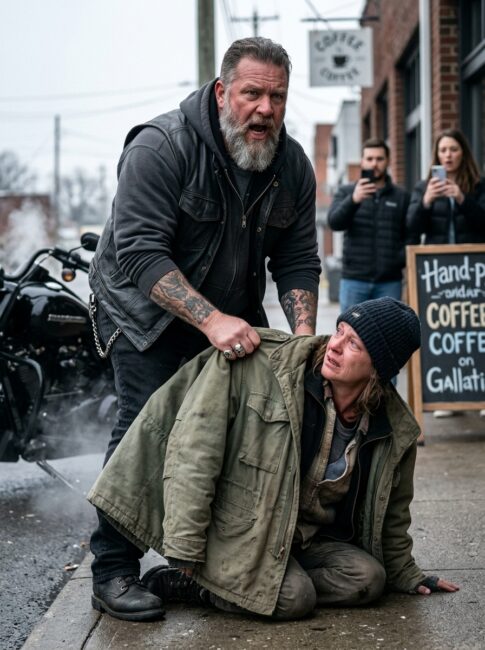
The first version of the story was the one everybody saw.
My clip was twenty-nine seconds long.
It showed Cole grabbing Rachel’s coat and pulling her up. It showed him yelling. It showed Rachel flinching. It showed two men stepping back instead of stepping in. It showed me breathing too hard behind the phone.
It did not show his hands open after he lifted her.
It did not show him catching her when her knees buckled.
It did not show his face after he said her name.
That was the thing I missed.
His face was not rage.
It was recognition so painful it came out wrong.
Inside the coffee shop, everything got quieter, not louder. Cole brought Rachel through the door with one arm around her shoulders, not gripping her now, holding her up. The barista looked ready to call police until Rachel whispered, “Don’t. I know him.”
Cole put her in the booth farthest from the windows.
Then he took off his leather cut and laid it over her shoulders.
A man like that without his vest looked strangely unfinished. Like he had put down his armor.
He went to the counter and ordered everything too fast.
“Egg sandwich. Oatmeal. Coffee. Water. Whatever soup you got. And no, not in to-go cups.”
His voice was gravel, but his hands were shaking when he pulled cash from his wallet.
The barista asked, “Is she okay?”
Cole looked back at Rachel.
“No,” he said. “But she’s here.”
I had followed them in, still holding my phone. I was not recording anymore, but I had already posted the clip. I could feel it buzzing in my pocket. Likes. Comments. Shares. Anger spreading faster than truth ever does.
Rachel sat with Cole’s vest around her shoulders, staring at the table like it might disappear.
She was not crying yet.
Cole sat across from her, huge hands flat on the table where she could see them.
“Six months?” he asked.
Rachel nodded.
“Sober six months?”
She nodded again.
His jaw tightened. His eyes got wet, but he did not cry. Men like Cole know how to swallow tears until they become something harder.
“Why didn’t you call?” he asked.
Rachel laughed once. Not because anything was funny.
“From where, Cole?”
He closed his mouth.
That one hit him.
The food came. Rachel looked at it like she needed permission. Cole pushed the plate closer but did not touch her.
“Eat.”
She shook her head.
“Rachel.”
“I can’t pay you back.”
He leaned forward.
“Eat.”
She picked up the sandwich with both hands and took a bite so small it broke something in the room. The barista turned away. A man near the door stopped pretending to read.
Cole made three calls.
The first was to someone named Gloria.
“Found her,” he said. Then nothing for a long second. “Alive. Six months clean. No place.”
The second was to a rehab clinic outside Hendersonville. He did not ask if they had space. He asked who was working intake and whether they still owed him a favor from “the Morgan kid.”
The third call was to a landlord named Pete who owned apartments above a pawn shop near Madison.
“No, not next week,” Cole said. “Today. I’ll bring cash.”
Rachel finally cried then.
Not loud.
Just one hand over her mouth, shoulders folding under that heavy leather vest.
Cole looked like he wanted to reach across the table.
He did not.
That, more than anything, made me understand he had loved her.
Because he knew love did not give him the right to touch her.
Rachel had been Cole’s wife for nineteen years.
That was the twist none of us saw on the sidewalk.
They married young, back when Cole was still drinking too much and Rachel worked nights at a Waffle House near Lebanon. He rode then, but not like he rode later. Back then the bike was escape. Afterward, it became discipline. That was how Gloria put it.
Rachel had a laugh people remembered. Loud, bright, a little smoky. She kept a red coffee cup patch sewn inside Cole’s vest because when they were broke, their dates were gas station coffee and sitting on the curb watching trucks pass.
“Cheapest romance in Tennessee,” she used to say.
The patch was her joke.
Then came pain pills after a work injury.
Then stronger things.
Then lies.
Then money missing.
Then three attempts at treatment.
Cole stayed through more than most people understood and less than Rachel needed. Both things were true. Addiction does not make clean heroes and villains. It makes everyone tired. It makes love feel like a room with no doors.
The final year got ugly.
Not violent. Never that, Rachel told me later. But loud. Bitter. Sleepless. Cole checking drawers. Rachel disappearing for days. Bills unpaid. Calls from hospitals. Calls from police stations. Calls from strangers who knew too much.
The divorce happened after Rachel sold her wedding ring.
Cole told people he was done.
Then he spent five years looking for her.
That was the second twist.
He checked shelters in Nashville, Murfreesboro, Knoxville, Chattanooga. He rode his Harley through winter rain to follow rumors that went nowhere. He carried an old photo in his saddlebag, the edges soft from being handled. He asked nurses. He asked outreach workers. He asked people under bridges, not like a cop, not like a savior, just like a man with a picture and a question.
“Seen her?”
Most had not.
Some lied.
One stole his wallet.
He kept looking.
The Iron Shepherds helped until they could not afford to keep taking days off work. That became the brotherhood test. Not whether they loved Cole. They did. But whether they could keep chasing a ghost when rent, jobs, wives, kids, and old injuries called them home.
One night at the clubhouse, a member named Duke finally said, “Brother, she don’t want found.”
Cole broke a coffee mug against the wall.
Then he swept it up himself.
For three months after that, the club split down the middle. Some thought they were enabling Cole’s grief. Others thought giving up was worse. Gloria settled it by putting a red coffee can on the clubhouse table.
“Rachel Fund,” she said.
Duke cursed, then dropped the first twenty in.
That was brotherhood. Not agreement. Not comfort.
Staying at the table after the mug breaks.
After my video went viral, I got what people always think they want online.
Attention.
Thousands of comments. People thanking me for exposing him. People demanding his arrest. People calling Rachel helpless, though none of them knew her name. People making Cole into a monster from twenty-nine seconds of sidewalk.
Then the other comments came.
The widow whose roof Cole fixed after a tornado.
The veteran Cole drove to detox and sat beside for fourteen hours.
The nurse who said he paid for motel rooms when shelters were full.
The woman who said, “That’s Rachel. He’s been looking for her since before my son was born.”
I felt sick.
By then, Cole had taken Rachel from the coffee shop to a clinic for evaluation. Not forced. Not dragged. He asked. She agreed. Gloria rode behind them in her truck because Rachel did not want to sit on the Harley. Too many memories. Too much noise.
At the clinic, Cole stayed outside.
That surprised me.
I had followed with Gloria after confessing that I was the one who posted the video. She looked at me for a long time and said, “Then you better be the one to post the truth.”
Cole did not go inside with Rachel because Rachel asked him not to.
“She said she can walk in on her own,” Gloria said.
So he let her.
That was love too.
Waiting in the parking lot with the engine off.
The Harley clicked as it cooled. His leather creaked when he sat on the curb. He smelled like gasoline, coffee, and cold sweat. His hands were clasped between his knees, tattooed fingers locked so tight the knuckles went pale.
I said, “I’m sorry.”
He did not look at me.
“For what?”
“The video.”
He stared at the clinic door.
“You saw what you saw.”
“I didn’t see all of it.”
“No one ever does.”
That was all he gave me.
Rachel came out after two hours with paperwork, a clinic bracelet, and Gloria’s arm around her. She had a plan. Not a miracle. A plan. Appointments. Counseling. A sober living referral if the apartment did not work out. A doctor. A case manager.
Cole stood.
Rachel handed him his vest.
He took it, but slowly, like accepting something fragile.
“I’m not coming back to you,” she said.
I remember that sentence because everyone around them seemed to stop breathing.
Cole nodded.
“I know.”
“I have someone,” she said. “Not like that yet. Maybe. He’s good. He knows the clean version of me.”
Cole’s face changed. Just a little.
A man can spend five years searching for someone and still not get the ending his heart rehearsed.
But he did not make her carry that.
“Good,” he said.
Rachel cried then.
“I’m sorry.”
Cole looked down at his boots.
“Me too.”
The apartment was small. One room above a pawn shop, with old carpet, a window facing a brick wall, and a heater that knocked like someone trapped inside it. To Rachel, it looked like a castle.
Cole paid the deposit and first month in cash.
Duke and two other Iron Shepherds showed up with a mattress, a microwave, towels, and a coffee maker.
Duke would not look at Rachel at first. He had been one of the brothers who wanted Cole to stop searching.
Then Rachel said, “Thank you.”
Duke’s face twisted.
He carried the mattress upstairs without a word.
The coffee maker went on the counter.
Cole stood in the doorway and looked at it.
Rachel noticed.
“The red cup patch,” she said.
He touched the inside of his vest.
“Still there.”
She smiled, barely.
“You always were sentimental for a man who scared waiters.”
“Only bad waiters.”
That was the first time I heard her laugh.
Small. Rusted. Alive.
That night, I deleted my first post.
Then I wrote a new one.
“I was wrong,” I began. “I thought I saw violence. I didn’t know I was watching love arrive loudly.”
Rachel did not become perfect after that.
That matters.
Viral stories like clean endings. Before and after. Broken and healed. Lost and found. But real healing has paperwork. Bad mornings. Missed buses. Panic in grocery stores. Apologies that do not fix everything. Six months clean becoming seven. Then eight. Then one year. Not with fireworks. With rent receipts and counseling cards and a key that turns in a door every night.
Cole did not rescue her once and disappear into applause.
He also did not become her husband again.
Every Tuesday, he rode to the apartment building and left a bag of groceries outside her door. Not fancy. Eggs. Bread. Coffee. Soup. Fruit when he remembered fruit existed. Sometimes he knocked. Sometimes he did not.
If Rachel’s boyfriend was there, Cole nodded and left.
No drama.
No claiming old territory.
No speeches about who loved her first.
Sometimes Rachel came downstairs and they drank gas station coffee on the curb like they had when they were young, except now they talked about normal things. Weather. Rent. The coffee shop. Gloria’s terrible stew. Duke pretending he hated cats after adopting one behind the garage.
Once, I asked Rachel why Cole had yelled that morning.
She looked out toward Gallatin Pike, where traffic kept moving like it had somewhere better to be.
“Because I would’ve run,” she said. “If he said my name soft, I would’ve vanished.”
Later, I asked Cole the same thing.
He was tightening a loose mirror on his Road King outside the diner. The engine was off, but the metal still ticked with heat. His cut hung open, and I could see the red coffee cup patch inside.
“Why yell?” I asked.
He kept turning the wrench.
“Because she was alive.”
“That’s not an answer.”
He looked at me then.
It was the kind of look that made me understand why people feared him and why some people trusted him with their worst day.
“I yelled because she could still hear me,” he said. “Soft didn’t reach her five years ago.”
Then he went back to the mirror.
The Iron Shepherds changed after Rachel too.
Not softer exactly. More honest.
The Rachel Fund stayed. They renamed it the Loud Love Fund, which Cole hated and everyone else loved because annoying him became a club hobby. It paid for motel rooms, clinic rides, phone cards, work boots, and once a bus ticket for a man trying to get home to his sister in Kentucky.
No cameras.
That was Cole’s rule.
If anyone posted a good deed for likes, Gloria made them clean the clubhouse bathroom for a month.
I kept the corrected post up.
The comments changed.
One stranger wrote, “I judged him.”
Another wrote, “I did too.”
And I wrote the only thing I could.
“Same.”
Two years later, I saw Rachel walk into the same coffee shop on Gallatin Pike.
Not the same woman from the sidewalk.
Not a new woman either.
Rachel.
Hair clean and tied back. Work shoes. Blue jacket. A little tired around the eyes. She ordered coffee and paid with her own card. The barista knew her name.
Cole was outside by the curb, sitting on his Harley, one boot planted, both tattooed hands resting on the bars. He looked older. Beard more gray. Scar over his eyebrow pale in the morning sun. Still big. Still scary to anyone who only gave him one glance.
Rachel came out carrying two coffees.
She handed him one.
He took it.
They did not hug. They did not kiss. They did not pretend the past had been gentle. Her boyfriend pulled up a minute later in a dented Ford, waved at Cole, and Cole lifted two fingers back.
Then Rachel walked to the Ford.
Cole watched until she got in safe.
Only then did he start the Harley.
The V-twin cracked the morning open. Coffee shop windows trembled. A woman at the door flinched, then smiled when she recognized him.
Cole looked once at the sidewalk where he had pulled Rachel to her feet and where I had mistaken urgency for cruelty.
Then he rode east toward the highway, leather creaking, engine low, red coffee cup patch hidden against his chest.
Rachel did not look back.
She did not need to.
She had a door now.
She had a key.
She had a life loud enough to reach her.
Follow this page for more biker stories about the people behind the leather, the scars, and the engines.