Part 2: My Son Slept in the Biker Vest of the Father He Hated — Then He Found the Photograph
My name is Hannah Maddox.
Before prison, Ray was the loudest person in any room even when he was not speaking.
He stood six-foot-three and weighed around 240 pounds. Thick beard. Heavy shoulders. Full tattoo sleeves. Scarred knuckles from years of repairing motorcycles and making poor decisions with his temper when he was younger.
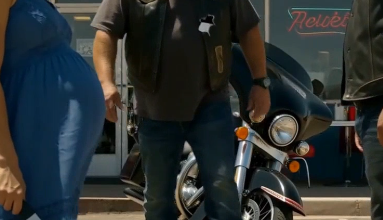
His Harley announced him before our front door opened.
The V-twin would roll down our street, settle into a low rumble, then cut off beneath the maple tree beside our driveway. After that came the smaller sounds: boots against porch boards, keys striking his belt loop, leather creaking as he bent to lift Caleb into his arms.
People saw Ray’s beard, the patches, the motorcycles, and the men who rode beside him.
They decided they understood him.
I made the same mistake in a different direction.
I believed the gentle version of Ray could overpower the reckless one if I loved him hard enough.
For a while, the evidence seemed to support me.
Ray repaired motorcycles in a narrow garage near an old Route 66 diner. He refused to charge single mothers for basic repairs if the bike was their only transportation. He kept dog biscuits in a drawer for a stray mutt that slept behind the shop. Every December, his club delivered winter coats to a family shelter in black trash bags because Ray hated photographs of charity.
His brothers called him Grinder.
Not because he was violent.
Because he would stay beneath a motorcycle for six hours until he found the source of a noise nobody else could hear.
But there was another Ray.
The one who confused providing with proving something.
The one who could not admit when the garage was failing.
The one who accepted money from men his club had warned him about.
At first, he told himself he was only making introductions.
Then only moving packages.
Then only doing it until the bills were paid.
Each line became easier to cross after the last one disappeared behind him.
His club brothers noticed before I did.
Duke Carter, Ray’s oldest friend, confronted him inside the garage. Duke was a broad Black man with a shaved head, a gray beard, and a voice so calm it made lies sound childish.
“You stop now,” Duke told him.
Ray wiped his hands on a rag.
“You don’t know what you’re talking about.”
“I know exactly what I’m looking at.”
Ray told Duke to leave.
Duke did not.
Neither did Preacher, a narrow white biker with sunburned cheeks and a faded cut that smelled permanently of coffee and rain.
The argument ended with Ray throwing a wrench across the garage.
Not at anybody.
Just hard enough to make the metal strike the wall and clatter onto the floor.
Caleb was asleep at home.
I am grateful he never heard that sound.
The brothers gave Ray a choice.
Walk away from the drugs and accept help.
Or lose their patch.
Ray chose badly.
Three weeks later, police arrested him.
The club did not hire someone to hide evidence.
They did not invent a story.
They did not threaten witnesses.
They removed Ray’s patch before sentencing and told him the truth.
“Brotherhood is not helping you run from what you did,” Duke said. “It is making sure you face it.”
That was the first thing Caleb never knew.
The second was hidden inside the left chest pocket of the vest.
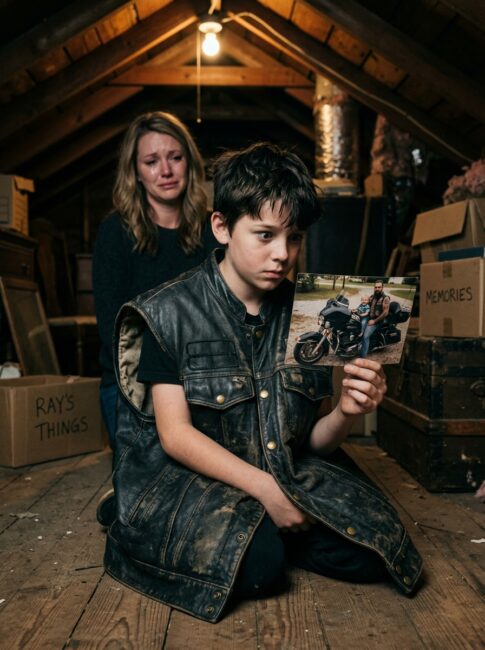
Sunday morning arrived cold and gray.
Caleb almost changed his mind three times.
The first time happened in our kitchen while he stared at a bowl of cereal he had not touched.
The second happened when we passed the Route 66 diner near Ray’s old garage. A line of motorcycles stood beneath the faded sign. Their engines had already gone quiet, but I recognized Duke’s bike and Preacher’s dark touring Harley.
The third happened in the prison parking lot.
Caleb remained in the passenger seat with the photograph clenched between both hands.
“I don’t know what to say,” he whispered.
“You don’t have to know yet.”
“What if he acts like nothing happened?”
“Then you tell him that is not acceptable.”
“What if he cries?”
I looked toward the concrete building beyond the windshield.
“Then he cries.”
Caleb wore Ray’s vest over a sweatshirt.
It still swallowed him.
I had suggested leaving it at home. He shook his head.
“No,” he said. “I need him to see it.”
Inside the visitation room, every sound felt too sharp.
Plastic chairs scraping the floor.
A vending machine humming near the wall.
Boots from a correctional officer crossing tile.
Children talking too loudly because silence frightened them.
When Ray entered, I almost did not recognize him.
He was thinner.
His beard had gone mostly gray. Prison had narrowed his face and slowed his walk. The tattoos remained, but the confidence people once mistook for strength had been stripped down to something quieter.
He saw Caleb.
Then he stopped.
His rough hands trembled at his sides.
Ray looked at the vest first.
Then at our son’s face.
He did not rush toward him.
He did not open his arms.
He understood that he had no right to ask Caleb to cross the room faster than he was ready.
Caleb sat.
Ray sat across from him.
For several seconds, nobody spoke.
Then Caleb placed the photograph on the table.
“You wrote this?”
Ray looked down.
His throat moved once.
“Yeah.”
“When?”
“The night before sentencing.”
“Why did you hide it?”
Ray rubbed his thumb against one scarred knuckle.
“Didn’t know how to give it to you.”
“That’s stupid.”
Ray nodded.
“Yeah.”
“You could have mailed it.”
“I could’ve.”
“You could have called more.”
“I should’ve.”
“You could have not done any of it.”
Ray’s eyes turned wet.
He did not look away.
“You’re right.”
Caleb expected an excuse.
I could see it in his face.
He had arrived prepared to fight a man who might blame money, bad friends, stress, or luck.
Ray gave him none of those exits.
“I chose wrong,” Ray said. “More than once. Nobody made me.”
Caleb stared at the tabletop.
His fingers moved toward the photograph but stopped before touching it.
“Did you choose drugs over us?”
Ray breathed in slowly.
“Yes.”
The word seemed to hit every wall in the room.
I wanted to interrupt.
To protect Caleb from the bluntness.
But Ray continued.
“I told myself I was doing it for you. That was a lie I liked because it made me feel less ashamed. Truth is, I got scared. I got proud. Then I got greedy.”
Caleb’s eyes filled.
Ray’s did too.
Neither cried yet.
Then Caleb reached inside the vest pocket.
His fingers found a loose section of lining.
He pulled gently.
A small folded piece of paper slipped onto the table.
I had never seen it before.
Ray looked at it and went completely still.
The paper was old.
Creased at the corners.
Soft from being unfolded and folded again.
Caleb opened it carefully.
The handwriting did not belong to Ray.
It belonged to Duke.
Grinder,
A brother is not somebody who tells you every choice is right. A brother is somebody who refuses to let your worst choice become your son’s whole life.
We will not cover for you. We will not lie for you. We will not carry messages you are too ashamed to send yourself.
But Hannah’s car will keep running. Caleb will have school shoes. The porch light will be fixed before winter. When you are ready to become honest, we will listen.
Until then, do the time. Tell the truth. Start there.
— Duke
Caleb read the letter twice.
Then he looked at me.
“Did they help us?”
I thought about the five years behind us.
The anonymous envelope that appeared when the water heater failed.
The new tire placed beside my car before I could afford one.
The grocery gift card inside our mailbox every December.
The porch rail repaired while Caleb and I were away at school and work.
I had suspected.
I had never asked.
Pride takes strange forms when your life has already been turned inside out.
Ray kept his eyes on the paper.
“Duke put that in the vest?” I asked.
Ray nodded.
“Before sentencing.”
“Why did you keep it?”
“Because he was right.”
His voice sounded rougher now.
“I read it every time I wanted to feel sorry for myself.”
Caleb traced one finger across Duke’s handwriting.
“Are they still your friends?”
Ray looked toward the visitation room window.
Outside the prison fence, beyond the parking lot, three motorcycles waited in the cold.
Duke.
Preacher.
Mara, a red-haired rider who had once repaired Caleb’s bicycle chain without saying who sent her.
“They’re still my brothers,” Ray said.
“Even after they took your patch?”
Ray nodded.
“Especially after.”
That was the part I had misunderstood for years.
The club had not abandoned Ray.
They had refused to rescue him from accountability.
Those are not the same thing.
Their loyalty was not soft.
It did not excuse.
It did not erase.
It stood outside the prison gates with engines cooling beneath a winter sky and waited for a man to become honest enough to hear the truth.
Caleb folded Duke’s letter.
Then he looked at his father.
“I’m still angry.”
“You should be.”
“I don’t trust you.”
“I know.”
“I don’t know if I forgive you yet.”
Ray pressed his palms flat against the table.
“That’s yours to decide. Not mine.”
Caleb picked up the photograph.
“I came because I wanted to say I might try.”
Ray closed his eyes for one second.
When he opened them, tears finally moved into his beard.
“That’s more than I earned.”
We stayed for forty-five minutes.
Not long enough to repair five years.
Long enough to begin speaking honestly.
Caleb asked questions children should never need to ask their fathers.
Did you know the drugs hurt people?
Yes.
Did you think about us when you did it?
Sometimes.
Why was thinking about us not enough?
Ray looked down at his hands.
“Because thinking ain’t the same as choosing.”
That answer hurt.
It was also true.
Ray told Caleb about prison without trying to make himself sound heroic. He worked in a vocational shop, helping other men learn basic motorcycle and small-engine repair. The work did not redeem him automatically. It gave structure to his days and a place to practice patience.
He attended recovery meetings.
He wrote letters he never mailed because some were still too full of excuses.
He had started writing new ones.
Shorter.
Cleaner.
More honest.
Caleb touched the empty outline on the back of the leather vest.
“Will they give your patch back when you get out?”
Ray looked through the window toward the parking lot.
“That ain’t the first thing I need back.”
“What is?”
“Your trust.”
Caleb lowered his hand.
Ray did not ask for a promise.
That mattered.
Before we left, he asked if he could hold the photograph.
Caleb slid it across the table.
Ray turned it over and read his own words.
Everything I did wrong. But you — you are the one thing I did right.
He shook his head.
“What?” Caleb asked.
Ray tapped the back of the photograph.
“This part ain’t completely right.”
Caleb frowned.
Ray chose his next words carefully.
“You are not a thing I did. You’re a person. Your own person. I don’t get credit for who you became while I was gone.”
Caleb looked at him for a long time.
“That’s the smartest thing you said today.”
Ray laughed once.
Small.
Surprised.
Then the laugh broke apart at the edges.
When visitation ended, Ray stood but did not reach across the table.
Caleb hesitated.
Then he extended one hand.
Ray looked at it.
His scarred fingers closed around his son’s hand gently, almost formally.
One shake.
That was all.
Outside, the January air cut through my coat.
Duke stood beside his motorcycle with both hands wrapped around a paper coffee cup. He was broader than I remembered. Gray had spread through his beard. His leather cut carried the same faded club patch, softened by years of sun and rain.
Preacher leaned against his bike.
Mara stood near the curb, helmet beneath one arm.
None of them approached Caleb first.
They waited.
Caleb walked toward Duke.
He held out the folded letter.
“You wrote this.”
Duke looked at the paper.
“Long time ago.”
“You fixed our porch?”
Duke took a sip of coffee.
“Porch needed fixing.”
“The tire too?”
“Mara did the tire.”
Mara shrugged.
“Your mom drives like she’s trying to escape a tornado.”
I almost laughed.
Caleb did.
It was the first easy sound of the day.
Then he looked at Duke again.
“Why didn’t you tell me?”
Duke studied the steam rising from his coffee.
“Help that needs applause ain’t help.”
Caleb looked down at the oversized vest.
“Dad says you’re still his brother.”
Duke’s expression tightened slightly.
“He’s got work to do.”
“That’s not an answer.”
Duke glanced toward the prison building.
“No,” he said. “It ain’t.”
Then he crouched so his eyes were level with Caleb’s.
“Your dad did wrong. Serious wrong. Loving him doesn’t make that smaller. Being angry doesn’t make you a bad son. Forgiving him someday won’t mean pretending it never happened.”
Caleb held the photograph inside one hand.
“What does it mean?”
Duke stood slowly.
“Means you decide what you carry.”
Behind us, a truck moved along the highway.
Preacher’s keys clicked against his belt loop.
Leather shifted.
Cold engines waited.
Caleb ran one hand across the vest.
For the first time, I understood why Ray had left it behind.
Not as a costume.
Not as a claim to an identity he had lost.
As something unfinished.
A piece of leather carrying oil, shame, brotherhood, and one photograph of a two-year-old boy laughing on a parked motorcycle before any of us understood how far a family could fall.
Or how slowly it could begin to stand again.
Caleb visited Ray again the following month.
Then again six weeks later.
Not every Sunday.
He set the pace.
Ray accepted it.
Sometimes the visits were difficult. Sometimes Caleb asked one question and spent the rest of the time looking toward the vending machine. Sometimes Ray said the wrong thing, caught himself, and started over.
That became their ritual.
Start over.
Tell the truth.
Do not demand a shortcut.
At home, the vest no longer lived in the attic.
Caleb hung it on a hook beside his bedroom door.
He stopped sleeping in it after the first week, but some evenings I found him standing with one hand inside the chest pocket, touching the photograph and Duke’s folded letter.
The leather still looked enormous on him.
Less enormous each year.
Duke and the Red Dust Riders remained part of our lives in the quiet ways they preferred.
A motorcycle engine would stop outside our house on a Saturday morning. Then came boots on porch boards and a knock.
Sometimes Duke brought coffee.
Sometimes Mara brought a tool kit.
Sometimes Preacher arrived with cinnamon rolls from the diner near Route 66 and complained that nobody under fifty knew how to make proper coffee.
Nobody treated Caleb like a charity project.
They taught him practical things.
How to check tire pressure.
How to listen for a loose chain.
How to hold a flashlight without shining it into somebody’s eyes.
How to admit when you stripped a bolt instead of hiding the damage.
“Metal remembers shortcuts,” Duke told him.
“So do people.”
Ray continued writing letters.
Caleb answered some of them.
Not all.
The first letter Caleb mailed contained only four sentences.
I am still angry. I am doing okay in school. Mom says I need to clean my room. I will visit next month.
Ray wrote back:
Fair enough. Clean your room.
Caleb laughed when he read it.
Then he placed the letter inside the vest pocket beside the photograph.
The pocket slowly filled.
Not with excuses.
With evidence of work.
Three years have passed since Caleb found the vest.
He is fifteen now.
The leather cut no longer reaches his knees, although it is still too wide across the shoulders. He wears it only occasionally. Never to pretend he is older. Never as a costume.
Last Sunday, we drove to visit Ray again.
The Red Dust Riders were waiting at the diner afterward.
Their motorcycles stood in a row beneath the faded Route 66 sign. Chrome caught the late-afternoon sun. Engines ticked as they cooled. The air smelled like coffee, cold pavement, and exhaust fading into the Oklahoma wind.
Caleb sat beside Duke on the curb.
He held the old photograph in one hand.
Ray will finish his sentence next year.
Nobody speaks about that day like it will solve everything.
There will be rules.
Work.
Counseling.
Slow conversations.
Trust rebuilt in pieces small enough to inspect.
Duke looked toward Caleb’s vest.
“You growing into that thing.”
Caleb glanced down at the worn leather.
“Still heavy.”
Duke nodded.
“Some things are.”
A truck passed on Route 66.
Preacher started his Harley.
Then Mara.
Then Duke.
Three V-twins settled into a low rhythm beneath the diner sign.
Before Duke pulled away, Caleb raised one hand.
Duke dipped his chin.
The motorcycles turned onto the highway, their red taillights growing smaller beneath the winter sky.
Caleb folded the photograph carefully and slipped it back into the chest pocket.
Then he snapped the vest closed.
He carried only what he chose.
Follow this page for more stories about the people behind the leather.