Part 2: A Biker Found My Daughter Walking the Highway — Then He Sat With His Back Turned
The argument began over a missing science assignment.
That is the embarrassing truth.
Not drugs.
Not a dangerous secret.
Not some dramatic crisis I had seen coming for months.
A missing science assignment.
Lily had received a failing grade because she had not submitted a project. I found out through the school portal after dinner. I asked why she had told me everything was finished.
She said she forgot.
I said forgetting did not explain lying.
She said I never listened.
I said listening was difficult when every conversation became an argument.
Then I made the mistake parents make when they are tired and afraid.
I turned one problem into every problem.
Her slipping grades.
The clothes on her bedroom floor.
The hours spent scrolling through her phone.
The way she had stopped telling me anything unless I asked three times.
Lily crossed her arms and stared at the kitchen tile.
I kept talking.
She said, “You already decided who I am.”
I answered too quickly.
“I am trying to stop you from making choices you will regret.”
Her face changed.
Not dramatically.
Just enough that I should have noticed.
She grabbed her hoodie from the chair.
“Where are you going?”
“Outside.”
“It is almost freezing.”
“I need air.”
“Stay near the house.”
She did not answer.
The door slammed.
For the first fifteen minutes, I gave her space.
Lily sometimes walked around our block when she became overwhelmed. We lived on the eastern side of Flagstaff near the roads feeding toward historic Route 66 and the interstate. Usually, she returned calmer.
At twenty minutes, I texted.
Please come home. We can talk tomorrow.
No response.
At thirty minutes, I called.
Straight to voicemail.
I called Ava’s mother.
Lily was not there.
By forty minutes, fear had replaced anger completely.
I drove our neighborhood twice. Then I checked the gas station near the frontage road, the small shopping center, and the diner where Lily sometimes bought hot chocolate with her friends.
Nothing.
A cold wind moved trash across the gas-station parking lot.
Every empty sidewalk looked wrong.
I called the police.
Saying the words out loud changed the night.
“My thirteen-year-old daughter left after an argument. I cannot find her.”
The dispatcher asked what Lily wore.
Gray hoodie.
Blue jeans.
Black canvas shoes.
No coat.
No gloves.
The dispatcher asked how long she had been gone.
I looked at the dashboard clock.
Almost an hour.
Officers began checking nearby roads.
I kept driving.
At 9:47 p.m., my phone rang from a number I did not recognize.
I answered before the first full ring.
A man spoke.
His voice was low and rough, almost lost beneath the sound of trucks passing nearby.
“Is this Lily’s mother?”
My hands tightened around the steering wheel.
“Who is this?”
“She gave me your number.”
“Where is she?”
“She’s safe.”
I pulled into an empty parking lot because my hands started shaking too hard to drive.
“Put her on the phone.”
A pause.
Then the man said something I did not expect.
“She doesn’t want to talk yet.”
My fear became anger instantly.
“Who are you?”
“Just a guy on the road.”
“Where is my daughter?”
He gave me the location.
An interstate shoulder east of Flagstaff, near an exit where the frontage road bent away from the highway and the city lights thinned into darkness.
I knew the area.
I also knew Lily should never have reached it on foot.
The man continued.
“She’s sitting behind me. I’m facing the other direction. She’s got a blanket. Police should come too. Drive careful.”
“How do I know she’s really there?”
The phone moved.
For a moment, all I heard was wind and traffic.
Then Lily’s voice.
Small.
Embarrassed.
“Mom?”
My chest tightened so sharply I could not speak.
“I’m coming,” I managed.
Lily did not answer.
The biker returned to the call.
“She wants you,” he said. “She’s just not ready to say it yet.”
I drove toward the highway with my hazards flashing.
An officer met me near the exit and followed.
When we reached the shoulder, the motorcycle appeared first.
Black paint.
Chrome reflecting headlights.
A red taillight glowing steadily against the dark.
Then I saw the biker.
He was sitting on the gravel several feet from his Harley with his back turned toward my daughter.
Lily sat behind him wrapped in a silver emergency blanket.
Ten feet separated them.
Maybe twelve.
Enough space for a frightened child to breathe.
Enough distance to tell me everything about the man who had stopped.
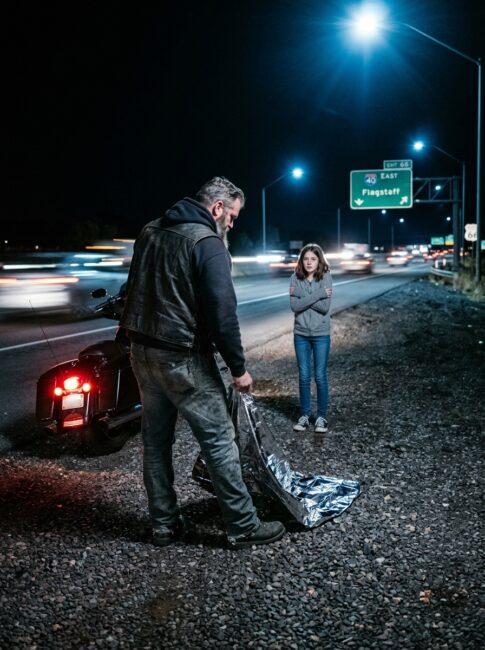
I parked too quickly.
The tires struck gravel harder than they should have. The officer behind me stopped at an angle, emergency lights washing the shoulder in slow flashes of red and blue.
Lily stood.
The silver blanket slipped from one shoulder.
For half a second, she looked younger than thirteen.
Then she ran toward me.
I opened my arms.
She hit me hard enough that I stepped backward.
“I’m sorry,” she said into my coat.
I held her.
“I’m sorry too.”
Her body shook from cold, fear, relief, or all three. I did not ask which one. Not yet.
Behind us, the biker rose slowly from the gravel.
He moved like a man whose knees hurt after long rides and bad decisions made decades earlier. Heavy boots pressed into the shoulder. Leather creaked when he rolled his shoulders.
The highway patrol officer approached him calmly.
The biker kept his hands visible.
They spoke beside the motorcycle.
I could not hear every word over passing traffic, but I saw the biker show his identification. I saw the officer nod. I saw them speak for several minutes.
Nothing dramatic happened.
No confrontation.
No speech about heroes.
The biker had done what he was supposed to do.
He stopped.
He kept distance.
He gave Lily something warm.
He contacted me after she agreed.
He stayed until law enforcement arrived.
Then he prepared to leave.
Lily remained pressed against me.
I looked over her shoulder at the man.
He was larger than I expected.
At least six-foot-three. More than two hundred pounds. Thick beard with gray near the chin. Tattoos covering both forearms. A black leather cut darkened by cold air and road dust. A chain wallet tapping lightly against his jeans as he walked.
His face was weathered.
Not unfriendly.
Just tired.
One patch stretched across the back of his cut. I could not read all of it in the rotating police lights. Beneath the larger patch was a smaller rectangular strip of fabric.
Three words.
NO ONE WALKS ALONE.
The officer stepped away.
The biker bent to pick up the silver blanket.
Lily released me long enough to say, “You can keep it.”
He looked toward her.
Not directly at first.
He gave her the same choice he had given her on the shoulder.
Then Lily nodded.
The biker turned fully.
“You sure?” he asked.
Lily nodded again.
“It’s one of those cheap emergency blankets.”
“I know.”
“It sounds like a bag of chips every time you move.”
For the first time that night, Lily almost smiled.
“Still works,” she said.
The biker shrugged.
“Fair point.”
He folded the blanket once, gave up when the wind caught it, then stuffed it into the saddlebag.
I stepped closer.
“Thank you.”
He nodded.
That was all.
“What is your name?”
The biker glanced toward Lily.
He seemed to think about the question longer than necessary.
Then he fastened the saddlebag and lifted his helmet.
“Doesn’t matter.”
“It matters to me.”
He rested the helmet against his hip.
A truck passed, its tires humming across asphalt.
“It matters that you came,” he said.
I felt the words more than I heard them.
He put on his helmet.
I reached for the one thing I could think to say.
“Please wait. At least tell me what I can do.”
The biker looked toward the highway.
Then toward the officer.
Then toward Lily.
“Listen tomorrow,” he said.
His Harley started with a deep uneven rumble.
The sound filled the shoulder and vibrated through the gravel beneath my shoes.
The red taillight moved away slowly, merged into the traffic, and disappeared.
I thought that was the ending.
A stranger stopped.
My daughter came home.
We were lucky.
But a year later, Lily wrote an essay for school.
That essay led me back to the highway.
And to a story the biker had never told us.
The assignment was called The Person Who Changed My Life.
Lily’s English teacher asked students to write about somebody whose actions had altered the way they saw themselves or the world.
Some students chose grandparents.
One wrote about a soccer coach.
Another wrote about an older brother serving overseas.
Lily wrote about a man whose name she did not know.
She titled the essay:
The Man Who Turned His Back.
I did not know about it until her teacher asked whether the school could include it in a student reading night.
Lily brought the printed pages home in her backpack and placed them on the kitchen counter.
“Can you read this?” she asked.
The request surprised me.
A year earlier, nearly every serious conversation between us had felt like stepping into a room filled with tripwires.
Things were better now.
Not perfect.
Better.
We had learned to pause.
To ask smaller questions.
To stop turning fear into lectures.
Lily had learned that telling the truth early usually hurt less than hiding it until the truth became a crisis.
I read the essay slowly.
Lily wrote about the highway.
The headlights.
The cold.
The motorcycle engine behind her.
The fear when she saw the rider.
Then the confusion when he did not follow.
She wrote about watching him sit on the gravel with his back turned while cars rushed past.
She wrote:
He was the first adult that night who did not tell me what to do. He gave me a place to stop running.
Near the end, she included the sentence I remembered.
It matters that you came.
Then she added something I had never known.
Before Lily gave the biker my phone number, she asked him whether he had run away too.
He said yes.
Twenty-five years earlier, when he was fifteen, he walked along a highway outside Flagstaff after leaving a house where anger lived in every room.
He did not describe the details.
He did not turn his pain into a performance.
He told Lily only that he walked for hours.
Cars passed.
Nobody stopped.
Eventually, a state trooper found him near dawn and brought him somewhere safe.
But the hours before that stayed with him.
The cold.
The headlights.
The feeling that every passing car confirmed something he already believed.
Nobody noticed.
Nobody cared.
The biker told Lily:
“I kept thinking somebody would stop. Then I started hoping nobody would.”
Lily asked why.
“Because after enough cars pass,” he said, “you stop wanting to find out whether the next person sees you either.”
That was why he turned his back.
Not because he ignored the risk.
Because he remembered the feeling of being watched by adults who wanted answers before offering safety.
He understood that Lily did not need another stranger approaching her in the dark.
She needed somebody close enough to remain.
Far enough away to feel safe.
He gave her what nobody gave him.
A choice.
When I finished the essay, I sat at the kitchen counter for several minutes.
Then I saw one final line.
I do not know his name. I do not know his face very well. He did not ask me to remember him. He only stopped. That was enough.
Lily’s teacher submitted the essay to a regional student-writing showcase.
It was published in a small local paper.
Two weeks later, an envelope arrived at the school.
No return address.
Inside was a silver emergency blanket folded badly into a square.
And a note written in block letters.
TELL THE KID SHE WRITES GOOD.
Beneath it:
AND TELL HER I STILL STOP.
The envelope changed something in Lily.
Until then, the biker had existed in our family story like a figure seen through moving headlights.
Real.
Important.
But distant.
The note confirmed that he had read her essay.
Somebody in town recognized enough details to pass it along.
Or maybe the highway officer knew how to reach him.
We never learned.
Lily did not try to find his name.
That surprised me.
At thirteen, she had wanted answers immediately. At fourteen, she had begun to understand that not every unanswered question was a threat.
Some were gifts.
Still, I wanted to know more.
The small patch on his leather cut stayed in my memory.
NO ONE WALKS ALONE.
I searched online and found a local riding group outside Flagstaff that organized winter-clothing drives, roadside assistance for stranded motorists, and occasional fundraising rides for youth shelters.
Their public page showed motorcycles lined outside diners, gas stations, and community centers along Route 66.
Some riders smiled openly.
Others looked uncomfortable in photographs.
One image showed a broad-shouldered man standing slightly behind the group.
Thick beard.
Tattooed arms.
Same black leather cut.
His face was turned away.
The caption did not name him.
I sent the page a message.
I explained who I was.
I said I wanted to thank the rider who had stopped.
A response arrived the next morning.
He knows. That is enough for him.
I replied.
Is he part of your group?
The answer came several hours later.
Sometimes. Mostly when somebody needs a hand.
Then another message appeared.
He does not like being called a hero. Do not call him that.
I understood.
Heroes sound like people who arrive from another world.
The biker had arrived because he remembered being a frightened kid on the same road.
He was not untouched by the darkness.
He recognized it.
A week later, the riding group held a winter-clothing drive outside a diner on Route 66.
Lily asked whether we could donate coats.
We packed three jackets she had outgrown, two new pairs of gloves, socks, and several emergency blankets purchased from a camping store.
The diner parking lot smelled like coffee, wet pavement, and gasoline. Harley engines cooled beneath the pale afternoon sun.
A dozen bikers carried cardboard boxes between pickup trucks and folding tables.
Lily scanned the crowd.
I did too.
For a moment, I thought I saw him beside a black touring bike near the edge of the lot.
Same build.
Same beard.
Same heavy boots.
The man lifted a box of coats from the pavement and carried it inside.
His back faced us.
A black leather cut stretched across his shoulders.
Beneath a larger patch, three words appeared.
NO ONE WALKS ALONE.
Lily saw the patch.
Her steps slowed.
“Is that him?” I whispered.
She watched the man set the box beside the diner entrance.
He never turned around.
Lily could have approached.
She could have asked his name.
Instead, she picked up a box of emergency blankets from our trunk and carried it toward the folding table.
The man walked past her on his way back to the parking lot.
They did not speak.
But as he passed, he tapped two fingers lightly against the edge of the cardboard box Lily carried.
A small gesture.
Barely anything.
Lily smiled.
That was enough.
I understood then why he never gave us his name.
The story did not need to become about the man who stopped.
It needed to remain about the child who came back.
Lily started carrying an emergency blanket in her backpack.
Not because she planned to run again.
Because she said somebody might need one.
The blanket remained sealed in its plastic package beside a phone charger, two pens, a paperback novel, and more lip balm than any human being could reasonably use.
During the summer, she volunteered twice at the youth shelter supported by the riding group.
She sorted donated clothes.
Packed hygiene kits.
Organized snack boxes.
The first time, she worked quietly.
The second time, she brought Ava.
The third time, she asked whether the shelter needed school supplies before August.
She never told other teenagers her highway story unless the moment felt right.
It belonged to her.
That mattered.
At home, we developed a small ritual.
Whenever an argument became too loud, either of us could say one word.
“Pause.”
No slammed doors.
No chasing each other through rooms with unfinished sentences.
No turning a missing assignment into a verdict on somebody’s entire character.
Sometimes Lily walked around the block.
Sometimes I made tea and stood in the kitchen until my fear stopped disguising itself as anger.
We always came back to the conversation.
Not immediately.
But we came back.
A year after the highway night, Lily placed a shoebox beside our front door.
Inside were gloves, bottled water, protein bars, phone-charging cables, and emergency blankets.
She wrote on the lid with a black marker:
ROAD KIT. TAKE ONE IF YOU NEED IT.
Our neighbors added supplies.
Then the gas station near the frontage road agreed to keep a similar box near the counter during winter.
One afternoon, I saw a folded note beneath the protein bars.
The handwriting was blocky.
Familiar.
ADD SOCKS. FEET GET COLD FIRST.
No signature.
Lily read the note and laughed.
Then she bought socks with money from her weekend job.
The rider remained part of our lives in small ways.
Never close enough to demand gratitude.
Never visible long enough to become a legend.
Occasionally, a motorcycle passed our house after dark with that deep uneven V-twin rhythm.
Lily would glance toward the window.
Not afraid.
Just listening.
Once, she said, “Do you think it’s him?”
I looked toward the taillight shrinking at the end of the street.
“Maybe.”
Lily nodded.
Then returned to her homework.
The motorcycle disappeared toward Route 66.
The room became quiet again.
Not empty.
Quiet.
There is a difference.
Two years after the highway night, Lily spoke at a school assembly about student safety.
She did not share every detail.
She did not turn the worst night of her life into entertainment for a room full of people.
She said only this:
“Sometimes somebody walking away does not need a lecture first. Sometimes they need a safe place to stop.”
Afterward, she placed copies of local support resources beside the auditorium doors.
She added a stack of emergency blankets.
Silver.
Cheap.
Loud enough to sound like bags of chips whenever somebody unfolded one.
That evening, Lily and I drove home beneath a cold Arizona sky.
Traffic moved along Interstate 40 in both directions. Headlights appeared, passed, and vanished behind us.
Near the exit east of Flagstaff, Lily looked toward the shoulder.
The gravel strip seemed smaller than I remembered.
Ordinary.
Almost forgettable.
But I could still picture a black Harley parked beneath the dark.
A red taillight glowing.
A broad-shouldered man sitting on the roadside with his back turned.
Not asking questions.
Not demanding trust.
Just staying.
Lily lowered the passenger window slightly.
Cold air entered the car.
Somewhere behind us, a motorcycle engine rose above the traffic.
The sound grew louder, then moved alongside our car.
A black touring bike passed in the left lane.
The rider wore a dark helmet and a leather cut.
For one second, the beam from a passing truck illuminated the patch on his back.
NO ONE WALKS ALONE.
Lily raised one hand.
The biker lifted two fingers from the handlebar.
Then the motorcycle continued west toward Flagstaff.
Its red taillight became smaller.
Smaller.
Gone.
Lily rolled up the window.
Neither of us said his name.
We still did not know it.
That was never the important part.
He stopped.
And she came home.
Follow our page for more stories from behind the leather cuts.