Part 2: The Father Sent His Daughter a Blank Text Before She Walked Onstage — The Meaning Behind It Left the Audience Speechless
Lily’s first step onto the stage felt wrong.
The lights were warmer than usual, almost golden, and the polished floor reflected them back at her like shallow water. The theater held six hundred people, but from where she stood, she could only see darkness beyond the first few rows.
And the empty seat.
Front row, left side, aisle seat.
Her father’s seat.
Claire sat beside it, shoulders pulled tight, one hand closed around her purse strap. She looked smaller than she had that morning.
Lily had seen her mother worry before. Bills. Doctor appointments. Late rent notices folded under magnets on the fridge. But this was different.
This was not the worry of a woman disappointed in her husband.
This was fear.
Lily noticed it just as the pianist played the opening chord.
For a second, she missed her cue.
Mrs. Whitman leaned forward from the wing.
The audience shifted softly.
Lily inhaled and began to sing.
Her voice came out thinner than it had in rehearsal, but it held. She sang the first verse of an old ballad about a lighthouse keeper waiting through a storm. Her father had loved that song because it reminded him of long drives home in winter, when the road disappeared under fog and headlights.
Halfway through the verse, Lily saw movement near the side entrance.
A man in a dark coat stepped inside.
Her heart jumped.
But it was not Daniel.
It was Mr. Alvarez, her father’s manager from the auto repair shop. He stood in the aisle, hat pressed to his chest, eyes fixed on Claire.
That was the first small crack in Lily’s anger.
Mr. Alvarez should not have been there.
He hated concerts. Daniel had once joked that his boss believed music was just “expensive air.” Yet there he stood, face pale, whispering to an usher.
Claire turned and saw him.
Her hand flew to her mouth.
Lily almost stopped singing.
The pianist glanced up.
The audience did not understand what was happening, but something had changed. A quiet tension moved through the room like cold air under a door.
Lily forced herself through the chorus.
Then her phone buzzed again inside her backstage bag.
She could not hear it.
But Mrs. Whitman did.
The teacher looked toward the bag, then toward Lily, then toward Claire.
After the song ended, the applause rose politely. Lily bowed, but her eyes never left the front row. Claire had stood. Mr. Alvarez had taken her elbow.
The empty seat between them looked louder than the applause.
Lily walked offstage, and Mrs. Whitman caught her before she reached the dressing room.
“Lily,” she said gently, “your phone keeps lighting up.”
“I don’t care.”
“You should look.”
Lily’s jaw tightened. “If it’s another blank text, I don’t want it.”
Mrs. Whitman did not move.
That was the second crack.
Her teacher’s eyes were wet.
Lily reached into her bag and grabbed the phone.
There were four messages from her father.
All blank.
Then one message from her mother, sent two minutes earlier.
Stay backstage after your next piece. Don’t leave.
Lily stared at it.
“What’s going on?” she asked.
Mrs. Whitman touched her shoulder. “Your father called the theater earlier.”
Lily looked up sharply.
“He called?”
“He asked if your solo could be recorded.”
Lily’s laugh came out bitter. “So he knew he wouldn’t make it.”
Mrs. Whitman swallowed.
“He asked three times if the front row lights would stay on.”
The words made no sense.
Lily looked toward the stage curtain.
Beyond it, another student had begun a piano piece. Gentle notes floated through the hallway, too pretty for the panic building inside her ribs.
Then Claire appeared.
Her face was drained of color, but she was trying not to cry.
“Mom,” Lily said. “Where is he?”
Claire looked at the phone in Lily’s hand.
“Did he text you?”
Lily held it up. “He sent nothing.”
Claire closed her eyes.
And that was when Lily remembered something from years ago.
A hospital room.
Her father sitting beside her bed.
A blank sticky note stuck to the side of her lunch tray.
She had been eight, recovering from a throat surgery that left her unable to speak for almost two weeks. Daniel had brought a pack of sticky notes to the hospital. Every day, he wrote jokes on them, little weather reports, reminders that her voice was only resting.
But once, when Lily was scared before a follow-up procedure, he had placed a blank note in her palm.
She had frowned at him.
Daniel had whispered, “That one means I’m here when there are no words.”
Backstage, Lily’s fingers tightened around the phone.
Blank message.
No words.
I’m here.
But the seat was still empty.
And Claire’s face told her that her father was somewhere else entirely.
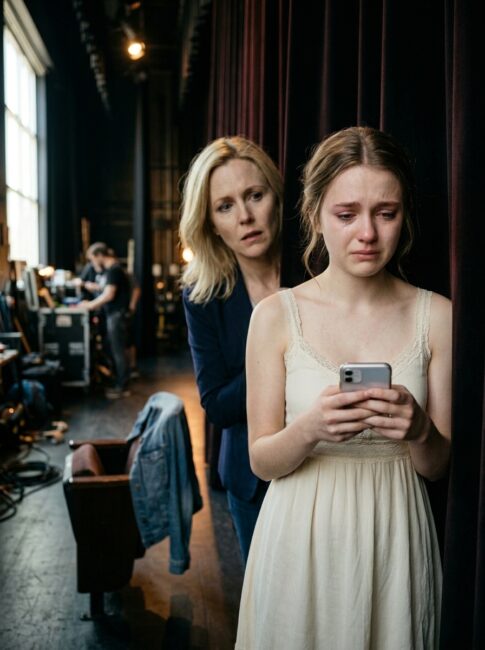
Claire led Lily into a small greenroom behind the stage, away from the other performers and the low murmur of the audience.
Mr. Alvarez stood inside.
So did Principal Dana Morton, who had come to congratulate the scholarship finalists. Her silver reading glasses hung from a chain, and her expression held the careful sadness of someone who had already heard the first part of a terrible story.
Lily stopped in the doorway.
“No,” she said.
Nobody had said anything yet.
But children often know the shape of bad news before adults hand it to them.
Claire reached for her. “Honey, your dad is alive.”
The room tilted back into place.
Lily breathed once.
Then anger returned, sharp and desperate. “Then where is he?”
Mr. Alvarez stepped forward.
“He was on his way here,” he said. “He left the shop early.”
Lily stared at him.
Her father never left early. Not for birthdays. Not for parent nights. Not even when he had a fever and Claire begged him to come home.
“He asked me to dock the time if I had to,” Mr. Alvarez continued. “I told him not to be ridiculous.”
Claire wiped her cheek.
“Then why isn’t he here?” Lily asked.
Mr. Alvarez looked down at his hat.
“Because on Maple Avenue, he saw a minivan roll through the intersection and hit a bike.”
Lily said nothing.
“A little boy,” he added softly. “Maybe nine.”
The room became terribly still.
Daniel Harper had been a mechanic, not a doctor. He had no title people applauded. He wore work shirts with oil stains that never washed out, and his hands were always rough around the nails.
But he was also the kind of man who kept a first-aid kit in his truck, jumper cables behind the seat, blankets in winter, bottled water in summer, and a list of emergency numbers taped inside the glove compartment.
He stopped.
Of course he stopped.
Lily knew that before Mr. Alvarez finished.
“The ambulance was delayed,” he said. “Traffic from the concert blocked two streets.”
Claire covered her mouth.
“He called 911, stayed with the boy, kept pressure on a leg wound, and talked to him until paramedics arrived.”
Lily’s phone felt heavy.
Mr. Alvarez’s voice lowered.
“He tried to call you first. He told me he didn’t want you going onstage thinking he forgot. But his hands were covered in blood, and his screen wouldn’t respond right.”
Lily looked at the blank messages.
“He used voice command,” Mr. Alvarez said. “But the phone kept sending empty texts.”
The third twist landed without drama.
The messages had not been neglect.
They had been effort.
Her father had been trying to reach her with hands that could not touch the screen.
Lily sat down slowly.
Claire knelt in front of her.
“He told the paramedic one thing,” Claire whispered. “He said, ‘Tell my daughter the blank one means I’m there.’”
Lily pressed the phone to her chest.
For a moment, no one spoke.
Then Principal Morton cleared her throat.
“There’s more,” she said.
Lily looked at her, almost afraid to ask.
“The boy’s mother is here.”
“What?”
“She was bringing him to watch his sister perform. She came in looking for help after the ambulance left.”
The fourth twist made the room feel smaller.
The injured boy was not a stranger to the night.
He was tied to the same stage, the same music, the same crowded lobby where parents held flowers and programs.
His sister was one of the younger dancers waiting for the second act.
Claire said, “Your dad didn’t want the mother driving behind the ambulance alone. He gave his truck keys to Mr. Alvarez and rode with them.”
Lily blinked.
“He went to the hospital?”
Claire nodded. “The boy kept asking for him.”
Lily could almost see it.
Her father crouched in the street, one knee in broken glass, telling a child to keep looking at him. His voice steady. His shirt ruined. His phone buzzing uselessly. His promise to Lily breaking in one place so he could keep a different promise in another.
All her anger loosened at once.
It did not vanish.
It became something softer and harder to hold.
A memory opened in her mind: Daniel in the kitchen at midnight, sewing a loose strap on her recital dress because they could not afford alterations. Daniel in the driveway, listening to her practice through the open garage door while changing brake pads. Daniel sitting outside auditions in his work boots, asleep in a plastic chair, still holding a bouquet from the gas station.
He had missed things, yes.
Sometimes because work took him.
Sometimes because money was tighter than pride allowed him to admit.
But he had never missed her heart.
Mrs. Whitman entered quietly.
“Lily, they can move your second song to the end if you need more time.”
Lily looked toward the hallway.
The next performer was finishing. Applause rolled through the walls.
“What’s my second song?” she asked, though she knew.
Mrs. Whitman answered softly. “The one your father chose.”
The old ballad’s companion piece.
A simple song called “No Words Needed.”
Daniel had found it in a thrift-store songbook years ago. He bought it for fifty cents because the title made him laugh. Later, when Lily’s voice returned after surgery, it was the first song they learned together.
He could not sing well.
He sang anyway.
Lily stood.
Claire grabbed her hand. “You don’t have to.”
Lily looked at the blank messages again.
Dad:
Dad:
Dad:
Dad:
Four empty bubbles.
Four little rooms with nothing inside.
Except everything.
“I know,” Lily said. “But I want him to hear it later.”
Mrs. Whitman nodded.
Before Lily walked out, the door opened.
A woman stood there holding a little girl’s hand. Her face was swollen from crying. Her dress was wrinkled, and one sleeve had a dark smear near the cuff.
“I’m sorry,” the woman said. “I’m Owen’s mother.”
Lily already knew.
The woman looked at Lily as if there were no correct words available.
“Your father saved my son from being alone,” she said.
Lily’s throat tightened.
The little girl beside her clutched a pair of ballet slippers to her chest.
“He told Owen you were about to sing,” the girl said. “He said you were brave.”
Lily covered her mouth.
The mother stepped closer and placed something in Lily’s hand.
It was Daniel’s old silver keychain, the one shaped like a tiny wrench.
“He asked me to give you this,” she said. “He said you’d know he didn’t leave.”
Lily closed her fingers around it.
Then she walked back toward the stage.
Not healed.
Not calm.
But no longer alone in the misunderstanding.
When Lily stepped into the light again, the theater had changed.
No announcement had been made, but news travels through an audience in whispers, especially when fear and tenderness share the same hallway.
Claire sat in the front row, still beside the empty seat.
Mr. Alvarez stood near the aisle.
Principal Morton had returned to the back wall.
And beside Claire, where Daniel should have been, rested his old denim jacket.
Someone had placed it over the seat.
Lily saw it and almost lost her breath.
The pianist waited.
Lily lifted her chin.
Before she sang, she took the phone from behind the music stand. Mrs. Whitman had placed it there without being asked.
Lily held it up just long enough for the front rows to see the blank message on the screen.
“My dad sent me this before I came onstage,” she said.
Her voice trembled, but it did not break.
“At first, I thought it meant he had nothing to say.”
The audience remained silent.
Lily looked at the empty seat.
“When I was little and couldn’t speak after surgery, he gave me a blank note. He told me it meant he was there when there were no words.”
Claire bowed her head.
“So this song is for him,” Lily said. “And for everyone who has ever loved someone the best way they knew how, even when it looked wrong from the outside.”
She did not explain the accident.
She did not turn her father into a hero on display.
She simply nodded to the pianist.
The opening notes rose gently.
This time, Lily’s voice did not come out thin. It came out low at first, touched by grief and fear, then grew into something steadier.
It filled the theater without forcing itself.
People did not cry all at once. They cried quietly, one by one, the way lights turn on in houses at dusk.
Claire pressed Daniel’s jacket to her face.
Mr. Alvarez wiped his eyes with the brim of his hat.
In the back row, Owen’s little sister stood between her mother and a volunteer, holding her ballet slippers against her chest.
When the song ended, nobody clapped immediately.
That was the moment Lily remembered most.
Not applause.
Not praise.
The silence.
Six hundred people holding still because words would have been too small.
Then the theater rose.
Lily bowed once and walked offstage before she fell apart.
Two hours later, she and Claire arrived at the hospital.
Daniel sat in a hallway chair, still wearing his stained work shirt. A nurse had wrapped his forearms where glass had cut him. His face looked older than it had that morning.
When he saw Lily, he stood too quickly.
“I tried to text,” he said.
Lily crossed the hall and put her arms around him.
“I know.”
Daniel held her like a man afraid he had almost lost something no accident had touched.
“I was there,” he whispered.
Lily pulled back and placed the tiny wrench keychain in his palm.
“I know,” she said again.
Down the hall, a little boy slept behind a half-open door, his leg wrapped in white bandages, a stuffed bear tucked under one arm. On the windowsill sat Lily’s concert program, folded open to her name.
Daniel looked at it.
“You sang?”
Lily smiled through tears. “Loud enough for the loudest quiet person in the room.”
For years after that night, Lily kept the empty message saved on her phone. When the screen finally cracked and the phone stopped charging, she wrote the date on a blank index card and tucked it into the old thrift-store songbook.
No words.
Just the date.
And whenever she found it again, she remembered the empty front-row seat, the denim jacket, the boy in the hospital, and the father who had tried to send love with hands that were busy saving someone else.
Follow this page for more heartfelt stories about the quiet love people carry when words are not enough.