Part 2: A Little Girl Vanished Into a Colorado Blizzard. When We Finally Found Her, She Wasn’t Alone — and the Dog Keeping Her Warm Wasn’t Mine.
Part 2
I should tell you about Atlas’s alert, because the alert is the whole reason I did what I did, and a person who has never worked a dog will not understand why I broke protocol on the strength of a dog’s posture.
A trained search dog tells you things with its body, and once you have spent years reading one specific dog, the body becomes a sentence you can read in the dark.
Atlas has a “nothing” — loose, casual, nose drifting, checking the world out of habit. And Atlas has an “alert” — and his alert is unmistakable, a complete change of the entire animal. The head comes up and locks. The ears go hard forward. The body stops being a dog walking and becomes a dog pointing, every muscle drawn toward one bearing, like a compass needle that has found north and will not let go of it.
In six years I have never once seen him give a hard alert on nothing. Not on a deer. Not on an elk. Not on another searcher. When Atlas locks up like that, there is a person on the other end of the air he is reading. It has been true eleven times. It has been true the four hard times too.
My name is Dana. I am forty-one. I have done this for nine years, and I trust my dog’s nose over my own eyes, my own ears, and the radio, in that order, because his nose has never once been wrong and the other three have all lied to me at least once.
Here is the small thing, the thing I clocked in that whiteout and did not have time to fully think about.
Atlas was not alerting the way he alerts on a person.
His alert was right — the locked head, the hard ears, the lean. But layered under it was something else, a second register I had felt from him only a handful of times, a kind of urgency that was not about a scent cone but about speed, about now, the alert he gives when the find is alive but the clock is short.
He wasn’t just telling me someone is that way.
He was telling me someone is that way and we are almost out of time.
I didn’t understand the full shape of it yet. I’m not sure I’d have understood it before we got there if he hadn’t dragged me to it.
But it mattered. The doubled urgency in his alert — that mattered more than I knew.
Part 3
I keyed my radio and told the incident commander that my dog had a hard alert and was refusing to break, and that I was going to follow him.
There was a long pause full of wind.
Then his voice came back, and I will not forget it, because it was the sound of a man weighing two terrible options. He said I was off protocol. He said he could not authorize it. He said if I went uphill into that, I was on my own, and he could not send anyone after me until the weather broke, and that might be hours.
And then, after another pause, he said: “Dana. Trust the dog. Go.”
He gave me one searcher who volunteered — a young guy named Brett, twenty-six, the only other person crazy enough to raise his hand — and the two of us turned uphill into the blizzard behind a dog who suddenly, finally, had somewhere to be.
Atlas pulled like a freight train.
I have never felt him pull like that. He is a disciplined dog; he does not haul on the line. That night he leaned into the harness and drove uphill through snow to his chest, breaking trail with his own body, dragging me by the waist belt, and every time I slowed he would throw a look back over his shoulder that I can only describe as furious — come on, come on, what is wrong with you, come ON — and then drive forward again.
We went up. The trees got thicker and then thinned out near a drainage. The wind on the open ground was a physical wall; I had to lean forty-five degrees into it to stand. Brett’s headlamp behind me was a smear of useless light in a million flying particles. My face had stopped hurting, which I knew was bad. I kept my eyes on the dog, on the dark working shape of him plowing the snow, because he was the only thing in the world that knew where it was going.
We crossed the open ground. We dropped into the lee of the drainage, where the wind cut suddenly and the snow stopped flying sideways and started just falling, thick and silent, and the change was so abrupt it was like walking through a door.
And Atlas stopped pulling.
He had been hauling for forty minutes and he just — stopped. Stood still. His head went down. His whole body changed from the desperate forward drive into something quiet and careful, and he took three slow steps toward the base of a deadfall, a big downed spruce with a hollow under its root ball, and he stood over the dark space there, and he looked back at me.
Not the furious look. A different one.
I got my headlamp down into the hollow under the roots.
And I saw two things in the same half-second, and my brain refused to put them in order.
Part 4
The first thing I saw was eyes.
Low, in the back of the hollow, reflecting my light back green — and for one ugly heartbeat I thought coyote, I thought we found her too late and something is at her, and my hand went toward Atlas’s harness to pull him back.
The second thing I saw was the girl.
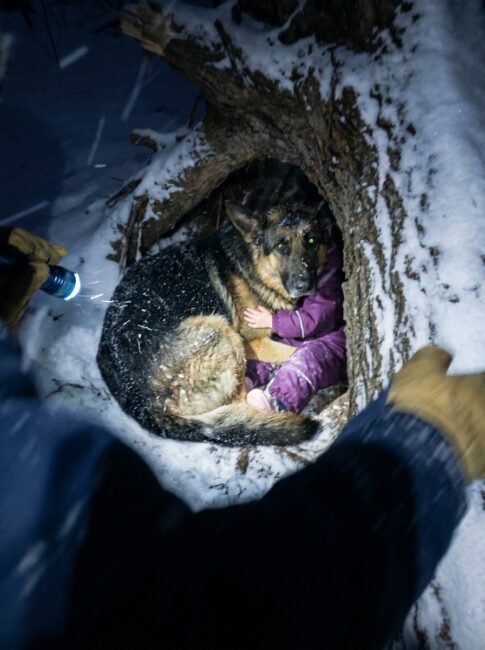
She was curled in the deepest part of the hollow, in her little purple snow jacket, and she was not blue, and she was not still in the way that means the worst — she turned her head toward my light and made a small sound, and she was alive, she was alive, a four-year-old who had been lost in a killing blizzard for nine hours was alive.
And she was not alone.
Wrapped around her — around her, body curved into a tight crescent with the child tucked against its belly and chest, exactly the way I had been taught a survival shelter is supposed to work, a windbreak of living muscle between the girl and the cold — was a German shepherd.
Not Atlas. Atlas was beside me. This was another dog. A big one, gaunt, with a thick storm-matted coat, no collar, no tags, a dog I had never seen in my life. The green eyes were his. He had lifted his head when my light hit the hollow, and he had a low sound coming out of him — not quite a growl, a warning, a careful — and he did not get up, and he did not uncurl, because uncurling meant taking his body off the child.
He had her tucked into the warmest configuration a dog’s body can make. Her bare hands were pressed into the fur of his chest. Her face was against his neck. And he had clearly been holding that position for a long, long time, in the lee of that deadfall, the one spot for a quarter mile in any direction where the wind could not reach.
Brett came up behind me and I heard him say, very quietly, “Oh my God.”
I did the only thing I knew how to do. I got down on my knees in the snow, slow, and I talked low — to the strange dog, not the girl, because the strange dog was the gatekeeper and the strange dog was armed with teeth and fear and a job he had appointed himself to.
“Good boy,” I said. “Good boy. I’ve got her. You can let me have her. Good boy.”
And Atlas, beside me, did something I did not ask him to do.
He lay down. Slow and deliberate, in the snow at the mouth of that hollow, he lowered himself into a down — calm, unthreatening, the universal dog language for I am not a threat — and he looked at the strange dog, and the strange dog looked back at him.
And whatever passed between those two animals in that second, I will never have the words for. But the gaunt dog’s warning sound stopped. And he lowered his head. And when I reached slowly into the hollow, he let me put my hands on the child.
Part 5
I want to be careful, because the easy version of this is that a wild dog is a guardian angel, and I don’t believe in those, and the truth is better than that anyway.
The dog that kept Maple alive was almost certainly not “wild” in the way the headlines later said. Northern Colorado has working ranches, and ranches lose dogs, and a German shepherd that throws a collar or gets separated or is dumped can survive a long time in that country living off carrion and small game and whatever a hard dog can take. He was gaunt because life out there is gaunt. He had no collar because he’d been gone long enough to lose it, or long enough that no one was looking.
But here is what I came to understand about what he did, and it is not magic, it is something harder and older than magic.
A German shepherd is built — bred, over centuries — to herd, to guard, to gather vulnerable things and hold them in a safe place against a threat. That instinct does not switch off when the dog loses its people. It just loses its object. A guarding dog with nothing to guard is a terrible, lonely thing.
That dog had been out in the storm. He had crossed the path of a small, freezing, crying human child, alone, the most vulnerable possible thing, broadcasting distress in every signal a dog can read.
And the oldest wiring in him woke up and answered.
He did not attack her. He did not avoid her. He did the thing his whole lineage was shaped to do — he gathered the vulnerable thing, and he moved it, or kept it, in the most sheltered spot available, and he put his own body between it and the death coming down out of the sky. He shepherded her. Literally. To the lee of the deadfall, and then around her, and then he held.
He had no people. So he made one out of a lost child. He had no flock. So he made one out of a four-year-old in a purple coat.
He kept her alive because keeping vulnerable things alive was the only purpose he had ever been given, and he had been waiting, out there in the cold with nothing to guard, for someone small enough to need him.
Part 6
Once I understood that, the whole night turned over in my hands.
Atlas’s doubled alert — the urgency under the urgency. I’d read it as alive but short on time, and it was that. But I think now it was more. Atlas had not been smelling one person in that drainage. He’d been smelling two living things, a child and a dog, curled together, and some part of his trained nose had read the configuration — had known, in whatever way a dog knows, that this was not a body to recover but a life being actively held, and that the holding would not last forever. He pulled like a freight train because the math was running out.
The spot. I’d wondered, plowing uphill, why a four-year-old would be a half mile from the cabin, uphill, across open ground a grown man could barely cross. She hadn’t gotten there on her own. She couldn’t have. The strange dog had moved her — gathered her and herded her, the way his blood told him to, off the killing wind and into the one sheltered hollow in that whole drainage. A four-year-old, left to her own wandering, dies in the open in that wind in under two hours. She was not in the open. She had been put somewhere safe by something that knew where safe was.
And the moment between the two dogs — Atlas lying down, the strange dog letting go of his warning. I’d seen it and not understood it. I think I understand it now, as much as a person can. One working dog recognized another. One guardian recognized that the relief had come. The gaunt dog had held his post for nine hours against a thing he could not fight, and he had been waiting — the way a sentry waits — to be relieved by someone who would take the watch. Atlas told him, in the only language they share, I’ve got it now. And he stood down.
We got Maple into Brett’s coat and mine, layered, and I got her against my own body, and I felt her cold weight settle into me, and she said one word into my collar that I will hear for the rest of my life.
She said, “Doggy.”
She wasn’t asking about Atlas. She was asking about the other one. The one who’d kept her.
Part 7
Maple lived.
She had hypothermia and frostnip on two fingers and they kept her in the hospital in Fort Collins for three days, and she went home to her family with all ten fingers and a story her parents will be telling at her wedding. The doctor who admitted her told me, flatly, in the hallway, that she should not have survived the night. That a four-year-old, exposed, in that wind chill, for nine hours, does not survive. That the only reason she did was that for most of those hours she had not actually been exposed — she had been pressed against the body of a large dog, in a windbreak, sharing his heat.
The dog had been a furnace. He had been a wall. He had spent his own warmth, for nine hours, on a child he did not know.
When we lifted Maple out of the hollow, the strange dog stood up.
He was bigger than I’d thought, and thinner, every rib of him showing under the matted coat, and he was unsteady on his feet in a way that told me how much he’d given. He backed off a few steps. He watched us bundle the girl. And then he turned to go back into the dark, into the storm, into the life he’d come from, the way a working dog goes off shift.
I could not let him.
I got down again. I called him — not a command, I had no command he’d know, just my voice, low, the way you call any dog. “Hey. Hey, buddy. Come here. You don’t have to go.”
He stopped. He looked back. And Atlas, my Atlas, walked out to him through the snow, and the two of them stood nose to nose for a moment in the falling dark, two German shepherds in a blizzard, and then Atlas turned and walked back toward me, and after a moment — a long moment, the longest of the whole night — the strange dog followed him in.
He let me put a slip lead over his head. He was shaking. I do not know if it was cold or something else.
We walked off that mountain at three in the morning, the storm finally breaking over us into stars, a handler and two German shepherds and a four-year-old girl alive against every reasonable expectation, and I cried the whole way down and the wind had stopped so there was nothing to eat the sound of it.
Part 8
No one ever claimed him.
We ran his description everywhere. No chip, no collar, no missing-dog report that matched, no ranch within forty miles that knew him. Wherever he’d come from, whatever he’d lost out there, the world had stopped looking for him a long time before he found Maple.
So I kept him.
His name is Sentry, because that is what he was doing when we found him, and that is what he had been doing, I think, his whole lost life — standing a post nobody had assigned him, waiting for something small enough to need guarding.
He sleeps in my house now, beside Atlas. He took months to trust a door, a bowl, a hand. He is still gaunt in the face in a way good food has never quite filled back in. But Maple’s family visits, and when that little girl walks through my door, the big dog who should not have known her, who owed her nothing, who came out of a killing storm and gave her his whole body’s heat for nine hours — that dog goes to her, and lies down, and lets her press her hands into the fur of his chest.
The same place she pressed them that night.
He had no flock. He found one in the snow.
And my own dog, who refused the order to turn back, is the only reason any of us know he was ever out there at all.
I trust the dog. The commander said it into my radio in the worst weather of my life. I will say it now as the truest thing I know.
Trust the dog. Go.
Follow this page for more stories about the ones who stand a post nobody assigned them, and the searchers who refuse to turn around.