Part 2: The Woman Who Threw Water in the Bride’s Face — Until the Truth Behind It Left the Whole Hall in Tears
Claire Donovan had almost not come to the wedding.
The invitation had arrived three weeks earlier in a cream envelope, elegant and thick, with her name written carefully across the front.
Ms. Claire Donovan.
No family title.
No note.
No explanation.
Just a seat assignment for row four and a reception card for a country club she had never entered in her life.
She held the invitation at her kitchen table for a long time. Outside her apartment window, rain tapped the fire escape. Beside her coffee mug sat an old photograph of a little girl in pigtails holding a blue handkerchief.
Emily.
Age seven.
Missing one front tooth.
Smiling like the world had not learned how to hurt her yet.
Claire had known Emily before the country club, before the wedding planner, before the groom’s family started talking about “blending circles.” She had known her when Emily’s mother, Anna Hart, was still alive.
Anna had been Claire’s patient first.
Then her friend.
Claire was a hospice nurse then, the kind of nurse who entered homes carrying pill schedules, clean sheets, and the quiet knowledge that some rooms were already saying goodbye.
Anna had breast cancer that had returned hard and fast. Robert, her husband, worked long hours at his accounting firm and called it providing. Emily was eight, small for her age, and always trying to make less noise.
Claire noticed that first.
A child learning to be quiet around grief.
Anna noticed everything else.
“She’s braver than I am,” Anna told Claire one late afternoon, while Emily colored on the living room floor. “But sometimes she disappears inside herself.”
Claire looked toward the child.
Emily had stopped coloring. Her crayon rested between her fingers, untouched. Her eyes were open, but she was no longer watching the room.
Anna whispered, “When she gets scared, she freezes. I put cold water on her hands. I tell her, find the cold, find your breath.”
Claire remembered that.
She remembered it the day Anna died, when Emily stood at the bedroom door without crying.
She remembered it at the funeral, when the child gripped a blue handkerchief so tightly her knuckles turned white.
She remembered it years later, when Robert remarried Vanessa, a polished woman who believed grief should be put away if it made guests uncomfortable.
Claire tried to stay in Emily’s life.
At first, Robert allowed it. Claire picked Emily up from school twice a week, helped with homework, and made tomato soup the way Anna used to. She braided Emily’s hair before recitals. She sat in the back row at school plays because Emily always looked for her there.
Then Emily turned thirteen, and things changed.
Vanessa began calling Claire “that nurse.”
Not cruelly at first. Just enough to draw a line.
Robert said Emily needed normalcy. Claire said normalcy was not the same as forgetting. Their conversations grew colder until, one spring evening, Vanessa met Claire at the door and said Emily was busy.
Emily had not been busy.
Claire saw her through the upstairs window, one hand pressed to the glass.
That was the first small heartbreak.
There were more.
Claire mailed birthday cards that came back unopened. She sent Emily a blue scarf for graduation and never knew if it arrived. She watched from far away as Emily became a woman with her mother’s eyes and her father’s careful smile.
Then, two years before the wedding, Emily found Claire again.
Not dramatically.
No storm.
No tearful reunion.
Just a message on a quiet Tuesday night.
Do you still have Mom’s letters?
Claire stared at the screen until it blurred.
Anna had written letters for Emily before she died. One for her sixteenth birthday. One for graduation. One for the day she felt lost. One for her wedding day.
Robert knew about them.
He had asked Claire to hold them because he said he could not bear to.
Then he stopped asking.
Claire kept every envelope in a cedar box under her bed.
Emily came to Claire’s apartment the following weekend. She was twenty-six, carrying coffee, flowers, and the nervous guilt of someone who had been kept away too long.
“I thought you left,” Emily said.
Claire shook her head.
“No, honey.”
Emily cried then.
Not loudly.
Just with her face in both hands, like a child trying not to wake anyone.
After that, they rebuilt slowly.
Lunches. Phone calls. Walks in the park. Stories about Anna told carefully, like handing over glass.
When Emily got engaged to Lucas, she asked Claire to come dress shopping.
Claire went.
Vanessa did not like it.
At the bridal boutique, Vanessa smiled at the consultant and said, “Claire was close to Emily’s mother during the illness.”
During the illness.
As if Claire had been part of the disease, not part of the family.
Emily heard it and went quiet.
Claire pretended not to.
That became the second twist nobody saw.
Claire had learned, over years of caring for the dying, that love sometimes had to sit in the fourth row and not correct the seating chart.
The third twist was the envelope in her purse.
Anna’s final wedding letter.
Emily had asked Claire to bring it. Not to read during the ceremony. Not to make a scene. Just to have it nearby.
“In case I need her,” Emily had whispered.
Claire promised.
But on the wedding morning, something felt wrong.
Emily was smiling in every photograph, yet her fingers kept searching for a pocket that was not there. Her face looked too still beneath the makeup. When Claire hugged her before the ceremony, Emily whispered, “I don’t know where to put missing her today.”
Claire had no answer big enough.
So she gave the only one she had.
“She is not lost to you.”
Emily nodded, but her eyes drifted toward the glass of water on the vanity.
Find the cold.
Find your breath.
Hours later, at the altar, when Emily opened her mouth and could not speak, Claire saw what others missed.
The bride was not hesitating about Lucas.
She was vanishing.
Her hands had gone stiff. Her eyes had gone far away. Her lips moved without sound, forming the same childhood sentence Claire had heard once beside a hospital bed.
I can’t find her.
That was why Claire stood.
That was why she took the water.
And that was why everyone in the chapel hated her before they knew she had just answered a promise.
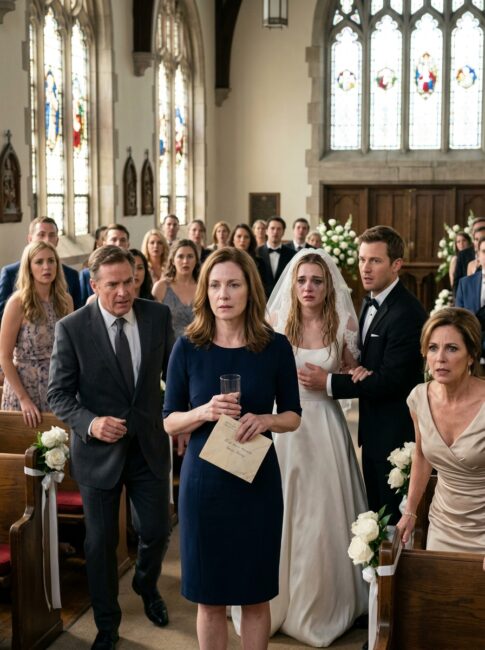
Robert reached Claire first.
His face was red with humiliation and anger, the face of a man watching his perfect day slip out of control.
“What have you done?” he snapped.
Claire looked past him to Emily.
The bride was shaking now, but her eyes had come back into the room. Water ran from her lashes onto her cheeks. The lace at her neckline was damp. Lucas held both her hands, murmuring her name.
“I am here,” he said. “Emily, I am right here.”
Emily blinked.
Then she looked at Claire.
Not with hatred.
With recognition.
“Find the cold,” Emily whispered.
Robert stopped.
The minister lowered his book.
Somewhere behind them, Vanessa said, “This is unacceptable.”
Claire turned to her only once.
“No,” she said quietly. “This is grief.”
The words landed harder than shouting.
Emily took one unsteady step toward Claire.
Her father moved as if to block her, but Lucas touched his arm.
“Let her,” Lucas said.
Robert looked at him, startled.
Lucas was thirty-one, a white American man with kind brown eyes and the careful patience of someone who had loved Emily through more than her pretty days. He had known she missed her mother, but even he had never seen this version of grief take her whole body.
Emily stopped in front of Claire.
The chapel watched.
Guests who had whispered moments earlier now sat still, caught between judgment and confusion.
Claire held out the envelope.
It was cream-colored, old but protected, with Anna Hart’s handwriting across the front.
For my Emily, on the day she promises forever.
Emily covered her mouth.
Robert’s anger drained so suddenly that he seemed older.
“You had that?” he asked.
Claire looked at him.
“You asked me to keep them.”
His eyes flickered.
That was the fourth twist.
Robert had not simply forgotten the letters.
He had avoided them.
For years, he told himself he was protecting Emily from pain. He had hidden Anna’s voice because he could not stand hearing it himself. When Claire reminded him, he said Emily was too young, then too busy, then too happy.
There was always a reason.
But grief does not disappear because a house is repainted.
It waits in the corners.
Claire had carried the letters through two apartment moves, one surgery, and years of silence. She paid for a safe-deposit box when a pipe burst in her building because she was afraid water would destroy Anna’s handwriting.
Emily took the envelope with shaking hands.
“Can I read it?” she asked.
Claire nodded.
The minister gently offered the microphone.
Emily almost refused. Then she looked at Lucas.
He squeezed her fingers.
She opened the envelope.
Inside was a letter and a small strip of blue fabric, folded around a dried pressed daisy.
Emily touched the fabric first.
“My handkerchief,” she whispered.
Claire smiled through tears.
“Your mother cut a piece from it.”
Emily unfolded the letter.
Her voice shook at the beginning, then steadied as Anna’s words filled the chapel.
My sweet girl,
If this letter finds you in a white dress, then I need you to know something before you say yes to anyone. I did not leave because I wanted to. I did not miss your first heartbreak, your graduation, or this aisle because love failed. My body stopped before my love did.
Emily paused, pressing the letter to her chest.
The chapel was silent now.
Not polite silence.
Wounded silence.
She kept reading.
If you freeze today, do not be ashamed. When you were little, fear made you very still. I used to put cold water on your hands and tell you to find your breath. If Claire is there, let her help you remember. She knows the way back.
Robert lowered himself into the nearest pew.
Vanessa’s polished face changed, not fully softened, but cracked at the edges.
Emily read on.
Claire is not just the nurse who helped me die. She helped me stay your mother until the last hour. She washed my hair the morning I could not lift my arms. She wrote down the stories I was afraid you would forget. She promised to sit somewhere close, even if life made her sit far away.
Claire’s shoulders trembled.
The bridesmaid who had screamed at her wiped her face.
Emily’s voice broke.
If she ever does something that looks strange to everyone else, pause before you judge her. She may be keeping a promise I asked of her when I had nothing left to give but trust.
The last line was almost too much for Emily to read.
Let there be water if you need it, sweetheart. Not because you are weak, but because even flowers need rain on beautiful days.
A sound moved through the chapel.
It was not a gasp.
It was the sound of people letting go of what they had assumed.
Robert covered his eyes.
For years, he had treated Claire like a shadow from the hardest chapter of his life. He had not considered that she had been the lamp in it.
He stood slowly and walked toward her.
Claire looked braced for another accusation.
Instead, Robert stopped in front of her and whispered, “I thought if I kept Anna’s things away, Emily would hurt less.”
Claire’s voice was gentle, but it did not spare him.
“No. She just hurt alone.”
Robert nodded once.
The truth had no decoration.
Emily turned to Lucas.
Her makeup was ruined. Her veil was damp. Her perfect bridal portrait was gone.
But her face was alive now.
“I am ready,” she said.
Lucas smiled with tears in his eyes.
“Then I am ready too.”
Before returning to the altar, Emily did something no one expected.
She took Claire’s hand.
“Come with me.”
Claire shook her head.
“Oh, honey, no. This is your father’s place.”
Emily looked at Robert.
Robert looked at the woman he had pushed out of his daughter’s life because she reminded him of the wife he lost.
Then he stepped aside.
“No,” he said, voice rough. “It is yours too.”
So Emily walked back to the altar with her father on one side and Claire on the other.
One hand held blood.
One hand held promise.
When they reached Lucas, Emily wiped her wet cheek and laughed softly.
“I look terrible.”
Lucas shook his head.
“You look like yourself.”
This time, when the minister began again, Emily did not freeze.
She repeated the vows slowly, with Anna’s letter folded against her heart and cold water drying on her skin.
No one in that chapel ever forgot the way she said forever.
It sounded less like a performance.
More like someone coming home.
The reception changed before it began.
The wedding planner offered to fix Emily’s makeup, but Emily asked only for a towel. She dabbed her face in the bridal room while Claire stood by the door, uncertain whether she was allowed to stay.
Emily saw her in the mirror.
“Don’t leave,” she said.
Claire stepped inside.
For a while, neither woman spoke.
The sounds of the reception drifted through the walls. Silverware. Soft music. Guests lowering their voices as if the whole building had become a hospital room where someone beloved was resting.
Emily touched the damp lace near her shoulder.
“I thought I was past this,” she said.
Claire shook her head.
“Past missing your mother?”
Emily looked down.
“No one gets past that.”
Claire came closer and gently dried a strand of Emily’s hair with the towel.
It was the same motion she had used when Emily was eight, after a rainstorm soaked her school uniform and Anna was too weak to stand.
Emily remembered.
That was the part that hurt most.
Not the missing years, but realizing how much love had been there before she had the language to name it.
At the reception, Robert made an unscheduled toast.
He stood with a glass of water instead of champagne.
That small choice did not go unnoticed.
“I spent years trying to keep this family from pain,” he said. “Tonight, I learned I had also kept my daughter from pieces of her mother.”
His voice failed for a moment.
He looked toward Claire.
“And from a woman who kept promises better than I kept memories.”
Claire lowered her eyes.
She did not want applause.
She had never wanted applause.
Emily reached for her hand under the table.
Robert lifted the glass slightly.
“To Anna,” he said. “To Emily. To Lucas. And to the people who sit close, even when we make them sit far away.”
This time, the room did cry.
Not loudly.
Not dramatically.
Just quietly, into napkins and palms, the way people cry when they recognize something in themselves.
Later, after dinner, Emily asked the DJ to play the song her mother used to hum while folding laundry. Nobody had planned it. Nobody had rehearsed it.
The first notes were soft and uncertain.
Robert stood.
Claire stood too, but only to leave room.
Emily stopped her.
“Dance with me.”
Claire smiled through tears.
“I am not your mother.”
Emily held out both hands.
“No,” she said. “But you helped her stay with me.”
So they danced together beneath warm lights and white roses, the bride with damp curls and bare shoulders, the older woman in a navy dress still smelling faintly of rain and paper.
Robert watched from the edge of the dance floor.
Lucas stood beside him.
After a long silence, Robert said, “I was afraid Anna would disappear if I opened those letters.”
Lucas looked at Emily laughing softly through tears.
“She did not disappear,” he said.
Robert nodded.
“No. I did.”
The next morning, the wedding photos arrived in a small preview gallery.
There were perfect pictures.
Emily and Lucas beneath the chapel arch.
The rings.
The kiss.
The families smiling in clean rows.
But the photo Emily saved first was different.
It showed Claire standing in the aisle, one hand still holding the empty glass, her face full of fear and love. In front of her, Emily’s veil clung to her wet cheeks as Lucas held her steady.
Anyone else might have seen a ruined wedding moment.
Emily saw the exact second she came back to herself.
Months later, she framed that picture beside Anna’s letter.
At the bottom, in small handwriting, she added one line.
Some promises arrive looking like rain.
On quiet evenings, Emily would touch the frame before leaving the house, not every time, but often enough. Then she would smile at the strange mercy of a day that had gone wrong in front of everyone and somehow given her back the one thing she thought she had to walk without.
Follow this page for more emotional stories about hidden love, misunderstood moments, and the quiet promises that change everything.