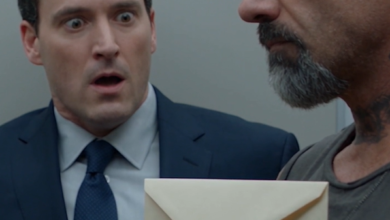
A Biker Tore Down My Airport Welcome Banner Before I Could Hug the Returning Soldier—and Then Asked My Oldest Son Where He Had Hidden His Brother
Daniel laughed.
It was a small, embarrassed sound, the kind people make when a child says something unfortunate at dinner.
“Mom, this man has been bothering the family for weeks.”
I looked at Dean.
He still held his arm where I could take it. Not around me. Not pulling.
Waiting.
The handkerchief lay open against my palm.
Three blue stitches.
I rubbed the thread with my thumb until it hurt.
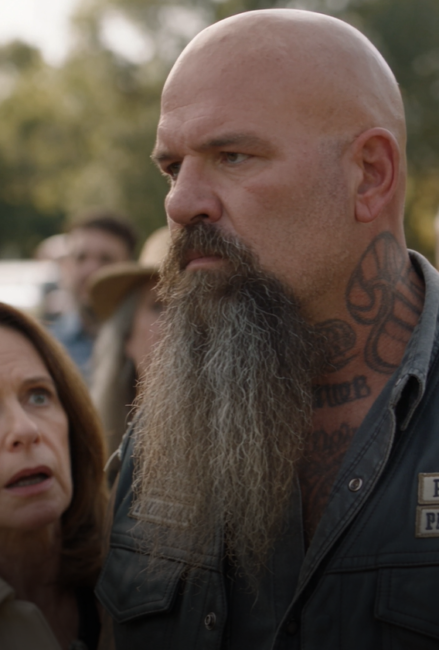
“Did you see Aaron?”
“Yes.”
“Alive?”
“Yes, ma’am.”
An airport police officer approached. Behind him, somebody stopped the little portable speaker that had been playing patriotic music.
The sudden quiet made everything worse.
Daniel stepped forward with both hands open.
“My mother’s been through a lot. There’s some confusion.”
The officer looked at me.
“Ma’am, would you like to sit?”
“I’d like him to answer.”
I pointed at Daniel.
For a moment, my son looked offended.
Not frightened.
Offended that I had said it in front of people.
The soldier took a step away from our banner.
“My name is Nathan Price,” he said. “I was invited to participate in a tribute.”
Daniel said, “Nathan, let us handle this.”
But Nathan was looking at me.
“I’m sorry. I thought you knew.”
My stomach turned.
Around us, passengers kept moving toward baggage claim. A little boy dragged a suitcase shaped like a dinosaur. Someone complained that we were blocking the walkway.
My world had opened underneath me.
The airport still needed its floor clear.
The officer guided us toward a seating area and asked everyone to stop crowding around. He separated the people who had organized the event from the people trying to understand it.
Dean handed over his identification.
He admitted tearing the banner.
“It was paper. It belonged to her,” he said. Then he looked at me. “Still shouldn’t have torn your work.”
I almost laughed.
I had spent three evenings painting it.
“Where is Aaron?”
“Outside Dayton. A residential rehabilitation place called Hawthorn House.”
Daniel shook his head.
“He has no access to medical information. He’s a volunteer driver.”
That sounded reasonable.
Dean had always worked with engines. He wasn’t a doctor. He wasn’t family.
And fourteen months earlier, I had stood beside an enlarged photograph of Aaron while our pastor spoke about loss.
Could one terrible man undo all that with a handkerchief?
Dean saw the doubt.
He took out his phone but didn’t push it toward me.
“Aaron asked me to bring this. You can hear it when you’re ready.”
Daniel moved.
The officer lifted one hand.
“Let her decide.”
On Dean’s screen, a man sat beside a window.
His hair was shorter.
His mouth pulled slightly to one side.
Then he raised his left hand.
The thumb bent outward.
“Ellie,” he said slowly. “Did you save the red cup?”
I covered my mouth.
If my son had been close enough to ask about a kitchen cup, whose grief had I been living inside for fourteen months?
Aaron called it the red cup even after most of the color wore away.
It was an enamel camping mug he bought at a yard sale when he was fifteen. There was a black chip near the handle and a crooked white line where he’d once tried to paint over it.
He drank everything from that cup.
Coffee.
Tomato soup.
Water when every other glass was clean.
The summer before his last Army assignment, Dean helped him rebuild a used motorcycle in our driveway. Aaron caught his thumb badly enough to need treatment, and afterward it never straightened quite like the other one.
Dean blamed himself.
Aaron blamed the wrench.
I blamed both of them and brought lemonade.
Daniel came by that afternoon carrying a new shirt still in its store bag. He stood clear of the grease while Aaron teased him.
“Your brother’s got sensible hands,” I said.
Aaron looked down at his bandaged thumb.
“Guess you picked your favorite.”
I told him not to be foolish.
But I remembered the sentence.
Especially later.
At the airport, I watched the video three times.
The man on the screen was Aaron.
Not because of the cup alone.
Because he looked away before asking the question, as though wanting something from me still embarrassed him.
The officer asked whether I needed medical assistance.
I said no.
I needed an address.
Daniel sat beside me.
“Mom, you don’t understand his condition.”
“Then explain.”
“He had a brain injury. He gets confused. He’s vulnerable to people telling him things.”
“Did you know he was alive?”
He looked toward the phones.
“I’m not discussing private health matters here.”
I stood too quickly.
Dean moved his arm closer without touching me.
I took it.
The officer asked Daniel the question again, this time without letting him talk about my health or Aaron’s.
“Yes,” Daniel said.
The word was quiet.
It still reached everyone.
He began explaining that the accident had initially been chaotic, that Aaron had been unidentified briefly, that there had been transfers between hospitals.
Some of that would turn out to be true.
None of it explained fourteen months.
I asked about the memorial.
Daniel rubbed his forehead.
“We thought he might never wake up.”
“That isn’t dead.”
“No.”
A woman carrying a camera lowered it.
Nobody seemed to know where to look.
Dean told the officer he had reported concerns to Hawthorn’s social worker and to a community advocate. He had also tried reaching me directly.
Daniel interrupted.
“He was upsetting her.”
I thought of my phone.
Daniel had replaced it after the memorial, transferred my contacts, and set up the settings because I kept losing things.
At the time, I’d called him thoughtful.
Now I asked Dean which number he had used.
He showed me.
Mine.
Six calls.
Several messages.
I had seen none of them.
The officer explained that we would need to make formal reports and pursue the financial and care questions through the appropriate agencies. He couldn’t resolve fourteen months in an arrivals hall.
I understood.
But I wasn’t going home with Daniel.
I called my sister, Joan.
While we waited, I opened the contacts on my phone.
Why was the man bringing me my son’s voice listed among the people I had supposedly chosen never to hear from again?
Nathan Price was exactly who his identification said he was.
A serving soldier.
A stranger.
He had flown into Dayton to visit family and agreed to attend a veterans’ charity event arranged around his arrival.
Daniel’s organization reimbursed the flight.
The instructions Nathan received described a grieving mother who wanted a symbolic welcome for servicemembers because her younger son had died.
A tribute.
Not an impersonation.
Nathan had been told I understood.
Then Daniel introduced him with words Nathan hadn’t agreed to.
“My mother’s boy is finally home.”
Nathan thought it was emotional shorthand.
Until he saw my face.
He gave the messages to the officer and later to the investigator handling the complaint.
Before leaving, he crouched slightly so I didn’t have to crane my neck.
“I should have stopped it sooner.”
“You stopped when you understood.”
He swallowed.
“I’m sorry anyway.”
For a little while, I hated him.
His clean uniform.
His whole body.
His ability to leave the airport and go somewhere ordinary.
Then I hated myself for that.
Joan squeezed my hand.
“He isn’t the one who lied to you.”
Dean drove separately to Hawthorn House. Joan took me in her car.
We didn’t arrive demanding to enter a locked ward.
Dean had called ahead with my permission. The social worker, Mara Benton, met us in a small office beside the reception desk.
She looked tired.
Not guilty.
Tired in the way people look when a file has stopped making sense.
Aaron had arrived after months of hospital care and rehabilitation. Daniel was the family contact and had been appointed to manage certain affairs during the period when Aaron couldn’t manage them himself.
Initially, visits had been limited for medical reasons.
Later, Mara said, the record reflected that his mother did not want contact.
I stared at her.
“Who told you that?”
“Your older son.”
“Did anyone ask me?”
She looked down.
“No.”
I waited.
She didn’t fill the silence with excuses.
“That should have been checked.”
Aaron’s ability to communicate had improved gradually. He needed extra time, written choices sometimes, and help with certain tasks.
That did not mean he had no wishes.
Mara had begun reviewing those wishes after Dean raised concerns.
Then she placed a document on the table.
A statement attributed to me.
It said contact with Aaron would worsen my health and that I preferred updates through Daniel.
My name was written at the bottom.
Not my signature.
But something trying to look like it.
Joan leaned closer.
“Ellie?”
“I didn’t write this.”
Mara made a note and explained what she was reporting and preserving. She said an independent review of Aaron’s decision-making support and access to family was already being arranged.
Through the glass beyond her office, I saw a wheelchair.
A man’s hand rested on its rim.
The left thumb bent outward.
Before I could move, Mara asked one gentle question.
“Would you like me to ask Aaron whether he’s ready to see you?”
Why had everyone spent so long deciding what we could bear without asking either one of us?
He said yes.
One word.
Mara came back smiling, then stopped when she saw I was crying.
“Take your time.”
I didn’t have any more time I wanted to waste.
Aaron sat beside the window from the video. A paperback rested open on his lap, though he wasn’t looking at it.
He watched the doorway.
I stopped there.
He looked older than thirty-four.
Not old.
Just as though every day I’d missed had left something visible.
“Hi, Ellie.”
His speech was slower.
The nickname wasn’t.
I knelt before I remembered my knees wouldn’t let me get up gracefully.
He laughed once.
Then he cried.
I held his hand and let both things happen.
Later, after a nurse helped me into a chair, we spoke in pieces.
Aaron remembered the crash.
Rain.
A delivery van crossing the line.
Then fragments of hospital rooms and people speaking over him.
He did not remember the memorial.
Nobody had told him.
What he remembered was Daniel saying I couldn’t cope and didn’t want him calling.
That I needed peace.
That he should get stronger first.
Every improvement had apparently required another wait.
A better week.
A clearer voice.
A safer time.
Dean had started volunteering with an adaptive transport program after a shoulder injury kept him away from full-time mechanical work. When he saw Aaron’s name on an approved ride schedule, he thought it had to be another man.
Then Aaron recognized him.
Dean had known him since the driveway motorcycle.
That was why a stranger hadn’t discovered my son.
Someone who remembered him had.
With Aaron’s consent and help from his own advocate, records began moving to people independent of Daniel.
There was an injury settlement.
A substantial one.
Money meant for Aaron’s care, equipment, housing, and future needs.
Daniel had been managing access to portions of it under court oversight.
The accounts required review.
So did invoices from a care-coordination business connected to Daniel.
I hired an attorney named Denise Carter.
Aaron’s advocate worked with separate counsel for him.
That distinction mattered. Loving my son didn’t entitle me to make all his decisions after someone else had done exactly that.
The first financial review found payments that didn’t match the services described.
A modified vehicle billed to Aaron’s account.
He’d never ridden in it.
Consulting charges.
Administrative fees.
Transfers requiring explanations.
At the same time, Daniel’s charity had been raising money through stories about military families, recovery, and reunion.
The airport video would have given him a new campaign.
A mother struggling to recognize a returning soldier.
A man willing to guide her.
The raw footage showed something else.
My questions.
Nathan’s objection.
Dean putting himself between me and the camera.
Denise preserved copies from people who had filmed independently.
That evening, I sat in Joan’s kitchen with the red handkerchief spread beside a stack of statements.
Daniel hadn’t needed me to believe the stranger was Aaron forever.
Had he only needed a few seconds of confusion he could edit into proof that I no longer knew my own mind?
Daniel called the next morning.
I let Denise hear the voicemail.
He said Dean had exploited an injured veteran. He said I was being manipulated. He said Aaron needed quiet and I was putting his recovery at risk.
Then he said something worse.
“If you keep this up, you won’t be helping either of your sons.”
I had spent forty-four years hearing love inside that voice.
Now I listened for what the words required me to do.
Stop.
Wait.
Let Daniel handle it.
He contacted Hawthorn and objected to the visits.
Mara told me they would not simply accept his account of our wishes again. Aaron’s advocate and care team were reviewing the arrangements, and any actual legal restrictions would be checked against the orders themselves.
Nobody promised everything could change overnight.
But the next afternoon, Aaron called me.
A staff member helped set up the phone.
Daniel wasn’t in the room.
“Did you find the cup?”
“Yes.”
“Don’t wash the chip off.”
I laughed so hard Joan came running.
Then the attacks began.
A short airport clip appeared online.
Dean ripping the banner.
Me staring at Nathan.
No handkerchief.
No questions.
No Daniel admitting Aaron was alive.
The caption described a confused mother and a disruptive biker ruining a tribute.
Dean’s workshop received calls.
Someone sent the transport program a complaint accusing him of violating privacy.
The program paused his assignments while it reviewed what happened.
He cooperated.
He provided the messages Aaron had authorized and the reports he’d made before the airport event.
It still cost him work.
One afternoon, I found him beside his Harley outside Joan’s house, rubbing a thumb across a scratch in the tank.
“You shouldn’t have had to do this,” I said.
He looked up.
“No.”
I appreciated that he didn’t pretend otherwise.
Daniel also sent relatives a letter claiming I had become susceptible to suggestion.
One cousin called to ask whether I knew what day it was.
I told her.
Then I told her to ask about Aaron.
She didn’t.
Denise helped me document my decisions and secure accounts Daniel had been assisting with. An independent physician assessed concerns raised about my health without treating an edited video as a diagnosis.
There were passwords to change.
Authorizations to revoke.
A door lock Joan insisted we replace because Daniel still had a key.
Ordinary tasks.
Each one showed me another place I had handed him control.
Then Denise asked about Aaron’s last visit before the crash.
“Was there any reason Daniel could convince him you didn’t want contact?”
I stared at the folder between us.
For weeks, I had been telling everyone my son was kept from me.
That was true.
It wasn’t all of it.
What would happen when Aaron learned that the lie his brother used had grown from something I had actually said?
Aaron came home from the Army with pain he didn’t know how to explain.
At first, he made jokes about it.
Then he stopped coming to dinner.
There were appointments, missed shifts, and medication that became something we argued about without understanding.
Daniel always arrived with a solution.
Pay this bill.
Cancel that card.
Tell Aaron he had to take responsibility.
I listened because Daniel sounded calm.
Aaron sounded angry.
I mistook calm for truth.
Three days before the crash, Aaron called asking to stay with me while he arranged treatment and a new place to live.
I heard only another emergency.
Another request.
I told him I couldn’t keep fixing things.
He said he wasn’t asking me to fix him.
I said, “Then call when you’re ready to be my son again.”
At Denise’s table, the words sounded even worse than I remembered.
I had wanted to frighten him into getting help.
Instead, I gave Daniel a sentence he could use like a locked door.
After the crash, I asked Daniel whether Aaron had been on his way to treatment.
He said yes.
Then, days later, he said the hospital had lost him.
I didn’t receive an official death certificate.
Daniel said paperwork would take time, that the accident investigation was complicated, that I should let him deal with it.
The memorial was our family’s service.
Not an official military funeral.
Aaron had already left active duty.
There had been no casualty officer at my door, no government confirmation that my son was dead.
Only Daniel.
And me, too ashamed of my last words to ask the questions I should have asked.
I told Aaron on a Thursday afternoon.
His advocate offered to stay nearby. He chose to have her outside the room.
I repeated what I had said.
All of it.
He stared at his hands.
For a long time, the only sound was a cart rattling in the hallway.
“Danny said you meant it.”
“I was angry. I was wrong.”
Aaron looked up.
“Both can be true.”
“Yes.”
He rubbed his thumb along the wheel rim.
“I kept thinking if I talked better—”
His voice stopped.
I waited.
That was something I was learning.
“I thought you’d want me when I sounded normal.”
I put my hands flat on my knees so I wouldn’t reach for forgiveness like something he owed me.
“I want you now. Exactly now.”
He cried.
He didn’t let me hold him.
I stayed.
Over the next weeks, Aaron asked for changes to the arrangements controlling his affairs. An independent assessment addressed the decisions he could make and the support he needed.
His difficulty speaking had too often been treated as permission not to listen.
The financial proceedings brought Daniel back into a room where answers would be recorded.
His attorney disputed the allegations.
Daniel described himself as an exhausted brother who had protected everyone.
Aaron asked Dean to attend.
He asked me, too.
Could I sit beside my younger son without trying to make the truth gentler for the older one?
The hearing took place on a rainy Monday.
Aaron sat beside his attorney with a communication tablet available on the table. He didn’t always need it.
Having it there meant he could choose.
Dean sat behind him.
Leather vest.
Clean shirt.
Hands folded between his knees.
Daniel arrived carrying the expression he used at charity dinners: tired but dependable, a man doing more than anyone could reasonably ask.
I recognized it.
That hurt.
The court reviewed financial records and the arrangements made while Aaron was unable to manage his own affairs.
Nobody suggested that Daniel had been wrong to help at the beginning.
The questions concerned what he did afterward.
The false statement attributed to me.
The withheld contact.
The payments.
The reports that failed to reflect Aaron’s improving abilities.
Daniel blamed misunderstandings.
He said I had refused contact.
Denise had provided my statement and relevant records through the proper process. Aaron’s attorney asked Daniel when, exactly, he believed I had signed the document Hawthorn received.
Daniel gave a date.
I had been staying with Joan that week.
The supposed signature had come from a file Daniel controlled.
He said an assistant must have prepared it incorrectly.
Then the bills.
The vehicle.
The care-coordination company.
Explanations began needing other explanations.
When asked about the airport gathering, Daniel said Nathan had been invited for a symbolic tribute.
That was true.
Then he said I had understood.
That wasn’t.
The independent footage played.
My voice filled the courtroom.
Why are you telling me to hug a stranger?
Daniel looked toward me.
For once, I didn’t look away.
His attorney asked for a break.
Before the judge ruled, Aaron lifted one hand.
His attorney leaned close, listened, then requested permission for him to address a factual point.
Aaron spoke slowly.
“Why didn’t you bring me?”
Daniel’s face changed.
“Because you weren’t ready.”
“I asked.”
“You couldn’t travel safely.”
“I asked to call.”
Daniel shifted in his chair.
“You were upset. You kept asking for things that made you worse.”
“What things?”
Daniel answered before caution caught him.
“That red cup. You wouldn’t eat unless someone brought it.”
The room went still.
He had claimed he hadn’t personally visited Aaron during much of the period when contact requests were being disputed.
He had blamed staff communication failures.
But the cup request appeared in a private visit note made after Daniel sat with Aaron and promised to bring it.
Aaron’s attorney placed that note beside the visitation record.
The red cup wasn’t proof of every allegation.
It was a small fact Daniel had forgotten to keep out of his own story.
Asked again about the visit, he admitted being there.
Asked whether Aaron requested me, he hesitated.
Then said yes.
Asked why he reported that Aaron was not seeking family contact, Daniel looked at his attorney.
No answer arrived for him.
Behind Aaron, Dean lowered his head.
Not in victory.
In relief.
The court made immediate changes to protect Aaron’s affairs and ordered further accounting. Separate concerns were referred for investigation.
I watched Daniel gather his papers.
When he passed our row, he stopped.
“Mom.”
I looked at him.
What did being his mother require now, when protecting him had already cost his brother so much?
It required telling the truth.
Even when Daniel called crying.
Even when relatives said the family had suffered enough.
Even when Aaron asked whether I still loved his brother and I had to answer honestly.
“Yes,” I said. “And he still has to answer for what he did.”
The accounting took months.
Some payments were legitimate.
Aaron had needed extensive care, and the early decisions hadn’t all been wrong.
Other charges paid for things he never received.
Some money could be recovered.
Some couldn’t.
Daniel lost control of Aaron’s finances. Independent oversight replaced the arrangements he had used to keep decisions inside his own hands.
The criminal case moved separately.
Investigators examined the false documents, disputed transfers, and representations made while Daniel controlled the money.
He eventually admitted offenses involving forged records and misuse of funds.
The sentence included prison and restitution.
No judge could order fourteen months returned.
At the airport, Dean had torn paper.
Daniel had torn time out of our lives and kept the pieces where we couldn’t find them.
Dean’s complaint with the transport program was resolved after review. He returned to volunteering, though he asked for assignments that didn’t involve our family.
He wanted Aaron to have help that didn’t depend on a friend being available.
I understood that, too.
Aaron didn’t move straight into my house.
For a while, I wanted him to.
I had a clean bedroom, a freezer full of food, and fourteen months of mothering trapped behind my teeth.
He chose supported housing closer to his therapy.
His own key.
His own schedule.
A kitchen where he could make a terrible cup of coffee without anyone calling it progress.
I helped when he asked.
Sometimes I had to sit on my hands.
We met on Tuesdays.
Not every Tuesday was good.
Some days his speech tired him. Some days I said something wrong and felt the old urge to explain until he forgave me.
I learned to stop.
To apologize.
To come back when invited.
One Saturday, Dean drove him over in an adapted van borrowed through the program.
The Harley stayed home.
Aaron wanted to help me sort the garage.
We found the remains of the airport banner rolled inside a grocery bag.
Blue paint.
Yellow stars.
A tear straight through the middle.
“I’m sorry about that,” Dean said.
Aaron looked from the paper to him.
“Pretty dramatic.”
Dean rubbed his beard.
“Yeah.”
I laughed first.
Then Aaron.
The sound was uneven, interrupted by breath, and entirely his.
We didn’t repair the banner.
Aaron asked for the blank section on the back.
He took a marker, steadied the paper with his left hand, and wrote slowly.
I didn’t look until he turned it around.
Tuesday. Lunch. My place.
No ceremony.
No camera.
An invitation.
I put it on the refrigerator.
Before he left, I brought out the red cup.
The black chip faced my palm.
He took it carefully and ran his thumb along the worn handle.
“Saved it.”
“Yes.”
He nodded toward the invitation.
“Don’t be late, Ellie.”
After the van disappeared around the corner, I stood beside the refrigerator, wondering what my son would choose to cook.