A Biker Snatched the Mayor’s Microphone During a Memorial—Then a Little Girl Recognized the Man on the Stone and Exposed the Widow Who Had Been Paid for Twenty Years
My mother reached for the microphone before the mayor did.
Ben pulled it away from her hand, then placed it on the lectern. The speaker gave a little squeal that made my daughter cover her ears.
“We’re not doing this here,” Mom said.
Behind her, somebody began folding the programs into a neat stack.
As if tidying could put the morning back together.
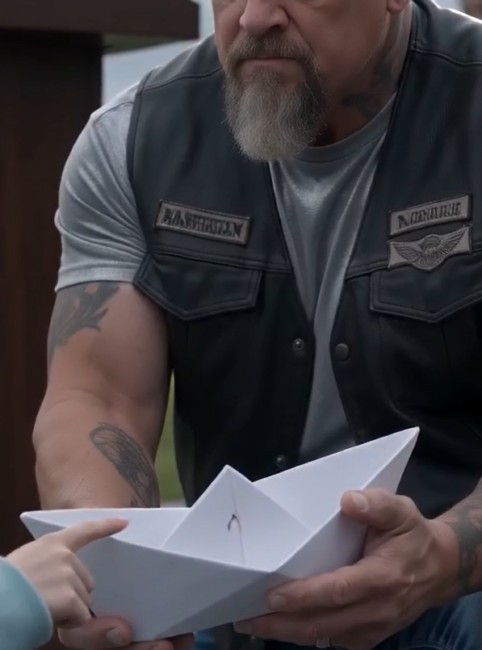
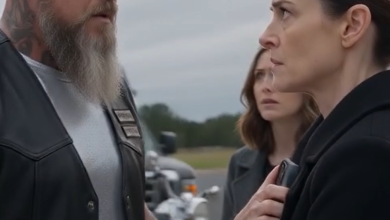
My brother stood in front of a memorial bearing our father’s name. His leather vest was worn white at the seams, and tattoos disappeared into both sleeves of his shirt.
The mayor looked from him to Mom.
“Elaine, do you know what he’s referring to?”
“My son’s been angry for years.”
That was true.
It was also an answer to a different question.
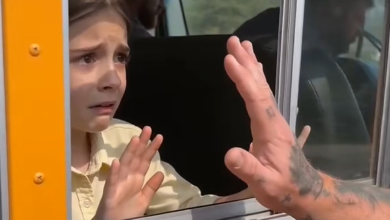
Ivy stood beside me holding a paper boat. The man beneath the bridge had made it for her two days earlier, when we were delivering sandwiches with a neighborhood outreach group.
He had called her Skipper.
Mom said she must have misunderstood.
Ben said he had gone back and spoken to him.
Then he said Mom had signed a fund declaration that month stating there had been no contact with Daniel Mercer.
Our father.
Her husband.
The man whose name the mayor had just read among those lost in the warehouse fire twenty years earlier.
An event volunteer asked Ben to step away from the stage.
He did, but he kept looking at Mom.
I followed him behind a row of empty folding chairs.
“How do you know it’s Dad?”
He took a photograph from his jacket.
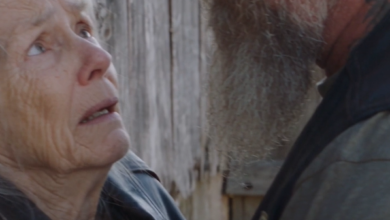
The face was thinner than I remembered. A gray beard covered the jaw. One eye didn’t seem to focus on the camera.
For a moment, I felt foolish.
I had spoken to that man. I had handed him a sandwich and asked whether he wanted mustard.
I hadn’t recognized my own father.
Then I remembered being nineteen the last time I saw him.
Twenty years could change a face.
They could also change what you wanted to see in one.
“He remembers things,” Ben said.
“Things he could have heard?”
His expression sharpened.
“You sound like her.”
I looked at the ground.
He wasn’t being fair.
I wasn’t being certain either.
Mom joined us carrying Ivy’s cardigan. She tried to put it around my daughter’s shoulders, but Ivy stepped closer to me.
“It’s chilly,” Mom said.
“I’m not cold.”
The mayor came down from the platform with the fund administrator. He asked whether we would sit in the community-center office while they worked out what had been alleged.
Mom said Ben had interrupted a ceremony honoring people who couldn’t defend themselves.
Ben looked toward the stone.
“One of them can.”
The administrator said a name on a memorial didn’t establish a legal identity, and a photograph didn’t settle one either.
I was grateful somebody had said it.
Then Ben put a copy of Mom’s recent declaration on the table.
He’d asked her about the fund after speaking to Daniel. She responded by sending him a packet of renewal papers, insisting everything she received was legitimate and telling him to read it before accusing her. He had. The page she’d offered as protection was now lying between us, dated less than three weeks before Ivy met the man beneath the bridge.
Her signature looked exactly like the one on my birthday cards.
If this was only a mistaken resemblance, why had she stopped looking at the photograph?
Two summers before the fire, Dad taught me to fold a paper boat at our kitchen table.
Ben had arrived on his Harley, and Mom told him to park farther from the tomatoes because the exhaust made the porch smell.
Dad gave him a chair anyway.
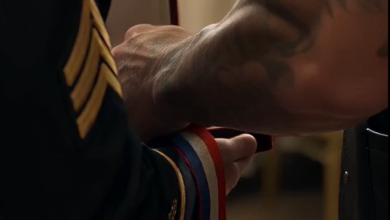
His hands smelled of orange hand cleaner. There was a short notch in his right thumbnail from an old machinery injury.
When he folded paper, the notch caught the crease and made a tiny extra dent near the bow.
“That one’s yours,” he told me.
He called every child Skipper until they earned the complicated title of Captain.
Mom brought tea in a yellow thermos. Two sugars, one slow stir. She set a paper boat beside it so Dad would know which lunch bag was his.
It was their little signal.
Ben teased them about making a shipping company out of lunch.
Mom flicked sugar at him.
Dad laughed hard enough to spill tea on the table.
At the community center, Ivy unfolded her boat and showed me the extra dent near its bow.
I wanted that small mark to be enough.
It wasn’t.
The fund administrator, Martin Shaw, explained the payments. The Riverbend Memorial Fund was a private trust supported by employers, residents, and donations after the fire.
It had provided immediate assistance to affected households, then continuing support under rules the trustees approved.
Mom had received monthly payments for twenty years.
The fund wasn’t a federal veterans program. It wasn’t the city’s general budget. But a recipient still had to report information that changed the basis for support.
Especially contact with someone listed as lost.
Martin showed us the separate sections for immediate aid and continuing support. He said the trustees would examine the rules in effect for each period rather than judge twenty years by one current form. I appreciated that precision. Mom deserved an investigation into what she had done, not a story that made every meal she’d bought us proof of a crime.
“I reported what I knew,” Mom said.
Martin asked whether she wanted him to explain the old file to us.
She said yes immediately.
That steadied me.
Maybe Ben had misunderstood a form.
Maybe the payments continued for reasons that had nothing to do with whether Dad was dead.
Mayor Owen Hart said the city had inherited the memorial list from the original committee. He read the names each year but didn’t personally review the family claims.
Ben had accused him from the stage.
Now Ben looked uncomfortable.
“Then check it,” he said.
The mayor nodded.
“We will.”
Mom touched my elbow while the men arranged calls.
“He frightens Ivy.”
I looked at my daughter.
She was sitting beside Ben, tracing the tattoo on his wrist with a finger while he held the boat’s torn edge steady.
No fear there.
Ivy looked up.
“The bridge man had a cup like Grandma’s. Yellow.”
Mom’s hand left my arm.
“Lots of people have yellow cups.”
She was right.
I told myself that while Martin pulled the original claim from an archive box.
On top was a handwritten notation that the family had reported no remains were recovered.
Below it, a later statement requested that assistance continue because Daniel had never returned or contacted them.
Ben pointed at the date.
“That’s when I stopped getting answers.”
What had happened between the fire and that second statement?
Mom wasn’t the person who first entered Dad’s name as dead.
The original committee had listed him among workers and volunteers who failed to return after the fire. Early reports were incomplete, and later memorial materials repeated the same list.
Martin read the records slowly.
He didn’t turn guesses into facts just because we were frightened.
There had been confusion, missing belongings, and accounts from survivors who thought they saw Daniel trapped near the loading bay.
For years, our family had treated those accounts as a body.
They weren’t.
The fund initially supported a household whose wage earner was missing after a disaster. Later decisions depended on additional declarations and the information available at the time.
Mom’s first application looked painfully ordinary.
Mortgage statement.
Utility bill.
My college expenses.
Ben’s name written under adult children.
I could see the woman who had opened envelopes at our kitchen table while neighbors brought casseroles she couldn’t eat.
I took her hand.
She let me.
Martin explained that his predecessor had handled renewals for many years. Several parts of the file were photocopies, and not every missing page could immediately be accounted for.
Suspicion shifted toward the fund itself.
Had an administrator kept payments flowing without checking? Had somebody used Mom’s signature on routine forms she barely understood?
Mom said she signed where she was told.
Ben asked who had told her.
She named the former administrator, who had retired to Florida.
Martin agreed to contact him and preserve the records.
For the first time that morning, Mom relaxed into her chair.
I noticed it.
I didn’t know what it meant yet.
Ben and I left Ivy with a friend and went back beneath the bridge with an outreach worker named Renee.
She asked us not to crowd Daniel or bring cameras.
The man had moved his bedding behind a concrete pillar. A blue tarp shielded it from spray, and his shoes stood upside down on a piece of cardboard.
Ben said his name.
Daniel looked up.
He stared at my face for a long time.
I wanted him to tell me something nobody else could know. My first bicycle. The song he used to ruin by singing the wrong words. Instead, he asked whether I still bit the inside of my cheek when I was nervous. I stopped doing it at once. Ben looked at me, and I realized he’d noticed the same small movement all morning.
“Katie?”
Nobody called me Katie anymore.
I sat on the dry end of a crate.
“Did you make the boat?”
He nodded.
“For my daughter?”
His hand lifted to his mouth.
Ben turned away.
I didn’t hug him immediately. He was shaking, and Renee said we could give him time.
Then I saw the thermos.
Yellow plastic. A crack beside the handle sealed with silver tape.
Mom’s.
Not proof by itself.
But I remembered dropping it at sixteen and trying to hide the crack before she found it.
“Where did you get that?” I asked.
Daniel glanced at Ben.
“Elaine brings tea.”
He touched a folded paper boat beside the cup.
“That’s how I know which bag is mine.”
Was the woman holding my hand that morning still using their old signal beneath this bridge?
Renee didn’t let us take Daniel straight to the memorial.
Ben wanted to.
So did I.
She asked what he wanted.
Daniel said somewhere quiet.
We drove him to a day center where he already knew staff. He accepted clean clothes, a shower, and a private room to speak with us.
The meeting wasn’t a reunion photograph.
It was a man asking whether the door would lock behind him.
Renee showed him how it worked and left it open.
He relaxed a little.
Over several visits, we learned about the fire and what followed. He described injuries, confusion, time in care under incomplete identifying information, and stretches he couldn’t reliably remember.
Some details would later be checked against records.
Others stayed uncertain.
An old coworker agreed to meet him at the center. They spent twenty minutes arguing about a machine they had repaired before either said much about the fire. Later, the coworker told the attorney he recognized Daniel, but would still answer whatever questions were needed. Familiarity could support the records. It didn’t give any of us permission to skip them.
What he remembered clearly was Mom coming to see him after he finally contacted her.
He thought it was within the first year.
Renee wrote that down as his recollection, not an established date.
He said she told him the children wanted nothing to do with him.
I looked at Ben.
We had been grieving.
We had never been asked.
An attorney helped Daniel begin proving his identity and requested the fund records through the proper channels. Old photographs, employment information, medical records, and surviving witnesses supplied pieces that a paper boat couldn’t.
The financial file supplied something else.
Twenty years of payments.
The earliest money paid bills I remembered. Later deposits continued after I had a job, after the mortgage was cleared, after Mom began giving speeches as a representative of the bereaved families.
The payments didn’t become improper simply because her circumstances improved. The issue was what she reported about Daniel.
In renewal after renewal, she confirmed no contact.
Daniel kept some of her notes in a tin.
They weren’t romantic letters.
“Don’t come to the house.”
“Keep this for groceries.”
“I’ll bring the bag Friday.”
Several envelopes carried dates and handwriting I knew.
One enclosed a money-order receipt from years before.
Martin located a copy of a question sent to Mom when somebody reported a possible sighting. Her reply said the person wasn’t her husband and asked the fund not to distress her children with it.
The sighting described Daniel’s damaged thumbnail.
Ben put the paper down.
“She didn’t miss him,” he said. “She kept him missed.”
Mom called me before dinner.
“Those men will tell you anything for money.”
“He’s not those men.”
She paused.
Then said Ben had always wanted revenge because she refused to finance his motorcycle shop.
That wasn’t how his business began.
She knew it.
By morning, a statement appeared on the memorial committee’s page asking people to avoid unverified claims from estranged family members.
Who had decided we were strangers to our own father?
Mom didn’t need to shout at us.
Other people did it for her.
A woman who organized the annual memorial called me at work and asked whether I understood how cruel this was to Elaine.
An uncle said Ben had humiliated our family in front of children.
Somebody posted the bridge photograph beside a picture of Mom receiving a community-service award.
The caption asked which person looked trustworthy.
I stared at it longer than I should have.
Renee reminded us that Daniel didn’t owe the internet a tidy appearance before his account could be heard.
He did owe investigators information they could check.
Those were different things.
Mom contacted the day center and said her husband had been confused for years. She asked that he not be allowed to sign documents without family involvement.
Then she caught herself.
Her husband.
She had said it to a staff member who made a note.
It wasn’t a legal conclusion.
It was another contradiction to preserve.
Daniel became frightened after the call. He packed his new clothes into the old sack and said he should go back under the bridge.
Ben sat by the door.
Not blocking it.
Just sitting where Daniel could see him.
“You can leave,” he said. “You don’t have to disappear.”
That distinction seemed hard for Dad.
He asked Ben whether people could force him into a photograph for the news. Ben said no and asked staff to help keep visitors from filming inside the center. By then, somebody had offered to pay for an interview. Dad looked at the amount as if it might buy his way out of being a problem. Ben put the offer aside.
It was hard for us too.
Ivy asked why people were saying her boat came from a liar.
I told her grown-ups sometimes decide what to believe before they finish listening.
She wanted to take the boat to school and explain.
I asked her not to become the person responsible for proving Grandpa existed.
She cried because she thought I was taking his side away from her.
I held her until she could hear the rest.
Mom sent me a photograph of the kitchen after the fire: unpaid bills, flowers, my college acceptance letter beneath a mug.
“Remember who stayed,” she wrote.
I remembered.
That was what made it hurt.
The mayor issued a new statement saying the city would cooperate with an independent review and that the memorial committee shouldn’t speak for the fund investigation.
The earlier post came down.
Screenshots remained.
Ben received a call from a customer canceling a repair. The customer said he didn’t want to get involved with a family trying to shake down a charity.
Ben finished repairing the customer’s engine anyway, then called to arrange pickup. He wouldn’t keep somebody’s truck as leverage.
That afternoon, Daniel asked for us both.
He had been looking at a copy of the old warehouse investigation.
His name appeared beside an inspection checklist.
I thought he wanted to explain how someone forged it.
He didn’t.
“I signed that,” he said.
What had our father done before the day we lost him?
The loading-bay exit had been chained after hours.
Daniel knew.
The checklist said the routes were clear.
He signed it because the manager said the chain would be removed before the next shift and because Daniel wanted the argument over.
It wasn’t.
During the fire, people reached that exit and found it blocked.
The old investigation had addressed the building’s failures. Daniel’s presumed death meant some questions about his account were never answered directly.
Now they could be.
I watched him turn the page.
His thumbnail caught the edge.
The same notch that made the boat look familiar had signed something that mattered far more.
“Were you trying to hide?” I asked.
“At first I couldn’t remember enough. Later, yes.”
Ben stood up.
He didn’t leave.
“You knew we thought you were dead?”
Daniel nodded.
“Elaine said it was settled. Said coming back would put everything on you.”
Ben had repaired equipment at the warehouse, but hadn’t authorized the blocked exit. Mom told Daniel a reopened account would ruin their son’s life.
Daniel believed her because believing her gave him somewhere to put his own fear.
He wasn’t only a man erased by somebody else.
He had helped stay erased.
“I told myself you were better off,” he said.
I hated that sentence.
It made abandonment sound like a gift.
He saw it in my face.
“You weren’t,” he said.
No excuse followed.
Ben asked why he hadn’t trusted us to hear the truth. Dad rubbed his damaged thumbnail against the table and said he was afraid we would look at him differently. My brother laughed once, without humor. We already had. For twenty years, we looked at him as a name on stone. He had protected himself from our judgment by leaving us with grief.
He admitted knowing assistance had been paid after the fire. He said Mom described the small amounts she brought him as his share of ordinary family support.
He hadn’t known the continuing fund payments depended on declarations of no contact.
The attorney asked him about that carefully.
Daniel answered without asking us to fill the gaps.
There might be consequences beyond correcting his identity. Old records would have to be examined, and the families affected by the fire deserved an honest account.
He agreed to provide one.
That didn’t make me ready to forgive him.
It made me willing to hear the next sentence.
Mom sent a message asking to meet him alone before the review.
He showed it to Renee.
She asked what he wanted.
“Not alone,” he said.
The fund arranged a public reporting session after its independent review had gathered enough records to explain the immediate findings. Private information about other recipients would stay out of it.
Mom asked to speak.
So did Daniel.
Before the meeting, Ivy repaired the torn edge of her boat with clear tape. She put it beside a cup of tea she made for Grandpa, with two sugars and one slow stir.
“Like Grandma does,” she said.
Daniel looked at the boat.
His face folded before the paper did.
At the public meeting, would Mom still say their signal meant nothing?
The chairs were set in the same community center where Mom had once accepted flowers on the anniversary of the fire.
This time, no flowers stood on the table.
Mayor Hart opened the session and acknowledged that the city had repeated information it hadn’t revisited. He apologized to families for the confusion without pretending he could decide the fund case himself.
The independent reviewer explained the records.
Payments.
Renewals.
The reported sighting.
Mom’s response.
Daniel’s verified identity and the evidence of contact over many years.
Not one photograph.
Not one paper boat.
A record assembled from separate sources.
Before questions began, the reviewer asked the audience not to interrupt speakers or photograph documents containing private details. One woman left rather than listen to Daniel. Her brother had died in the fire. Nobody followed her or tried to turn her departure into forgiveness delayed. She had come hoping for answers, and she was entitled to decide how much she could bear.
Ben sat beside me wearing his leather vest. An older woman behind us whispered that he could at least have dressed respectfully.
He heard her.
He didn’t turn around.
Daniel spoke about leaving us without answers and about signing the inspection checklist. He said the truth about his return didn’t erase what the other families lost.
Nobody applauded.
I was glad.
Then Mom took her place at the microphone.
She said she had been grieving. She said the payments kept a family together. She said contact with an unwell man who sometimes claimed different names wasn’t the same as knowing Daniel had come back.
The reviewer asked about the notes.
She said she helped people in need.
About the thermos.
She said it was an old cup anybody could have.
Daniel looked at her.
“Two sugars,” he said quietly.
Mom shook her head.
“Don’t do that.”
“One stir.”
“Stop.”
The reviewer asked whether she denied delivering bags to the same man she now recognized as her husband.
“I left things,” she said. “I didn’t sit and visit.”
He pointed to the wording she signed: no direct or indirect contact, and no information indicating Daniel was alive.
Mom looked out at the room.
For a second, she seemed to be waiting for somebody to rescue her with a kinder question.
Then she saw Ivy’s paper boat in my hand.
“You weren’t supposed to give those to strangers,” she said to Daniel.
His head lifted.
“You said the boat told you which bag was yours.”
The room became very quiet.
Their private signal.
Not an anonymous donation.
Mom pressed both hands against the table.
“They paid a widow,” she said. “Nobody was going to pay for what we actually had.”
I heard somebody begin crying behind me.
It wasn’t Mom.
The reviewer ended the exchange rather than turn it into a spectacle. The evidence would be referred through the appropriate channels, and the fund would address recovery of improper payments.
Outside, Ben handed the microphone stand back to the volunteer who had carried it out.
“Sorry about the first one,” he said.
The volunteer nodded without smiling.
What would remain of our family when the payments stopped and nobody could hide behind the stone?
The fund stopped Mom’s payments while the findings were addressed.
It didn’t stop everyone else’s.
The trustees commissioned further checks because one family’s fraud didn’t make every grieving household dishonest. Martin explained that at the next meeting, and repeated it when reporters asked.
Recovery claims and the criminal investigation took time. Mom eventually entered a plea to charges arising from knowingly false declarations and the payments obtained through them.
I learned to say what happened without claiming every dollar she ever received had been stolen.
The first assistance came during real confusion.
The later lies kept it coming.
Both parts belonged in the record.
Daniel gave a statement about the blocked exit and the checklist. The new review added his account to the history of the fire and acknowledged his wrongdoing instead of replacing it with another clean version of a hero.
Some families wanted to see him.
Others didn’t.
He didn’t ask me to persuade them.
The city corrected the memorial information after consulting the affected families. Daniel’s name would no longer be presented as a person who died there.
The other names stayed.
Their absence deserved more than becoming background to our discovery.
Ben went to the next remembrance without grabbing anything. He stood near the back, took off his sunglasses, and listened.
I stood beside him.
Mom didn’t attend.
I still visited her sometimes. I wasn’t ready to make every childhood memory disappear because of what she did later.
I also stopped letting those memories answer questions about her conduct.
She asked whether I understood how alone she had been.
I told her I did.
Then I told her being alone didn’t entitle her to make us fatherless.
We sat without speaking for a while.
Daniel moved into a small room arranged with an outreach program. It took appointments, documents, and people who kept showing up after the news stopped calling.
Renee helped him find support he would actually accept.
He still flinched when somebody closed a door too quickly. He still lost track of dates. Those things didn’t disappear when his name was corrected.
Once, he missed a planned lunch and Ben found him walking toward the bridge with his coat over one arm. He wasn’t trying to trick us. He had become overwhelmed by an appointment and followed the route he knew. We changed the next week’s plans instead of treating a room key as proof that twenty years outdoors had already been solved.
Neither did my anger.
He learned to ask whether I wanted a visit instead of assuming survival meant access to my life.
Some Saturdays I said yes.
On one of them, Ben brought breakfast to my kitchen. He parked the Harley away from the tomatoes, though I didn’t have a porch garden like Mom’s.
Old habits traveled strangely.
Ivy put out four chairs.
Then she made place cards from scrap paper.
Mom used to do that for holiday meals so nobody argued about where to sit. Ivy didn’t remember the arguments, only the pleasure of finding your name.
She wrote Grandpa on one card.
Daniel held it carefully.
His damaged thumbnail bent the corner.
“That’s okay,” Ivy said. “Boats need bends.”
He smiled.
The yellow thermos sat on the counter. We had washed it and kept the silver tape because the crack was part of its history too.
This time, nobody left it under a bridge.
Daniel looked from the place card to the chair, then toward me.
“Is that chair still mine?”