A Biker Blocked a Veteran’s Hearse and Refused to Let the Funeral Continue—Then His Granddaughter Discovered Why Her Mother Had Identified a Man Who Was Still Alive
My mother took the phone out of Lucy’s hand.
Not gently.
Jonah reached for it, then stopped before touching her. He stood beside his parked Harley with both palms visible while the funeral director hurried down the driveway.
The hearse hadn’t moved beyond the gate.
Behind its windshield, the driver watched us without turning off the engine.
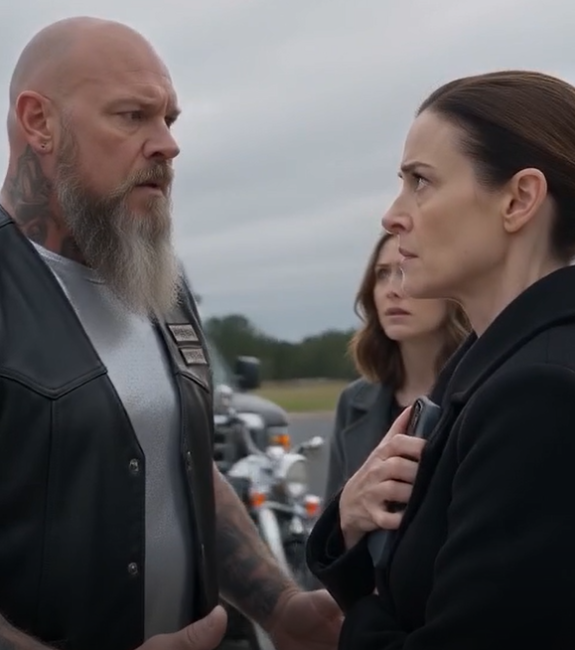
“Claire,” the director said, “what is happening?”
Mom held the phone against her black coat.
“My ex-husband is upsetting my children.”
My father looked at me.
I hadn’t seen him in four years. I knew his beard had gone gray because he sent photographs sometimes, usually of something he’d repaired rather than himself.
I answered those messages less often than I should have.
Now he was standing between a hearse and the road, saying the man inside wasn’t my grandfather.
Lucy had seen the shelter video.
I had seen six seconds before Mom took the phone.
An old man in a borrowed cardigan, tapping a plastic cup three times. Two pale lines on his left wrist. A voice calling my sister Sparrow.
It looked like Grandpa.
It sounded like him.
But he was supposed to have died eleven days earlier.
“Move the motorcycle,” Mom said.
Jonah shook his head.
“Not until they check.”
The director asked him to explain away from the cars. Dad agreed, provided the hearse remained where it was.
“I can’t decide identity in a driveway,” the director said.
“Then call somebody who can.”
He did.
The director also asked the driver to close the partition and keep the mourners away from the vehicle. Dad hadn’t asked to open the coffin. He wasn’t treating the person inside as something to display. That mattered later, when people described him as a man who had tried to disrupt a burial for attention.
Mom looked at me while he dialed.
“You know your father.”
I did.
He used to promise he’d arrive by six and call at eight with an explanation. After the divorce, there were birthdays where his gift came but he didn’t.
He had stopped drinking years ago.
That hadn’t automatically made us trust him.
“Where did you get the video?” I asked.
“Mercy House. Yesterday.”
“Then why didn’t you come yesterday?”
“I called her.”
He pointed at Mom’s phone.
She said he had threatened her.
He said he’d asked her to postpone the funeral.
Both looked at me as if I could sort twenty years of their marriage in ten seconds.
Lucy tugged my sleeve.
“Ask him about the spoon.”
Grandpa didn’t always tap three times. Sometimes he tapped twice, paused, then added the third. In the video, it had been three quick taps.
Such a tiny thing.
Enough to frighten me.
Could Dad have found an old man who resembled him and coached the rest?
An officer arrived and asked Jonah to move his motorcycle to one side of the driveway. The officer arranged for the hearse to remain while the concern was checked.
Dad moved it immediately.
That surprised Mom.
It surprised me too.
The officer asked who had identified the deceased.
Mom answered before the director could.
“I did.”
Her fingers tightened around the phone.
If she was certain, why wouldn’t she let us watch the rest?
On Lucy’s fifth birthday, Grandpa turned breakfast into a magic show.
He tapped a spoon twice against his mug, waited until she leaned closer, then tapped once more and produced a strawberry from behind her ear.
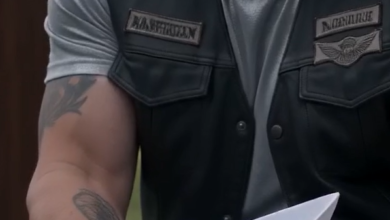
Jonah was there, wearing the leather vest Mom hated and washing dishes because he’d arrived too late to help cook.
Grandpa called him son anyway.
Lucy wanted to copy the trick. She mixed up her hands, so Grandpa showed her the two pale burn lines on his left wrist, souvenirs from an old repair-shop mistake.
“Left is scar,” he said.
Mom drew a tiny star on Lucy’s right wrist.
“Right is star.”
Later, Grandpa wrapped leftover cake in foil and gave Jonah the piece with extra frosting. Mom pretended not to notice.
For an afternoon, we almost looked like a family that had solved its problems.
That memory lasted longer than the cake.
At the funeral home, the officer put us in a small arrangement room while calls went back and forth.
I sat beside a display of brass handles. Lucy sat on my knee even though she was too old and too tall for it.
Mom returned Dad’s phone after the officer asked her to.
The complete video showed a shelter dining room, a clock above a serving hatch, and Walter Pike rubbing the scars on his left wrist.
My grandfather.
Or somebody whose face and voice I wanted desperately to recognize.
“Why is he there?” I asked.
Dad told us Mercy House accepted people who arrived without identification. Some guests had lost wallets. Some had left unsafe homes. Staff helped people work through paperwork without making a document the price of a bed.
He volunteered there twice a month, fixing doors and kitchen equipment.
He had seen Walter before, but only from behind. The old man avoided the common room whenever Dad came.
Yesterday, they met face-to-face over a broken cabinet hinge.
“He said your mother knew where he was.”
Mom stood up.
“That is not true.”
Dad opened a message thread.
He had sent her the video the previous afternoon. Beneath it were three calls with no answer, then one returned call lasting two minutes.
That didn’t tell us what she said.
I checked the video’s file information while Dad held the screen steady. Yesterday’s date. That wasn’t proof nobody had altered it, and he didn’t pretend otherwise. He gave the officer Denise’s number and offered the original recording. For once, he was asking somebody to check his story instead of asking us to trust a promise.
It told us she had seen his claim before putting on her funeral clothes.
The officer asked to speak to her separately.
Lucy slid off my knee.
“Can we go get him?”
Dad didn’t say yes immediately.
He called the shelter and asked staff to check whether Walter was still there. A woman said he was eating lunch and asked who had permission to contact him.
“Ask him if Jonah can come,” Dad said.
We waited.
She returned to the line.
“He says bring Mara. Not Claire.”
Mom heard it from the doorway.
Her face changed before she spoke.
Why did a man supposedly too confused to recognize his family know exactly whom he didn’t want to see?
Mom cried in the officer’s car.
I watched through the funeral-home window and hated myself for wondering whether the tears were real.
Then the director brought in the identification paperwork.
He explained that the name had come to them through the official release documents. Nobody at his funeral home had independently decided who the deceased was.
The body had been found with belongings linked to Walter Pike.
A jacket.
A wallet.
An old card carrying his name.
Mom had been contacted as family.
She said she believed those things and the photograph she was shown. She described the funeral as the end of eight months of worry, not a plan to deceive anyone.
For a moment, it sounded possible.
Grandpa had lost weight before disappearing. He had stopped answering calls. We had no recent photograph that looked like the healthy man on the funeral program.
The process had begun with an assumption.
Maybe everybody after that had simply trusted the previous person.
I asked why Mom hadn’t told us she was asked to make an identification. She said she wanted to spare us. That sounded like her. When Grandma died, she handled every call and let me think being protected was the same as being included. I had thanked her then. Now I couldn’t tell where protection ended.
The officer cautioned that the living man’s identity also needed verification. A resemblance, a nickname, and a video weren’t the final answer.
I nodded.
Mom came back inside carrying a tissue worn soft from folding.
“I thought it was him,” she said.
I wanted to believe her.
It would mean she had suffered a mistake instead of creating one.
Dad looked at the paperwork but didn’t argue.
He asked whether the reported belongings included a canvas shoulder bag.
They did.
“Walter said he gave that to somebody at the shelter.”
The officer wrote it down.
Suspicion moved toward the shelter. Had another guest taken Grandpa’s identity? Had staff ignored something they should have noticed?
That afternoon, Dad and I went there with the officer’s knowledge. Lucy stayed with my roommate, who promised to answer every call.
Mercy House occupied a converted church building in Knoxville. The front steps were patched concrete, and somebody had taped a handwritten repair request beside the office.
The staff member who met us, Denise, asked us to wait while she spoke privately to Walter.
No dramatic entrance.
No reunion staged in the lobby.
She came back and said he would see us in the little garden behind the kitchen.
Grandpa stood when I appeared.
Then sat because standing too quickly made him dizzy.
“Mara.”
I held him before I knew whether I was angry.
He smelled like laundry soap and the peppermint candies he used to keep in his truck.
I asked about Lucy’s call. Grandpa said he’d dialed the house number the previous night, hoping to hear her voice. Mom took the handset before Lucy could tell him about the funeral. He assumed she was angry because he’d contacted the family after being told to wait.
“Who took your wallet?” I asked.
“Nobody took it.”
He had left it in the bag he gave a guest who needed warmer clothes. He hadn’t realized until later.
“Did you tell somebody?”
“Denise.”
She had helped him begin replacing documents. Some records arrived slowly; others required calls he avoided making.
Then Denise brought a visitor log for investigators to copy.
Mom’s name appeared twice.
Once before the unidentified man died.
Once after Mom signed the identification.
Had she made a mistake, or had she made a choice?
Grandpa didn’t want to look at the funeral program.
I placed it facedown on the garden table.
The paper was damp along one corner from my hand.
“She came Tuesday,” he said.
“After the identification?”
Denise checked the date.
Yes.
Grandpa said Mom told him Jonah was asking questions and that showing up at home would make everything worse. She wanted him to stay until she arranged a quieter place.
He had refused to sign something she brought.
“What something?”
He pointed toward his jacket hanging over the chair.
Inside the pocket was a folded property agreement.
His house.
The house I thought Mom was maintaining until we found him.
An attorney Grandpa had known years earlier agreed to meet him the next morning. Dad drove, and I took an unpaid day off from the dental office where I worked reception.
At the attorney’s desk, the house stopped being a family memory and became a stack of documents.
Grandma’s old estate plan had left arrangements protecting Walter’s right to live there. Mom had a future interest, but she couldn’t simply treat the occupied house as hers to deliver to a buyer.
The attorney didn’t try to explain every clause to me at once.
He asked Walter what he had signed.
“Nothing to give it up.”
Then he asked for the proposed sale file.
Over the following days, the records showed Mom had committed money from a future sale to cover debts from her event business. A lender wanted repayment. A buyer wanted a clear path to possession.
Walter’s return would interrupt both.
His recorded death offered her the opposite.
A death-benefit claim had also been submitted. It hadn’t been paid, and the property transaction hadn’t closed.
There was still something to stop.
The buyer wasn’t a shadowy stranger working with Mom. Their representative sent records when asked and said the company had relied on information she supplied. One email requested confirmation that Walter’s occupancy rights had ended. Mom’s reply attached the death document. I stared at that ordinary attachment icon until the screen went dim.
The attorney contacted the parties handling those matters and asked them to preserve records while the identity issue was investigated.
Mom called me that evening.
“You have no idea what he’s cost me.”
I thought she meant Grandpa’s attorney.
She meant Grandpa.
For years, she had bought groceries, scheduled appointments, and driven him places. I remembered those things. I had helped with some of them.
“That doesn’t make him dead,” I said.
She went silent.
Dad stayed at a motel rather than my apartment. He said he didn’t want Mom claiming he had moved back into my life to control the investigation.
I hated that the possibility had occurred to him.
I hated more that it had occurred to me.
The next morning, the memorial page changed. Beneath the obituary appeared a notice asking people not to engage with false claims made by an estranged relative.
Someone attached a photograph of Jonah outside a bar from years earlier.
Grandpa’s attorney received a letter alleging Walter was being manipulated by a financially interested former son-in-law.
Mom had begun trying to turn a living witness into an unreliable one.
What would she do if he agreed to speak where other people could hear him?
Dad knew the photograph before I showed it to him.
“Bad night,” he said.
“Were there good nights?”
He looked down at his coffee.
“Not enough.”
That answer did more for me than a speech about how he’d changed.
He had changed.
He had also hurt us before changing.
Mom understood that history better than anybody, and she knew how to use it.
A message went to several relatives warning that Jonah had coached Walter to seek money. Another accused the shelter of exploiting an elderly veteran.
Denise began receiving calls from strangers demanding to know whether the building housed criminals.
She put a staff member near the entrance and asked us not to post its address.
People living there had problems of their own. Our family scandal didn’t give the public a right to turn their beds into a spectacle.
Grandpa agreed to stop using the garden for visits until things settled.
He still wouldn’t come home with me.
“Not yet.”
I thought he was afraid of Mom.
That was true.
It wasn’t all of it.
Two days after the funeral stopped, Mom arrived at my apartment carrying Lucy’s overnight bag.
My sister waited in the hallway.
“Tell Mara what you saw,” Mom said.
Lucy looked at me.
“Grandpa.”
“A man who looked like Grandpa.”
Lucy started crying.
I asked Mom to leave her with me for the afternoon. She refused, then accused me of helping Jonah turn Lucy against her.
I wasn’t my sister’s parent.
Knowing that made the doorway feel very small.
Dad stayed across the street, visible but far enough away that nobody could say he crowded her. Later, he told me it took everything he had not to come upstairs.
The officer who had attended the funeral contacted Mom about preserving messages and documents. I learned that from him, not from her.
She told relatives police had apologized for listening to a biker.
My aunt called to ask whether I had considered how lonely Mom must feel. I told her Walter was alive. She said she understood, but wanted the family brought back together quietly. I realized she was asking the people who had been lied to to solve the discomfort of people who had believed the lie.
They hadn’t.
Walter finally agreed to the formal identity checks investigators requested. Records, photographs, and identifying information would be compared through the appropriate offices.
He asked whether he’d have to explain why he hadn’t carried identification.
“Probably,” Dad said.
Grandpa rubbed his left wrist.
“Then there’s something I need to tell you first.”
He asked Denise to join us.
He didn’t ask for the attorney yet.
That frightened me more than anything Mom had posted.
“I wasn’t lost,” he said.
Dad looked toward the door.
“I left on purpose.”
Outside, a delivery truck rattled past the window. Inside, Grandpa reached for the funeral program I had kept folded in my bag.
He laid it beside his shelter intake slip.
Two versions of him.
Neither quite complete.
Why had a man with a home chosen to let us search for him?
Grandpa had known we were worried.
He had listened to messages Denise offered to relay.
He had let weeks become months.
“I thought you were better without me,” he said.
I pushed my chair back.
“You don’t get to decide that for us.”
He nodded.
There was no argument in him.
That didn’t make me less angry.
Before he disappeared, Mom discovered he had used savings to help Jonah reopen his repair shop after a long stretch of unstable work.
Some of the money came from an account Mom had helped manage for his future care.
It was his money, but he had hidden the withdrawal and lied when she asked about the balance.
Dad looked at me.
“I knew he hadn’t told her.”
Another silence.
Another person who had decided honesty could wait until it was convenient.
“How much?” I asked.
They told me.
Enough that I understood why Mom was furious.
Not enough to make a funeral for a living man acceptable.
Grandpa said the argument became ugly. Mom told him Jonah would drain whatever he had left and that she wouldn’t keep paying for the consequences.
Walter left before dawn with clothes, cash, and an old shoulder bag.
He intended to stay away a week.
He lost his wallet when he gave away the bag. Then shame made every call harder. At Mercy House, he used his middle name, Ray, and said he had nobody nearby he wanted contacted.
Denise believed he was avoiding a difficult family situation.
She hadn’t known they were arranging his funeral.
“You watched us hurt,” I said.
He looked at me.
“Yes.”
I wanted an excuse.
He didn’t offer one.
Denise said staff had encouraged him to contact family and accept help replacing his documents. They could offer calls, appointments, and a place to stay. They couldn’t make every frightened or stubborn guest use those offers. Walter looked embarrassed when she said stubborn. He had wanted the shelter’s kindness without telling the people providing it his whole situation.
Mom had eventually found him through a message he sent asking for documents. She visited once, before the other man died, and again afterward.
Walter thought she was arranging temporary housing while the house was repaired and financial matters settled.
He hadn’t agreed to give up his right to live there.
He hadn’t known she signed an identification.
“She said not to ring the old doorbell,” he told us. “Not until she called.”
The attorney later obtained that message from Walter’s phone records and the device Denise helped him use. It was dated after the official record of his death.
That mattered more than any of our memories.
When the identity checks confirmed Walter was alive, his attorney sought to stop use of the death record in pending transactions and protect his control over his affairs.
There would be a hearing.
Mom would attend.
Before it, an investigator asked about the two scars.
The identification statement Mom signed described them on the right wrist of the deceased.
I thought of Lucy’s birthday.
Left is scar.
Right is star.
Mom had taught her the second half herself.
Had she forgotten which hand belonged to her father, or counted on nobody asking?
Walter wore a borrowed blazer to the hearing.
Its sleeves were too long.
Dad rolled them once, and Grandpa told him he was making an old man look like a schoolboy.
Neither laughed much.
Mom sat with her attorney across the room. She didn’t look at Walter until the clerk said his name.
Then she looked away first.
There were relatives in the public seats, along with a reporter who had covered the missing-person search. Lucy wasn’t there. I had asked that she be spared another room where adults argued about whether someone she loved existed.
The hearing concerned the immediate documents and transactions. The separate investigation into the false identification was continuing.
Our attorney explained that distinction before Walter spoke.
He identified himself.
He described the house.
He admitted leaving voluntarily and lying about the money.
Mom’s attorney asked whether he had sometimes avoided his family and failed to respond when they tried to reach him.
“Yes,” he said.
Nobody rescued him from the answer.
Then the records confirming his identity were presented.
Mom wasn’t being asked to believe a stranger in a shelter video anymore.
The question was what she had known and what she had done with it.
She said the initial identification was a terrible mistake made while grieving.
She said her later visit left her uncertain because the man at Mercy House looked unwell and behaved strangely.
She said Jonah had filled the gaps with accusations.
Our attorney produced the message telling Walter not to ring the doorbell.
It used his childhood nickname.
It mentioned a bill only he and Mom had been discussing.
It told him she would call after closing arrangements were settled.
Mom said she had been trying to avoid distressing him.
Then the identification statement was placed beside an older family photograph showing Walter’s left wrist.
Our attorney asked why she had confirmed two scars on the deceased’s right wrist.
“Photographs reverse things,” Mom said.
The photograph came from a printed family album. Nobody claimed it was conclusive alone.
The attorney asked whether Mom remembered teaching Lucy the phrase about the star.
She stared at me.
Walter pushed his sleeve back.
Two pale lines.
Left wrist.
“Claire,” he said, “you knew these hands.”
Mom’s face changed.
For a moment, she looked less like a defendant than a daughter who had been caught taking something from the kitchen.
“The other man’s marks were close enough,” she said.
Her attorney spoke her name.
But she kept going.
“You promised to stay away until I could close. You always make me carry everything, and then you come back when somebody else gets to be the hero.”
Nobody moved.
The other man.
Not her father.
My aunt sat two seats behind me. I heard her inhale, then heard nothing else from that row. Dad kept his eyes on Walter instead of Mom. Nobody applauded. The revelation left us with a living grandfather, an unidentified man’s family still waiting somewhere, and a daughter who had decided one death could solve her financial problem.
Not a mistake she still couldn’t understand.
The other man.
Her words didn’t replace the documents or decide the criminal case. They sat beside the visitor records, the message, the signed statement, and the financial file.
The judge halted the disputed transactions and directed that the identity records be addressed through the proper offices.
Outside, Mom walked past me without speaking.
What would happen to the man in the coffin now that our grandfather had his name back?
The answer took longer than I wanted.
Walter’s identity was corrected through the offices involved. Letters went to institutions that had received notice of his death. Every correction seemed to uncover another place where a wrong record had already traveled.
Dad drove him to appointments.
I made lists.
Grandpa complained about both of us, which felt more hopeful than gratitude.
The house sale didn’t close. The lender pursued Mom over money already advanced, and the pending death claim was stopped.
Months later, charges arising from her knowing false identification and attempted fraud moved through court. She eventually entered a plea.
I won’t pretend the outcome made it easy to say her name.
She was still my mother.
She had done this.
Both facts followed me into ordinary places: the supermarket, Lucy’s school concert, a dentist’s waiting room where someone recognized us from the news.
Lucy received support from a counselor. Nobody asked her to choose which adult she loved.
She asked me once whether remembering Mom teaching her the star meant the memory was bad now. I told her it was still something that happened, and she could decide how it felt on different days. I wasn’t sure I had answered well. The counselor later helped us keep talking without turning every good memory into another accusation.
I rebuilt contact with Dad in smaller promises.
Lunch on Thursday.
A call answered.
A visit that ended when he said it would.
He didn’t ask me to make the years before this disappear.
Grandpa repaid what he could toward the money he’d hidden and apologized without adding that he had meant well.
Dad accepted that he should have questioned the secrecy before taking it.
They still drank coffee together.
Sometimes I joined them.
Sometimes I didn’t.
The deceased was eventually identified as Thomas Bell, a man Walter knew only as Tommy at the shelter. Investigators established his identity through records and the continuing work on the original case.
He hadn’t stolen a veteran’s life.
He had worn a jacket somebody gave him.
That distinction mattered to Walter.
Thomas had a daughter in another state. The funeral director contacted her through the appropriate channels and helped arrange what happened next.
We didn’t attend as if his grief belonged to us.
Walter wrote her a letter about the man who saved the softer dinner rolls for guests whose teeth hurt. He asked Denise to check it for anything he might have remembered wrong.
The daughter wrote back.
She wanted to keep the jacket.
Walter said yes.
By summer, he was back in his house with help he agreed to accept. His documents lived in a labeled drawer, and copies were kept somewhere safer than an old shoulder bag.
Jonah fixed the front doorbell.
It hadn’t needed much. A loose connection, a corroded screw.
Such a small thing to keep a person from announcing himself.
On the first Saturday Lucy visited, Dad parked his Harley clear of the driveway. She inspected it carefully, then told him he was never allowed to block Grandpa’s car.
“Fair,” he said.
Inside, Walter set out three mugs and one small glass of milk. Lucy took a spoon and tapped twice against his cup.
She waited.
He supplied the third tap.
Then she drew a tiny star on her right wrist, just as Mom once had, and pressed her left hand over his scars.
Neither memory erased the other.
The doorbell rang because Dad had gone outside to test it one more time.
Walter smiled toward the hall.
“Can somebody let my son in?”