A HOSPITAL BIGWIG CALLED 45 BIKERS “ANIMALS” FOR REVVING OUTSIDE THE CHILDREN’S WARD—THEN THE LEADER TURNED OFF HIS ENGINE AND THE WHOLE STREET REALIZED WHO THEY’D COME FOR.
Part 2
The first hundred yards were the easiest.
After that, the weight started to talk. A loaded cruiser runs over seven hundred pounds, and pushing one on flat ground is like leaning into a stalled pickup that won’t quite roll on its own. Deuce kept his shoulder low and his elbows locked. He listened to the sounds he’d never heard on Harmon Avenue before: rubber whispering on wet asphalt, chains ticking, and forty-five pairs of boots scuffing in uneven rhythm behind him.
Nobody said a word.
Behind him, Hollis “Padre” Grant, the club’s sixty-eight-year-old president, was breathing hard through his nose. Behind Padre came the Delgado brothers, then Big Ronnie, then everybody else, stretched out under the streetlights like a funeral procession without the hearse.
Deuce glanced up once at the paper star in the window of Room 412.
His daughter had drawn that star.
Her name was Lily Warner, and she was eight years old. She liked horses, grape popsicles, and loud things. Five days earlier, a surgeon had removed a tumor from the bone above her left knee. The doctors called it a good surgery, a clean one. They also warned that the pain afterward would be the hardest part.
They didn’t say it would be three nights of it.
For three nights Lily had cried through the medicine, through the ice packs, and through her mother singing every song she knew. Hannah had sat beside the bed until her voice gave out. Deuce had walked the hallway at 3 a.m. with his hands opening and closing, a man who could rebuild an engine blind but couldn’t do one useful thing for his little girl.
On the second night, between sobs, Lily had asked him for something.
“Daddy, can the bikes come sing to me?”
That was what she called it. Ever since she was a baby, she had fallen asleep in her car seat to the sound of his engine. She said the club rides sounded like “a big thunder song.”
So Deuce made a promise. He called Padre, and Padre called everybody. Forty-five riders showed up on a work night in November. The plan was simple: roll past the hospital at nine o’clock, give one long rumble under Lily’s window, and let her wave from the glass.
Then Tasha came running out the side door, and the plan stopped mattering.
Now they were pushing.
Tasha had explained it to him in a rush on the sidewalk afterward. The pediatric wing faced the street, sound bounced off the brick, and you could hear a motorcycle start all the way out at the river bridge from the fourth floor.
The river bridge was a mile away.
“A mile,” Big Ronnie muttered when the word got passed down the line. Then, a few steps later: “Well. Guess we’re walkin’.”
Halfway there, Deuce’s forearms were burning and his gloves were soaked through. He could smell gasoline, old leather, and the cold river air coming up the hill. He started counting streetlights to keep his mind off his legs. Seventeen, eighteen, nineteen.
When he looked back, the line was still unbroken. Even Padre, with his bad hip, was still pushing.
He also saw a figure on the sidewalk, half a block behind, phone held up and lit.
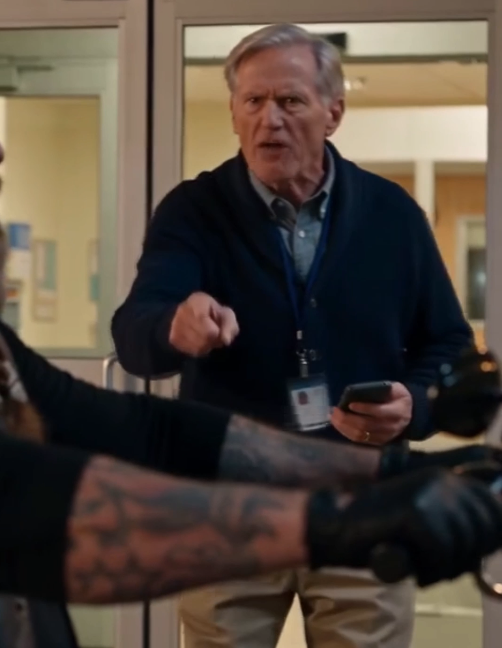
It was Gordon Pratt, following them.
At the bridge, Deuce finally let the bike rest against its stand and straightened his aching back.
That was when he saw the police cruiser parked under the bridge lamp with its lights off.
An officer was already stepping out.
Part 3
Sergeant Lena Ortiz was small, sharp-eyed, and unimpressed by large men. She looked at the forty-five motorcycles lined up along the bridge railing. Then she looked at the forty-five sweating riders standing beside them, steam rising off their shoulders in the cold.
“Got a call about a motorcycle gang harassing staff at the children’s hospital,” she said. “Blocking the entrance and intimidating a nurse.”
Gordon arrived thirty seconds later, a little out of breath, his cardigan buttoned wrong.
“That’s them, officer. All of them. They’ve been terrorizing that street for twenty minutes. I’m chairman of the hospital foundation, and I want every one of these people cited.”
Ortiz didn’t take her eyes off Deuce. “Cited for what, sir?”
“Noise. Obstruction. Trespassing on hospital grounds. They nearly caused a panic.”
“Did they?” Ortiz said. “Because from where I was sitting, I just watched forty-five guys push their bikes a mile in total silence.”
Gordon opened his mouth. “That was after they—”
“After the nurse asked,” Deuce said.
It was the first thing he’d said to Gordon all night. His voice was low and even, and it stopped the older man cold.
Ortiz turned to Deuce. “Want to tell me what this is?”
He told her in a few sentences: his daughter, the surgery, the three nights, and the promise. He told her about the plan to rumble once under the window and the nurse running out to say Lily had finally fallen asleep.
“So we shut ’em off,” he said. “That’s it.”
His phone buzzed in his jacket. He pulled off a glove with his teeth and looked at the screen.
It was a text from Hannah, a photo taken in the dim light of Room 412. Lily lay curled on her side under a pink hospital blanket, one hand tucked under her cheek, her mouth slightly open. Below the photo were five words.
She’s still out. Thank you.
Deuce turned the screen so Ortiz could see it. The sergeant looked at it for a long moment, and her jaw tightened.
“Sir,” she said to Gordon, without turning around. “I’m not writing anything tonight. Go home.”
“This is ridiculous. You’re taking their word over—”
“I’m taking the word of my own two eyes.” Ortiz handed Deuce back his phone. “Mr. Warner. Hope your girl sleeps till noon.”
Gordon walked off toward the hospital, stiff-backed and already typing.
Deuce knew the name Gordon Pratt. Everyone in the Night Shepherds Riding Club did. For six years the club had run its Long Mile Toy Run every December, raising money for kids on the fourth floor. And for six years Gordon had refused to let them hold the finish line in the hospital parking lot. He said it “didn’t fit the foundation’s image.” The toys were accepted at the loading dock out back. The checks were accepted too, quietly.
They had never complained. Padre always said they didn’t ride for the photo.
The club rode home slowly that night, engines low, taking the long way around the hospital.
At 6:40 the next morning, Hannah called him from the hospital. He could hear something wrong in her voice before she said a word.
“Caleb,” she said. “You need to look at Facebook. Right now.”
Part 4
Gordon’s post had gone up at 11:52 p.m.
Last night a biker gang descended on Millbrook Children’s Hospital at 9 PM, revving engines under the windows of critically ill kids. They blocked the entrance, ignored repeated requests to leave, and cornered one of our nurses. As foundation chairman, I will not allow our children to be endangered by this kind of behavior. Please share. Our families deserve better.
The video was forty-one seconds long. It showed the bikes idling and the noise rattling the phone speaker. It showed Gordon shouting and Deuce staring silently up at the building like a man up to something. It showed Tasha running to the bikes and leaning in close to Deuce.
Then it ended.
There was no key turning and no silence. There were no forty-five men walking a mile in the dark.
By morning it had eleven thousand shares. The local news station had picked it up with the headline Biker Group Disrupts Children’s Hospital. People in the replies wanted names, license plates, and employers.
At 9:15, Deuce got an email from hospital administration. The Night Shepherds Riding Club was banned from hospital property, effective immediately, pending review. The December toy run partnership was “suspended indefinitely.”
Hannah came down to the cafeteria to meet him. She looked like she hadn’t slept either.
“People from my work are texting me,” she said. “Asking if that’s you in the video. My sister asked if you were okay to be around Lily.” She pressed her palms against her eyes. “Maybe we just stay away. Let it die down. She doesn’t need to be in the middle of this.”
Deuce sat with his big hands around a paper cup of coffee he hadn’t touched.
Twenty years ago, a man like Gordon would have gotten a visit from him. Twenty years ago, he would have shown up at that big house on Lakeview Drive and said things there was no taking back.
He wasn’t twenty anymore. He had a daughter upstairs who’d finally slept.
“I’m not fighting him,” he said. “Not his way.”
“Then how?”
He didn’t have an answer.
Scrolling through the replies, he noticed one that had been posted and then deleted, still showing in a screenshot someone had shared. It came from an account called TBell_RN.
That is NOT what happened. I was there.
The screenshot was all that was left.
They went upstairs at noon. Lily was awake, propped up on pillows, pale but clearer-eyed than she’d been in a week. When she saw her father in the doorway, she frowned.
“Daddy, did the bikes come?” she asked. “I didn’t hear them.”
Deuce stopped halfway to the bed. He didn’t know how to tell her that they’d come and gone without a sound, that they’d done it because of her, and that half the town now thought they were monsters.
Before he could answer, a small voice spoke from the bed by the window.
“They came. I saw them.”
Part 5
The boy in the other bed was Mateo Reyes. He was ten, bald from chemo, wearing dinosaur pajamas and a hospital bracelet that had been on his wrist since August. He had a bone marrow transplant behind him and too many sleepless nights to count.
He’d been awake at nine o’clock the night before, as usual, sitting at the window with a sketchbook.
“There were a whole bunch of motorcycles,” Mateo said. “Like, a million. And this mean man in a sweater came out and yelled at them. And then the nurse ran outside.”
He flipped his sketchbook around.
It was drawn in pencil and colored marker. There was a street with round yellow streetlights, and a long line of black motorcycles. Next to each motorcycle stood a little stick figure, leaning forward with its arms out, pushing. Above them all floated a building with a star in one window.
Mateo had numbered every single figure.
The last one was 45.
“They didn’t turn the engines back on,” he said. “They pushed them all the way down the hill. I watched till I couldn’t see them anymore. The big one was first.” He pointed at Deuce. “That was you. I could tell from your beard.”
Lily looked from the drawing to her father. Her lower lip started to shake.
“You pushed them?” she whispered. “For me?”
“You were sleeping, baby.”
“But they’re so heavy.”
“Yeah,” Deuce said, his voice thick. “They are.”
She held her arms out, and he bent down very carefully so he wouldn’t touch her leg. He let her hang onto his neck for a long time.
A soft knock came at the door. Tasha Bell stood there, not in scrubs this time but in jeans and a hoodie, her badge missing.
“I’m not supposed to be up here,” she said. “I got suspended this morning.”
Hannah stood up. “Suspended? For what?”
“Leaving my post without coverage. Engaging with what Mr. Pratt’s complaint calls ‘a hostile group.'” She gave a short, tired laugh. “I tried to tell the truth in his post last night. HR called me in an hour later and told me to take it down.”
Deuce straightened up slowly. “He went after you.”
“He went after everybody who was there.” Tasha came farther into the room. She looked at Lily and Mateo, then back at Deuce, and lowered her voice. “But that’s not why I came. Mr. Warner, I’ve worked here nine years. You know the pain management program on this floor? The nerve block pumps, the child-life specialist, the comfort cart? The stuff that finally let your daughter sleep?”
“Sure.”
“It’s all paid for by one fund. The foundation calls it the Anonymous Community Donors Fund. Gordon accepted an award for it last spring at the gala, in a tuxedo. Gave a whole speech.”
She paused.
“Do you know where that money actually comes from?”
Part 6
Deuce knew. He had just never heard anybody say it out loud.
Six years of Long Mile Toy Runs had raised $212,000. It came from forty-five riders, from bake sales, from a poker run, and from Big Ronnie selling barbecue out of a smoker trailer behind his garage every Saturday in October. Every dollar had gone to the fourth floor. Every check had been made out to the Millbrook Children’s Hospital Foundation and delivered to Gordon Pratt’s office.
And every one of them had been logged as anonymous.
“He told Padre the first year that the donors list was ‘family oriented,'” Deuce said slowly. “Said biker money would scare off the big givers. We didn’t care. We just wanted the kids taken care of.”
“He took the credit,” Tasha said. “The plaque in the lobby says Pain Care Program, made possible by Gordon and Eileen Pratt and our anonymous community friends. I walk past it every shift.”
Hannah sat down hard in the visitor’s chair. “And now he’s banning the people who paid for it.”
“Now he’s trying to make sure nobody ever asks where the money came from,” Tasha said. “If the club’s a dangerous biker gang, nobody’s going to believe they funded a children’s program. The story just goes away.”
Deuce looked at the paper star taped to the window, slightly crooked, catching the afternoon light.
He thought about the thousands of dollars in toys dropped off at the loading dock, where no one could see. He thought about Padre’s bad hip pushing seven hundred pounds up Harmon Avenue in the dark, and about Gordon in a tuxedo accepting applause.
He felt the old heat rising in his chest. He let it come, and he let it go.
“There’s a foundation board meeting Thursday,” Tasha said. “Gordon’s going to ask them to make the ban permanent. He’s got the news clip, the video, and the complaint against me. If it passes, the toy run’s done. The club’s off this campus for good.”
“Who decides?”
“Eleven board members. Mostly doctors, a couple of bankers, a retired judge.” She hesitated. “And there’s something you should know. The foundation’s bookkeeper, Diane Hollister, has been there longer than Gordon. She cuts the deposit receipts. She’s kept copies of everything.”
That night Deuce drove out to the clubhouse on County Road 9, a cinderblock building behind Big Ronnie’s garage with a woodstove and a pool table. Thirty-one riders showed up on two hours’ notice.
He told them all of it. Tasha’s suspension. The award speech. The plaque. The vote on Thursday.
When he finished, nobody spoke for a while. The woodstove ticked.
Then Padre set his coffee mug down on the pool table.
“Thursday,” the old man said. “We go. All forty-five of us. Same jackets.”
“And do what?” one of the Delgado brothers asked.
Padre looked at Deuce.
“The same thing we did on Harmon Avenue,” he said. “We don’t say a single word.”
Part 7
The foundation boardroom was on the hospital’s second floor. It had a long walnut table, framed photos of smiling patients, and a wall of windows facing the parking lot.
On Thursday at 6:58 p.m., forty-five riders filed in through the back door and lined up along the rear wall, shoulder to shoulder in black leather. They took off their gloves and didn’t sit.
The eleven board members stared. Gordon Pratt, at the head of the table, went pale and then red.
“This is exactly what I’m talking about,” he said. “Intimidation. They’re doing it right now, in front of all of you.”
“They’re standing, Gordon,” said Judge Margaret Ellison, the retired judge, dryly. “Proceed.”
Gordon proceeded. He played his forty-one-second video. He read from the nurse complaint. He showed the news headline, the share count, and a stack of emails from “concerned parents,” most of whom had never set foot on the fourth floor. He was smooth and reasonable and well rehearsed. A couple of board members nodded.
“I’m asking for a permanent ban,” he finished. “For the safety of our patients.”
The judge looked down the table. “Anyone else wish to speak?”
Sergeant Lena Ortiz stood up from a chair by the door. Nobody had noticed her come in.
“I was at the river bridge that night,” she said. “I watched these men push forty-five motorcycles a full mile, up a hill, in the cold, without starting a single engine. Mr. Pratt was there too. He followed them the whole way.” She looked at Gordon. “He saw everything I saw. He just didn’t post it.”
Then Tasha stood, in her badge-less hoodie, and told them what she’d whispered on the sidewalk and what happened after.
Then a gray-haired night security guard named Earl Whitfield cleared his throat. He set a thumb drive on the table. He’d pulled the fourth-floor hallway camera, which looked straight down onto Harmon Avenue.
They played it on the big screen with no edits.
The board watched the bikes arrive and Gordon storm out. They watched Tasha run. They watched one engine die, then the next, then all of them, and a long silent line of men begin to push. Halfway through, the footage caught Gordon turning to a bus-stop bystander. He was clearly saying something and laughing.
Earl had pulled that audio from the lobby door camera too.
“Doesn’t matter what they do now. I’ve already got what I need.”
The room was dead quiet.
Then a small woman with reading glasses stood up from the corner. It was Diane Hollister, the foundation bookkeeper. She placed a binder on the walnut table and slid it to the judge.
“Six years of deposit records,” she said. “Every check that funded the pain care program. Every one of them was signed by a treasurer of the Night Shepherds Riding Club.” She took off her glasses. “Mr. Pratt instructed me to log them as anonymous. In writing. I kept the memo.”
Gordon didn’t say anything. There was nothing left for him to say.
The vote took four minutes. The ban was rescinded unanimously. Tasha was reinstated with back pay. And by a vote of ten to one, Gordon Pratt was removed as chairman of the Millbrook Children’s Hospital Foundation, effective immediately.
As the room emptied, Judge Ellison stopped in front of Deuce.
“Mr. Warner. Is there anything you’d like to say for the record?”
Deuce thought for a moment.
“My daughter wants to know when the bikes can come sing for her.”
Part 8
Lily went home three weeks later, on a cold, bright Saturday in December, on crutches with a pink cast and a backpack full of cards from the nurses.
Tasha pushed her wheelchair out the front entrance herself. The administration had signed off on it, and the new foundation chair had insisted.
Forty-five classic American V-twin cruisers were lined up along Harmon Avenue in the same spot as that night in November. Forty-five riders stood beside them. Upstairs, half the windows on the fourth floor were full of small faces pressed against the glass. Mateo was in the window of Room 412 holding up a new drawing. It showed the same street and the same bikes. This time every stick figure was riding.
Deuce knelt beside the wheelchair.
“You ready, Jo?”
Lily grinned so wide it looked like it hurt.
“Wake me up, Daddy.”
He raised one gloved hand. Down the line, forty-five keys turned. Forty-five engines caught at once, and the sound rolled up Harmon Avenue and off the brick walls and through the glass. It was the big thunder song, finally. Up on the fourth floor, a dozen kids were cheering and waving. Lily pressed both hands over her ears and laughed until she cried.
Later, people would ask about the star.
It’s tattooed on the inside of Deuce’s right forearm: five crooked points, one of them noticeably too long. Lily drew it on a napkin when she was four, at a diner on the way back from her first club ride. She’d handed it to him and said it was “so you can find your way home in the dark.” He got it inked the next day.
The paper star in the window of Room 412 was her way of telling him which window was hers.
The Night Shepherds don’t do a toy run in December anymore. Now they do two rides a year.
The first is still the Long Mile, loud and proud, with the finish line in the hospital parking lot right out front. Their name is on the lobby plaque now, the old one replaced at the new chairman’s request. It reads: Pain Care Program, made possible by the Night Shepherds Riding Club.
The second ride is new. They call it the Quiet Mile.
Every November, on the first Tuesday night, the club rolls up Harmon Avenue to the children’s hospital. A block away, they kill their engines. Then they push their bikes in silence, a full mile past the pediatric wing to the river bridge, for every kid upstairs who’s fighting to sleep through the pain. Riders from four other clubs joined last year. People pay to sponsor each mile, and every dollar goes to the fourth floor.
Gordon Pratt resigned from the hospital board entirely that spring. The Pratts’ names came off the lobby wall. He doesn’t attend the gala anymore.
Lily is ten now. Her scans have been clean for twenty months. She still walks with the smallest hitch in her left leg, and she has asked her father roughly four hundred times when she can have her own motorcycle.
Last November, she walked the Quiet Mile for the first time, beside her father’s bike, one hand on the seat, helping him push.
At the bridge, she looked back up the hill at the dark hospital windows.
“Do you think they’re asleep?”
“I hope so, baby.”
“Good.” She leaned her head against his arm. “That’s what the quiet is for.”
“We’re the loudest machines in town,” Deuce says, when people ask him about that night. “But that night, forty-five of us pushed our bikes by hand for a full mile past my little girl’s window. She slept the whole way through. First time in three nights.”
That night, the man in the cardigan saw leather jackets and tattoos, and he decided he knew everything about the people wearing them. He never once asked why they had come.
The kindest people on Harmon Avenue that night were the ones he called animals, sweating in the cold so a little girl could sleep.
If this story meant something to you, follow our page. There are more stories like this one, and we’ll keep telling them.