Guests Thought A Biker Was Stealing A Donor’s Chair—Then A Teenage Scholarship Winner Pointed At The Janitor
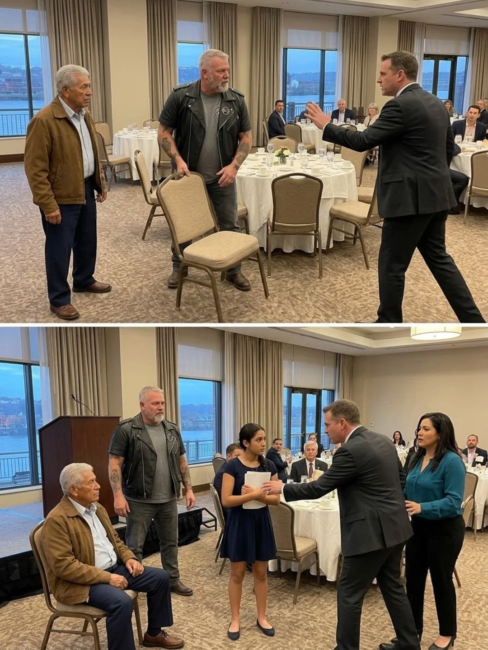
“Put that chair back,” the director snapped as the biker dragged it away from the donor’s place and across the ballroom floor.
Elena Reyes stood up so quickly that her program slipped beneath the table.
The man did not stop. He was enormous, perhaps 286 pounds, with tattooed arms beneath a black short-sleeved leather biker jacket. A small patch on the back showed an open latch inside a circle. No words. Nothing that explained why he had just taken the most conspicuously reserved chair in the room.
It was scholarship night at a riverfront hotel in Pittsburgh. Elena’s seventeen-year-old daughter, June, had spent weeks preparing to cross that stage.
Now Calvin Porter was dragging a chair toward Elena’s father.
She knew Calvin from the locksmith shop near her bus route. People called him Latch. Her father called him Cal, which had always suggested a history Elena had never thought to ask about.
“Ben,” Calvin said, setting the chair down. “Sit.”
Benito Reyes shook his head. His good shirt hung awkwardly beneath the plain work jacket he had refused to take off in the lobby.
“I’m fine.”
“You’ve been standing twenty minutes.”
The event director followed them, smiling tightly at the watching guests.
“There’s been a misunderstanding. That seat belongs at the sponsor table.”
Elena stepped between him and her father.
“We asked for another chair.”
“And I explained we’re at capacity.”
Across the room, two other reserved chairs remained empty.
June waited beside the stage steps with the other recipients. Elena saw her daughter look toward their table, then at the chair Calvin had moved. The girl’s hands closed around the speech she had folded into quarters.
Somebody behind Elena muttered that the biker was stealing from a private event. Another guest lifted a phone.
Calvin kept one hand on the chair back.
“He’s an invited guest.”
The director glanced at Benito’s jacket.
“He was working here this afternoon.”
“I finished,” Benito said quietly.
Elena’s face burned. She knew her father still cleaned the hotel on weekend shifts. She had not known anybody would use that fact to decide where he belonged after changing his shirt.
Onstage, the emcee announced June’s name.
Her daughter did not move toward him.
Instead, she walked down the steps and pointed at her grandfather.
“Before you give me anything,” she said, “read the part you took out.”
The director reached for her folded pages.
Part 2
June pulled the pages back against her chest before his fingers reached them.
Elena crossed the last few feet between them.
“Give her space,” she said.
The director stopped. His badge identified him as Gavin Pruitt, program director. Elena had exchanged three courteous emails with him about June’s dinner invitation, and none of them had prepared her for how much she now wanted to take her daughter home.
“We have a schedule,” he said.
“Then explain what she means.”
June unfolded the paper. Elena recognized the original speech because she had listened to it at the kitchen table, pretending to dry the same plate while her daughter practiced.
“My grandfather taught me that honest work isn’t something you grow out of,” June read. “It’s something that makes the rest possible.”
Her voice trembled. She stopped, not because she had forgotten the next line but because everyone had begun listening.
Gavin held up the printed program.
“We shortened every recipient’s remarks. It isn’t personal.”
“You left the part where I thanked the sponsors,” June said.
“Of course. They fund the awards.”
“You took out who I was thanking with mine.”
Elena looked toward her father. Benito remained standing beside the chair as though accepting it might make the problem worse. Calvin had moved his hand away, leaving him room to choose.
“Dad, please sit,” Elena said.
He looked at June, then lowered himself into the chair. The small movement made Elena angrier than another argument would have. Her father looked grateful for something that should not have required a confrontation.
A woman from the stage approached. She introduced herself as Marcia Kent, a board member overseeing the awards that evening.
“We’re going to pause for a few minutes,” she told Gavin.
“That will make it look like there’s a problem.”
“There is a problem.”
The emcee announced a brief break. People began talking at once. A server moved quietly through the room collecting unused glasses, and Elena felt an absurd urge to apologize for creating extra work.
She stopped herself. Her father had spent a lifetime apologizing for occupying space near other people’s celebrations. She would not teach June to do it too.
Marcia asked to see the invitation.
Benito reached into the inside pocket of his jacket. He brought out a creased envelope, then a card with June’s name and his own beneath it. He had kept the return envelope too, carefully folded around the confirmation Elena had printed for him.
“I thought maybe I had the wrong entrance,” he said.
Elena took the papers from him. The guest confirmation was clear. A seated dinner place. No instruction to report for work. No ambiguity about whether he had been invited as June’s family.
Marcia read it twice.
“You didn’t have the wrong entrance.”
Gavin shifted the program under his arm.
“He arrived through the service corridor.”
“Because I’d finished my shift,” Benito said. “My good shoes were in my locker.”
Elena looked down. The shoes were polished so carefully that a little dark stain marked one thumbnail.
He had prepared for this evening. He had expected it to matter.
Marcia turned the card over.
“Your place was confirmed,” she said. “I want to know why it disappeared.”
Part 3
A volunteer at the registration desk brought the seating folder.
Her name was Kendra Cho. Elena recognized her as the young woman who had smiled at June’s nervous joke about balancing a dinner plate and a scholarship folder without dropping either.
Kendra opened the folder on an unused table near the wall. Marcia asked the family whether they wanted to step there, away from the center of the room.
June looked at her grandfather.
“You want to?”
“If you do.”
They moved together. Calvin stayed beside the chair until Benito stood, then returned it to the sponsor table without waiting to be asked. Elena noticed that he did not make returning it a surrender. The point had been a place to sit, not possession of an expensive chair.
Kendra showed them the first seating list. Benito’s name appeared beside Elena’s at the family table.
On a later version, it had been crossed out.
“Who changed it?” Marcia asked.
Gavin looked at the page. “We adjusted guest numbers.”
“Everyone else at that table stayed.”
“There were sponsor requirements.”
Kendra shook her head, then hesitated as though remembering who decided whether she would be invited back next year.
Marcia waited.
“The sponsor office asked for one accessible seat near the aisle,” Kendra said. “That was at the front table. They didn’t ask us to remove family places.”
Gavin’s smile had disappeared.
“There were other conversations.”
“Then we can check them,” Marcia said.
Elena looked toward the empty places across the room. A small problem had become a larger one because someone had preferred to insist there was no problem at all.
“Why didn’t you just tell us the seating was wrong?” she asked Gavin.
“I offered your father a place in the back.”
Benito raised his head.
“You said I could watch from the doorway until the meal was cleared.”
Nobody answered immediately.
Calvin folded his tattooed arms. A small chair was inked near his wrist, one leg drawn crookedly, a blue line beneath the seat. Elena had seen the tattoo when he handed her a repaired key months earlier. She had never noticed it properly.
“He asked for a chair three times,” Calvin said.
Gavin turned toward him. “You can’t just take furniture.”
“I moved an empty chair. Didn’t touch anybody.”
“That isn’t the point.”
“Then talk about the point.”
Elena expected him to add something louder. He did not. The silence forced Gavin to look at the crossed-out name instead of the biker’s jacket.
June laid her speech on the table beside the seating list.
“Did my grandfather disappear from this for the same reason?”
Gavin started to explain about time limits again. Kendra opened another section of the folder: the recipient biographies collected for the evening’s presentation.
Elena saw June’s original paragraph on the left and the edited version on the right.
My grandfather cleans buildings at night, the original began. He made sure I had a place to study before he worried about where he would sleep.
The replacement described June as having been supported by the community program.
Elena knew the program had helped with applications. It had not raised her daughter.
She put a hand flat on the table.
“That sentence belongs to him.”
Kendra slid another page out from behind the edited biographies. It was a printed question she had sent when she noticed that one guest had vanished from the seating list.
“I asked yesterday,” she told Marcia. “I thought it might be an accidental deletion.”
Gavin looked at her. “We were still finalizing the room.”
“You told me not to contact the family.”
“Because I would handle it.”
“Then why did they arrive without knowing?”
Her voice shook on the last word. Elena could see that this was not a practiced confrontation. The young woman was choosing to say something while the person she contradicted stood within arm’s reach.
Marcia asked whether she could retain a copy of the exchange for the review. Kendra agreed.
Elena looked at her father. He had folded the guest card back into its envelope, a habit of putting things away neatly even when they might still be needed.
“Leave it out, Dad,” she said.
“I don’t want to lose it.”
“I’ll hold it.”
He passed it to her. The edges were soft from how often he had checked it. Elena imagined him in his small kitchen, taking the card out again to make sure he had the right date, the right time, the right clothes.
“You were excited,” she said quietly.
Benito looked toward June.
“Of course.”
“You could have called me when they wouldn’t seat you.”
“You were helping her get ready.”
“That doesn’t mean I didn’t want to help you.”
He nodded, but Elena knew a single conversation would not undo a lifetime of trying to be the person whose needs cost everyone else the least.
Part 4
“It belongs to June,” Marcia said gently. “She gets to decide how to tell it.”
Elena nodded. The correction was fair, and it reached somewhere uncomfortable.
At home, she had suggested that June describe Benito as a maintenance worker rather than saying he cleaned toilets and emptied trash. She had told herself she wanted readers to hear his skill before making assumptions about his job.
She had not considered what June heard when her own mother softened the truth.
“I asked you to change that first sentence,” Elena said to her daughter.
June looked down.
“You said people might get the wrong idea.”
“I did.”
“But it wasn’t wrong.”
“No.”
Elena felt her father watching her. She had spent years defending him against strangers while quietly teaching her daughter which parts of his life should be translated before respectable people heard them.
“I was trying to protect you from being judged,” she said. “I think I made it sound like there was something to hide.”
June’s fingers loosened around the paper.
“I wasn’t embarrassed.”
“I know that now.”
Benito touched his daughter’s sleeve.
“You wanted easier for her.”
“You wanted easier for all of us,” Elena replied. “You still told the truth about the work.”
The conversation did not excuse Gavin. It did make the problem harder to leave entirely on his side of the table.
A woman with silver hair approached with a walking cane and an event volunteer beside her. Elena recognized her photograph from the program: Lenora Voss, the principal donor whose reserved chair Calvin had moved.
“Marcia,” she said. “Somebody tells me my chair has been on an adventure.”
Calvin straightened.
“That was me.”
“Is it back?”
“Yes, ma’am.”
“Then I can probably survive it.”
She looked at Benito, then at the invitation on the table. Marcia explained what they knew, without asking June to repeat the whole experience for another audience.
Gavin began to speak about sponsor expectations.
Lenora stopped him.
“You can ask my office what I requested. You don’t get to invent requests because they’re convenient.”
Elena watched him look toward the front table, where his explanation had finally run out of shelter.
“I was trying to keep the evening polished,” he said.
Lenora looked at Benito’s carefully pressed shirt.
“It appears he was too.”
She did not make a speech about having started with nothing. She did not need a comparable hardship to recognize what had happened in front of her.
Instead, she asked June a question.
“Do you want to give your original remarks tonight?”
June glanced toward her mother.
“Will I lose the scholarship if I don’t go back up?”
Marcia answered immediately.
“No. Your award is yours. Speaking tonight is a choice.”
The relief on June’s face told Elena how long she had been carrying that fear while the adults argued about a chair.
“And if I do speak?”
“Use your own words.”
June turned toward her grandfather. Before she could ask him anything, he reached for the edited program.
“There’s something else they got wrong,” he said.
Part 5
Benito pointed to a line beneath June’s photograph.
“They said I paid for everything.”
Elena looked. The rewritten biography had made him a distant, unnamed relative who provided financial help while the program supplied guidance and opportunity.
“You paid for plenty,” she said.
“You drove before sunrise. Worked the extra routes.”
“Dad—”
“She needs to hear you in the story too.”
June pulled out a chair for him. This time, nobody had to claim one from another table.
“That’s in the long version,” she said.
Benito smiled. “I like the long version.”
Elena sat beside him and felt the familiar knot of money, exhaustion, and gratitude begin to loosen. Her father was not asking the room to repay him. He was refusing to let the family’s life become a simpler story just because a simpler story fit the program better.
Calvin stood a little apart, looking toward the ballroom doors.
“You don’t have to stay in trouble with us,” Elena told him.
He looked surprised.
“Wasn’t planning to leave Ben standing.”
“How do you know him?”
Benito gave a small laugh. “He used to break things.”
“Allegedly,” Calvin said.
“The chair outside the old vocational classroom. Every week, another loose leg.”
Calvin looked down at the tattoo on his wrist.
Elena followed his glance.
“That chair?”
He nodded.
“I was taking evening classes. Worked days. Slept in a car for a while.”
Benito had cleaned that building then. He had found Calvin sitting outside the classroom one night, embarrassed to go in after arriving late in dirty work clothes. Instead of asking him to explain his circumstances, Benito had brought out a chair, let him finish eating, and walked in beside him when he was ready.
“He said a man could learn sitting down as well as anybody else,” Calvin told Elena.
“You kept falling asleep,” Benito said.
“Day job.”
“I know.”
The two words held an old understanding Elena had never been part of. She looked at the rough little tattoo again. A chair. A blue line that might have been the classroom door. Nothing a stranger would identify as a debt.
“Your daughter drew it?” June asked.
“Years later. Heard me tell the story. Said the chair needed to stay where I could see it.”
“Why the crooked leg?”
“Her grandfather supervised the drawing. Refused to improve the facts.”
Benito grinned. Elena realized she had not seen that expression since they arrived.
The relationship did not give Calvin special authority over the room. It explained why he had recognized the particular shape of Benito standing by a doorway, pretending he did not need anything.
He had seen the chair first because he had once needed one himself.
Marcia returned with the original printed biography and asked June whether she wanted it used or removed entirely. June read it, crossed out a sentence she no longer liked, and added her mother’s name beside her grandfather’s.
“Now it’s mine again,” she said.
Elena reached for her hand.
Then June looked toward the stage and asked where her family would be sitting when she went back.
Part 6
Marcia took them to a family table with enough places for all three, close enough for June to see them without searching the room.
Benito removed his work jacket and folded it over the chair back. Underneath, his shirt had a tiny mark near the cuff where the iron had caught it. Elena had nearly offered to find him another shirt earlier. Now she was glad she had stopped herself.
“Calvin can sit here,” June said, pointing to the remaining place.
He shook his head.
“Your dinner.”
“You came with Grandpa.”
“Drove him.”
“Then you’re our ride. We need to keep an eye on you.”
Benito laughed. Marcia checked with the banquet staff before confirming the additional meal, rather than leaving a server to absorb another improvised instruction. Calvin offered to pay for his place. They settled it quietly. Elena appreciated that the kindness did not require anyone else’s work to become invisible.
Across the room, Lenora took her original seat. She did not move the family to the sponsor table for a photograph. The point was to restore their place, not turn their discomfort into the evening’s new attraction.
Calvin caught the banquet supervisor’s attention before sitting.
“Sorry about moving furniture through your service path,” he said. “Nobody working dinner caused this.”
The supervisor nodded. “We’ll keep the aisle clear from here.”
Elena was glad to hear the exchange. Gavin’s conduct did not make every inconvenience Calvin created somebody else’s responsibility. He could have been right to intervene and still owe the people carrying hot plates a little consideration. Her daughter heard him say it without becoming smaller in his chair.
Before the program resumed, Marcia spoke briefly from the stage.
“We made an error involving a recipient’s invited guest and her remarks,” she said. “We have corrected the seating. The recipient will decide what she wishes to say.”
She did not identify Benito’s job or rehearse the humiliation for people who had missed it.
June listened, breathing slowly. Elena recognized the look she wore before an important exam: frightened, prepared, still deciding whether she trusted herself.
“You can leave the speech in your bag,” Elena whispered.
“I know.”
“You don’t have to fix the whole room.”
“I just want to thank my family.”
Elena nodded. “That’s enough.”
When June’s name was called again, she walked to the stage with the original pages in her hand. She accepted the scholarship folder, looked out at the tables, and found her grandfather.
“My grandfather cleans buildings at night,” she began.
Elena heard a few people shift in their chairs. June continued without sharpening the sentence into an accusation.
She described a cleared corner of a small kitchen table, a man asleep in a chair after work, a mother who drove an early bus route and still came home to check an application essay. She named the teacher who helped with the forms and thanked the donors for funding a scholarship her family could not have supplied on its own.
There was room for all of them in the truth.
“I’m proud to be going to college,” June said. “I was already proud of who helped me get here.”
Benito looked down at his hands. Calvin placed his own hand briefly on the back of the older man’s chair, then took it away.
Elena applauded with everyone else, but she watched her father rather than the stage. He was trying to smooth a crease in the unused napkin. His fingers had stopped being steady.
“Dad?”
He looked at her.
“She put us in the same sentence,” he said.
Part 7
“We were already in it,” Elena told him. “She just made people hear it.”
June returned with the scholarship folder tucked under her arm. Her grandfather stood slowly and hugged her, leaving the folder pressed between them like something that belonged to their ordinary life rather than a prize she had to earn twice.
Calvin rose to give them room.
“Don’t go,” June said. “We haven’t eaten.”
He sat again. The meal arrived late enough that Elena would remember the soup as cooler than it should have been. She would also remember June stealing a bread roll from her grandfather’s plate while he pretended not to notice. Neither detail would appear in the official event photographs. Both mattered more to her than the perfect picture she had imagined that morning.
On the drive home, June fell asleep with the folder against her chest. Calvin drove without putting on the radio. Elena sat beside her father in the back, watching the city lights move across his polished shoes.
“I wanted to leave,” Benito said quietly.
“I know.”
“Before you came over. I thought I could tell her I wasn’t feeling well.”
“She would have believed you.”
“That was the idea.”
Elena looked at her daughter’s sleeping face.
“Then she’d remember the empty chair and think it was something nobody could help.”
Benito rubbed a thumb along the envelope edge.
“I didn’t want her first big night to be about me.”
“It was already about you. You were in her speech before anybody moved a chair.”
From the driver’s seat, Calvin said, “She wrote the invitation too.”
Benito smiled faintly. “Yes.”
“Believe her,” Calvin added.
Elena watched her father take that in. Accepting a child’s pride could be harder for him than taking another weekend shift. Work gave him something he could offer. Being celebrated required him to sit still and let somebody else give.
At his building, June woke before they opened the door. She looked around quickly, checking for the scholarship folder, then for her grandfather.
“We didn’t leave anybody,” Elena told her.
June nodded, still half asleep. “Good.”
Calvin carried nothing but the folded jacket while Benito carried his own envelope. Elena was glad nobody turned walking him upstairs into proof of another person’s generosity. He was tired. He was proud. He was entitled to be both without becoming a lesson every second of the evening.
The correction did not end with dinner. Marcia contacted the family the following week with the results of the board’s review. Kendra’s dated seating lists, the guest confirmation, and the original biographies established that Benito’s place and June’s acknowledgment had been deliberately changed, not lost in a printing error.
Gavin’s explanation about sponsor requirements was unsupported by the correspondence. He was removed from directing recipient events and from editing student biographies. The board assigned those responsibilities elsewhere and required recipients to approve future edits before publication.
June’s scholarship was confirmed in writing without conditions about publicity or participation in future dinners. The program replaced the altered biography in the materials it controlled. Elena checked the corrected version with her daughter before agreeing that it reflected what June wanted to share.
Nobody asked Benito to accept an apology on camera. He received one privately and chose to answer it in his own time.
Elena was relieved the consequences were specific. She had not wanted an evening of people declaring how much they valued workers while leaving the same person free to cross out another family’s name next year.
Calvin stopped by their apartment that Sunday to help Benito fix a loose cabinet latch. Elena suspected the repair could have waited. She was glad they had found an excuse that did not require anybody to discuss gratitude while standing awkwardly in a doorway.
June made sandwiches. She put four chairs around the kitchen table, then found another when a neighbor dropped in to return a borrowed dish.
“We’re running a restaurant now?” Benito asked.
“You started it,” Elena said.
Calvin checked the latch once more before joining them. June placed a folded drawing beside his plate: a chair with a straightened leg, facing an open door.
“You fixed the facts,” he said.
“Just that part.”
He tucked the drawing into his jacket without pretending it meant nothing to him.
Later, Elena told her father she was sorry for suggesting his work needed a different name in June’s essay.
“You knew what I did,” he said.
“I needed to be willing to let other people know too.”
He accepted that with the same quiet attention he gave a difficult repair. No quick reassurance that would let her skip learning anything. No punishment that required her to keep earning her place at his table.
People see a huge, tattooed biker dragging a chair across a ballroom, and they decide he is the person who does not belong. Sometimes he is the only one willing to interrupt a polished evening long enough to ask who has been left standing.
Follow this page for more stories about the dignity people overlook. When you invite someone, make sure there is a real place for them—and when you tell a young person’s story, ask before changing the people who helped write it.