A Biker with Face Tattoos Wore Fairy Wings for His Sick Daughter — Her Third Wish Left the Entire Hospital Silent
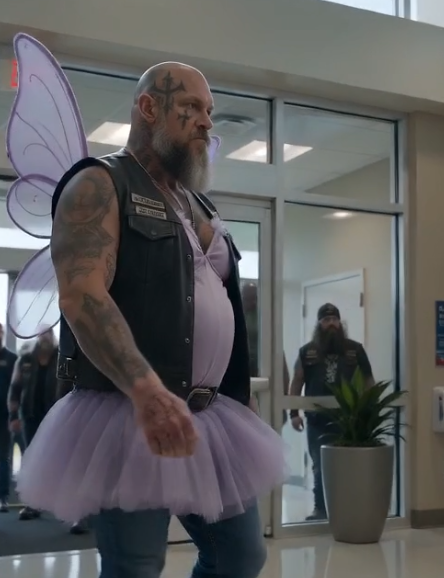
I am six-foot-four, covered in tattoos from my throat to my knuckles, and feared by people who have never spoken to me—yet I entered a children’s hospital wearing silver wings, a purple tutu, and enough glitter to shame a parade float.
My road name is Grimm.
The name came from the black thorn tattoo that begins above my left eyebrow, crosses my cheek, and curls down toward my jaw. Add the shaved head, gray-black beard, scarred hands, chain wallet, and leather vest, and most strangers decide what kind of man I am before I get close enough to introduce myself.
That morning, the security guard at St. Catherine’s Children’s Hospital made the same decision.
He stepped away from his desk when I came through the sliding doors. His right hand drifted toward the radio on his belt while every person in the lobby turned to stare.
I couldn’t blame them.
My leather vest hung over a bright lavender fairy costume. Two enormous silver wings rose behind my shoulders. A crooked plastic crown sat on my head, and a glitter-covered wand was tucked through my belt beside my motorcycle keys.
My riding boots were painted pink.
The nurses stopped walking.
A father lowered his phone and pulled his young son closer. Two teenage volunteers laughed until they saw my face, then quickly looked away.
Behind me stood twenty-seven members of the Black Pines Motorcycle Club, each carrying a sealed cardboard box. They wore faded leather cuts with unreadable patches, heavy boots, old tattoos, and expressions that made the hospital security team exchange nervous glances.
Nobody knew what was inside the boxes.
Nobody knew why men who smelled of gasoline, cold wind, and engine oil had come to the pediatric oncology floor.
Only I knew.
And I was terrified.
My seven-year-old daughter, June, was upstairs in Room 614. She had spent five months fighting leukemia, endured weeks of chemotherapy, lost her hair, regained a little strength, and then lost it again when the cancer returned.
Three nights earlier, she had asked me whether fairies were real.
I told her I wasn’t sure.
She studied the tattoos on my face and said, “You don’t know because fairies are probably scared of you.”
That hurt more than she intended.
Then she pulled three folded paper stars from beneath her pillow.
“My storybook says a real fairy grants three wishes,” she whispered. “I saved mine for when one comes.”
I took those stars home.
I sat alone in my garage until sunrise, surrounded by tools, motorcycle parts, and every mistake I had made before June gave me a reason to become someone better.
Then I called my club.
“I need wings,” I said.
Nobody laughed.
Now, as I approached the elevator, a hospital administrator blocked my path.
“You cannot take those men upstairs,” she told me. “And those boxes must be inspected.”
“Inspect them.”
“What are you planning?”
I looked at the elevator numbers, knowing June was waiting six floors above us.
“I’m granting three wishes.”
The administrator opened the first box.
Her expression changed immediately.
Then a nurse ran from the elevator and shouted my daughter’s name.
The wand slipped from my hand.
Want to know what the bikers carried in those boxes and why June’s nurse came running before I could grant the first wish? Drop FAIRY in the comments — I’ll share more soon.
My name is Elias Vance, but I had been Grimm for so long that hearing my real name usually meant a judge, a doctor, or my daughter needed me.
The tattoo on my face came first.
I was nineteen, angry, and convinced that frightening people counted as earning respect. A friend with a homemade tattoo machine drew the black thorn across my cheek during a night neither of us remembered clearly.
By twenty-three, I had added tattoos to my neck, hands, chest, and both arms. I had also collected charges for stealing cars, possessing things that destroyed lives, and believing every insult required an answer.
I spent three years in an Ohio state prison.
I don’t tell that part for sympathy.
I belonged there.
Prison didn’t transform me. It only removed the distractions that had helped me avoid looking at myself. When I came home, I was sober, unemployed, and marked in ways no clean shirt could conceal.
People saw my face before they saw my application.
The Black Pines Motorcycle Club gave me work rebuilding transmissions at a garage outside Cedar Falls. They weren’t saints. Some of them had records. Some carried grief, addictions, broken marriages, and memories from wars they rarely discussed.
But the club president, Wade “Hawk” Lawson, had one rule that mattered.
“Your past can ride behind you,” he said. “It doesn’t get to steer.”
I started by sweeping floors.
Then I rebuilt an engine nobody else could save. Within two years, I was running the service bay. Within four, I had earned my patch.
I met Claire at a twenty-four-hour pharmacy after my motorcycle battery died in the rain. She was a respiratory therapist finishing a double shift, and I was standing beneath the awning, trying to appear less suspicious while holding jumper cables.
She offered me help.
I asked whether she was afraid of me.
She looked at my face and said, “I’m afraid you don’t know the difference between negative and positive terminals.”
I loved her immediately.
We married three years later. June arrived on a snowy February morning with red cheeks, a furious cry, and fingers so small that my thumbnail looked enormous beside them.
The nurse asked whether I wanted to hold her.
I said no.
Claire knew why.
“Elias,” she whispered, “take your daughter.”
I had broken machines, laws, promises, and nearly every relationship I had ever touched. Holding something that pure felt irresponsible.
Then June closed one tiny hand around my tattooed finger.
That was it.
I was finished.
For the next seven years, June treated my frightening appearance like a collection of toys. The thorn tattoo became “Daddy’s vine.” The skull on my forearm wore sticker earrings. The serpent around my wrist received a pink crayon hat.
When she was three, she asked why strangers stared at me.
“Because I look different.”
“You look like Daddy.”
She said it as if that settled the matter.
It did.
Claire and I separated when June was five, but we learned to remain a team. There was no betrayal or dramatic villain. We had simply spent too many years surviving and too few learning how to speak before resentment hardened.
June lived with each of us during the week.
The club became her extended family. Hawk taught her to whistle through her fingers. Tiny, a six-foot-six Black American former Army medic, attended her school play and cried louder than any parent there.
Rico, our Latino American painter, airbrushed tiny stars onto her bicycle helmet. Doc, an Asian American paramedic whose real name was Minh Tran, checked every scraped knee like he was assessing a national emergency.
June called them her “loud uncles.”
Whenever the club arrived, she ran toward the engines.
Then, one April morning, she stopped running.
She stood beside my motorcycle, pale and breathless, one hand pressed against the fuel tank. Purple bruises had appeared along her legs, though she couldn’t remember falling.
Claire took her to the pediatrician.
By sunset, we were sitting inside St. Catherine’s while a doctor explained white blood cells, bone marrow, treatment protocols, and survival rates.
I heard only one word.
Leukemia.
My first instinct was to find something to blame.
There was nothing.
No enemy. No bad decision. No broken part I could identify and replace.
Only my seven-year-old daughter lying in a hospital bed, asking whether she would lose her hair before school picture day.
I held her hand.
“Yes,” I said, because Claire and I had promised not to lie.
“Will you still know it’s me?”
I leaned closer.
“I’d know you in the dark.”
She accepted that answer.
I spent the next five months proving it.
June responded well to the first treatment.
Then she didn’t.
Cancer teaches families not to trust good news too quickly. A promising test becomes a difficult scan. A quiet hallway becomes a room where physicians sit instead of standing.
The relapse came in October.
Dr. Patel explained that June needed stronger treatment and, if her body could manage it, a bone-marrow transplant. Claire held June’s hand while I studied the doctor’s shoelaces because looking at anyone’s face felt impossible.
June listened carefully.
“Will it hurt?”
“We’ll work very hard to keep you comfortable,” Dr. Patel said.
“That means yes.”
“It means some days will be difficult.”
June nodded.
She was braver than I was, but children shouldn’t have to be praised for surviving things adults cannot fix.
The treatments weakened her. Food tasted metallic. Her muscles disappeared beneath hospital pajamas printed with moons. Some days, she couldn’t sit up without help.
I slept in the chair beside her bed.
Claire slept on the narrow window bench.
We stopped caring about comfort, schedules, or who had been right during our marriage. The old arguments became too small to remember.
One night, June woke shortly after two.
Rain tapped against the window. The hospital machines made their soft electronic sounds while I sat beneath a blanket too small for my shoulders.
“Daddy?”
“I’m here.”
“Do fairies get sick?”
I opened one eye. “Probably.”
“Then who grants their wishes?”
“I guess other fairies.”
She considered this.
“Are fairies afraid of bikers?”
“Everybody’s afraid of bikers.”
“I’m not.”
“You’re unusual.”
She smiled faintly.
A volunteer had brought her a book about a fairy who granted three wishes to a child lost in a forest. June had read it eleven times. She believed rules mattered in magical situations, so each fairy could grant only three.
I asked what she would wish for.
She refused to tell me.
“If I say them before the fairy comes, they won’t work.”
The next morning, she folded three stars from gold craft paper. Nurse Amelia helped her write inside them because June’s hands shook after treatment.
She hid the stars beneath her pillow.
I found them two days later while changing the sheets.
I should not have opened them.
I did.
The first star said:
I wish it could snow while the sun is warm.
The second said:
I wish Daddy’s dragons would sing outside my window.
The third remained folded.
I couldn’t open it.
Something about the crease stopped me. Perhaps I wanted one wish to remain beyond my control. Perhaps I was afraid she had written what every sick child eventually wonders.
I wish I could go home.
I wish Mom would stop crying.
I wish I wouldn’t die.
I put the third star inside my vest.
Then I called Hawk.
“I need the entire club.”
“How soon?”
“Two days.”
“What are we doing?”
I stared at the first star.
“Making snow.”
Hawk was quiet for three seconds.
“Inside or outside?”
That was why I called him.
We contacted Dr. Patel, the head nurse, infection control, facilities management, and every department capable of telling us no. Most of them did.
Real snow was impossible. Artificial snow machines could irritate lungs. Confetti was prohibited. Glitter was forbidden near medical equipment, which created an immediate problem with my costume.
We adjusted.
Six clean white bedsheets went to the hospital laundry, where they were sterilized and cut into thousands of soft fabric snowflakes. The freezer truck came from Rico’s cousin, who delivered frozen food to restaurants. He donated sealed containers of shaved ice for the courtyard, where June could view it behind glass if she was too weak to go outside.
Hawk found the fairy costume at a rental shop.
The woman behind the counter looked from my face to the lavender tunic.
“What size?”
“Largest fairy you’ve got.”
She brought out silver wings, a purple tutu, a plastic crown, a glitter wand, and pink boot covers designed for a man half my size.
“I’m not wearing the tutu.”
Hawk folded his arms.
“Three wishes, brother.”
I wore the tutu.
The club wives replaced loose glitter with reflective fabric because of hospital safety rules. Rico painted my riding boots pink using removable paint. Tiny attached elastic straps to the wings so they would fit across my shoulders.
Nobody took photographs.
Nobody laughed where I could hear.
The night before the wishes, I stood before my garage mirror.
The black thorn tattoo crossed my glittered face. Silver wings rose above my leather vest. The tutu rested over my jeans, and the wand looked absurd in my scarred hand.
For most of my life, I had used my appearance to keep people away.
Now I needed it to make one child believe.
I rode to the hospital dressed like that.
The wings caught the wind, so Hawk tied them to the back of the support van. I wore the costume beneath my leather cut and put the wings on in the parking lot.
Twenty-seven bikers followed.
Each carried a box of fabric snowflakes.
When I reached the oncology floor, Nurse Amelia came running. June’s fever had spiked, and doctors had moved her for emergency tests.
For twenty minutes, nobody would tell me whether our fairy day was already too late.
Then Dr. Patel emerged.
“She’s stable,” she said. “Weak, but stable.”
My knees nearly failed.
“Can I see her?”
“In a moment.”
I looked toward the boxes.
“What about the courtyard?”
Dr. Patel studied my wings.
“Give us thirty minutes.”
The entire club went to work.
June’s room overlooked the hospital’s enclosed courtyard.
By the time her bed was returned, the October sun had broken through the clouds. Warm light fell across the brick walls and the small garden below.
June looked exhausted.
Then she saw me.
Her mouth opened.
I stood beside the window wearing silver wings, a lavender tunic, purple tutu, plastic crown, pink boots, and my leather vest. The reflective dust on my face made the thorn tattoo sparkle.
“You’re a fairy.”
“Temporary assignment.”
She stared at the wand.
“Is that real?”
“It was nineteen dollars, so it better be.”
Claire laughed and cried at the same time.
June pointed at my wings. “Can you fly?”
“Weight restrictions.”
That earned a small smile.
I bowed carefully, though the crown slid down over one eye.
“June Vance, I am here to grant three wishes.”
“You know my wishes?”
“Fairies know things.”
“You read my stars.”
“Fairies also violate privacy.”
She narrowed her eyes, but she was too happy to remain offended.
I opened the first paper star.
“I wish it could snow while the sun is warm,” I read.
Below us, twenty-seven bikers stepped into the courtyard. They formed two lines beside the flowerbeds, still wearing leather vests, tattoos, jeans, and motorcycle boots.
Every man held a white box.
Hawk raised his hand.
The boxes opened.
Thousands of soft white fabric snowflakes lifted into the warm air. Hospital fans placed safely outside the windows carried them across the courtyard in slow spirals.
They landed on leather shoulders, gray beards, shaved heads, rosebushes, and the arms of nurses who had come outside to help.
The bikers began throwing handfuls at each other.
Tiny dropped onto one knee and made a snow angel against the brick path until an infection-control nurse shouted at him to get up.
June laughed.
Not the polite sound she made when adults tried to cheer her. This laugh came from somewhere beneath the illness, from the girl who had once chased the club across a campground with a water pistol.
Her shoulders shook.
The monitor beside her changed rhythm, and a nurse glanced toward it before smiling.
“It’s snowing,” June whispered.
The sun warmed the window beneath her palm.
“Wish one,” I said.
She held up one finger.
“Granted.”
By late afternoon, her fever remained stable. Dr. Patel allowed us to attempt the second wish from the hospital’s covered terrace, provided June wore a mask and stayed inside a protected glass room.
We moved her bed carefully.
Outside, the parking lot was empty except for twenty-seven Harley-Davidson cruisers and touring motorcycles arranged beneath her window.
June called them dragons.
The name began when she was four. She heard Hawk start his engine inside the club garage and ran to me with both hands over her ears.
“That dragon is angry.”
“Only before coffee.”
From then on, every motorcycle was a dragon. Chrome exhaust pipes were tails. Headlights were eyes. Engines didn’t rumble.
They sang.
I opened the second star.
“I wish Daddy’s dragons would sing outside my window.”
Hawk stood below with one gloved hand raised.
June pressed closer to the glass.
His hand dropped.
Twenty-seven engines started together.
The sound rolled upward, deep and steady, softened by the hospital walls. Nobody revved aggressively. Nobody made it a spectacle.
The engines idled like enormous animals breathing together.
June closed her eyes.
Her small fingers curled around mine.
“That’s Daddy’s dragon,” she said when she recognized the uneven rhythm of my Harley.
“You can tell?”
“I always can.”
Then the club did something I hadn’t expected.
The engines shut down.
Hawk removed his helmet and began singing “You Are My Sunshine.”
He couldn’t carry a tune.
Neither could the rest of them.
Twenty-seven bikers stood beneath a pediatric hospital window and sang badly enough to offend the entire state of Ohio.
Nurses joined from the terrace.
Parents opened curtains in neighboring rooms. Children pressed their hands to the glass while the men below continued through every verse they could remember.
June leaned against my arm.
“Wish two,” she whispered.
“Granted.”
She raised two fingers.
Only one remained.
I felt the unopened paper star inside my leather vest.
For the first time that day, I wanted the fairy costume to be more than fabric.
I wanted the wand to work.
June was tired after the motorcycles.
We returned to Room 614, where the afternoon light faded across the wall. Claire helped her settle beneath a clean blanket while I removed the plastic crown.
The wings stayed on.
June insisted.
Hawk and the others waited in the family lounge. The boxes had been cleared away, the courtyard cleaned, and every hospital rule followed.
There was nothing left for them to do.
Still, they stayed.
That is what brothers do when leaving would mean admitting they are afraid.
June pointed toward my vest.
“Last star.”
I sat beside her.
“We can save it.”
“Fairies have to finish.”
“Who made that rule?”
“The book.”
“I’d like to speak with the author.”
“Daddy.”
Her voice was gentle but firm.
I removed the paper star.
The crease had softened from being carried against my chest. My hands were large enough to rebuild a transmission, but I struggled to unfold that small piece of paper.
The wish inside was written in Amelia’s careful handwriting.
I wish Daddy would always be my fairy.
I read it twice.
There was no request to leave the hospital. No wish for her hair to return, for the needles to disappear, or for the doctors to promise she would live.
She wanted me.
Not stronger.
Not less frightening.
Not cleaned of my past.
Just present.
“Can you do it?” she asked.
I looked at Claire. She turned toward the window because tears had already reached her chin.
My own voice refused to work.
June waited.
I had promised her honesty. I couldn’t tell her I would always be there, because the word always is larger than any human life.
So I answered the only way I knew.
“Your first two wishes were easy.”
“They were hard.”
“No. Hard is different.”
I held up the paper star.
“This one doesn’t end tonight.”
She watched me closely.
“I can’t promise forever the way storybooks do. But I can promise that for every breath I’m given, every morning I wake up, and every road that still brings me back to you, I’ll be your fairy.”
“Even without the wings?”
“Especially without the wings.”
“What do fairies do?”
I thought about it.
“They show up.”
She nodded.
“Then you already were one.”
That broke me.
I lowered my head beside her hand. I didn’t make a sound, but tears fell onto the purple sleeve of the costume.
June touched the black thorn tattoo on my cheek.
The same mark I had chosen as a young man because I wanted the world to fear me had been covered with silver dust by my sick daughter.
“You’re getting glitter on me,” I said.
“You started it.”
She lifted her little finger.
I wrapped mine around it.
“Wish three,” she said.
“Granted.”
Outside the room, leather creaked.
I looked through the glass wall.
Twenty-seven bikers stood in the corridor.
Hawk had removed his sunglasses. Tiny pressed both fists against his eyes. Rico looked at the ceiling. Doc, who had seen more emergencies than any of us, turned away and placed one hand against the wall.
They had heard everything.
Hawk entered first.
He carried my leather vest, which I had removed earlier to adjust the wings. During the second wish, the club wives had sewn something inside it.
A small gold star.
Beneath it were three words stitched in purple thread:
JUNE’S FAIRY. ALWAYS.
I ran my thumb across the letters.
“You planning to put that in every vest?” I asked.
Hawk shook his head.
“This one is yours.”
The club members entered one at a time. None gave speeches. They touched June’s bedrail, offered a quiet promise, or placed a paper star inside a glass jar beside her window.
Twenty-seven stars.
Twenty-seven men.
June looked at the jar.
“Are they fairies too?”
“Don’t tell them,” I whispered. “They’re sensitive.”
Tiny heard me.
“We’re not wearing tutus.”
June smiled. “That can be your first wish.”
For the first time all day, the room filled with laughter.
That evening, June’s condition worsened.
The fever returned. Her oxygen level dropped. Nurses moved quickly while Claire and I were sent into the hallway.
The fairy wings caught against the doorway.
I tore them loose.
For six hours, I sat on the floor outside intensive care wearing a torn lavender costume and pink boots. My wand rested beside my motorcycle keys.
The club remained.
Nobody spoke about wishes.
Near midnight, Dr. Patel came through the doors.
June was stable.
The transplant could proceed if the next tests were favorable.
It wasn’t a miracle.
It was medicine, donor registries, skilled doctors, exhausted nurses, and a stranger whose bone marrow matched my daughter’s.
But when June opened her eyes the following morning, she saw my torn wings beside the bed.
“You stayed.”
“Fairy rules.”
She closed her fingers around mine.
The third wish had begun.
June received her transplant three weeks later.
There were setbacks. Infections. Long nights. Numbers that rose when we needed them to fall and fell when we needed them to rise.
I learned to disinfect my hands until the skin cracked. I learned medication names, warning signs, and how to sleep through monitor alarms without missing the one sound that mattered.
I also learned that fulfilling the third wish had very little to do with wings.
It meant being present when June was angry.
It meant accepting that illness didn’t make her endlessly grateful, gentle, or wise. Some days she hated me because I couldn’t take her home. Some days she refused medication and threw a pillow at the wall.
Fairies, I discovered, still had to enforce bedtime.
Claire and I rebuilt our friendship around June’s treatment. We didn’t reunite as a couple, and neither of us pretended tragedy had repaired every reason we separated.
We became something quieter.
Parents standing on the same side.
The Black Pines rearranged the garage schedule so I could remain at the hospital. Hawk covered payroll when the medical bills consumed my savings. Rico repaired Claire’s car without telling her. Doc translated every frightening medical phrase into words I could survive.
None of them called it charity.
They called it club business.
The photograph of me in the fairy costume eventually spread beyond the hospital. Someone had captured the moment I stood beside June’s bed holding the paper star.
People shared it online.
Some laughed at the face-tattooed biker wearing a tutu. Others wrote that it restored their faith in humanity, a phrase that made me uncomfortable because it turned one frightened father into something cleaner than he was.
I wasn’t heroic.
I was desperate.
There is a difference.
Requests began arriving from families whose children were receiving treatment. A little boy wanted a dragon knight. A girl waiting for surgery asked for a motorcycle princess. Another child wanted twenty bikers to attend a tea party where every stuffed animal required a formal introduction.
The club voted.
Twenty-six supported helping.
Tiny voted no because of the tutu concern.
We ignored him.
We created the Three Stars Ride, a small hospital program funded through garage raffles and weekend charity runs. We never promised miracles. We granted practical wishes approved by doctors, parents, and hospital staff.
Sometimes that meant filling a courtyard with washable fabric snow.
Sometimes it meant parking motorcycles beneath a window.
Sometimes it meant sitting beside a lonely child while wearing wings that pinched the shoulders.
I kept the costume.
The tutu faded. One wing remained slightly crooked. Glitter continued appearing in my garage for years, though the hospital-safe costume contained almost none.
Each time I wore it, June inspected me first.
“Crown straight.”
“Yes, ma’am.”
“Wand?”
“Right here.”
“Pink boots?”
“I have limits.”
“You promised always.”
Then I wore the boots.
One year after the transplant, June’s tests showed no detectable cancer.
We didn’t celebrate too loudly.
Cancer had taught us caution.
Two years passed.
Then three.
Her hair returned darker and curlier. She went back to school, joined the science club, and developed a talent for correcting adults in public.
At ten, she decided she no longer believed in fairies.
I asked whether that released me from the costume.
“No,” she said. “The little kids still believe.”
The third wish remained active.
June is fourteen now.
She is healthy enough to argue about chores, complain when I ride too slowly, and pretend she doesn’t enjoy visiting the pediatric ward where she once spent most of a year.
Every October, St. Catherine’s holds a Three Wishes Day.
The Black Pines arrive before sunrise. Their motorcycles fill the lower parking lot, but nobody revs the engines near the patient rooms.
Hawk carries boxes. Tiny wears dragon horns. Rico paints cardboard castles. Doc checks every hospital safety instruction twice.
And I wear the wings.
The black thorn still crosses my face. My beard has turned grayer, and my hands hurt in cold weather. The leather vest remains faded from thousands of miles.
Inside it, the gold star still reads:
JUNE’S FAIRY. ALWAYS.
New families sometimes stare when I enter the oncology floor. Parents see the tattoos, scarred knuckles, heavy boots, chain wallet, and menacing face before they notice the lavender tunic.
Children notice the wand first.
June walks beside me now, carrying the glass jar filled with the original twenty-seven paper stars. She tells younger patients that fairies can look like anything.
One little girl recently pointed at my face.
“Are you a scary fairy?”
I crouched beside her.
“Only to vegetables and early bedtimes.”
She considered that answer, then handed me her wish.
June laughed from the doorway.
For a second, I saw her at seven again—bald beneath a knitted cap, weak from treatment, holding three folded stars as if hope could be stored inside paper.
After the event, June and I ride home in my truck because transporting fairy wings on a motorcycle remains a bad idea.
The Harley follows on a trailer.
At home, she helps me hang the costume inside the garage. The wings go beside my leather vest, above the uneven shelf where I keep her childhood drawings.
“You know you don’t have to keep doing this for me,” she said last year.
“Yes, I do.”
“I was seven.”
“You made a wish.”
“You’re taking the rules too seriously.”
“That’s rich coming from you.”
She smiled and straightened the crooked wing.
“Until your last breath?”
“Until my last breath.”
People still fear me before they know me.
That doesn’t bother me anymore.
My face tells the story of the man I once thought I needed to be. The wings tell the story of the father my daughter asked me to become.
June wished for three things.
The first required snow beneath an October sun.
The second required twenty-seven dragons singing outside a hospital window.
The third required the rest of my life.
My daughter still has her fairy.
Follow our page for more powerful biker stories about misunderstood men, fierce family love, and the promises hidden beneath leather vests, weathered faces, and roaring engines.