A POOL MANAGER ORDERED THE SOBBING BIKER PULLED AWAY—THEN HE OPENED HIS WALLET AND THE OFFICER BENT CLOSER.
PART 1
THE BIKER WRAPPED BOTH ARMS AROUND THE OFFICER’S LEGS, AND RACHEL MORRIS THOUGHT HE WAS TAKING THE LAST HELP HER SON HAD LEFT.
The pavement outside the apartment clubhouse was wet, although the March sky over Millbrook, Pennsylvania, had cleared an hour earlier. Rachel stood in pink house slippers with her eight-year-old daughter pressed against her navy jacket. Lily held her little brother’s blue plastic dinosaur. Beyond the gathered neighbors, responders worked behind an improvised privacy screen near the pool gate.
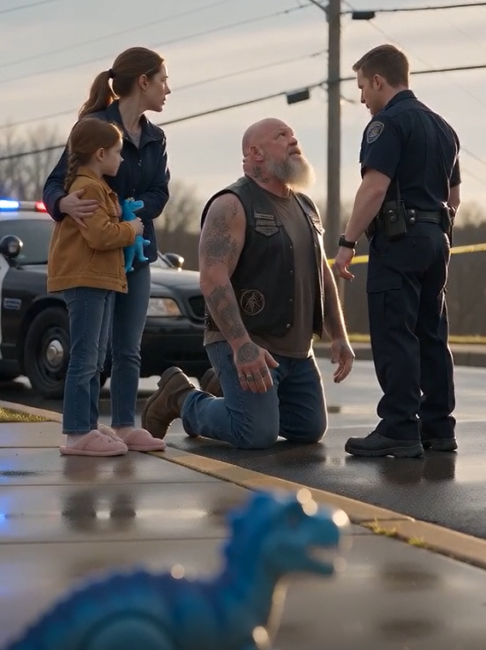
Noah was four.
Rachel couldn’t make herself think in sentences longer than that.
Officer Luke Harris had stepped toward her. His navy uniform was damp at the knees. He said there had been no response yet. Something about fifteen minutes. Something about speaking with the doctor on the radio.
Then he began to turn away.
Rachel heard an ending he had not actually said.
A motorcycle had stopped beside the curb. Its rider crossed the wet lane without looking at the phones rising around him.
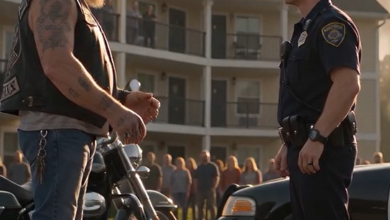
He was enormous, with a shaved head, a long white beard, and tattoos covering both arms. A sleeveless black leather riding jacket hung open over a charcoal shirt. On its back was a lantern inside a wheel.
“Wait.”
The officer paused.
“Sir, stay behind the line.”
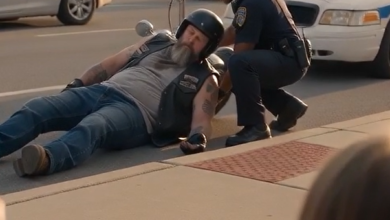
The biker dropped to his knees.
His arms closed around the officer’s lower legs, and the sound that came out of him seemed too raw to belong to a stranger.
“Please. Five more minutes.”
Officer Harris steadied himself and bent toward him.
“You need to let go.”
Grant Ellis pushed forward.
He managed the apartment pool and clubhouse, and Rachel had been grateful to see his familiar green fleece among the uniforms.
“Get him off the officer,” Grant said. “These people have a job to do.”
The biker didn’t look at him.
Rachel wanted to scream the same thing. Her son was beyond that screen. Every second somebody spent managing this man felt stolen from Noah.
Lily gripped her sleeve.
“He’s saying please, Mom.”
“I hear him.”
“He’s not trying to fight.”
The officer held one hand out to keep the crowd back.
“Let me use my radio.”
The biker loosened his arms immediately.
Only then did Rachel see how badly his hands shook.
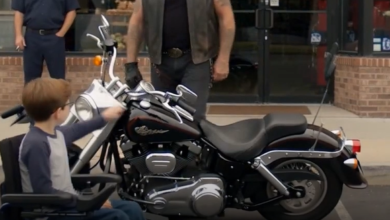
His old American V-twin cruiser stood at the curb with a canvas bag strapped behind the seat. A small rolled poster protruded from the bag. He looked as if he had arrived for some ordinary appointment at the wrong possible time.
“Listen to the team,” Harris told him.
The biker swallowed.
“How long in the water?”
“We don’t have a confirmed time.”
Grant answered anyway.
“Fifteen minutes. I already told them.”
Rachel turned toward him.
She had heard fifteen minutes since her call. She hadn’t said Noah had been underwater that long.
The biker looked up.
Not at Grant.
At the officer.
Then he reached slowly inside his jacket.
Harris’s shoulders stiffened.
“Just my wallet,” the biker said.
He took out a battered leather billfold, opened it, and held it toward the officer with both hands.
Harris bent closer.
His eyes stopped on something Rachel couldn’t see.
Part 2
“Benjamin Mercer,” the officer read.
The biker nodded.
Below the photograph was a hospital name, then two letters Rachel could make out when Harris shifted the wallet toward the light.
MD.
“I’m retired from emergency medicine,” Ben said. “I’m not asking to take over. Please tell the team the submersion time isn’t confirmed.”
Harris looked toward Rachel.
“Mrs. Morris?”
“I called fifteen minutes ago. I don’t know how long he was in.”
Grant began to speak.
Harris raised a hand.
“Let her finish.”
Rachel pressed her fingertips against her own mouth, trying to arrange the sequence. Laundry basket. Courtyard. Lily coming through the kitchen door. Noah’s dinosaur on the table.
She could not turn those images into a reliable number.
“I don’t know,” she repeated.
“Then that’s what we give them.”
Harris relayed the correction immediately.
Behind the screen, the work continued.
Rachel heard a responder’s voice, another answering, the clipped exchange of people changing tasks. Nobody had stopped while Ben knelt in the road. Nobody had declared her child dead.
Her mind had taken fragments and built the worst possible sentence.
Harris crouched beside Ben.
“Can you stand?”
“Yes.”
“Then come this far. Stay outside their working space.”
Ben stood slowly. His jeans were dark at the knees. Rachel noticed a tear caught in his beard before he wiped it away with the back of his wrist.
“Five minutes,” she said.
He turned toward her.
“Is that enough?”
His expression hurt to look at.
“I don’t know.”
It was not the answer she wanted.
It was the first answer she believed completely.
A paramedic came around the screen. Her name patch said Dana Cole. She listened while Harris explained the uncertainty about the timeline and Ben identified himself.
Dana didn’t hand him equipment or surrender her place.
“What did you witness?” she asked.
“Only this part. I was coming to the clubhouse.”
“Then tell me what you know about the water.”
Ben looked toward the open gate.
“That’s what I need somebody to check.”
Grant shook his head.
“It’s heated.”
“Was the heater operating?”
“Yes.”
A young man standing beside a white maintenance van looked up.
He wore a soaked work jacket and held a clipboard beneath it to keep the paper dry.
“No,” he said.
Grant turned sharply.
“Theo.”
“It hasn’t been on.”
Rachel stared at the young man.
He swallowed.
“I measured the water this afternoon.”
Dana asked for the reading.
Theo gave it.
Forty-two degrees.
Ben shut his eyes for half a second.
When he opened them, he looked at Dana rather than the crowd.
“Please make sure medical control has that information.”
She was already reaching for her radio.
Grant lowered his phone.
Rachel wanted to ask why a temperature could matter when she could not feel her own hands. Dana repeated the information back before returning to the team. Ben moved out of her path. He had wanted to be heard; once he was heard, he made room. Rachel noticed that before she understood anything else about him.
Part 3
Cold water.
Rachel held onto the words as if they were a promise.
Ben saw it happen.
He stepped closer, stopping far enough away that she didn’t have to move.
“Cold doesn’t mean safe,” he said. “They need the whole picture.”
“But children can—”
“Sometimes. Nobody can promise you.”
Lily watched his face.
“Are you Noah’s doctor now?”
“No, sweetheart. His team is right there.”
“Then why are you crying?”
The question seemed to catch him unprepared.
He rubbed one hand over his beard.
“Because I want them to have every chance.”
Rachel turned toward the screen.
The responders were still working. Harris went back when Dana called for a trained person to relieve another rescuer. A different officer took his place beside the family.
The sound of the radio continued.
Later, Rachel would learn how much was happening inside those minutes: breathing support, compressions, assessments, decisions passed between the crew and the physician directing them.
At the time, she understood almost none of it.
Her husband arrived carrying his work lunchbox.
Mark stopped when he saw her slippers.
For a second, he looked at them instead of the screen.
Then he set the lunchbox on the ground and put his arms around her.
“Where?”
She pointed.
“Is he—”
“They’re still helping him.”
Mark nodded too many times.
Theo stood near the van with his clipboard.
Grant walked toward him.
Rachel couldn’t hear every word, but she heard, “Not now,” and, “You don’t know what you’re causing.”
Ben looked over.
“The information’s already with the team,” he said.
Grant stopped.
A responder called something behind the screen.
Rachel stiffened.
Dana came out moments later.
“We have a pulse.”
Mark’s arm tightened around her.
Rachel waited for the rest.
“He’s very ill. We’re moving him now.”
“Can I see him?”
“Briefly, as we pass. Then we need you ready to travel.”
The ambulance doors were open.
There was no cheering.
Noah didn’t sit up and ask for his dinosaur. The equipment moved with him, and the people surrounding him kept their attention on their jobs.
Rachel saw only enough to know where her son was.
It was enough to make her knees weaken.
Lily held out the blue dinosaur.
“Can he take this?”
Dana looked at Rachel.
“I’ll keep it,” Rachel said.
Harris stepped away from the stretcher.
He braced one hand against the patrol car and lowered his head.
Ben stood beside him without speaking.
The crew later documented the return of circulation twenty-two minutes after resuscitation had begun. Rachel would read that number so often it nearly became a name.
The number would not tell her how long Noah had been submerged. Those were different clocks, the hospital team later reminded her. One had records. The other had gaps. She had to learn to say she didn’t know without feeling she was abandoning him. Guessing a more certain answer would not change what had happened.
Right then, she heard only Harris breathing unevenly.
“I remember this,” he said.
Ben looked at him.
“Six years,” the officer whispered.
Then Dana called Rachel to the ambulance.
Part 4
At the hospital, Rachel discovered that a heartbeat could bring a new kind of fear.
There were doors she could not follow Noah through. Questions she answered twice because she forgot answering them the first time. A nurse brought dry socks, and Rachel stared at them until Mark helped her pull them on.
Lily went home with Rachel’s sister.
She refused to leave the dinosaur.
“It has to stay here.”
Rachel put it inside her jacket pocket.
Noah went to intensive care.
The physician who spoke with them did not call his pulse a recovery. She described the support he needed, the concerns they were watching, and how little they could responsibly tell them about the coming days.
Rachel asked about the water.
“Does that mean his brain was protected?”
“We can’t determine his outcome from the water temperature.”
The doctor explained that severe cooling could change resuscitation decisions, but the sequence mattered. So did oxygen deprivation, the unknown time underwater, and the care Noah received.
Rachel heard the parts she understood.
They did not know yet.
They were not stopping.
She asked whether Ben Mercer had saved him.
“The team kept working,” the doctor said. “The corrected history mattered. So did the people who started care before the ambulance arrived.”
Nobody could give her one man to thank and one moment to hold responsible.
She wanted both.
That evening, Ben came to the waiting room carrying the canvas bag from his motorcycle.
He had asked at the desk whether the family wanted visitors.
Mark stood when he entered.
“Doctor Mercer?”
“Ben.”
“Thank you.”
Ben looked toward Rachel.
“I’m glad he reached the hospital.”
She noticed the careful limits of his words.
He put the bag beside his chair.
The rolled poster slid halfway out.
Bright little drawings of helmets showed along its edge.
“What were you coming for?” she asked.
“A family safety afternoon. Our riding club was helping with the bicycle station.”
Rachel looked at him.
“That was canceled.”
“Found that out when I got here.”
“Why didn’t they tell you?”
He shrugged.
“Somebody missed a call.”
He had ridden over with handouts, a box of children’s reflector clips, and a promise to help for two hours.
Instead, he had ended up on his knees.
Rachel stared at the bag.
“You weren’t even supposed to see any of this.”
“I was there.”
His phone vibrated.
He glanced at it and answered.
“Yes, I’m all right.”
A pause.
“No. Not home yet.”
His voice softened.
“I’ll call before I ride.”
Rachel pictured somebody waiting for him too.
After he left, Mark handed her his phone.
Grant had posted a statement in the apartment residents’ group.
Rachel could hear carts passing in the corridor. A cleaner paused to move a chair so a visitor using a walker could get through. Everyone around her seemed to be performing one small necessary task. She wanted something equally simple to do for Noah. Instead, she held a phone while somebody elsewhere turned their afternoon into a statement.
It said the pool had been secured, the water heated, and an unidentified man had interfered with emergency personnel.
Part 5
Rachel read the statement beside a vending machine that hummed louder than it should have.
She read it once as Noah’s mother.
Then again as somebody who had stood there.
The pool had been secured.
Her son had reached the water.
The water had been heated.
Theo had said the heater was off.
An unidentified man.
Ben had opened his wallet directly in front of the officer.
Rachel felt anger arrive before she had room for it.
Mark took the phone gently.
“We don’t have to answer tonight.”
“What if people believe it?”
“Then we answer with facts when we can breathe.”
She wanted to argue.
Instead she went back to Noah’s room.
The following morning, Officer Harris called to ask permission to visit.
He arrived without his uniform.
Rachel met him in the family waiting area, where somebody had left a puzzle with three missing edge pieces.
“I owe you an explanation,” he said.
“About what?”
“What you heard outside.”
She waited.
“I told you there’d been no response and that the team was speaking with medical control. I should’ve made clear that care was continuing.”
“I thought you were telling me he was gone.”
“I know.”
His hands rested flat on his knees.
“I’m sorry.”
“Were you going to stop?”
“The team was making its decisions with the physician on the radio. I was going back to help and pass information.”
“And Ben?”
“He thought I was walking away. Once I asked him to release me, he did.”
Rachel looked toward the corridor.
“So everybody saw something different.”
“Parts of the same thing.”
He told her the accounts would include the complete timeline, witness statements, and the responders’ documentation.
“Not a neighborhood post.”
She nodded.
Harris stood to leave.
Rachel remembered his voice beside the patrol car.
“Six years,” she said.
He stopped.
“You said that.”
For a moment, she thought he would pretend not to remember.
“There was another child,” he said.
He gave her no name.
A different place. A different rescue. He had helped until the medical team ended the attempt under its physician’s direction.
He had carried the outcome home.
“Was it the same amount of time?” Rachel asked.
“No. Different circumstances.”
“But you keep counting.”
He looked at her.
“Yes.”
She understood counting now.
Noah’s minutes. His oxygen numbers. The space between one update and the next.
Harris touched the back of a chair.
“I shouldn’t be putting this on you.”
“You’re not.”
He nodded toward Noah’s corridor.
“Today’s his day.”
He asked whether there was anything the department could help arrange for Lily. Rachel hadn’t thought beyond who could collect her from school. Harris gave her a family-support contact and wrote down a number. It was a practical offer, small enough that she could accept it without needing to know what the next week would look like.
After he left, Rachel found a message from Theo.
I kept the original work order.
Part 6
Theo met Mark in the hospital lobby with a folder.
Rachel joined them while her sister sat with Noah.
The maintenance worker looked younger in dry clothes. His knuckles were cracked, and a pale rectangle showed where his watch usually covered his wrist.
“I’m not trying to cause trouble for anybody,” he said.
Mark leaned forward.
“Then tell us what happened.”
The pool’s heater had been shut down for maintenance. That part was routine.
The gate latch was not.
Theo had reported that it failed to catch reliably. The work order he submitted said a replacement part was needed and access to the pool should remain restricted until the repair was complete.
A later version in the office system showed the job as finished.
Theo’s signature appeared underneath it.
He placed two copies on the table.
“I didn’t sign that version.”
Rachel stared at the pages.
“Who changed it?”
“I’ve given everything to the investigator. I don’t know who used the office login.”
He refused to guess.
She respected him for it, even while wanting an answer immediately.
“Why come to us?”
“Grant told me not to mention the heater. Said people would think I’d left things unsafe.”
“Did you?”
“I left written instructions. I put up the temporary barrier. I came back because the part arrived.”
He swallowed.
“When I saw the gate standing open, I thought somebody had brought me through.”
Rachel remembered the laundry basket again.
The ordinary courtyard.
Noah deciding to follow something she had not seen.
Mark asked Theo to send the documents to the detective, the property company, and their insurance contact.
“Keep your originals,” he added.
Theo nodded.
As he stood, Rachel caught his sleeve.
“Thank you for saying the temperature.”
He looked down.
“I should’ve spoken sooner.”
“You spoke.”
That afternoon, Rachel sent Ben a short update.
Noah had made it through another night.
Ben replied with four words.
Thank you for telling me.
She asked if they could speak.
On the phone, she finally asked the question she had carried since the road.
“Why did you beg like that?”
He took time before answering.
“I spent thirty years standing on the other side of those conversations.”
“Did you know he could live?”
“No.”
“Then why?”
“I knew the history wasn’t clear. I wanted them to have what was missing.”
His voice roughened.
“And I wanted that boy to live.”
There was no secret family connection. Noah wasn’t his grandson. No one owed him a debt.
He had seen a child’s mother waiting and had been unable to remain a man passing by.
She asked whether he missed the emergency department.
“Parts of it.”
“Not the rest?”
“I retired because I wanted to have time while my wife and I could still use it.”
He hadn’t left medicine because he’d stopped caring, she realized. He had simply wanted a life that included Saturday afternoons. She hoped this one wouldn’t take that away from him.
Rachel held the phone against her forehead after they hung up.
Across the room, Noah’s blue dinosaur sat beside a box of tissues.
That evening, a nurse came to get her.
“He’s responding when we speak to him.”
Part 7
Rachel followed so quickly she left her cardigan on the chair.
The nurse slowed her gently at the doorway.
“This is encouraging. We still take it one step at a time.”
Rachel nodded, though she would have agreed to anything that let her keep walking.
Noah did not wake into a clean, bright version of himself.
His recovery came in small uncertain pieces, mixed with support being reduced, assessments, exhaustion, and stretches when nothing seemed different.
Rachel learned to stop asking whether each new movement meant everything was fine.
She asked what it meant today.
Several days later, he followed a simple request.
Later still, he spoke.
His voice sounded strange from everything his body had been through.
“Lily?”
Rachel bent so close she nearly touched his forehead.
“She’s coming, baby.”
Lily arrived with a drawing of their apartment courtyard.
She had left the pool out.
Noah noticed.
“Where’s the blue?”
“I didn’t draw that part.”
“Okay.”
She showed him the dinosaur instead.
One tiny arm had snapped off in the waiting room. Lily had wrapped the stump in a strip of blue paper.
“He got hurt too,” she explained.
Noah examined it solemnly.
“Can Ben fix him?”
Rachel looked up.
“Which Ben?”
“The beard man.”
She had told Noah about the people who helped him, carefully, without the frightening parts. She hadn’t realized how firmly he had attached a face to the name.
“We can ask.”
Ben visited the following afternoon.
He stayed at the foot of the bed until Noah invited him closer.
“You have a big beard.”
“Been growing it awhile.”
“Does food get in it?”
“More than I’d like.”
Noah smiled.
Rachel had not been ready for that.
Ben took the dinosaur when asked, inspected the broken arm, and said he could smooth the sharp edge but couldn’t make the missing piece reappear.
Noah thought about that.
“Can he still be a dinosaur?”
“Absolutely.”
“Okay.”
When Ben stepped outside, Harris was waiting near the elevators.
Rachel watched the two men see each other.
The officer extended his hand.
Ben took it.
Neither said anything dramatic.
Harris asked about Noah.
Ben looked back toward the room.
“Asked about lunch.”
Harris took a folded paper from his pocket. Lily had asked him to bring Noah a sticker, but he had brought a little drawing instead: a dinosaur directing traffic with its tail.
“I’m not much of an artist,” he said.
Rachel looked at the crooked dinosaur.
“He won’t care.”
She was right. Noah asked to keep it beside the bed.
Rachel laughed, and for once it didn’t break halfway through.
Near the end of the third week, the hospital team began planning discharge. Noah would need follow-up visits. They were encouraged by his progress, but nobody promised that one examination could answer every future question.
That same day, the property company requested a meeting.
Its letter referred to the gate records.
Grant’s name appeared at the bottom.
Part 8
Rachel attended with Mark.
They brought a folder, a notebook, and a photograph of Noah taken that morning, sitting up in bed with a dinosaur missing one arm.
They did not put the photograph on the table.
They were there for answers, not a performance.
The property company’s regional director sat across from them. So did Grant.
A representative explained that the outside investigation remained separate from the company’s employment and safety review.
Then she placed the two versions of Theo’s work order side by side.
“The completion status was entered through your account,” she told Grant.
He folded his hands.
“Office staff use that terminal.”
“We reviewed the access records and your messages.”
Rachel watched his expression change.
Not much.
Enough.
Grant had asked an office assistant to close the ticket before a scheduled review. He had described the gate problem as resolved, although the replacement part had not arrived.
The assistant had kept the message.
Nobody claimed that closing a computer ticket explained every moment of the accident.
But it explained why a known defect had disappeared from the active list.
Grant leaned toward Rachel.
“I never meant for a child to get hurt.”
She believed that.
It did not help him.
“You knew the repair wasn’t finished,” Mark said.
Grant looked at the table.
The director continued.
There were also the statements made afterward: the heater operating, the area secured, the maintenance worker responsible for information Grant himself had supplied.
“And the man interfering?” Rachel asked.
Grant shifted.
“He was holding a police officer.”
“For a few seconds,” she said. “Then he let go. You left out everything after that.”
“He was upsetting you.”
Rachel put both hands flat on her notebook.
“I was upset because my son was being resuscitated.”
Nobody interrupted her.
“You don’t get to use that as your explanation.”
The company removed Grant from his role and referred the altered records to the authorities conducting the investigation. Repair verification and pool access procedures were transferred to an outside contractor.
Residents received a written correction.
Rachel read it at home with Noah asleep down the hall.
Ben’s name was in it.
So was Theo’s.
Neither was described as the problem.
Months later, Rachel attended a responder-training session with the family’s permission for their experience to be discussed.
Ben sat beside the instructor rather than standing over everybody.
Harris helped demonstrate communication during a handoff.
The revised local training emphasized accurate timelines, drowning resuscitation that included breathing support, assessment of possible hypothermia, and decisions through medical control.
No invented countdown.
No promise that cold water made a child safe.
Afterward, Harris handed Rachel an envelope.
“Can you give him this on Saturday?”
Inside was a birthday card.
Noah was turning five.
Part 9
The party took place in Rachel’s sister’s backyard.
No pool.
A folding table leaned slightly toward the fence, and Mark kept moving the cake away from that end as though it might travel there by itself.
Lily wore a paper crown she had made for her brother and refused to admit she liked.
Noah wore his backward.
Ben arrived on his old cruiser with a small box secured in the canvas bag.
Harris came ten minutes later carrying a badly wrapped present.
“You can tell which one of us has children,” the officer said.
Ben looked at the wrapping.
“Not from that.”
Rachel laughed.
For most of the afternoon, the men were simply guests.
They carried chairs. Found a missing lighter for the birthday candles. Listened while Noah explained a game whose rules changed whenever he began losing.
Nobody asked them to recreate the worst day of the family’s life.
Rachel had made that clear beforehand.
Noah had continued his follow-up care. His doctors were pleased with his development, and by his birthday he was running, talking, learning, and exhausting everyone in the ways Rachel had once taken for granted.
She knew how fortunate they were.
She no longer treated that fortune as something another family could earn by pleading harder.
Harris stood near the fence while the children chased paper streamers.
Rachel joined him.
“You doing okay?”
“Better.”
“Really?”
He nodded.
“I started talking to someone about the old call.”
She waited.
“I kept treating the ending like evidence I’d failed. My counselor keeps bringing me back to what we actually knew and what we did.”
“And now?”
“Now I’m trying to do that too.”
He looked toward Noah.
“This doesn’t rewrite that other child’s story.”
“No.”
“But I slept through the night last week without waking up and doing the arithmetic.”
Rachel touched his sleeve.
“I’m glad.”
At the table, Ben opened his small box.
Inside was Noah’s dinosaur.
The sharp edge had been smoothed. A tiny fabric sling rested around its shoulder, sewn by Ben’s wife.
Noah lifted it carefully.
“You didn’t make a new arm.”
“Couldn’t.”
“But you helped.”
“Best I could.”
Noah accepted that answer.
He carried the dinosaur over to Harris and asked him to hold it while he climbed onto a chair for the candles.
Rachel watched the officer take it in both hands.
She remembered thinking Ben’s leather and tattoos told her everything she needed to know.
What mattered had taken longer to see: his willingness to stay, admit what he didn’t know, and ask the right people to keep listening.
Follow the page for more stories about people we almost misunderstand.
Noah drew a breath and blew.