A BOY IN A WHEELCHAIR KNOCKED OVER A BIKER’S MOTORCYCLE—THEN POINTED AT THE EMPTY PARKING SPACE AND SAID, “DON’T LIFT IT.”
PART 1
A BOY IN A WHEELCHAIR KNOCKED OVER A BIKER’S MOTORCYCLE, AND THE OWNER RAN OUT SWEARING BEFORE HE EVEN SAW THE CHILD’S FACE.
Tom “Bear” Bennett had been inside his shop for less than a minute.
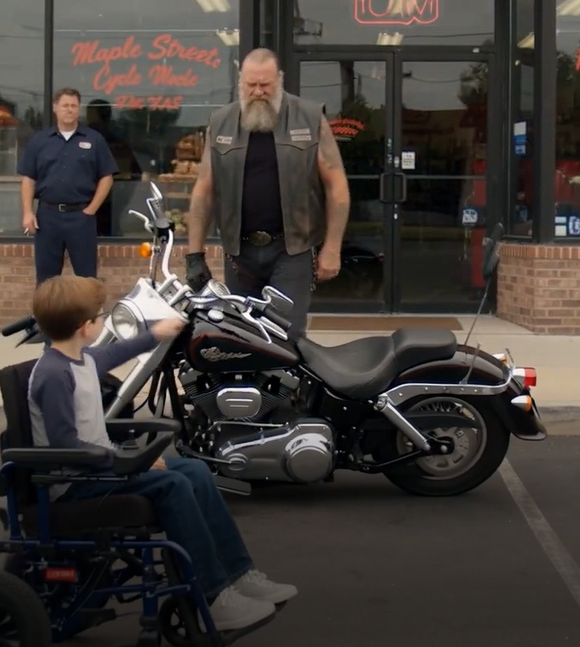
At 3:42 on a Wednesday afternoon, Maple Street Cycle Works in fictional Briar Glen, Ohio, smelled of warm rubber and the coffee nobody had remembered to replace. Tom had just returned from a short ride. His classic American V-twin cruiser stood in the marked parking space beside the sidewalk.
Then came the scrape.
A hard metallic crash followed it.
Tom reached the doorway in three strides.
His motorcycle was down.
A boy sat beside it in a dark-blue power wheelchair, both feet still supported, one hand frozen above the joystick. His glasses had slipped down his nose. He looked eleven.
“What the hell?”
Tom’s voice carried farther than he intended.
He was fifty-eight, six-foot-five, with a shaved head, a long gray beard, and shoulders that filled the shop doorway. Tattoos covered his forearms, knuckles, and the side of his neck. His black sleeveless leather biker jacket carried a silver compass with a break in its outer ring.
The boy flinched.
Tom saw it.
He stopped.
Warren Blake, the service writer, stepped away from the wall with a cigarette between two fingers.
“He drove straight into it.”
A customer lifted his phone.
Across the sidewalk, a woman in a sage-green cardigan came out of the bakery carrying a paper bag.
“Owen?”
The boy turned his head toward her.
His breathing was shallow. His lips moved, but Tom couldn’t make out the words.
Warren spoke over him.
“Someone needs to pay for this. Those chairs aren’t toys.”
The woman crossed toward her son, then stopped when she saw the motorcycle.
Tom pulled off one glove slowly.
He could hear the air compressor cycling inside. Somewhere behind him, a wrench hit concrete.
The boy hadn’t backed away.
He hadn’t tried to explain the impact.
He kept looking at the patch of pavement where the motorcycle had been standing.
“Are you hurt?” Tom asked.
Owen shook his head.
“Your chair?”
Another small shake.
Warren gestured toward the fallen bike.
“You saw what he did. He lined himself up.”
The customer’s phone tilted toward Tom’s face.
“Don’t scare him,” the man said.
Tom swallowed the answer that came first.
He knew how he looked. A huge man in black leather, angry beside a frightened child who couldn’t stand up and walk away.
He lowered his empty hands.
“Owen. That your name?”
The boy nodded.
His mother reached the chair.
“I’m Claire. What happened?”
“I don’t know yet,” Tom said.
Warren started answering anyway.
Tom lifted one palm toward him.
“Let him.”
Owen pressed his fingers against the armrest, working for enough breath to speak. His eyes stayed fixed on that empty patch beside the curb.
Tom glanced toward his motorcycle.
He shifted as if to approach it.
Owen’s hand shot up.
The boy pointed at the place the bike had occupied, not at the damage.
“Don’t lift it.”
Part 2
Tom followed the boy’s finger and saw gasoline spreading across the asphalt.
For half a second, he mistook it for rainwater.
Then the smell reached him.
“Everybody back.”
He turned toward Warren.
“Move away with that cigarette. Away from the fuel.”
The service writer looked down.
His face changed.
Tom did not reach for the fallen motorcycle. He directed people away from the spill while Ava Ruiz, his other mechanic, called for help and kept customers out of the work area.
Claire asked Owen whether he could move his chair.
He nodded.
Tom pointed toward clear pavement, leaving the choice of movement to Owen and his mother. He did not grab the joystick or push the chair.
Owen backed away slowly.
Only when they were clear did Tom notice his own hands shaking.
Less than a minute earlier, he had been standing inside, thinking about a parts invoice.
Outside, his hot motorcycle had been leaking fuel beside a man with a lit cigarette.
The boy had been the first person to notice.
Ava came back to the doorway.
“Fire crew’s on the way.”
“Keep the bay clear.”
“Already done.”
Warren stood farther down the sidewalk, his cigarette extinguished.
“The impact must have split something,” he said.
Owen shook his head sharply.
Tom looked at him.
“Before?” he asked.
The boy nodded.
“It was dripping before?”
Another nod.
Claire bent closer without blocking his face.
“Take your time.”
Owen’s voice came in short pieces.
“Onto the pipe.”
Tom looked toward the bike without approaching it.
He could picture the fuel hose beneath the tank. He could picture the exhaust after his ride.
He did not like either picture.
The fire crew arrived, checked the scene, and took control of the immediate hazard. Nobody started the motorcycle. Nobody dragged it across the pavement to prove a point.
Tom answered questions.
Then he stayed out of the way.
Once the area was safe for them, a firefighter explained that fuel had escaped around a deteriorated connection. The leak needed proper investigation before anyone could say exactly what the impact had changed.
“The hot bike and the smoking were enough reason to clear people out,” she said.
Tom nodded.
No fire had started.
That did not make the danger imaginary.
He walked back to Owen and lowered himself onto one knee at a comfortable distance.
His leather jacket creaked.
“I shouted at you.”
Owen watched him.
“I’m sorry.”
The boy looked at his mother, then back.
“You didn’t see.”
“No.”
“I tried.”
“I believe you.”
Owen’s shoulders dropped slightly.
Tom glanced at the chair.
“Before we talk about anything else, we’ll have someone check that.”
Claire nodded.
Owen pressed a finger against the armrest.
“I smelled it first.”
Tom looked toward the motorcycle.
“You know that smell?”
The boy’s answer was barely audible.
“From the other fire.”
Part 3
Tom stayed on one knee.
He did not ask Owen to explain in front of the people still gathered near the bakery.
“Would you like somewhere quieter?”
Owen looked at Claire.
She asked whether he wanted to go home.
He shook his head.
They moved to the bakery’s side patio, away from the repair bay and the remaining odor. Tom waited until Claire had helped Owen settle before taking an ordinary chair opposite him.
Nobody towered over anyone.
“The other fire was five years ago,” Claire said.
Owen touched the seam of his sweatshirt.
“I was six.”
He had been at a neighbor’s garage with other children while the adults worked nearby. Fuel leaking from a motorcycle had contributed to a fire.
There had been a collapse during the escape.
Owen had sustained a spinal injury. Smoke had damaged his lungs.
Claire gave Tom only those details.
He did not ask for the rest.
When Owen paused, Claire did not finish his sentence. Tom noticed how deliberately she waited. He had spent years mistaking a quick answer for a useful one. Here, the useful thing was an empty space in the conversation, held long enough for the person who belonged in it.
“My voice gets small,” Owen said.
“I hear you.”
“Not when things are loud.”
Tom thought of the compressor.
Then of Warren talking over him.
Owen had been waiting outside while his mother collected a bakery order. They had agreed on the spot where she could see him through the window.
He used that sidewalk often.
He knew how to drive his chair.
This had not been a child escaping supervision or playing with controls he did not understand.
“I smelled it,” he said again. “Then I saw drops.”
“Did you try to get someone?”
Owen nodded toward the shop.
“You went inside. He was looking at his phone.”
Warren.
“I waved.”
Tom waited.
“I said something. Not loud enough.”
Claire rested her hand near Owen’s, leaving him room to move.
The boy described looking from the fuel to the cigarette and back again.
“I thought if it fell the other way, the drops wouldn’t hit there.”
Tom took a breath.
He wanted to say that Owen had saved them.
He also needed to tell him the truth.
“It made us look,” he said. “But knocking it down could have made things worse.”
Owen stared at his knees.
“I didn’t know what else.”
“I understand.”
Tom kept his voice quiet.
“You should have had somebody listening before it got that far.”
Across the patio, the customer who had raised his phone was lowering it into his pocket.
His name was Martin. He asked whether Owen wanted the recording deleted.
Claire looked at her son.
“Yes,” Owen said.
Martin deleted his copy in front of them.
Tom stood slowly, his knee objecting.
“I’ll handle my motorcycle,” he told Claire.
She opened her mouth.
He continued before she had to offer money.
“And we’ll arrange the chair inspection through the people who service it.”
Ava appeared at the patio entrance carrying a clipboard.
Her face was pale.
“Tom,” she said. “There’s something in the work order you need to see.”
Part 4
The first page looked ordinary.
Tom’s motorcycle. Routine service. A familiar list of checks.
The final box said ready.
He had relied on that word when Warren handed him the keys that morning.
Ava turned the page.
Her original note sat beneath a photograph taken two days earlier.
Fuel odor after warm-up. Hold for inspection.
Tom read it twice.
“You found that before today?”
“Yes.”
“Who did you tell?”
“Warren. You were collecting the lift parts.”
“Did anybody inspect it afterward?”
Ava swallowed.
“I was told you had.”
Tom looked toward the shop.
Warren stood beside the counter, arms folded.
He saw the clipboard and came outside.
“That’s an internal document.”
“It’s my motorcycle,” Tom said.
“And my shop.”
Warren glanced toward Claire.
“Maybe we should discuss it privately.”
“We will. We won’t ask them to pretend this didn’t happen.”
Ava explained that she had reported an odor, not diagnosed the exact failure. The bike needed another inspection before release.
Her photograph did not prove where every drop had landed.
It did prove the concern existed before Owen touched the motorcycle.
Tom checked the timestamps.
Then he called the independent mechanic who handled the shop’s more complicated diagnostic work and asked for a documented examination once the bike could be moved safely.
Warren began explaining the schedule.
A delayed delivery.
Two absent workers.
An angry customer waiting for the lift.
All real problems.
None explained the word ready.
“I thought it was residue from the service,” he said.
“Who confirmed that?”
No answer.
Tom had spent years telling customers that a cheap guess could become an expensive repair.
Now one had left his own motorcycle beside a child and a cigarette.
Claire watched him from the patio.
He could see what she was waiting for.
Whether he would protect the boy.
Or the business with his name on the door.
Tom handed Ava back the clipboard.
“Preserve the original record. Nothing gets changed.”
Warren’s jaw tightened.
“You’re taking the kid’s side before we’ve even assessed the impact.”
“I’m assessing both.”
“He deliberately damaged property.”
“He did.”
Claire’s face fell.
Tom turned toward her.
“That doesn’t erase what he saw.”
The independent examination would take time. So would checking the rest of the records.
Tom suspended Warren from customer-facing duties pending the review and put someone else in charge of the counter.
He did not announce a verdict on the sidewalk.
He also did not let Warren keep speaking for the shop.
That evening, Claire called.
Someone had sent her an estimate for Tom’s motorcycle repairs.
It listed Owen as the responsible party.
Tom looked at the email header she forwarded.
Warren had sent it from his personal account.
Part 5
“Don’t pay it,” Tom said.
Claire sounded tired.
“I wasn’t going to do anything tonight.”
“Good.”
“What happens tomorrow?”
“I put in writing that he had no authority to send it.”
“And the day after?”
Tom heard the question beneath the question.
Would she need to defend her son forever because a man had seen the damage before seeing the child?
“I’ll give you the examination report when it’s finished.”
“Even if it makes your shop look bad?”
“Yes.”
The report found aged, deteriorated material at the leaking fuel connection. Damage from the fall also needed repair, but the existing deterioration had not been created by a wheelchair bump.
Ava’s earlier note supported that finding.
Tom sent Claire the complete report.
No page missing.
No request that she keep it quiet.
He sent a separate written correction about the unauthorized estimate.
Then he called the customer who had stood filming and asked whether he would witness an apology if Owen wanted one.
Claire asked her son.
Owen wanted the apology.
He did not want a camera.
They met outside the shop after closing.
Tom wore the same leather jacket.
This time, he left room for Owen to approach the conversation instead of entering it already angry.
“I believed what I saw first,” Tom said.
Owen waited.
“My bike was down. I shouted. Then other people started talking, and you had to work harder to be heard.”
He paused.
“That was mine to stop.”
Claire looked at the ground.
Tom continued.
“You’re not getting a bill from me.”
“What about my chair?” Owen asked.
“The service company’s checking it. We’re paying for that.”
“Not a new one?”
“Not unless the people who know your equipment say you need one.”
Owen nodded.
Tom understood the relief.
A wheelchair was not interchangeable with whatever an adult thought looked generous.
Its fit mattered. Its controls mattered. It belonged to the person using it.
The inspection found a damaged guard and alignment issue that could be repaired. Owen’s usual provider handled the work.
Warren’s review took another week.
It established that he had cleared the hold without the required inspection, misrepresented who had checked it, and sent an unauthorized demand after being told not to contact the family.
Tom dismissed him.
He also changed the release procedure and hired outside help to audit recent safety-related jobs.
He did not describe the problem as one bad employee and carry on unchanged.
Ava brought him a list of records to review.
Tom looked at the growing pile.
“I should’ve built a system where ready meant something you could verify.”
“Yes,” she said.
He appreciated that she did not soften it.
Ava had joined the shop eighteen months earlier. Until then, Tom had treated her careful notes as evidence that she was learning. Now he saw that she had already done the careful part. The business had failed to carry it forward. He changed who could clear a safety hold and required a second recorded check.
At the end of the week, Owen returned with a notebook.
He opened it to a drawing of three wheels.
Part 6
Tom looked at the sketch.
“Yours?”
Owen nodded.
The drawing showed a small electric three-wheeler with a low seat, wide rear track, and controls clustered where two hands could reach them.
No pedals.
No promise that its rider would stand.
“I already drive my chair,” Owen said.
“I noticed.”
“This would be different.”
“How?”
Owen considered the question.
“It would be for fun.”
Tom looked at Claire.
She smiled a little.
“He’s been drawing it for months.”
Tom had expected the boy to ask about his motorcycle.
Instead, Owen had brought him a problem.
A proper one.
Something with measurements and compromises.
“Want to see the bench?”
Owen looked toward the shop entrance.
Tom followed his gaze.
The threshold had a raised lip.
He had stepped over it for twelve years without thinking.
Before the next visit, he had an appropriate accessible entry installed and rearranged a work area so Owen could approach it.
He did not announce this as a gift.
He needed customers to be able to enter his business.
The trike was a different matter.
Tom knew engines and fabrication.
He did not know enough about adaptive seating, stability, or individual control needs to build something safe by himself.
With Claire’s agreement, they brought in a rehabilitation engineer named Dana Brooks, who worked with adaptive recreation equipment.
Dana studied Owen’s drawing.
Then she asked him questions.
Where did he want his hands?
What tired first?
What could he already do comfortably?
Owen answered until his voice faded.
Dana waited through the pauses.
At the end, she said, “We start with a suitable manufactured platform. We don’t guess our way through the parts that keep you supported.”
Tom wrote that down.
The project would take months.
It would cost more than his first excited estimate.
Owen would help choose and test the design.
Professionals would handle the systems that required their expertise.
Meanwhile, the Open Compass Riders organized their first free fuel-system inspection day.
Ava helped develop the checklist with qualified technicians.
The event offered inspections, not a promise to repair every motorcycle free of charge.
Bikes with serious defects were not sent back onto the road to save anyone embarrassment.
Owners arranged repairs or safe transport.
Tom’s damaged motorcycle stood inside the shop as a useful reminder.
At the first event, a rider pointed at it.
“What happened to that?”
Tom glanced toward Owen, who was checking appointment names at an accessible table.
“I stopped listening too early.”
The man looked puzzled.
Tom handed him a form.
“We’re trying to improve that.”
Three months into the trike project, Dana called them together.
The latest layout did not fit Owen properly.
Tom began explaining a possible compromise.
Owen interrupted him.
“Is it going to be something I can drive, or something you want to finish?”
Part 7
Tom stopped talking.
Dana set her pencil down.
Claire looked at her son with an expression Tom could not quite read.
Owen’s cheeks had gone pink.
“I don’t mean—”
“You mean it,” Tom said. “You’re right to ask.”
They had been trying to preserve too much of the first layout. The controls were reachable during a brief fitting but uncomfortable over time.
Owen had been trying not to disappoint them.
Tom recognized that before the boy said it.
“You don’t have to like something because we worked hard on it.”
Owen looked up.
“Really?”
“Especially then.”
They went back to the measurements.
The schedule moved.
A part went back to its supplier.
Tom spent an evening taking apart work he had been proud of.
He did not complain where Owen could hear him.
That mattered more than saying the right thing at the workbench.
The boy began disagreeing sooner.
He chose a brighter color.
He asked for a clearer place to rest his hands.
He rejected a decorative tank shape because it made the vehicle look like a miniature version of Tom’s motorcycle.
“I’m not you.”
Tom grinned.
“Probably a relief to your mother.”
Claire laughed.
There were still difficult visits.
Days when Owen’s lungs made sustained talking tiring.
Days when his schoolwork came first.
One afternoon, he stayed home because he simply did not want a workshop appointment.
Tom took that as progress.
The boy did not owe them constant enthusiasm.
Across the year, the inspection program traveled to several community sites. Other qualified shops volunteered time.
Some motorcycles arrived because their owners had already noticed a smell.
Others came for routine checks.
By the ninth event, the documented total reached forty motorcycles with confirmed fuel leaks requiring attention.
Not forty explosions predicted.
Forty defects that could now be repaired.
The count included bikes brought from neighboring towns and machines whose owners had already stopped riding them. Ava refused to describe every leak as a near disaster. She wrote down what the technicians actually found and what needed to happen next. Owners received copies instead of promises about what might have been.
Ava kept the records precise.
Tom learned to appreciate that kind of unexciting language.
His own shop’s audit identified two customer jobs needing follow-up. He contacted the owners, explained the problem, and paid for the corrective work.
He had wanted to find none.
Finding them was the point of looking.
One evening, the customer who had filmed the original incident brought his motorcycle for inspection.
Martin waited until Owen had finished arranging the forms.
“I’m sorry I talked over you,” he said.
Owen nodded.
Then he asked for the bike’s mileage.
They went on with the work.
Near the end of the year, the trike passed its professional checks and the fittings Dana required before a controlled trial.
There would be no surprise unveiling.
Owen had seen every stage.
He knew what it looked like.
What he did not know was how it would feel to move in it.
The evening before the trial, he asked Tom to invite Ava.
Then he added, “And the people who heard you shout.”
Part 8
“All of them?” Tom asked.
“Not everybody. Just the ones who were there.”
Claire asked Owen why.
The boy thought for a while.
“I want them to hear me this time.”
They invited a small group.
No local news crew.
No banner calling the trike a miracle.
Dana supervised the final fitting and explained how the controlled trial would work. Owen and Claire had already agreed to the plan.
The closed paved practice area belonged to a community recreation center.
No traffic.
Room to stop.
No audience crowded around the controls.
Tom stood beside a table holding the original notebook, the inspection program’s totals, and a few photographs Owen had approved.
Ava arrived carrying the first work order.
She handed it to Tom.
“Thought you might want the whole story here.”
He laid it beside Owen’s drawing.
When everyone had settled, Tom spoke briefly.
“A year ago, Owen damaged my motorcycle trying to get us to notice fuel leaking from it.”
He looked toward the boy.
“The collision wasn’t a safe way to solve that problem. He knows that. It should never have become the only thing he could think of.”
Warren was not there.
Tom did not use his absence to make the shop blameless.
“A warning was missed here before Owen arrived. Our records and our release procedure failed. That was my responsibility to put right.”
Ava stood beside him.
Claire held her son’s notebook.
Tom continued.
“People keep asking what I built for him.”
He lifted the drawing.
“This started before he met me.”
Owen looked down, smiling.
The first sketch was uneven. The wheels were too large for the body. A note beside the seat said hands here, both sides.
It was still recognizably the same idea standing beside them.
Dana asked Owen whether he was ready to transfer using the arrangement he and his family normally used.
He nodded.
The others gave them privacy and space.
When Owen was settled, the test took time.
Positions checked.
Questions answered.
One adjustment made before anything moved.
Tom waited outside the marked area.
He had spent years starting engines to impress people.
Now he could barely tolerate the silence before a small electric motor.
Owen looked at him.
“You’re making the face.”
“What face?”
“The one from when you broke that bolt.”
Ava laughed.
Tom let out a breath.
“Different problem.”
Claire stood beside him.
For a moment, she watched her son without speaking.
Then she said, “He didn’t need someone to teach him how to want things.”
Tom nodded.
“I know.”
“He needed someone who wouldn’t decide for him.”
Inside the practice area, Owen moved his hand to the control.
Dana asked one final question.
“Still want to go?”
“Yes,” he said.
Everyone heard it.
Part 9
The trike moved quietly.
Only a few feet at first.
Owen stopped exactly where he had planned.
Dana checked with him.
He answered, made a small adjustment to his hand position, and tried again.
Tom stayed where he was.
He did not run beside the vehicle.
He did not shout instructions over the person responsible for the trial.
Owen made a broad turn across the practice area, the yellow bodywork bright against the gray pavement.
He was twelve now.
Still used his wheelchair.
Still needed breaks when breathing became tiring.
Nothing about that had disappeared because a workshop project was finished.
He also had a vehicle he had helped design, built around what he wanted to do.
That was enough to fill the space.
On the second circuit, he looked toward Ava.
She raised both thumbs.
He grinned and looked back at his route.
When he returned to the stopping point, Claire asked how it felt.
Owen considered the question with great seriousness.
“Like we need somewhere to put my drink.”
Tom closed his eyes.
Ava leaned against the table laughing.
Dana made a note.
The first improvement had arrived before the first afternoon was over.
Later, while the others ate sandwiches, Owen asked to see Tom’s motorcycle.
It stood at the edge of the site, repaired and inspected, the engine off.
The scraped saddlebag had been restored. The broken mirror had been replaced.
Tom pointed to a small scuff on a metal guard.
“Left that.”
“Why?”
“Didn’t matter to how it worked.”
Owen looked at him.
Tom could have made it into a speech.
He did not.
The boy already knew the rest.
Claire came over carrying a paper plate.
“He wants to know whether the workshop visits stop now.”
Tom looked toward Owen.
“Do you want them to?”
“No.”
“Then bring the next drawing.”
“There’s a next one?”
“That seems likely.”
There was.
Two weeks later, Owen brought plans for an accessible tool cart with a handle he could reach without twisting.
Ava found a clear place on the bench.
Owen measured the available space himself. He asked for the ruler, corrected a number, and told Tom the first shelf was too high. Nobody called him brave for noticing. Nobody thanked him for inspiring the shop. They moved the shelf on the drawing and asked what he wanted below it.
The inspection program continued too. Forty documented leaks became a reason to keep checking, not a number printed on a victory banner.
Tom’s shop kept the revised release records.
He still wore the black leather jacket.
Strangers still sometimes looked at the beard, the tattoos, and the size of him before deciding what kind of man he was.
Tom understood that first impressions could be wrong.
He had shouted one across his own sidewalk.
Follow this page for more stories about the people who learn to listen.
On Owen’s next visit, a delivery truck blocked the entrance.
He stopped safely behind it.
Then he pressed the horn.
Tom looked up at once.