A TEN-YEAR-OLD CRACKED A BIKER’S HELMET WITH A ROCK—THEN RAISED BOTH HANDS AND SHOUTED, “THE BRIDGE! THE BRIDGE!”
PART 1
A TEN-YEAR-OLD THREW A ROCK AT A BIKER’S HELMET, AND THE MAN WHO TURNED AROUND LOOKED BIG ENOUGH TO BREAK HIM.
At 11:10 on a Saturday morning, Hank “Anchor” Bennett was riding Bell Creek Road outside the fictional town of Miller’s Run, West Virginia. Rainwater still shone in the pasture ditches. His classic American V-twin cruiser smelled faintly of warm gasoline, and the sack of biscuits strapped behind him had begun leaking butter through the paper.
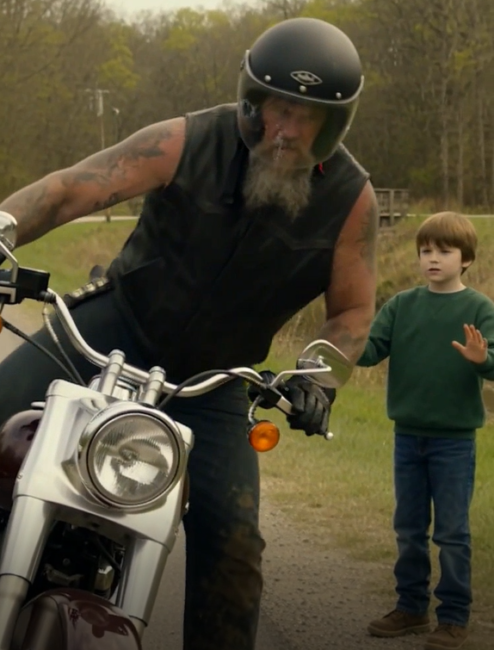
The rock struck above his left temple.
A sharp crack cut through the engine noise. Hank kept the bike upright, slowed, and pulled onto the gravel shoulder before turning around. Through his dark glasses, he saw a skinny boy beside a leaning fence, one arm still extended.
Ten years old, maybe. Brown hair. Green sweatshirt. Red sneakers sunk in mud.
The boy didn’t run.
Hank stopped several yards away and shut off the engine. His black sleeveless leather biker jacket creaked as he climbed down. A silver anchor inside a broken circle covered the back. His gray beard reached his chest; tattoos covered both forearms and crossed his knuckles.
“What was that?”
The boy raised both empty hands.
Before he answered, a county pickup rolled out of a nearby farm lane. The driver lowered his window.
“Eli Turner. Again?”
Wade Mercer, the county road supervisor, stepped out in a tan work jacket. A feed-delivery driver stopped behind Hank. A woman in a blue compact pulled over farther back, her phone already raised.
Wade glanced at the big man’s vest.
“Don’t go getting rough with him. We’ve got enough trouble without motorcycle people making a scene.”
Hank felt heat climb his neck. He had not touched the boy. He had not even moved closer.
He slowly removed one glove.
Gravel clicked beneath Wade’s clean work boots. The feed driver looked from Hank’s tattooed hands to Eli’s raised palms, and Hank understood how the picture would look in somebody’s phone.
A grown man. A frightened child. An easy story.
Then Eli shouted.
“The bridge! The bridge!”
Hank stopped working at the helmet strap.
Wade waved toward the crossing roughly a thousand feet up the road. From there, the wooden deck made a straight brown line above the creek.
“He gets worked up about that bridge,” Wade said. “You can see it’s still standing.”
But Eli wasn’t watching the supervisor. He was watching Hank’s hands, waiting for something Hank had not done.
Hank took off his helmet.
A thin split marked the outer shell. He set it on the seat without holding it toward the boy.
“Show me.”
Eli lowered his arms.
He led them along the shoulder, away from the traffic lane. Hank walked behind him. Wade followed, still talking. The feed driver brought up the rear, leaving the woman beside the stopped vehicles.
At a wide gravel turnout sixty feet before the bridge, Eli stopped. He kept both sneakers well back from the creek bank.
He pointed beneath the rail.
“Look underneath.”
Part 2
Hank bent at the knees and looked beneath the boards.
At first, the rail blocked his view. He shifted sideways on the gravel, keeping Eli behind his shoulder, and the center of the bridge opened into something his eyes did not want to accept.
There was daylight where a support should have been.
One timber pier had disappeared. Two long beams hung crooked above brown water, and the deck boards remained attached to the sections on either side like a rug stretched over a hole.
From the road, they looked connected.
From below, they were waiting.
Hank had spent thirty-one years welding and repairing steel around bridges. Timber work was outside his trade, but a missing support did not require an argument.
He stood slowly.
“Nobody goes closer.”
Wade came alongside him.
“It might be the angle.”
A length of wood struck something beneath the crossing. The hollow knock traveled up through the creek noise.
The feed driver stopped walking.
“That isn’t an angle.”
Hank took out his phone. Two bars appeared, vanished, then returned. He called emergency dispatch and gave the road name, the crossing, and their position.
“Possible bridge failure. Deck still looks passable from the approach. We need both ends closed.”
Wade lifted his own phone.
“I can get my crew.”
“Do that.”
Hank stayed on the line until the dispatcher repeated the location.
Then he turned to Eli.
“Anybody on it now?”
The boy shook his head.
“Two cars came before you. I waved. One stopped right at the boards. The other turned by the field.”
“Did they talk to you?”
“No.”
“Anybody downstream?”
“I don’t think so.”
The words came out carefully, as if Eli had learned that guessing could get him dismissed.
Hank asked the dispatcher to send someone to the opposite approach. Then he walked everyone back from the turnout to the stopped vehicles, where the woman in the blue compact was still recording.
“Please stop filming the boy,” he said.
She lowered the phone.
Wade began explaining that nobody had established how much of the bridge was damaged. Hank ignored him and opened the biscuit sack.
“You eaten?”
Eli stared at the paper.
“Since breakfast?”
A small shake of the head.
“What time was breakfast?”
“Six.”
Hank checked his watch.
“Where’s your grown-up?”
“My aunt’s house. Mom’s working.”
“Can we call them?”
Eli recited two numbers without hesitation. Hank handed his phone to the feed driver, who introduced himself as Ned Collins and moved a few steps away to make the calls.
Hank offered Eli a biscuit.
The boy held it without eating.
“How long you been out here?”
“Since seven-ten.”
Four hours.
Hank looked toward the bridge again. He could still picture his front wheel reaching those boards.
“Why didn’t you go home?”
Eli rubbed a muddy sneaker against the gravel.
“Because somebody was going to cross.”
“You could’ve gotten hurt.”
Eli looked up then.
“So could my dad.”
Part 3
Hank waited.
The boy broke a corner from the biscuit, rolled it between his fingers, and dropped it into the sack.
“Dad died there,” he said. “Two years ago.”
Wade looked away.
That small movement stayed with Hank.
Eli explained in pieces. His father’s name was Daniel Turner. He drove a delivery van. A storm had come through while he was finishing his route, and the creek had risen faster than anybody expected.
“He thought he could get across.”
Hank glanced at the straight brown line between the banks.
Eli had been eight.
“What happened wasn’t yours to fix,” Hank said.
“I know.”
But the boy said it like an answer he had practiced for adults who needed him to agree.
Ned returned with the phone.
“His aunt’s coming. His mother’s on her way from work.”
Eli’s shoulders rose toward his ears.
“Am I in trouble?”
“We’re telling them where you are,” Hank said. “That comes first.”
The aunt arrived before the deputy, driving a small pickup with garden tools rattling in the bed. Her name was Beth. She stopped so abruptly that her sunglasses slid off the dashboard.
“You said you were going to the pond.”
“I did.”
“For an hour, Eli.”
“I know.”
She reached him, checked his face and hands, then pulled him against her coat.
Hank stepped away to give them room.
Beth explained that the pond sat on family property beyond a pasture footpath. Eli had gone there many times. When he failed to return, she had searched the pond, called his mother, and started checking neighboring houses.
His phone was charging on her kitchen counter.
The creek ran behind the pond. That morning, Eli had heard the bridge making a knocking sound and followed the bank far enough to see the missing support.
Then he had taken the footpath to the road.
“Why didn’t you come get me?” Beth asked.
“I thought I could stop the cars until somebody came.”
Hank knew that kind of mistake.
A child solved the first problem he saw. Then the solution became a job he believed he could not leave.
Wade folded his arms.
“This is why children shouldn’t be making decisions around county roads.”
Beth looked up sharply, but Hank spoke first.
“He shouldn’t have been alone.”
Wade nodded.
Hank continued.
“Neither should that bridge.”
The county supervisor’s expression hardened.
“You don’t know what’s been reported.”
“No,” Hank said. “I don’t.”
Ned had been checking his phone. Now he turned the screen toward Hank.
A photograph showed a pale yellow slip lying on a feed-store counter. Written across the top were the words FLOOD DAMAGE.
“My morning driver called your office,” Ned told Wade. “Before eight.”
Wade barely glanced at it.
“We get a lot of calls after storms.”
Ned enlarged the bottom of the photograph.
“He wrote down who answered.”
Hank watched Wade read the name.
For the first time since he had stepped out of his pickup, the supervisor had nothing ready to say.
Part 4
The deputy arrived while Beth was helping Eli change into dry socks from a grocery bag she kept behind her seat.
Deputy Lena Price listened without interrupting.
Hank described the rock, his stop, the walk toward the bridge, and what he had seen beneath it. He gave her his name and offered the damaged helmet.
Wade waited until she began taking notes.
“You should know he came back angry,” he said. “That boy had his hands up.”
“I was angry,” Hank said.
Price looked at him.
“Did you threaten him?”
“No.”
“Touch him?”
“No.”
Wade made a small impatient sound.
“There are ways to threaten somebody without saying it.”
The woman from the blue compact stepped forward.
Her name was Marcy Bell. Up close, Hank could see that her hands were shaking too.
“I started recording because I thought something bad might happen,” she said. “You can watch.”
The video began after Hank had parked.
It showed him standing beside the motorcycle. Eli was several yards away. Wade’s voice was clear.
“You keep your hands off that boy.”
Then Hank’s hands filled the bottom of the frame as he slowly removed a glove.
He never advanced.
Price watched through Eli’s shout about the bridge, then asked Marcy to preserve the original recording.
Wade pointed toward the helmet.
“The kid could have caused a wreck.”
“Yes,” Hank said.
Eli stopped moving.
Hank turned toward him.
“Throwing that rock was dangerous.”
The boy stared at his new socks.
Price crouched several feet away, keeping her voice ordinary.
“Tell me what you tried before that.”
Eli counted on his fingers.
Waving. Shouting. Holding up his green sweatshirt until he got cold. Standing where drivers could see him without stepping into their lane.
Then Hank had come around the bend.
“I thought he wasn’t looking.”
Hank remembered his dark glasses, the engine beneath him, the biscuits behind him, and his easy assumption that the road would continue being a road.
Ned’s phone rang.
His morning driver had sent the dash-camera clip.
They watched it on the truck’s larger screen. At 7:42, Eli appeared beside the road with both arms moving. The driver slowed, saw a strange dip near the center of the crossing, braked, and reversed.
The camera never showed the missing support.
It showed enough.
Ned played the audio.
“County roads?” the driver said through the truck’s hands-free system. “You need to close Bell Creek crossing. Something’s wrong with the deck.”
The person answering asked for the location twice.
Then she repeated it correctly.
Price wrote down the time.
Wade said a report was not the same as a confirmed hazard.
“No,” she replied. “It’s a reason to check.”
A second county truck arrived carrying barricades. Behind it came a woman in office clothes and mud-spattered shoes.
Wade’s face tightened.
The woman looked directly at him.
“I need to correct what I entered this morning.”
Part 5
Her name was Dana Holt.
She worked at the county roads desk on Saturdays, answering calls and entering maintenance requests. She had brought a printed copy of the morning’s log.
Hank expected a simple mistake.
A wrong road. A missing digit. Somebody hearing “loose board” instead of “bridge.”
Dana held the paper flat against the pickup hood.
“I marked it urgent,” she said. “Possible flood damage. Immediate field inspection.”
Wade reached for the sheet.
She kept her hand on it.
“You called me back.”
“We discussed the workload.”
“You told me to change it to routine follow-up.”
The creek made a dull knocking sound beyond the pasture.
Nobody looked toward it this time.
Wade lowered his voice.
“Because the first report was from a driver who never got out of his truck.”
Dana swallowed.
“I should have left the original classification.”
Price asked her to keep the printout and the electronic records available. She did not announce an arrest. She did not declare what had caused the bridge to fail.
She separated the people giving statements.
That steadiness helped Hank more than outrage would have.
Eli’s mother arrived while a crew unloaded the first barricade.
Rachel Turner wore black bakery pants, a flour-marked gray shirt, and a coat buttoned crookedly over both. She went straight to her son.
For several seconds, Hank heard only her asking whether he was hurt.
Then Eli pointed at the helmet.
“I broke his.”
Rachel turned toward Hank with a face that had already begun calculating a bill.
“We’ll pay for it.”
“We can talk later.”
“How much?”
“Later.”
She nodded too quickly.
Hank recognized the gesture. People who had been short of money for a long time often treated a delayed bill as a trap.
He opened his saddlebag and took out a folded flyer.
“This was where I was headed.”
Rachel looked at the paper.
The bakery had supplied lunch for a community repair workshop that afternoon. The flyer listed bicycle checks, mower repairs, and basic home fixes.
At the bottom was a small anchor inside a broken circle.
“The club with the garage?” she asked.
Hank nodded.
“The Open Anchor Riders.”
“You’re the people who fixed Beth’s furnace fan.”
“One of our guys did.”
It was a small connection. No secret fortune. No powerful office.
Just work somebody had done and never thought to mention again.
Rachel looked at the cracked helmet differently.
Then Wade walked over.
“Rachel, you know how Eli gets around that bridge. I was trying to keep him calm.”
Hank expected her to raise her voice.
Instead, she asked a question.
“Did you inspect it?”
Wade hesitated.
“I drove past the approach.”
“Did you get out?”
The pause answered before he did.
Rachel reached into her coat pocket and pulled out an old, folded envelope.
“Then we need to talk about the last time someone told my family it looked fine.”
Part 6
The envelope held copies, not original records.
Rachel explained that she kept them because people often asked questions she could no longer answer without help.
The crash report. The insurance letter. A list of calls she had made afterward.
Daniel had died in a different failure of the same old crossing. The damaged section had been repaired, the road reopened, and the family had been left with language about water conditions and driver judgment.
Nothing in Rachel’s envelope proved that Wade had caused Daniel’s death.
Hank was careful about that.
It did show that she had repeatedly asked what flood-inspection procedure had changed.
She had never received a clear answer.
“I’m not doing this here,” Wade said.
Rachel looked toward her son.
“He already did.”
The first barricade went up. Hank helped carry its weighted feet where the crew directed him, then stepped back while they installed it.
He called two club members.
“No ride,” he told them. “Bring the pickup. My helmet’s done.”
They arrived with drinking water, dry sweatshirts, and another adult who stayed with Rachel and Eli. Nobody parked motorcycles across the road. Nobody wore a weapon or tried to command the crew.
Hank stood behind the temporary closure with Ned, pointing approaching drivers toward the marked detour until the workers finished.
Eli stayed beside Beth.
Once, the boy started forward when a car slowed.
Hank held up an open palm.
“Your shift’s over.”
Eli stopped.
“Both sides?”
“Both sides are covered.”
“Somebody’s really over there?”
Price radioed the unit at the opposite approach. She let Eli hear the answer.
Only then did he sit down.
His hands began shaking so hard he spilled water onto his jeans.
Rachel took the bottle. Beth wrapped the dry sweatshirt around his shoulders.
Hank looked away.
For four hours, the boy had held himself together with a job.
Now adults finally had it.
By evening, the woman’s video had spread through local pages. Some people praised Eli. Others called him reckless. A short excerpt showed only his raised hands and Hank’s face.
Under it, somebody wrote that a motorcycle gang had surrounded a frightened child.
Hank read that sentence at his kitchen table while his boots dried by the door.
One club member wanted to answer every stranger.
“Don’t,” Hank told him.
“They’re calling us—”
“I can read.”
He sent the full recording to the deputy and asked Marcy to share her original version with Rachel’s permission, keeping Eli’s face obscured.
Then he placed the damaged helmet on a shelf.
His wife, June, touched the split with one finger.
“You’re quiet.”
“I was mad enough to miss what he was saying.”
“But you listened.”
Hank looked at the helmet.
“Eventually.”
The next morning, Rachel called.
The bridge was closed.
Wade had filed his own written account.
And in that account, he claimed nobody had warned his office clearly enough to justify an urgent inspection.
Part 7
Hank read Wade’s statement twice.
The wording was careful. It acknowledged a call about an “uneven surface” and described the supervisor’s roadside encounter as an effort to protect a distressed minor.
It did not mention the missing support.
It described Hank as a motorcyclist who had “returned to confront” the child.
That part was close enough to the truth to make the rest sound believable.
Rachel wanted to post every page of her envelope.
Hank asked her to wait until she had removed personal information and spoken with the person reviewing the records.
“I’m tired of waiting,” she said.
“I know.”
“No, you don’t.”
He let the silence stand.
Then he said, “You’re right.”
That answer changed her voice.
For the next several weeks, Hank attended meetings he would ordinarily have avoided. He wore a clean shirt beneath the same leather cut and sat beside Rachel while officials discussed reports, temporary access, and replacement costs.
At the first meeting, someone asked whether he could assess a proposed repair.
“No,” he said.
“But you worked on bridges.”
“I welded steel. Hire the right engineer.”
The engineer’s report later confirmed that floodwater had undermined the timber support. The hanging deck could not carry traffic safely.
Hank read that sentence at home.
It was dry language for the space his motorcycle had nearly entered.
The replacement proposal met a different problem.
Money.
A concrete crossing had been studied before Daniel died, then pushed behind other projects. The plans needed updating. The county needed matching funds, environmental work, and agreements allowing crews onto adjoining land.
The club could not sell enough raffle tickets to build a public bridge by itself.
It could make delay harder to ignore.
Members organized a benefit meal. Local businesses supplied materials for the event. Ned’s drivers collected donations along their routes. Rachel agreed to have the bakery provide rolls, but Hank insisted the club pay its cost.
“Don’t feed a fundraiser with your rent money.”
For the first time, she laughed around him.
Then Dana called.
She had been placed on administrative leave while the county reviewed her handling of the report. Wade had said she misunderstood him.
She had found the follow-up message he sent after their morning call.
It was brief.
Keep Bell Creek routine pending confirmation. Do not pull the hauling crew for this.
Dana had followed that instruction.
Now the message sat beside the original urgent entry and the driver’s recorded call.
“It doesn’t excuse what I did,” she told Hank.
“No.”
“But it means I didn’t imagine it.”
“No.”
At the public review meeting, six weeks after the rock struck his helmet, Hank watched Wade take a seat behind the table.
Dana placed three pages in front of the board.
Then Ned connected his phone to the room’s speaker.
Part 8
The driver’s voice filled the meeting room.
“You need to close Bell Creek crossing.”
Nobody could turn it into a complaint about a rough patch of road after hearing that.
Dana’s original entry appeared on a screen beside Wade’s message. The review had preserved the timestamps and the later change to routine status.
The board chair asked Wade why no inspection had followed.
He spoke about limited crews, storm damage across the county, and a hauling job that would have missed its scheduled completion if he reassigned workers.
Those pressures were real.
So was the choice he had made.
“Did you inspect underneath the crossing?” the chair asked.
“No.”
“Why did you tell the people present it was safe?”
“I said it was standing.”
Hank felt Rachel go still beside him.
She raised her hand.
When the chair recognized her, she stood without her envelope.
“My son knew it was standing,” she said. “That was why he stayed. People could still mistake it for a bridge.”
Wade looked down.
Rachel did not accuse him of killing Daniel. The current review had not established what happened two years earlier, and she refused to trade one careless claim for another.
She asked for that older incident to be examined separately.
Then she asked why a child’s fear had been used to explain away what adults had failed to do.
Hank kept his hands flat on his knees.
He had come prepared to speak about the underside of the bridge, the phone call, the distance between his boots and Eli.
Instead, the chair asked him about the helmet.
“Are you seeking reimbursement from the family?”
“No.”
“The boy admits throwing the stone.”
“He does.”
“And you agree that was dangerous?”
“Yes.”
Hank looked toward Eli, seated between his mother and aunt.
“So did he. Before anyone asked.”
There was no applause.
A man near the back rubbed both hands over his face. Dana cried quietly into a tissue. Wade’s wife left the room before the board went into its closed personnel session.
Consequences arrived through ordinary paperwork.
The county later dismissed Wade following its investigation into the ignored warning, altered priority, and inaccurate account. Dana received formal discipline and mandatory retraining for changing an urgent hazard report without ensuring a field response.
The county adopted a documented process for flood-related crossing warnings.
Rachel received a written apology.
It did not replace Daniel.
It did stop calling her questions a misunderstanding.
Funding for the new crossing came together from county money, an approved infrastructure allocation, and community contributions toward the local share. Updated plans and access agreements finally moved.
The Open Anchor Riders kept working the benefit meals.
At one of them, Hank found Eli studying the club patch on his back.
“Why’s the circle broken?”
“Room for someone who isn’t here.”
“Who?”
“A few people.”
Eli considered that.
Then he asked whether the new bridge could have room for one more name.
Part 9
Eight months after the rock, Hank parked his cruiser beside the completed crossing.
It was cold enough that his breath showed beneath his beard.
The new bridge had concrete beneath it, proper approaches, and rails that did not tremble when a delivery truck passed. The creek still ran brown after rain.
Nobody pretended the water had become harmless.
Rachel stood beside a small sign covered with a plain cloth. Beth held one corner so the wind would not lift it too soon.
The county had approved the family’s naming request after a local petition.
Daniel Turner Memorial Bridge.
Eli wore the same green sweatshirt under a winter coat. His red sneakers had finally been replaced.
He found Hank near the motorcycle.
“I brought you something.”
From his pocket, he took a folded piece of notebook paper.
Hank opened it.
The drawing showed a motorcycle on one side of a bridge and a small boy on the other. Between them was an oversized stop sign held by a grown-up.
The helmet was round and unbroken.
“That last part’s generous,” Hank said.
Eli smiled, then lost it.
“I’m still sorry.”
“I know.”
“I shouldn’t have thrown it.”
“No.”
The boy nodded.
Hank folded the drawing carefully.
“If you ever see something like that again, get yourself somewhere safe. Get an adult. Call for help.”
“What if they don’t listen?”
Hank took a moment before answering.
“Keep telling. Find another one. You don’t have to stand there alone.”
Eli looked toward his mother.
She was watching them.
After the naming, there were coffee urns, store-bought cookies, and speeches that ran longer than anyone wanted. Hank stayed through all of them.
When the crowd thinned, Rachel joined him at the rail.
“People keep saying he saved your life.”
“He did.”
“They don’t know what to do with the rock part.”
“Neither do I.”
That made her turn.
Hank rested his forearms on the cold rail.
“Something dangerous can still be the thing that stopped me. I don’t have to pretend otherwise.”
Rachel looked down at the creek.
“Thank you for letting him be a kid again.”
Hank did not know what to say to that.
So he asked whether they needed a ride home in the club pickup.
By spring, Eli sometimes came to the repair garage with his aunt. He swept beneath benches, learned which tools required an adult, and spent more time eating June’s sandwiches than repairing anything.
His mother no longer flinched when a motorcycle stopped outside.
She knew who might be under the leather and the tattoos.
The old helmet stayed on Hank’s garage wall. He never wore it again.
Beneath it, he taped a handwritten card:
“The rock that saved my life.”
Eli’s drawing hung beside it.
If you follow this page, stay for the people who take time to listen.
One afternoon, June found Hank standing beneath the helmet with the garage door open. Outside, Eli was asking Beth a question for the third time.
Hank put down his wrench.
This time, he answered before the boy asked again.