Part 2: The HVAC Repairman Was Looked Down On at His Daughter’s Engagement Party — Until Her Words Silenced Both Families
The ballroom grew warmer within minutes.
At first, the guests treated the failing air-conditioning as a minor inconvenience. Jackets came off. Men loosened their ties. Women reached for folded programs and used them as fans.
The hotel manager hurried toward a side door with two employees behind him.
Richard Whitmore watched them go, visibly irritated.
“This hotel charges enough to prevent this kind of embarrassment,” he muttered.
Vivian pressed a napkin lightly against her forehead.
“Someone should call the proper people,” she said.
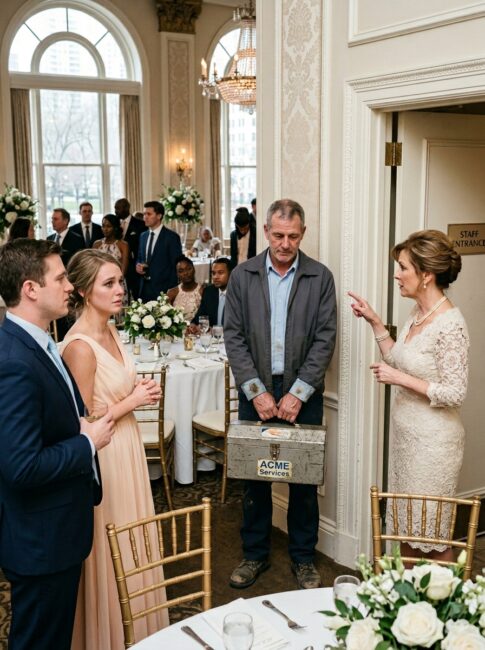
Frank had already placed his toolbox beneath an empty chair.
He did not offer to help.
That seemed to bother Richard more than the heat.
“I thought this was what you did,” Richard said, loud enough for the nearest tables to hear. “Cooling units, vents, all of that.”
Frank took a sip of water.
“It is,” he replied.
Richard waited.
Frank said nothing else.
Across the room, Emily watched him with a concern that had nothing to do with the temperature.
Nathan leaned close to her.
“Is he feeling all right?” he asked.
Emily followed her father’s gaze.
Frank was staring toward the ballroom ceiling, where a faint vibration moved through the decorative panels.
Then his eyes shifted toward the hallway.
A young hotel employee pushed through the kitchen doors and approached the manager.
“The banquet system shut down again,” she whispered. “The backup is not responding.”
The manager looked at Frank’s toolbox.
For a moment, he seemed uncertain.
Then recognition crossed his face.
“Mr. Miller?” he asked.
Frank turned.
The manager stepped closer.
“You are Frank Miller, right?”
Vivian looked between them.
“You know each other?”
The manager nodded slowly.
“Mr. Miller worked on this building years ago.”
Frank shook his head slightly.
“That was a long time back.”
“Not that long,” the manager said. “The old compressor layout is still the same. We have called three emergency contractors, but nobody can reach us for at least two hours.”
Richard gestured toward Frank with one open hand.
“Then perhaps we are in luck.”
Frank looked toward Emily again.
It was her night.
He seemed reluctant to move.
The manager lowered his voice.
“There is something else. One of our kitchen workers fainted near the service corridor. It may be the heat.”
Frank immediately stood.
His hesitation disappeared.
He removed his jacket, folded it neatly over the chair, and picked up the dented toolbox.
Underneath the jacket, he wore a pale blue dress shirt with an old grease stain near the cuff. He had tried to scrub it out, but some marks outlasted soap.
Vivian watched him walk away.
“So he really brought tools to his own daughter’s engagement party?” she said.
Emily heard her.
Nathan did too.
“Mom,” Nathan said quietly.
Vivian forced a smile.
“I am only saying that some people never leave work behind.”
Frank disappeared through the service door with the hotel manager.
A few minutes later, the kitchen worker was brought into the hallway and given water. She was conscious, but shaken.
Then the lights flickered again.
The ballroom fell completely silent.
From somewhere behind the walls, a deep metallic thud echoed through the hotel.
The manager returned alone.
His shirt was damp with sweat.
“Mr. Miller found a damaged control relay,” he said. “But he asked everyone to stay away from the west service corridor.”
Richard frowned.
“Why?”
The manager glanced toward the ceiling.
“Because he thinks the electrical panel may be overheating.”
Vivian stared at the closed service door.
For the first time that evening, she looked less annoyed than afraid.
Emily remained still.
She knew the expression her father had worn before leaving the ballroom.
It was the same expression he had worn every time a storm knocked out power across the neighborhood, every time someone called after midnight, and every time he came home exhausted but refused to complain.
Nathan took her hand.
“I did not know your father worked on hotels,” he said.
Emily gave him a tired smile.
“There is a lot about him people do not ask.”
Before Nathan could answer, the service door opened.
Frank stepped back into the ballroom.
His dress shirt was streaked with dust. One sleeve had been rolled above his elbow. A shallow cut crossed the side of his hand.
The air-conditioning had not returned.
Still, he walked directly toward the family table.
He was not carrying his toolbox anymore.
He was carrying a small framed photograph.
The photograph was old enough for the colors to have softened around the edges.
Frank placed it carefully on the table in front of Emily.
It showed a much younger Frank standing beside another man in front of a white service van. Both wore work uniforms. Both smiled as though they had been laughing a second before the camera clicked.
The other man had his arm around Frank’s shoulder.
Nathan leaned closer.
His expression changed.
“That is my grandfather,” he said.
Vivian turned sharply.
Richard stopped moving.
Frank lowered his eyes.
The manager stood several feet behind him, holding the toolbox Frank had left in the service corridor.
“I found it inside the mechanical room,” Frank said. “It was still hanging where your father left it.”
Richard picked up the frame with both hands.
His father, Thomas Whitmore, had died fifteen years earlier.
The Whitmore family rarely spoke about the years before the real estate company, before the hotel investments, and before the renovated Victorian home that appeared in local magazines every Christmas.
Thomas had built his business slowly.
What the younger guests knew was polished and incomplete.
The older guests knew slightly more.
Almost nobody knew about the years Thomas spent repairing heating units, hauling compressors, and climbing into overheated attics across Georgia.
Richard stared at the photograph.
“Why was this in the mechanical room?” he asked.
Frank rubbed the cut on his hand with a folded napkin.
“This hotel was your father’s first large commercial contract,” he said. “He kept the picture there after the opening.”
Vivian looked at Frank as though she were seeing him for the first time.
“You worked for Thomas?”
Frank shook his head.
“With him.”
The distinction settled heavily over the table.
Frank explained only because Nathan asked him gently.
He and Thomas had started as technicians for the same small repair company. Thomas was older and better at talking to customers. Frank was better at hearing problems before machines failed completely.
When the company closed, Thomas wanted to start his own business.
He had ambition.
He did not have enough money.
Frank had savings.
It was not a fortune. It was the down payment he had planned to use for a modest house after Emily was born.
He lent it to Thomas without a written contract.
Thomas bought a secondhand van, basic equipment, and enough parts to begin taking calls under the name Whitmore Climate Services.
Richard slowly sat down.
“I never heard this story,” he said.
Frank nodded.
“Your father did not enjoy owing people.”
The hotel manager cleared his throat.
“Whitmore Climate Services installed the original system in this building,” he said. “Before the family sold that division and moved into development.”
Nathan looked at Frank’s worn boots.
“Did my grandfather repay you?”
Frank smiled slightly.
“Every dollar.”
That should have ended the conversation.
It did not.
Emily reached for the photograph and turned it toward the light.
Behind the frame was a yellowed envelope secured with faded tape.
Frank had not noticed it in the dim service room.
Richard removed the envelope carefully.
His father’s handwriting covered the front.
For Frank, if he ever comes back.
The ballroom no longer felt crowded.
Richard looked at Frank.
“May I open it?”
Frank hesitated, then nodded.
Inside was a single sheet of paper and a check.
The check had never been deposited.
It was made out to Frank Miller for twenty-five thousand dollars.
The letter was brief.
Thomas wrote that the money was not repayment. Frank had refused extra money too many times for that.
It was a share of the first major hotel contract, offered to the man who had climbed through the mechanical room during a dangerous heat wave and saved the deal before the grand opening.
Thomas also wrote that Frank had declined partnership again because Emily had just lost her mother.
Frank wanted predictable hours.
He wanted to pick up his daughter from school.
He wanted to be home for dinner whenever possible.
The letter ended with one request.
Do not let pride keep you from accepting what your work built.
Emily covered her mouth.
She had known parts of the story, but not the letter.
Her mother had died when she was six. After that, Frank stopped accepting projects that required long travel.
He took residential calls instead.
Smaller jobs. Smaller checks.
He fixed old window units for retirees who could not afford replacements. He repaired systems at a women’s shelter every summer and sent invoices marked paid, although nobody remembered writing a check.
He never described those choices as sacrifice.
To Emily, they were simply the shape of her childhood.
Her father arriving at school in a work van.
Her father sitting through dance recitals with grease still beneath his fingernails.
Her father repairing a neighbor’s broken furnace on Christmas Eve while dinner cooled in the oven.
Vivian looked down at the table.
“I misunderstood,” she said softly.
Frank folded the letter and returned it to the envelope.
“It happens.”
Richard’s face tightened with embarrassment.
“I made a joke about your work.”
Frank met his eyes.
“You did.”
The honesty landed more heavily than anger would have.
Richard took a slow breath.
“My father would have been ashamed of me.”
Frank looked toward the photograph.
“Your father said things he regretted sometimes too.”
The answer offered Richard a little dignity without excusing him.
Then Emily stood.
The room turned toward her.
She had been quiet throughout the evening, allowing the details to emerge without stepping between the men. Now she rested one hand on the back of her father’s chair.
“I need to say something before this party continues,” she said.
Nathan remained beside her.
Emily looked at Vivian and Richard first, then at the guests who had laughed when Frank entered carrying his toolbox.
“My dad did not bring that toolbox because he cannot separate himself from his job,” she said. “He brought it because the air-conditioning in my apartment failed this morning.”
Frank glanced at her, surprised.
Emily smiled through tears.
“He knew I was anxious about tonight. He spent four hours repairing the unit so I could get ready without worrying. Then he came straight here because he did not want to miss a single minute.”
The ballroom was silent.
Emily rested her hand on Frank’s shoulder.
“When I was six years old, my dad chose a life that would keep him close enough to raise me. He could have built a bigger company. He could have worn cleaner shirts.”
Her voice trembled.
“But every important day of my life, he showed up.”
She looked around the room.
“Tonight, some people saw his boots before they saw him.”
Nobody shifted in their seat.
Emily looked down at the dented toolbox.
“I saw the man who taught me what showing up looks like.”
At that moment, the air-conditioning rumbled back to life.
Cool air began flowing through the ballroom vents.
The pianist did not start playing immediately.
For several seconds, the only sound in the room was the quiet mechanical hum of a system Frank had repaired once again.
The engagement party continued, but the room had changed.
The temperature dropped first.
Then the tension softened.
Guests returned to their tables, speaking more quietly than before. Several people approached Frank to shake his hand. He accepted each greeting with the same modest nod.
He did not seem pleased by the attention.
He seemed relieved that the food had not spoiled and nobody else had fainted.
Richard asked Frank to sit beside him during dinner.
Frank hesitated.
Then he moved his chair.
The two men spoke carefully at first, circling around old memories and family histories that had gone untold for years.
Richard admitted he had spent most of his adult life trying to move beyond the part of his father’s past that smelled like sweat, dust, and machine oil.
Thomas had encouraged that ambition.
Somewhere along the way, Richard had mistaken distance for improvement.
Frank did not respond with a speech.
He simply unfolded his napkin and said, “Your father worked hard so you could choose your own road.”
Richard looked at his hands.
“Yes,” he said. “I suppose I forgot what the road was made of.”
Vivian approached later with a glass of iced tea.
She had removed the formal smile she wore whenever she did not know what else to offer.
“I am sorry about the service entrance,” she said.
Frank looked at her for a moment.
Then he gave a small nod.
“Thank you.”
That was all.
Emily watched from across the room while Nathan spoke with his grandmother near the flowers.
When Frank caught his daughter looking at him, he lifted one eyebrow and pointed discreetly toward the dessert table.
Emily laughed.
It was the same gesture he had used at every birthday party when she was a child, silently asking whether she wanted cake before someone cut the slices too small.
Later, Richard tried to hand Frank the old check.
Frank refused.
“It belongs in the frame,” he said.
Richard looked confused.
“That money is yours.”
Frank glanced toward Emily.
“I have what I came for.”
Before leaving, he wiped the dust from the toolbox with a folded paper napkin. Nathan offered to carry it to the parking lot.
Frank handed it over.
Nathan almost dropped it.
The toolbox was heavier than it looked.
Frank smiled for the first time that evening.
“Most things are,” he said.
Outside, the hotel driveway glowed beneath rows of small white lights. Frank walked slowly beside Emily while Nathan carried the toolbox with both hands.
At Frank’s aging work van, Emily reached into her purse and removed the photograph of Frank and Thomas.
She had asked Richard for permission to make a copy.
For now, she held the original.
“I think this should stay with you tonight,” she said.
Frank studied the younger version of himself in the picture.
His hair had been darker. His shoulders had been straighter. Thomas had looked certain the future would open for both of them.
Frank carefully placed the frame on the passenger seat.
Emily wrapped her arms around him.
His shirt still carried a faint trace of dust from the mechanical room.
“You did not have to fix everything tonight,” she whispered.
Frank rested one hand against the back of her head.
“I know,” he said.
Then he looked through the windshield at the old photograph waiting on the seat.
“But I was already there.”
Emily stepped back as Frank closed the van door.
Nathan stood nearby, still holding the dented toolbox.
This time, nobody mistook him for a maintenance worker.
Before Frank drove away, Nathan placed the toolbox carefully in the back of the van, as though it were something valuable.
Follow our page for more heartfelt stories about the people whose quiet sacrifices are often noticed last.