A One-Armed Veteran Was Mistaken for a Beggar Outside a Military Ceremony—Until He Took the Stage for a Medal and Opened a Dead Soldier’s Tin Box
Part 2
Claire felt the change in the lobby before she understood it. Conversations weakened. Uniformed shoulders straightened. The retired general, William Hale, crossed the marble floor faster than his cane seemed to allow.
“Staff Sergeant Carter,” he said.
Samuel gave a slight nod. “General.”
Hale held out his hand, then hesitated when he noticed Samuel had only one. Samuel spared him the embarrassment and extended his right hand.
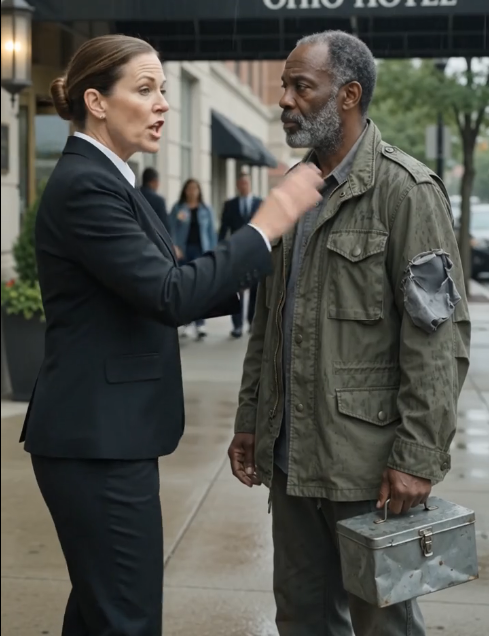
“You were supposed to arrive an hour ago,” Hale said.
“My bus arrived on time.”
Claire looked through the revolving doors. The nearest city bus stop was six blocks away. Rainwater still ran from Samuel’s jacket onto the polished floor.
“We sent a car to your address,” Hale continued.
“I moved.”
“Why didn’t you tell us?”
Samuel glanced at the donors watching from beneath the ballroom chandeliers. “Didn’t seem important.”
Claire’s cheeks warmed. The award recipient’s biography described a decorated soldier who had spent fourteen years counseling wounded veterans. It mentioned nothing about a shelter address, worn shoes, or a coat that smelled faintly of rain and engine oil.
She began apologizing, but Samuel raised his hand.
“You were protecting your event.”
The words offered no comfort. He had described her motive accurately without excusing what she had done.
Daniel retrieved Samuel’s invitation from the curb. It had been soaked through and crushed by a delivery van. The name remained barely visible beneath a tire mark.
“Where’s your wallet?” Daniel asked quietly.
Samuel looked toward the street. “In the coat pocket.”
“What coat?”
“The one I gave away.”
Twenty minutes earlier, Samuel had found a young white veteran named Evan Reed crouched behind a bus shelter, shaking beneath a thin sweatshirt. Evan had slept outside for three nights after leaving a crowded transitional home where another resident’s shouting triggered his combat memories.
Samuel wrapped his only formal coat around him, put Evan in the taxi intended for the ceremony, and sent him to the veterans’ clinic. His wallet and invitation had remained in the inside pocket.
The mud on Samuel’s trousers came from kneeling beside Evan.
Claire listened with her hands pressed against her event clipboard. She had spent six months placing the words dignity and service into speeches, donor packets, and table cards. Yet when dignity arrived without polished shoes, she directed it toward a shelter.
Daniel offered Samuel his own suit jacket. Samuel declined.
“The general invited the coat or me?”
“You,” Hale answered.
“Then this will do.”
Inside the ballroom, an assistant tried to remove the dented box for safekeeping. Samuel tightened his arm around it.
“No.”
For the first time, his voice carried enough weight to stop everyone nearby.
Claire led him toward the stage. As they passed the memorial display, Samuel halted before the photograph of her father, Captain Thomas Dalton, who had died eight months earlier after a long illness.
Thomas wore desert camouflage in the picture. A faint half-smile pulled at one corner of his mouth. Claire had chosen the photograph because he looked young and certain.
Samuel looked neither surprised nor sentimental.
“Your father repaired this sleeve,” he said.
He touched the dark green stitches around the brass button.
Claire stared at the thread. As a child, she had watched Thomas mend camping gear with that same uneven cross-stitch because he refused to throw useful things away.
“You knew him?”
Samuel placed the metal box in her hands.
It was heavier than she expected. Beneath the lid, scratched into the steel, were four words:
Carter tells it true.
Below them were her father’s initials.
Part 3
The medal presentation was delayed while guests returned to their seats. Claire carried the box into a private service corridor and asked Samuel to follow. General Hale and Daniel joined them, though Daniel remained near the door.
Claire lifted the lid.
Inside lay a burned photograph, two military identification tags, a folded map, and eighteen unopened envelopes addressed to Samuel. Each bore Thomas Dalton’s handwriting. The earliest had been mailed in 2008. The last was dated three weeks before Thomas died.
“You never opened them?” Claire asked.
“I opened the first twelve he sent,” Samuel replied. “Those eighteen kept asking the same thing.”
“What thing?”
“To let him correct the report.”
The official citation awaiting Samuel described an attack on an Army convoy outside a small Iraqi town in 2007. When an armored vehicle caught fire, Samuel crossed exposed ground repeatedly, pulled three soldiers to safety, and shielded two local children during a secondary explosion. He lost his left arm above the elbow.
The citation did not say why the medal had taken nineteen years.
Samuel had been accused of abandoning his assigned position before the explosion. A damaged radio, a missing route log, and conflicting statements left questions about whether he had disobeyed orders. He received medical retirement and a lesser commendation, but the higher recommendation disappeared during the investigation.
Thomas had commanded the convoy.
“He told them I left my post,” Samuel said.
Claire’s face tightened. “My father lied?”
“No. I did leave it.”
Minutes before the attack, Samuel had seen twelve-year-old Nadia Al-Sayeed waving from a doorway. Her younger brother had wandered toward an unexploded shell half-buried near the road. Samuel left his vehicle and pulled the boy away.
The convoy moved ahead without him. When the first blast struck, Samuel was already outside the armored column, close enough to reach the burning vehicle.
“I broke procedure,” he said. “I also got there first. Both things are true.”
Thomas initially testified that Samuel had left without permission. After learning about the children, he tried to amend his statement. Military investigators suspected he was changing it to protect a wounded subordinate.
Samuel refused to confirm the rescue.
“Why?” Claire demanded.
“The children’s uncle had worked as an interpreter. Armed men were searching for families who helped us. Putting Nadia’s name in a report could have marked all of them.”
Samuel accepted the stain on his own record rather than identify the family. Thomas carried the blame for a command decision he believed had destroyed Samuel’s career.
Claire picked up the burned photograph. It showed Samuel beside two children, but the girl’s face had been carefully cut away.
Years later, Nadia’s family resettled in Michigan. Only then did she submit a sworn statement describing what Samuel had done. Thomas renewed the medal request, found surviving witnesses, and spent his final years reconstructing missing records.
The medal had finally been approved six weeks after his death.
Claire looked at the eighteen unopened letters. “He wanted you to know he fixed it.”
“He wanted forgiveness.”
“Isn’t that the same thing?”
“No.”
Samuel’s answer was quiet. He admitted that Thomas had tried to correct his mistake, but he had never forgiven him for making frightened soldiers choose between telling the truth and protecting vulnerable civilians. Samuel also admitted his own silence had punished Thomas long after the family was safe.
“I knew when Nadia reached Michigan,” he said. “I still waited four years before signing my statement.”
“Why?”
“Anger can start feeling like the last piece of a person you still own.”
Samuel reached into the box and removed the folded map. One corner had been repaired with green cross-stitches.
Claire recognized her father’s clumsy sewing again.
But when the map opened, Samuel froze. A name was written along the bottom in faded pencil—someone he had not known Thomas had ever found.
Part 4
The name was Marcus Carter, Samuel’s younger brother.
Samuel sat on a banquet-service crate, the metal box balanced across his knees. For several moments, he said nothing.
Marcus had returned from the Gulf War in 1992 with ringing in his ears, sleepless nights, and a temper he worked hard to hide. He repaired heating systems during the day and sometimes slept in his truck rather than let his children see him unravel.
In 1998, his truck broke down outside Dayton during a snowstorm. Thomas Dalton, then a young lieutenant driving home on leave, stopped and found Marcus nearly unconscious from cold.
Thomas paid for a motel, arranged the repair, and stayed until Marcus’s wife arrived. Before leaving, Marcus repaired a tear in Thomas’s canvas map case with dark green thread.
The same map case now rested inside the box.
“My brother always stitched an X over the final knot,” Samuel said. His finger found the tiny cross beneath the corner seam.
Marcus died in 2003 from heart complications. He had never told Samuel the stranger’s name. Thomas had apparently recognized the stitching on Samuel’s empty sleeve years later and asked about it.
The connection had cost Thomas more than Claire knew.
After the investigation, he declined promotion and transferred out of field command. He sent part of every performance bonus to a veterans’ housing program under Marcus Carter’s name. Claire had assumed those missing checks paid an old gambling debt. Her parents had argued about money for years, and her mother died believing Thomas had hidden another family expense.
“He should have told us,” Claire whispered.
“Yes,” Samuel said. “Doing good in secret doesn’t stop secrecy from hurting people.”
For the first time, his voice softened. Thomas had helped Marcus without expecting recognition. Later, when he failed Samuel, he spent years trying to repay a debt Samuel had never known existed.
The map case had traveled from Marcus to Thomas, then from Thomas back to Samuel.
General Hale offered to move the medal presentation to another evening. Samuel shook his head.
“Too many families took buses to be here.”
Claire asked whether he wanted Thomas’s letters delivered to his home.
Samuel looked at the return addresses. The earliest envelopes came from military posts. Later ones came from Claire’s childhood house. The final letter carried the return address of a hospice center.
“I’ll take the last one,” he said. “You keep the rest until you decide whether your father’s words belong to him, to you, or to the truth.”
Claire did not know how to answer.
Before returning to the ballroom, Samuel asked about the young veteran he had sent to the clinic. Daniel called and learned Evan had been admitted overnight. The clinic could stabilize him but had no guaranteed bed afterward.
“The hotel donates to three veterans’ charities,” Claire said quickly.
Samuel studied her.
“Can any veteran enter this building without a ticket, sit somewhere warm, and ask for those charities?”
“No.”
“Then the donation protects the donor more than the door.”
Claire wanted to defend the hotel. She knew the cost of staffing, liability rules, guest complaints, and the calls police answered when the lobby became a refuge on freezing nights. She also knew Samuel was not asking her to remove every boundary.
“What would help?” she asked.
“Ask Daniel. He is the one who works at the door.”
Daniel had remained silent throughout the conversation. Now he confessed that he had been sleeping in his sister’s basement for five months after medical bills and a divorce took his apartment. His uniform was clean, his posture controlled, and no one at the hotel knew.
“I turn men away,” he said, “then go home afraid I’m two paychecks from standing where they stood.”
Samuel did not offer him money.
Instead, he asked Daniel to sit beside him at the medal table—not as security, but as a veteran who understood the doorway from both sides.
That small change left an empty chair near the entrance.
Claire placed Thomas’s metal box on it.
Part 5
When Samuel stepped onto the stage, the ballroom rose. He waited without smiling until everyone sat again.
General Hale read the citation. It described courage under fire, injuries suffered, lives saved, and evidence recovered after years of review. It did not mention the hotel entrance, Samuel’s missing wallet, or the coat wrapped around Evan Reed at the clinic.
Claire stood near the curtain holding the medal case. Her father’s letters felt heavy inside the box behind her.
When Hale pinned the Distinguished Service Cross to Samuel’s faded field jacket, the clasp caught on the dark green stitching. Samuel steadied it with his right hand.
There was no long applause in his mind. He heard only the small scrape of metal against the brass button his brother had once taught him to secure with an X-shaped knot.
Hale invited him to speak.
Samuel looked at the prepared podium, then toward Daniel seated beside the generals.
“I came for Captain Dalton’s daughter,” he said. “The medal could have been mailed.”
Claire’s breath caught.
Samuel explained that Thomas’s final request had not been forgiveness. It had been for Claire to hear the truth from someone who had survived it. Thomas knew his daughter believed he had wasted money, hidden debts, and chosen the Army over his family.
Some of that was true.
He had kept secrets and used silence as if good intentions made it harmless. But the missing money had supported nineteen veterans and their families. His refusal of promotion had not been punishment ordered by the Army; it was a decision to remain close to the soldiers whose testimony had been questioned.
Samuel did not turn Thomas into a saint.
“He made a frightened decision,” he said. “Then I made an angry one. We both let years pass because admitting only half the truth felt safer than telling all of it.”
Claire opened the final envelope during the reception.
Thomas’s handwriting had weakened, each line slanting downward:
Claire, if Samuel comes, do not thank him for forgiving me. He may not. Thank him only for coming through the door.
Beneath the letter was a cashier’s check for $38,400—the balance of Thomas’s retirement account. It was payable to Samuel.
Samuel refused it.
Claire expected him to name a charity. Instead, he asked the hotel to use the money only after its staff designed something veterans would actually accept.
During the following month, Claire met with Daniel, two local outreach workers, Evan, Samuel, and six veterans who had experienced housing instability. The hotel’s executives first proposed a polished campaign with photographs, donor plaques, and an annual gala.
Samuel left the meeting.
Claire followed him into the hall.
“What did I do wrong?”
“You asked people who need a door to pose beside the people who own it.”
The eventual program looked smaller. That was why it worked.
The hotel converted an unused luggage office near the side entrance into a staffed evening room with coffee, lockers, charging outlets, clean shirts, transportation vouchers, and direct access to housing and benefits workers. Veterans did not have to tell their stories to receive help. No photographs were permitted. The room was not named for Samuel, Thomas, or the hotel.
The front entrance policy also changed. Staff were trained to ask what a person needed before deciding what they were seeking. Security still enforced boundaries, but anyone turned away received a specific referral, transportation when necessary, and a human explanation.
Daniel became the paid evening liaison. His background check revealed a disciplinary warning Claire had never seen: two years earlier, he had allowed a freezing veteran to sleep in the employee break room and lied to protect the housekeeper who brought him food.
The warning had stalled his promotion.
Claire removed it from consideration but did not erase the record. Daniel had broken procedure, just as Samuel once had. This time, the hotel changed the procedure instead of pretending rules and mercy could never occupy the same room.
Evan entered transitional housing. He returned Samuel’s formal coat after six weeks, professionally cleaned, with the wallet still inside. He had spent eleven dollars from it on a bus ticket and enclosed eleven one-dollar bills with an apology.
Samuel kept the apology but returned the money.
Claire’s own reckoning took longer. She wrote Samuel a letter acknowledging that she had looked at his clothes, missing arm, and metal box and decided he needed removal before she asked his name. She did not mention pressure, donors, or the people who had previously deceived her.
Samuel replied on a hotel notepad:
You saw what the room trained you to see. Now train the room differently.
He also apologized for letting her humiliation unfold publicly when he could have given his name more firmly. He had been tired, proud, and unwilling to prove himself to people gathered to honor men like him.
Neither apology erased the doorway.
They simply stopped asking the other person to carry it alone.
Three months later, Claire opened Thomas’s remaining letters. The earliest were defensive. The middle ones were ashamed. In the final years, he stopped asking Samuel to clear his name.
He began asking what his silence had cost other people.
Claire placed the eighteen letters back in the dented box, but she repaired the broken bootlace around it with dark green thread.
The stitches were uneven.
The final knot formed a small X.
Part 6
Eighteen months later, Samuel returned to the hotel on a cold November evening. He moved more slowly now. Arthritis had stiffened his remaining hand, and the place where his left arm ended ached whenever the weather changed.
He was not wearing the medal.
It rested inside the dented box, wrapped in Thomas’s final letter.
The former luggage office had become known simply as the Evening Room. No sign outside identified it as a charity. A brass lamp burned beside the door, and anyone entering could sit down before answering a question.
Evan worked there three nights a week while completing certification as a peer-support specialist. He still wore Samuel’s old formal coat on interviews, though the sleeves were short at his wrists.
Daniel had moved from his sister’s basement into a small apartment. He continued overseeing hotel security, but twice a week he took the chair nearest the Evening Room. He had learned that listening did not make every decision easy. Some guests still had to leave. Some refused help. Some returned angry.
The difference was that nobody became invisible before a conversation began.
Claire found Samuel struggling with the brass button on his empty sleeve. His fingers could no longer guide the thread through the small holes.
“May I?” she asked.
He handed her the jacket.
They sat at a narrow table where Thomas’s metal box had once rested. Claire threaded a needle with dark green cotton and reinforced the button using the crossed stitch she had practiced on old towels.
“You’re pulling it too tight,” Samuel said.
“That sounds like my father.”
“He pulled everything too tight.”
Claire smiled without defending him.
She had sold her parents’ empty house and used no part of the proceeds for the Evening Room. Samuel had insisted that guilt should not become another wealthy person’s shortcut. Instead, Claire helped veterans complete hotel-training programs, while the hotel paid regular wages and accepted outside audits of the program.
The remaining money from Thomas’s retirement account stayed in trust until a committee—half of whose members had experienced homelessness—decided how it should be used.
On the anniversary of the medal ceremony, Nadia Al-Sayeed visited from Michigan with her two children. She had become a respiratory therapist. She did not call Samuel a hero. She scolded him for ignoring her messages, then placed a container of food in his refrigerator because she had learned he often forgot dinner.
Samuel finally opened Thomas’s last letter with her beside him.
It contained no request for forgiveness. Thomas wrote only that a leader could save a man’s life and still fail him afterward. He hoped Samuel would accept the medal because the truth belonged to Nadia, the rescued soldiers, and the families—not to the two men who had spent years fighting over the pain around it.
Samuel read the letter twice.
Then he placed the medal inside the Evening Room’s glass cabinet, below eye level. Beside it, Claire placed the ruined invitation bearing the tire mark and rain-blurred name.
There was no portrait of Samuel.
Years later, when his hand could no longer manage buttons at all, Evan fastened the empty sleeve before every winter walk. He did it without ceremony, pressing the old brass disk through its opening while Samuel complained that young people always made jackets too tight.
One evening, a rain-soaked man stopped outside the hotel. His trousers were dirty, and he carried everything he owned in a plastic grocery bag.
A new employee moved toward the door, uncertain.
Daniel nodded toward the empty chair beneath the brass lamp.
The man was invited to sit before anyone asked why he had come.
Across the room, Samuel’s medal rested beside the damaged invitation, while the small green X in his sleeve held a tarnished button exactly where it belonged.
Follow this page for more heartfelt stories about quiet kindness, misunderstood people, and the ordinary moments that reveal what someone has been carrying all along.