He Smashed a Car Window in Broad Daylight — Then Waited for the Police Beside the Glass
His name was Ray Mercer, though everybody at the diner called him “Gravel.”
Not because he was hard, although he looked like it.
Because his voice sounded like somebody had poured a bucket of driveway stones down a steel pipe.
I knew him a little before that day. Not well. Nobody really knew Ray well unless they had earned the right to sit beside him in silence for a few hundred miles.
He came into the Route 66 Diner every Thursday morning around 6:20, always before the tourist buses, always after riding in from a little trailer outside Golden Valley. He ordered black coffee, two eggs over hard, wheat toast, and bacon he usually tore into pieces and wrapped in napkins.
At first I thought he was saving it for later.
Then one morning I saw him walk outside and feed the bacon to a three-legged mutt behind the dumpster.
“Dog belongs to you?” I asked him.
He looked at me from under his brow.
“No dog belongs to anybody,” he said. “Some just tolerate us.”
That was Ray.
He said little. Paid cash. Tipped too much. Looked mean enough to empty a room, but once spent twenty minutes fixing the squeaky hinge on our kitchen door because the sound made a waitress with migraines flinch.
He rode with a small club called The Copper Saints. They weren’t famous. No flashy nonsense. Mostly veterans, welders, mechanics, two retired firefighters, one man who owned a tire shop, and a prospect named Benny who looked terrified of everybody but still showed up every weekend with coffee.
When the Saints rolled in, you heard them before you saw them.
V-twins in the distance. Leather creaking when they stepped off the bikes. Boots hitting pavement in that slow, heavy way men walk when their knees have been through too much and they refuse to complain about it.
Most folks saw the tattoos and moved their purses closer.
I saw Ray making sure old Mrs. Haskins had her walker unfolded before she stepped off the curb.
Still, he scared people.
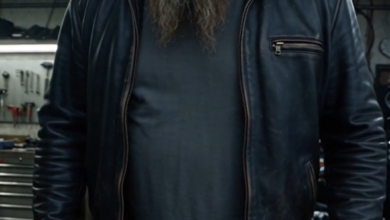
He had prison ink on his left forearm. Not decorative. Real. Faded. A black bar with dates underneath. He never hid it, but he never explained it either. There was a scar across his throat that made every word sound like it cost him something. His hands were big and scarred, the knuckles swollen from old fights or old work, maybe both.
But his nails were always cut clean.
That was the first thing I noticed that didn’t fit.
The second was that little blue paw patch inside his vest.
You could only see it when he sat down and the cut opened a little at the chest. It looked hand-stitched, not bought. The letters were uneven. Milo.
I asked Benny once.
He went pale like I had touched a loaded wire.
“Don’t ask him that,” Benny said. “Not unless he brings it up.”
So I didn’t.
Over time, I learned pieces.
Ray had been a dog handler in the Marines years back, working roads in places where the dust got into your lungs and stayed there. He came home with a limp, a temper, and a silence that wrapped around him like barbed wire. He drank. He disappeared for months. He got into a fight outside a bar in Needles and did eighteen months for aggravated assault.
He never made excuses for it.
“Prison don’t wash a man clean,” he told me once while fixing my dead car battery in the diner lot. “It just shows him what dirt he’s made of.”
The Saints found him after that. Or maybe he found them. Brotherhood is funny that way. It doesn’t always come smiling. Sometimes it shows up with a flatbed trailer, a burnt pot of coffee, and a man saying, “You riding with us or dying by yourself?”
Ray rode.
He got sober.
He started taking in dogs nobody wanted. Old ones. Scarred ones. One-eyed ones. Dogs that bit before they trusted. Dogs that hid under porches. At the time of the Walmart incident, he had four at home: June, Copper, Little Man, and an elderly brindle named Tank who could barely walk but still barked at thunder.
“Four’s enough,” Ray always said.
But every time he said it, the Saints laughed.
Because four was never enough for a man like Ray.
And Milo, whoever Milo had been, stayed sewn inside his vest where only the close and the careful could see.
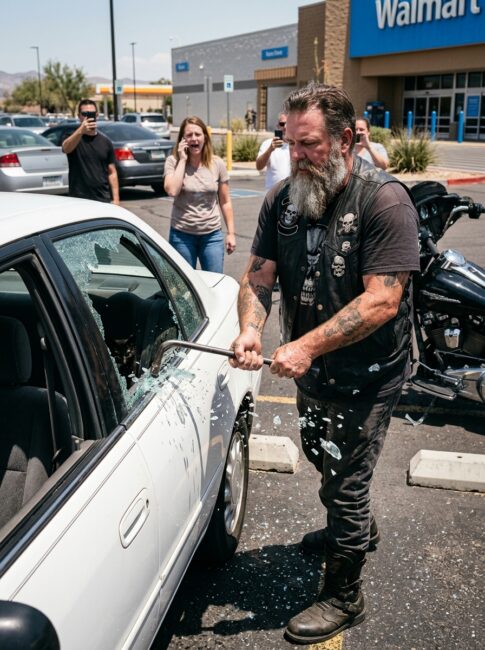
That afternoon, Ray wasn’t supposed to be at Walmart.
That was the first twist nobody online understood.
He had been riding back from the county animal shelter with Benny. The Saints had just dropped off forty bags of dog food they’d collected during a charity ride nobody heard about because Ray hated cameras.
They were heading to the diner when Benny’s old Harley coughed, backfired, and died near the pharmacy entrance.
Ray pulled in behind him.
I remember the sound. One bike cutting off clean. The other sputtering like a man choking on smoke.
Benny pushed his bike toward the shade, cursing softly. Ray got off and opened his saddlebag for tools.
That was when he heard it.
Not barking.
Not scratching.
A tiny dull thump from inside the white sedan beside him.
He paused.
In a parking lot full of noise, that was strange. Carts rattling. Tires hissing across hot pavement. A child crying near the entrance. Store doors breathing cold air every few seconds.
But Ray heard one thump.
Then nothing.
He stepped closer.
The sedan was locked. Windows up. Engine off. No sunshade. No cracked glass. Just a cheap pine air freshener hanging from the mirror and a back seat full of grocery bags.
At first, I didn’t see the puppy.
Ray did.
It was wedged low in the back footwell, half under a towel, tiny body limp, chest barely moving. A pit bull pup, maybe ten weeks old. Gray-and-white face. Pink belly. Tongue out.
Ray knocked on the glass.
Nothing.
He slapped the roof.
Nothing.
His whole body went still.
Then he turned and shouted, “Whose white Chevy?”
Nobody answered.
He yelled it again, louder.
“WHO OWNS THE WHITE CHEVY?”
People stared like he was the problem.
A man in a red cap said, “Don’t touch other people’s property.”
Ray looked through the glass one more time.
The puppy’s leg twitched.
That was all.
Ray grabbed the tire iron.
People always talk about how fast he broke the window. They say it like rage moved him.
It didn’t.
I was close enough to see his hands.
They were shaking.
He wrapped his left forearm in the edge of his vest, shielding the puppy from glass, then struck the small rear window near the top corner. Not wild. Not careless. One hard hit. A sharp crack. A second hit. Then the window gave way in a bright burst.
The sound was terrible.
Glass sounds violent even when mercy is behind it.
People screamed. Phones rose. A woman yelled, “I called 911!”
Ray ignored all of us.
He reached through the broken frame, unlocked the door, and opened it just wide enough to slide his big arms in. Glass cut the back of his wrist. Blood ran down to his thumb. He didn’t look at it.
He lifted that puppy out like it was a newborn.
“Easy,” he rasped. “Easy, little brother.”
The puppy didn’t move.
Ray carried him to the strip of shade beside the cart return and dropped to his knees. The sidewalk was hot enough that I saw him wince through his jeans, but he didn’t shift away.
Benny ran over with bottled water.
Ray didn’t pour it into the puppy’s mouth. He wet his fingers. Rubbed the gums. Dampened the paws. Put water under the belly, behind the ears. Slow. Careful.
“Don’t drown him,” he told Benny. “Small sips. Shade first.”
That was when I realized he knew what he was doing.
His voice changed too. Still rough, still gravel, but lower. Like he was talking somebody back from a ledge.
The puppy gave one weak cough.
The crowd gasped.
Ray bent close, his beard nearly brushing the dog’s face.
“Come on,” he whispered. “Not here. Not in a damn parking lot.”
Police sirens came four minutes after the call.
By then, Ray was still kneeling beside the puppy, blood on one wrist, glass in his boots, and a half circle of strangers standing far enough away to judge him safely.
Two Kingman officers stepped out fast, hands near their belts.
“Sir, stand up.”
Ray didn’t.
He kept one hand on the puppy’s side.
“Dog’s heat-stroked,” he said. “Needs animal control and a vet. Now.”
The officer looked at the shattered window.
Then at Ray.
Then at the puppy.
For one hard second, everyone thought the story was ending with handcuffs.
The young officer’s name was Delgado. I remember because he said it twice into his radio, calm but quick.
“Unit requesting animal control, possible heat injury to a juvenile dog, Walmart lot off Stockton Hill. Also need med kit.”
The older officer kept his eyes on Ray.
“You broke the window?”
Ray nodded.
“Yeah.”
“Vehicle yours?”
“No.”
“You understand that’s property damage?”
“Yeah.”
“You planning to leave?”
Ray looked up at him then, and I saw something cold move through his face.
“No.”
That word landed heavy.
He had not run. He had not argued. He had not puffed up his chest or threatened anybody. He just stayed on his knees beside the puppy and waited for whatever came next.
That was the second twist.
A man everyone had mistaken for a criminal acted like the only person in the lot who understood law.
Not the written kind.
The older kind.
The kind that says you don’t let a living thing bake behind glass because you’re afraid of paperwork.
Officer Delgado crouched down, pulled off his hat, and used it to fan the puppy while Benny held the water bottle. The older officer checked the car, looked through the window, and muttered something under his breath I won’t print.
Then the puppy moved.
Not much.
A blink.
One tiny breath.
His tongue pulled back a little.
Ray’s whole body sagged like somebody had cut a cable inside him.
He didn’t cry. Men like Ray almost never do where anyone can see. But his eyes went wet, and he turned his face away so fast you could miss it.
Then the owner came out.
He was a clean-shirt kind of man, early thirties, shopping bags in both hands, sunglasses pushed up on his head. He stopped when he saw the police. Stopped harder when he saw his window.
“What the hell happened to my car?”
Nobody answered right away.
He walked closer.
Then he saw the puppy.
His face did something strange. Not fear. Not relief. Annoyance first.
“Is he okay?” the man asked, but the tone was wrong. Like he was asking whether a package had been dented.
Ray rose slowly.
He was taller than the owner by half a head and wider by a whole lifetime. Blood dripped from his wrist onto the pavement.
The officer stepped between them.
“Sir,” Delgado said to the owner, “is this your dog?”
“Yeah. I was inside for, like, twenty minutes.”
A woman behind me snapped, “You were in there an hour.”
The owner looked around at the phones.
“I cracked the window.”
“No, you didn’t,” Benny said.
The older officer pointed to the car.
“All windows were fully closed when we arrived.”
The owner’s mouth tightened.
“It’s a dog. I was shopping. He was fine when I left.”
Ray’s hands closed.
Leather creaked.
Every Saint there felt it. Benny shifted closer, not to help Ray fight, but to remind him not to. That is brotherhood too. Not cheering a man’s anger. Standing near enough to keep him from letting it own him.
Ray looked at Benny.
Benny shook his head once.
Ray opened his fists.
Animal control arrived six minutes later, followed by a vet tech from a clinic across the street who had heard the call on a scanner. They wrapped the puppy in a cool towel, checked his gums, took his temperature, and loaded him into a van.
Before they closed the door, the puppy lifted his head just enough to look back.
Right at Ray.
That was the moment the parking lot stopped being a scene and became a story.
The owner got cited.
Five hundred dollars.
Animal cruelty investigation pending. Dog removed from his custody. Car left with one busted rear window and a seat full of safety glass.
People clapped when the officer handed him the citation.
Ray didn’t.
He just stared at the paper.
Then he said the sentence that made the video go viral.
“I’ll pay it.”
Everyone turned.
Even the owner looked confused.
Ray pointed at the broken window.
“I swung the iron. Fine’s mine.”
The officer blinked.
“That’s not what this citation is for.”
Ray reached for his wallet anyway.
“Don’t care.”
That was the part the internet argued about for three days.
Some people said Ray was wrong.
Some said he was a saint.
Some said the owner deserved worse.
Some said a man who breaks a window should pay for the damage, not the cruelty fine.
But the video didn’t show what happened thirty minutes later behind the Walmart, near the loading dock where the shade was longer and the crowd had thinned.
I was there because I had followed Ray with a wet towel for his wrist. He hadn’t asked for it. He wouldn’t have.
He was sitting on the curb, pulling bits of glass from the cuff of his jeans. Benny stood beside him with his arms crossed, saying nothing.
The older officer approached.
“Animal control says the pup’s responding,” he said. “Vet thinks he’ll make it.”
Ray nodded once.
No smile.
Just a nod, like anything more might break him.
The officer glanced at Ray’s vest.
“At the station, we’ll need a statement.”
“You got it.”
“And the window damage?”
“I’ll cover it.”
The officer studied him for a moment.
“Why?”
Ray didn’t answer.
Benny did.
“Milo.”
Ray shot him a look.
Benny shut up.
The officer waited.
Ray rubbed his thumb over that little blue paw patch inside his vest, the one I had noticed for months but never understood.
Then he said, “Had a dog overseas.”
That was all at first.
The officer didn’t push.
Maybe he had learned that men like Ray don’t open doors if you kick them.
Ray kept looking at the pavement.
“Bomb dog. Pit mix. Ugly little thing. Ears too big. Slept with one paw on my boot.” He swallowed. The scar on his throat pulled tight. “Milo found three devices before they found us.”
Nobody moved.
Even the heat seemed to back off.
Ray kept talking, but barely.
“Last one was in a school courtyard. Kids had been playing there that morning. Milo alerted. I pulled two boys back. Then…” He stopped.
His fingers tightened on the patch.
“Then there wasn’t much dog left to bring home.”
Benny looked away.
That explained the patch.
But not all of it.
Ray reached into the inside pocket of his vest and took out a folded photograph, soft at the edges from years of being handled. In it, a younger Ray stood in desert gear beside a small gray pit mix with ridiculous ears and bright eyes.
On the back, in faded ink, someone had written:
MILO — HE FOUND WHAT WE MISSED.
Ray stared at that line.
“That dog saved children,” he said. “And I spent years after that acting like my life was the only thing that got blown apart.”
He tucked the photo back.
“I don’t leave dogs in heat. I don’t walk past glass. Not anymore.”
That was the real twist.
Ray hadn’t saved that puppy because he was reckless.
He saved him because thirty years of grief had trained his ears to hear one dull thump inside a locked car.
The clean nails made sense then too.
He trimmed them because one of his dogs at home was blind and scared of being scratched when he cleaned her eyes.
The bacon from breakfast made sense.
The blue paw made sense.
The way he wet the puppy’s paws instead of forcing water down his throat made sense.
The way Benny moved close when Ray’s fists curled made sense.
Brotherhood wasn’t the roaring line of motorcycles people imagine. It was a nervous prospect stepping between a wounded man and the old version of himself.
Later, the officer told Ray the cruelty fine was not his to pay.
Ray paid money anyway.
Not directly as a fine. That part online got blurred because videos flatten truth. He paid the shelter’s emergency care deposit. Five hundred dollars. Same amount. Same day.
When the owner complained about his broken window, Ray also handed him a business card from a glass shop.
“Send the bill,” Ray said.
The owner looked at him like he didn’t understand being spared by someone he had every reason to hate.
Ray stepped close enough that the man finally shut up.
Then Ray said, very quietly:
“Next time, leave the dog at home.”
No threat.
No performance.
Just a warning wrapped in mercy.
The puppy lived.
The shelter named him Stockton because that was the road where he was found, but nobody called him that for long. People online started calling him Glass.
Glass gained three pounds in two weeks. His ears stood up crooked. One folded forward like it had a secret. The vet said there might be long-term sensitivity to heat, but otherwise he was lucky.
Lucky.
That word bothered Ray.
“Luck didn’t break the window,” Benny said one Thursday at the diner.
Ray glared at him over his coffee.
Benny grinned and shut up.
The Reddit post hit five million views before the end of the week. A tourist from Flagstaff had filmed the whole thing: Ray swinging the tire iron, lifting the limp puppy, kneeling in broken glass, waiting for police, later handing money to the shelter clerk with his bleeding wrist wrapped in a paper towel.
The top comment said:
“The man broke the law, then paid the price, just because a dog needed him. That’s the kind of justice heroes follow.”
Ray hated that.
He didn’t want to be called a hero. He didn’t want interviews. When a local station called the diner asking for him, he told me to say he had moved to Idaho.
“You didn’t move to Idaho,” I said.
“Then lie better.”
But every Thursday after that, he rode past the Walmart before breakfast.
Not slow enough to make a show of it.
Just slow enough to look.
The engine would drop into that low potato-potato thump near the entrance. His head would turn toward the spot by the cart return. Then he’d continue to the diner, park under the same crooked mesquite tree, and come inside smelling like leather, sun, and old engine oil.
He still ordered bacon.
He still wrapped half of it in a napkin.
A month later, animal control held an adoption event outside the shelter. The Saints showed up with a trailer full of food, blankets, collars, and cheap plastic kiddie pools for overheated dogs.
Ray stood in the back, arms crossed, trying to look like he wasn’t watching Glass wobble around on a leash.
A little girl in purple sneakers adopted him.
Her father asked Ray if he wanted first chance.
Ray shook his head.
“Got four.”
The girl hugged Glass around the neck, and the puppy licked her chin.
Ray turned away fast.
Benny pretended not to notice.
Before the family left, Ray crouched in front of the little girl. That big scary man with the scarred throat and tattooed hands lowered himself until he was eye level with a child.
He handed her a small blue bandana.
“For hot days,” he said. “Wet it first. Shade matters.”
The girl nodded like he had handed her a medal.
Glass wore that bandana in every update photo after.
Last summer, one year after the window broke, I saw Ray in the Walmart lot again.
Same heat.
Same ugly shimmer rising off the asphalt.
Same Harley ticking as the engine cooled.
He parked beside the cart return and sat there for a minute with both boots on the ground.
Nobody was trapped in a car.
No sirens came.
No crowd gathered.
He just reached into his vest, touched the little blue paw patch, and looked toward the spot where a dying puppy had taken one more breath.
Then a minivan pulled in two spaces over.
A little girl jumped out holding the leash of a strong gray-and-white pit bull with one crooked ear and a blue bandana around his neck.
Glass saw Ray before Ray saw him.
The dog dragged the girl three steps, tail whipping like a flag in a storm, paws skidding across the pavement.
Ray turned.
For the first time since I’d known him, his whole face changed.
Not much.
Just enough.
Glass hit him in the knees.
Ray dropped to the curb like an old wall finally giving way and let that dog climb all over his chest, licking his beard, whining like he remembered the sound of broken glass and the hands that carried him out of hell.
The little girl asked, “Do you know him?”
Ray scratched behind the dog’s crooked ear.
“Yeah,” he said.
Then he stood, wiped his hands on his jeans, and walked back to his Harley.
The engine caught with a deep, steady rumble.
He rolled out toward Route 66, taillight shrinking in the heat.
Glass watched until he was gone.
So did I.
Some men don’t explain mercy.
They just leave glass on the pavement.
Follow the page for more true-feeling biker stories about the people behind the leather, the scars, and the road.